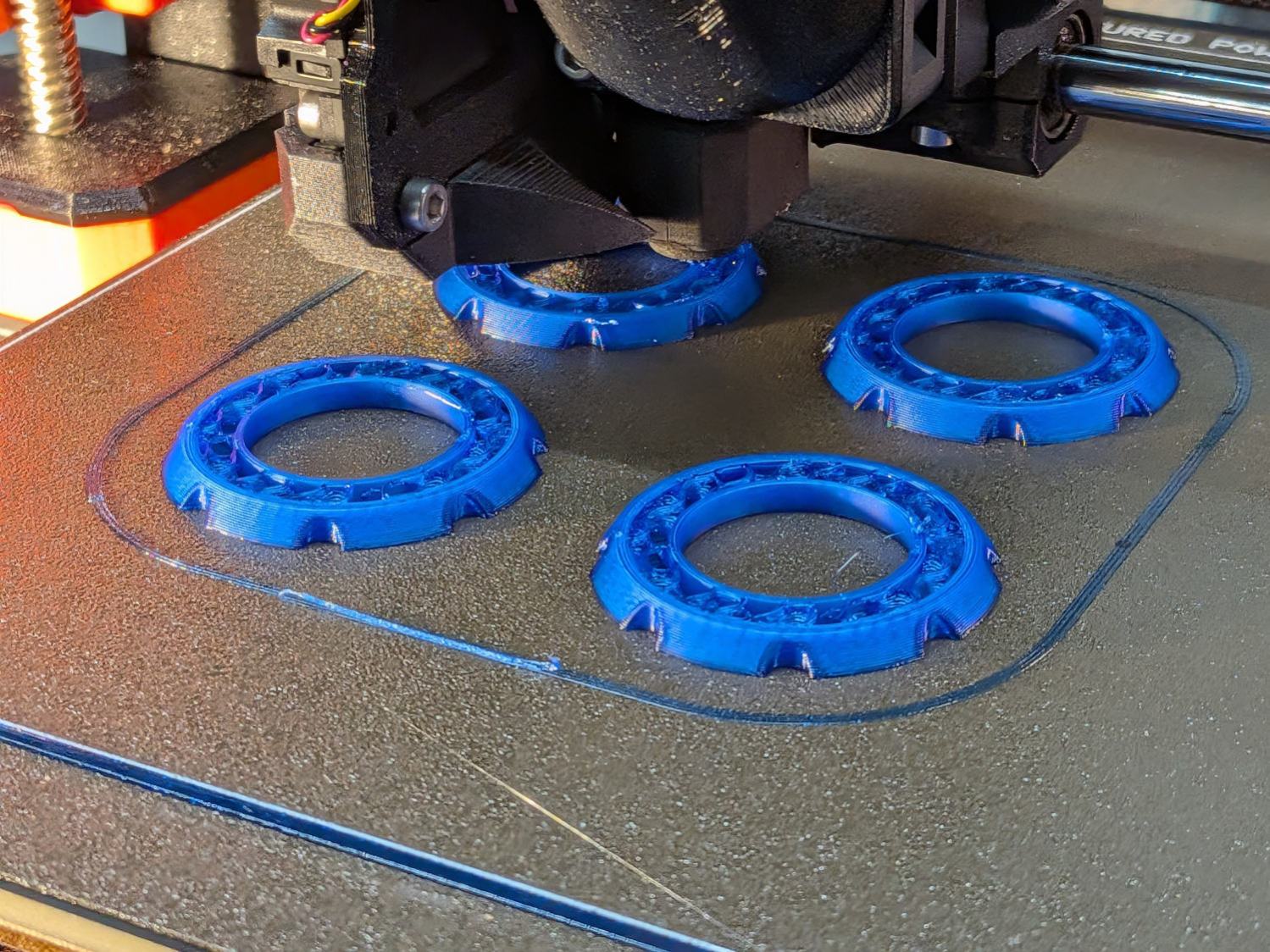
With very rare exceptions, 3D printing on the Prusa MK4 proceeds without problems:
Results like that came to a screeching halt shortly after I installed a cheap textured PEI printing plate:
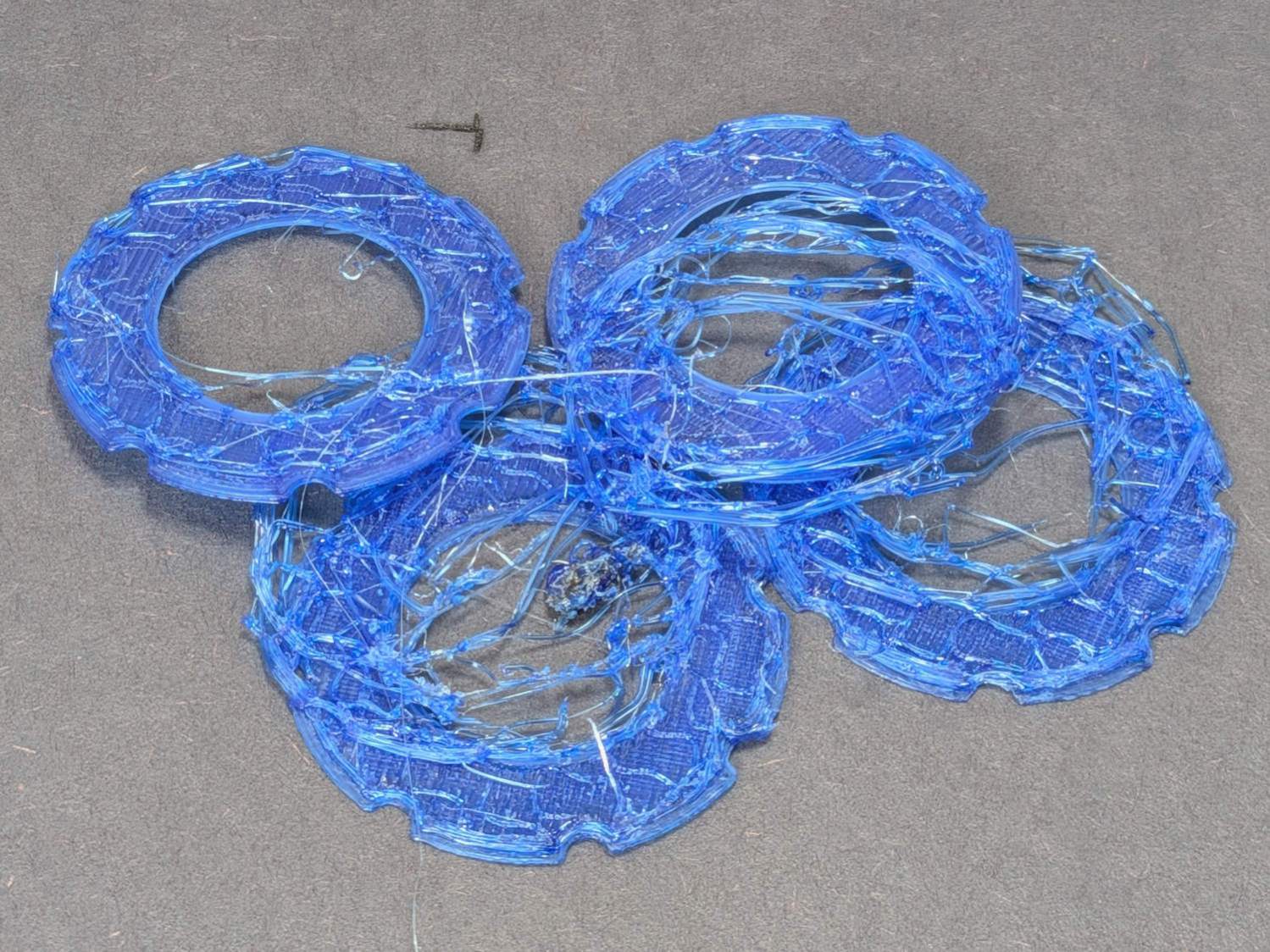
The glob near the middle of that pile (seen in the light box, not in the printer) came from the extruder, where it had accumulated while the nozzle plowed through the poorly bonded infill on the underlying layers.
The parts started with poor adhesion to the plate:
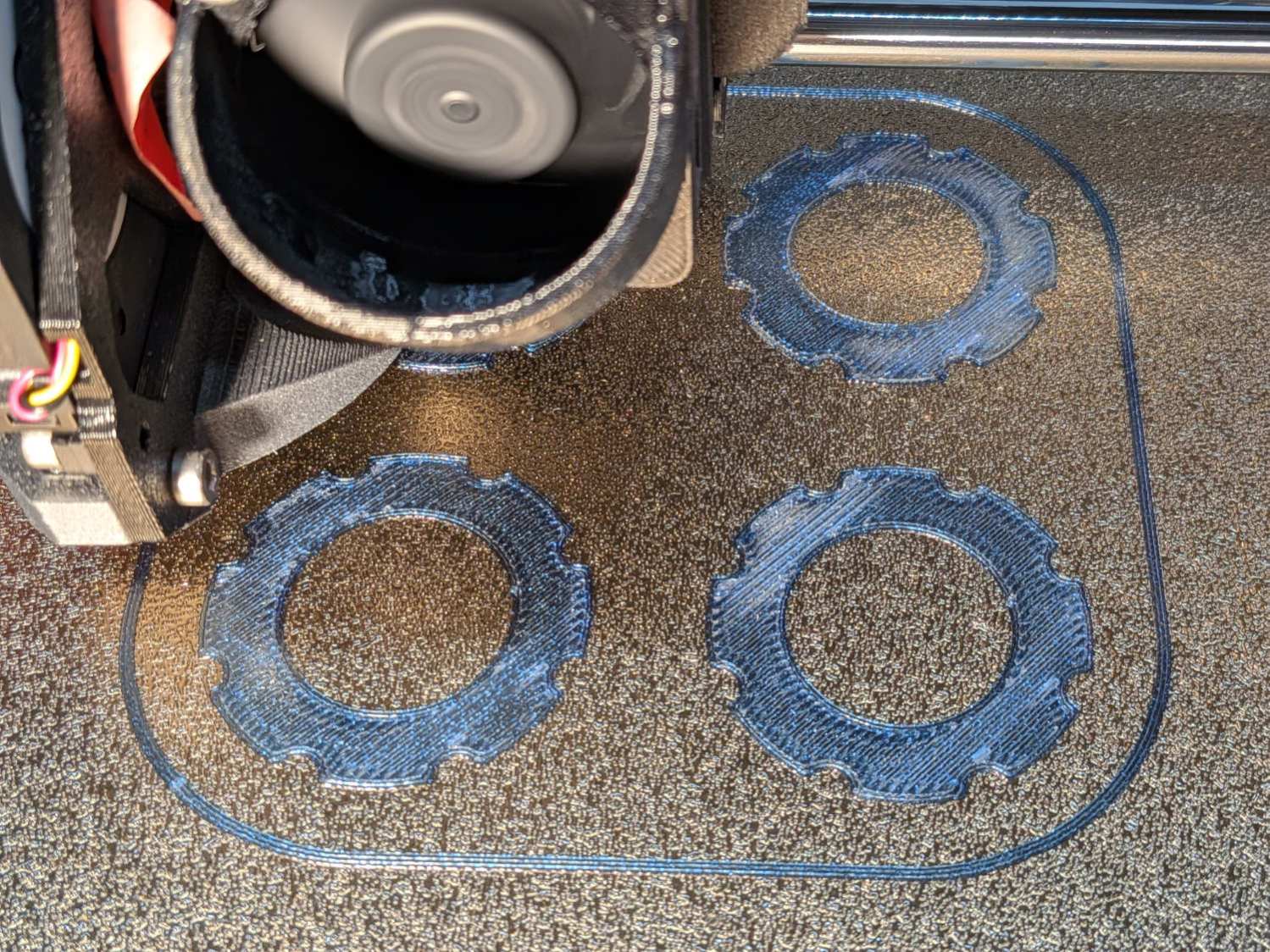
The light-colored areas detached from the plate after the second layer went down, despite the plate’s heavily textured surface.
Overall, the new “gold-tone” plate has the same 0.7 mm thickness as the Prusa plate, but weighs only 197 g compared to the Prusa’s 247 g. Assuming the PEI coating weighs nothing, the steel is 80% as thick, which explains why it is much more flexible than the Prusa plate.
The plate stamping die produced raw edges all around, with a burr along the front lifting the plate slightly above the heatbed. A few passes with a fine file cleaned off the burrs, but it should not be necessary.
The plate has an invisibly slight mound toward the right rear of the center triggering the MK4’s “retest in a small circle” behavior while mesh-probing the platform. Flipping it over moves the problem to a different spot, so there may be a matching dent on the other side.
My trusty IR thermometer reports the same 18.8 °C for both plates as the rest of the basement surfaces, so the PEI coating has an IR emissivity somewhere close to the thermometer’s 0.95 setting.
However, with the heatbed stabilized at 80 °C:
- Prusa = 74, Δ=-6
- New = 68, Δ=-12
The PCB heatbed under both plates measured 77 °C, so the temperature differences at the top surface seem to be due to the heat transmission through the plate.
The difference at 90 °C:
- Prusa = 83, Δ=-7
- New = 76, Δ=-14
Which certainly explains the terrible adhesion and print failures.
Rather than adjust my PETG / PETG-CF print settings for the new plate, I’ll use it for TPU and similar materials requiring much lower plate temperatures. Finding the proper nozzle and plate temperatures for new materials is just part of the dialing-in process, so doing that with the cheap plate wouldn’t pose any problem.


Spam comments get trashed, so don’t bother; you’re not as clever as you think. Comment moderation may cause a delay.