The Smell of Molten Projects in the Morning

Ed Nisley's Blog: Shop notes, electronics, firmware, machinery, 3D printing, laser cuttery, and curiosities. Contents: 100% human thinking, 0% AI slop.

Category: Science

If you measure something often enough, it becomes science

  • XTC-3D Epoxy Coating: Results

    Having figured the mixing ratios, found the mixing trays, and donned my shop apron, I buttered up several iterations of the badge reel case to see how XTC-3D epoxy works on the little things around here.

    In all cases, I haven’t done any sanding, buffing, or primping, mostly because I’m not that interested in the final surface finish.

    A single coat produces a glossy finish with ripples from the printed threads:

    XTC-3D - Hilbert - reflective
    XTC-3D – Hilbert – reflective

    Seen straight on, without the glare, a little speck toward the lower right corner shows that cleanliness is next to impossible around here:

    XTC-3D - lines - direct
    XTC-3D – lines – direct

    An additional coat atop a Hilbert-curve upper surface comes out somewhat smoother:

    XTC-3D - Hilbert - reflective 2
    XTC-3D – Hilbert – reflective 2

    Another view, with less glare, shows the pattern a bit better:

    XTC-3D - Hilbert - reflective 1
    XTC-3D – Hilbert – reflective 1

    With no glare, the 3D Honeycomb infill shows through the surface:

    XTC-3D - Hilbert - direct
    XTC-3D – Hilbert – direct

    Coating the surface with epoxy definitely makes it more transparent / less translucent by filling in the air gaps.

    The sides of that part have only one coat and still show typical 3D printed striations.

    Three coats wipe out the striations, along with all other surface detail:

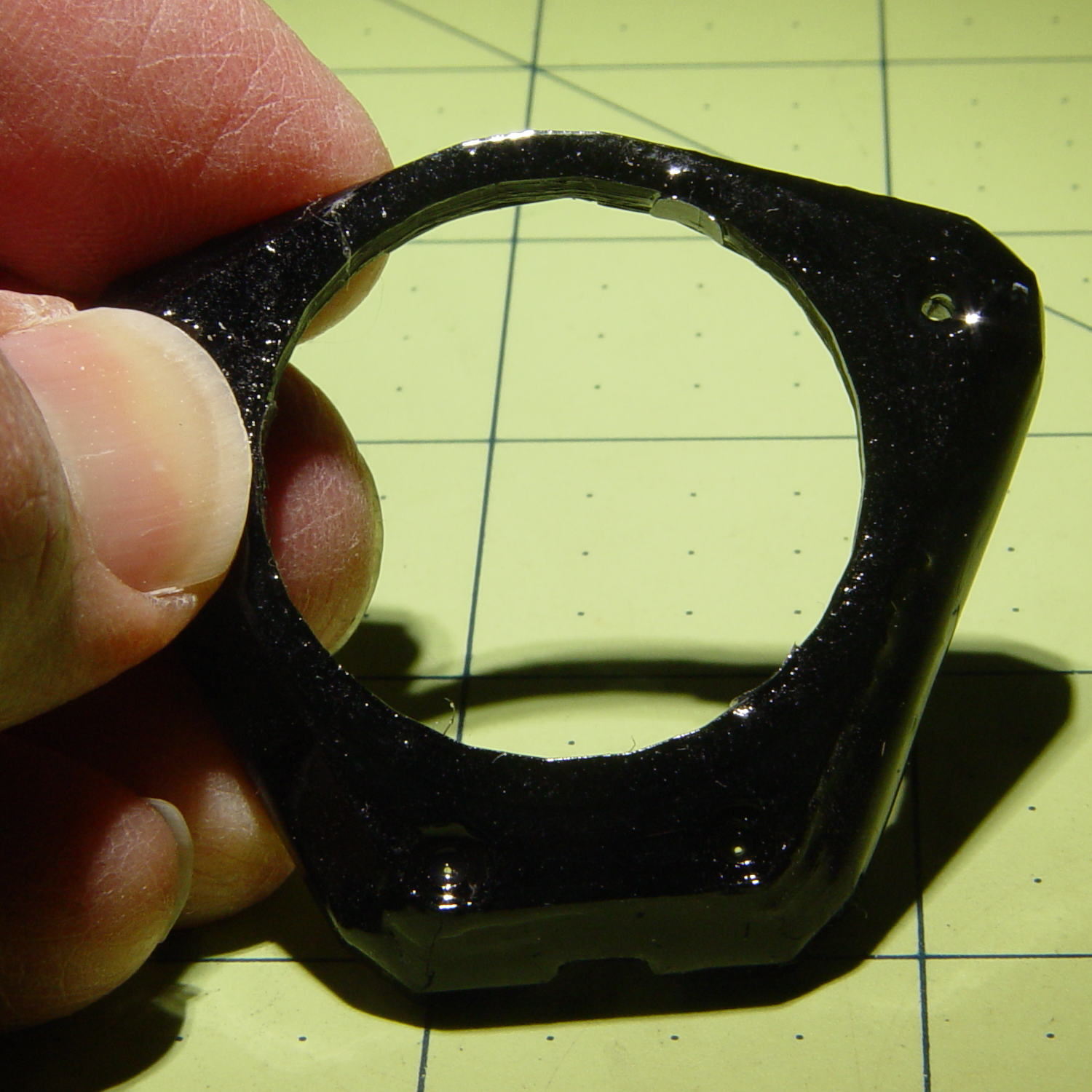
    XTC-3D - Bezel - front oblique
    XTC-3D – Bezel – front oblique

    The bolt head recesses collected enough epoxy to require reaming / milling, which certainly isn’t what you want in that situation. The bolt holes also shrank, although my usual hand-twisted drill would probably suffice to clear the epoxy.

    Another view shows a glint from the smooth surface filling the upper-right recess:

    XTC-3D - Bezel - front
    XTC-3D – Bezel – front

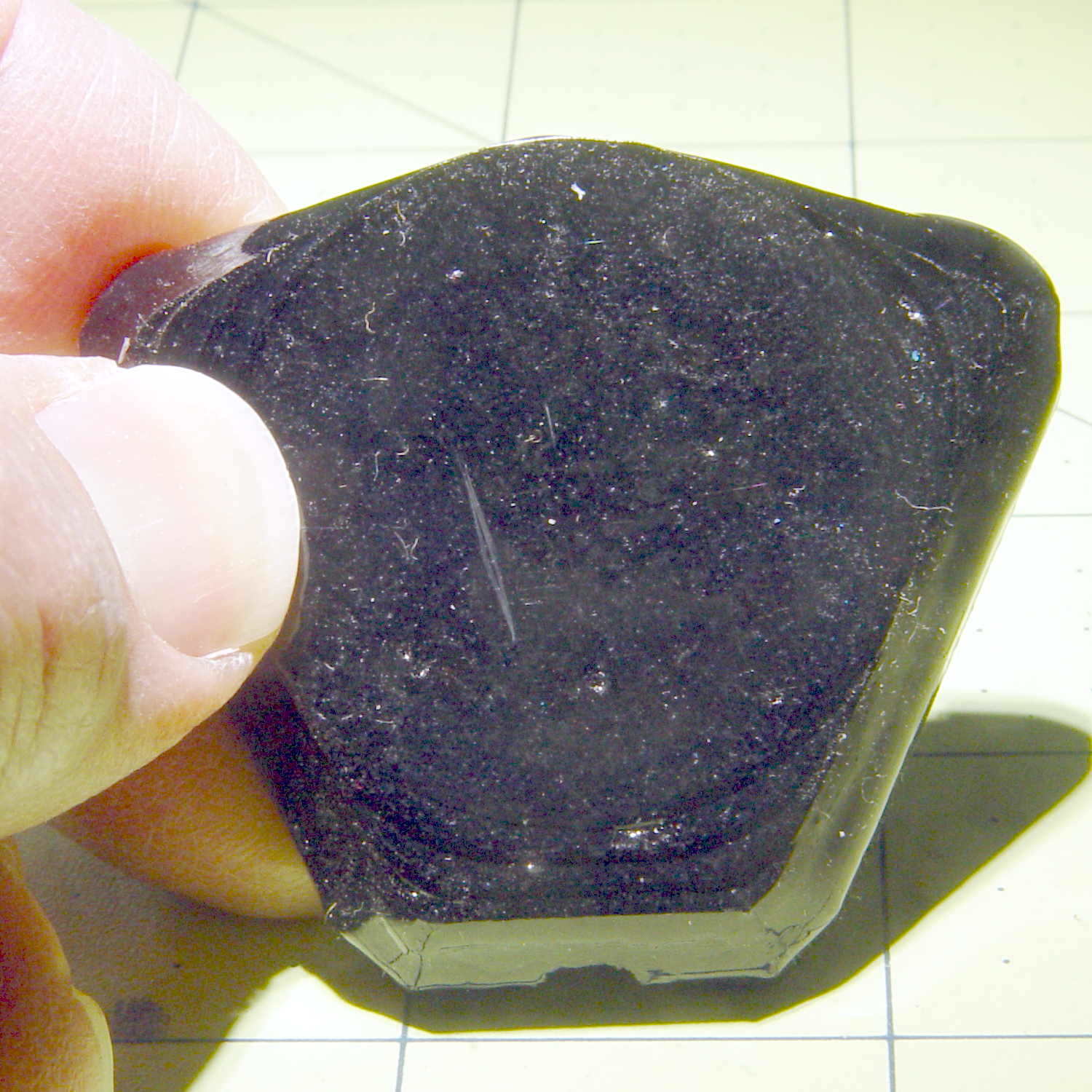
    Three coats definitely hides the 3D printed threads, although you can see some ridges and edges:

    XTC-3D - heavy - oblique
    XTC-3D – heavy – oblique

    The epoxy isn’t perfectly self-leveling, probably due to my (lack of) technique:

    XTC-3D - heavy - reflection
    XTC-3D – heavy – reflection

    Blowing out the contrast shows the surface finish:

    XTC-3D - heavy - direct - boost
    XTC-3D – heavy – direct – boost

    Those scratches come from fingernails, after the overnight curing time. The surface is hard, but not impervious to scratching, which is about what you’d expect for a clear epoxy.

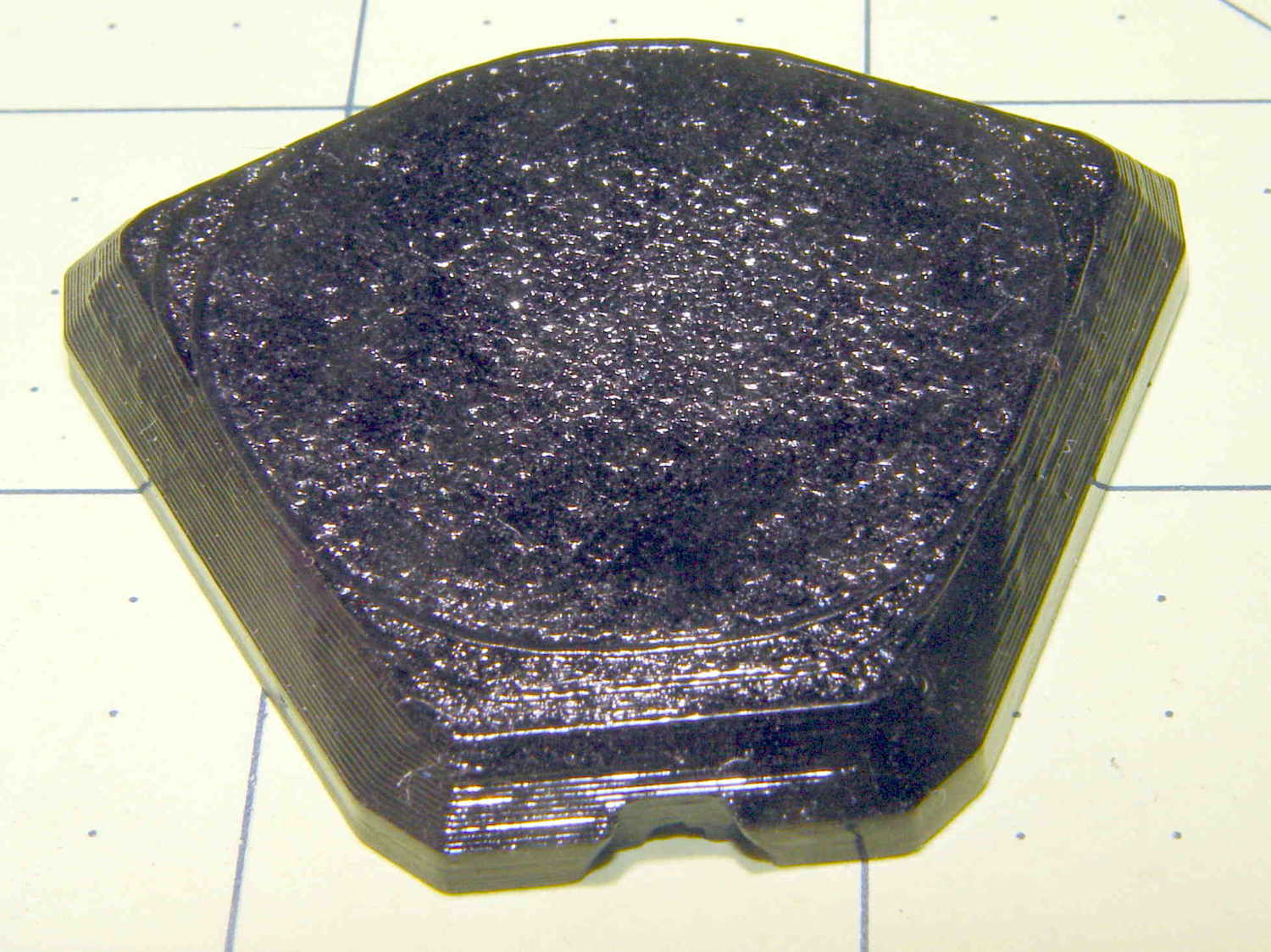
    Slightly over-thinning the XTC-3D with denatured alcohol in a 0.7 : 0.3 : 0.3 by weight ratio produced a watery liquid that penetrated directly into the surface:

    XTC-3D - thinned - oblique
    XTC-3D – thinned – oblique

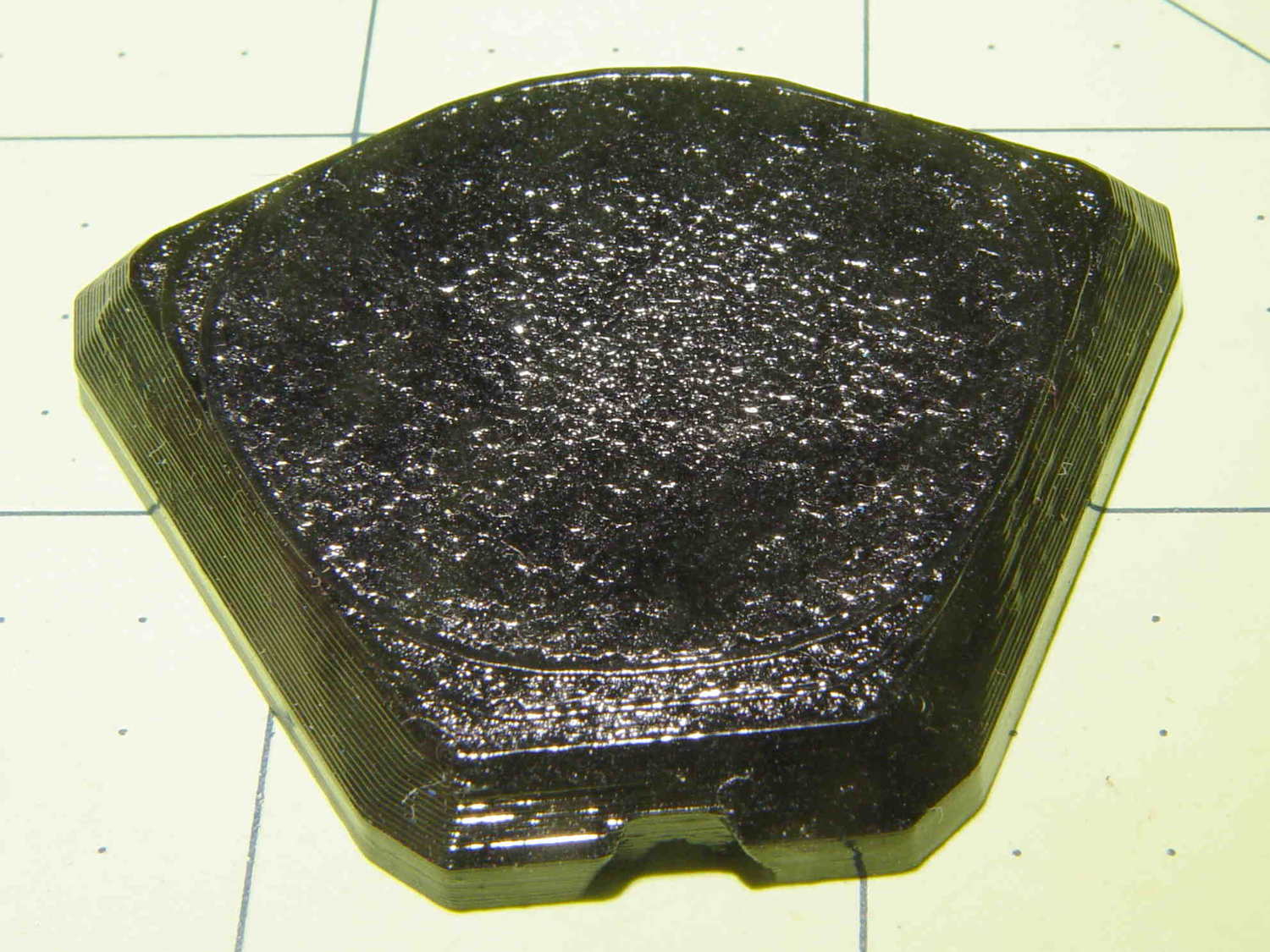
    The finish depends critically on what’s below the surface and how much epoxy you apply. I tried to spread it uniformly with a foam brush, but the center came out somewhat rougher than the outer edge:

    XTC-3D - thinned - oblique
    XTC-3D – thinned – oblique

    The striations along the sides filled in a bit, but surely not enough to satisfy anybody who worries about such things.

    A specular reflection shows the changing surface smoothness:

    XTC-3D - thinned - oblique reflective
    XTC-3D – thinned – oblique reflective

    Perhaps two coats of thinned epoxy would produce a watertight / airtight part, without changing the overall dimensions by very much. The mechanical properties depend almost entirely on the plastic-to-plastic bond, so I doubt a thin epoxy layer would improve its pressure-handling capabilities.

    Few of the parts I make will benefit from an epoxy coating and I definitely don’t want to get into post-processing the parts just to improve their looks!

  • Wearable LED vs. Astable Multivibrator vs. Dead Lithium Cells

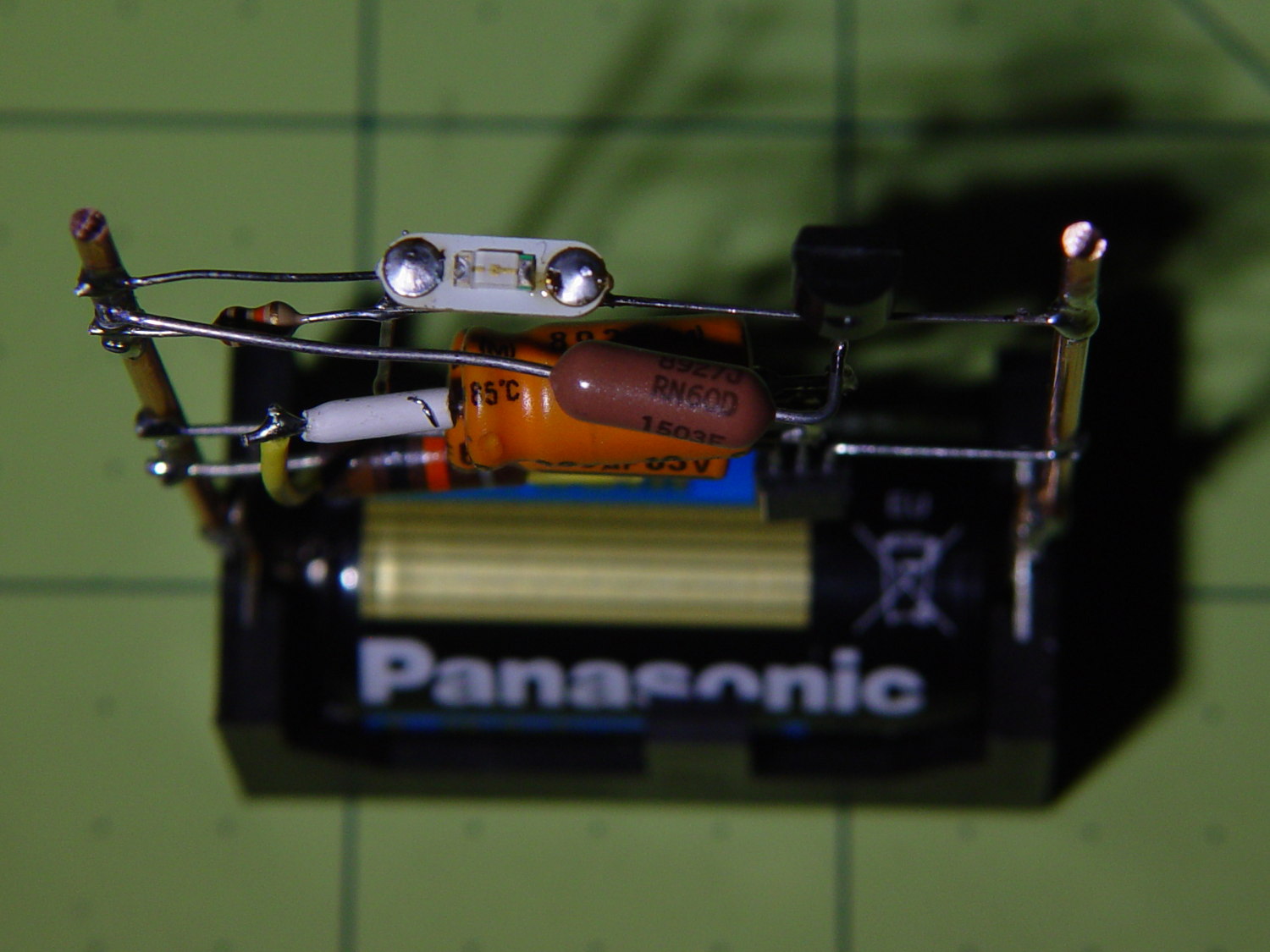
    Mashing the wearable LED from the completely dead CR2032 cell with a classic astable multivibrator circuit and a not-dead-yet CR123 cell produced a pure-analog desktop blinky:

    CR123A Astable - front
    CR123A Astable – front

    Of course, I managed to swap the base resistors, which meant the LED stayed on most of the time, which accounts for the slightly off-kilter brown resistor just under the LED.

    It doesn’t look like much with the LED off:

    CR123A Astable - top - off
    CR123A Astable – top – off

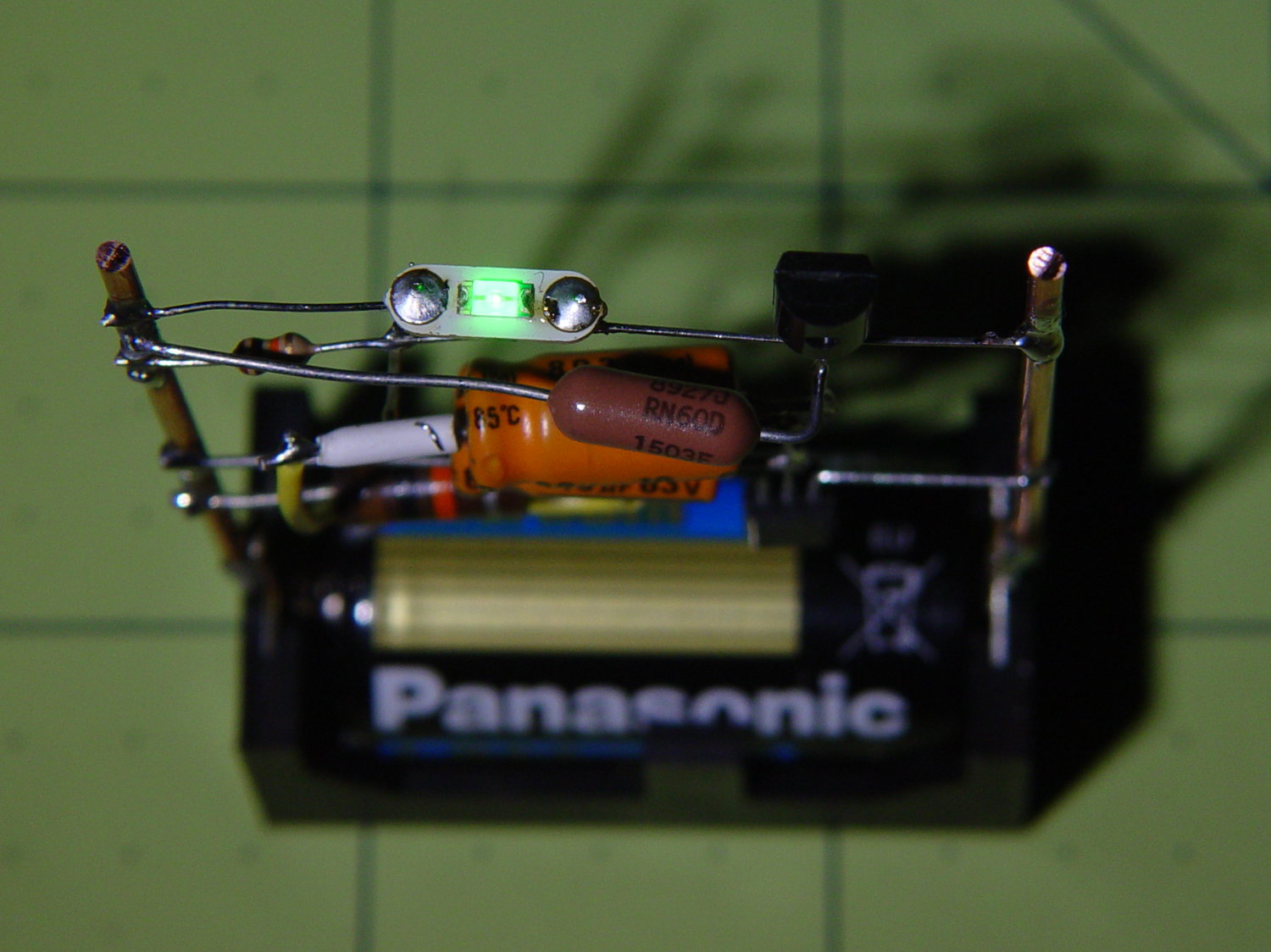
    Running from a 2.8 V (= dead) lithium cell, the LED lights a dark room at 3 mA:

    CR123A Astable - top - on
    CR123A Astable – top – on

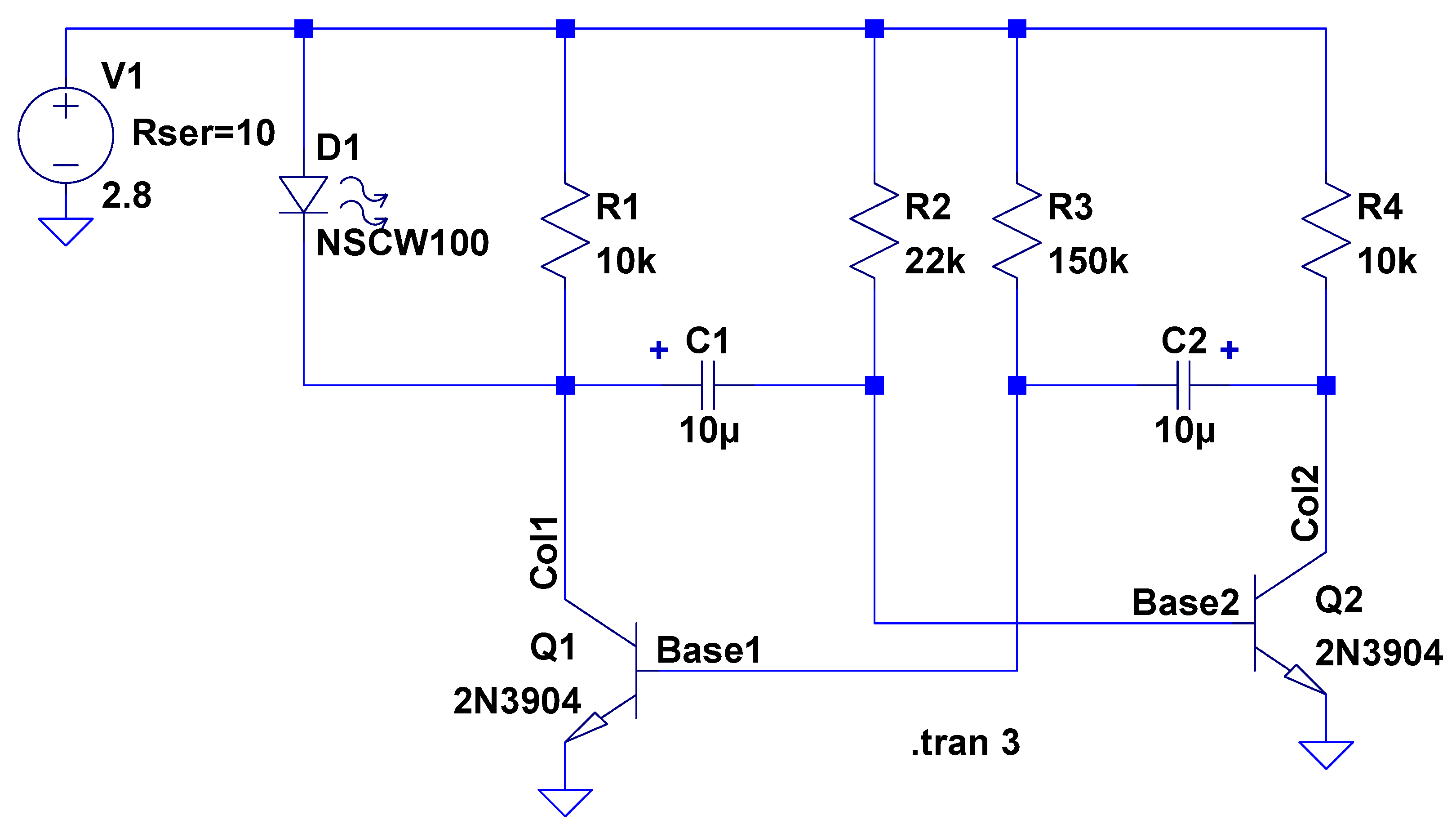
    The LTSpice schematic gives the details:

    Astable Multivibrator - CR2032 - schematic
    Astable Multivibrator – CR2032 – schematic

    The LED definitely didn’t come from Nichia and the 2N3704 transistors aren’t the 2N3904s found in the LTSpice library, but, by and large, this is the kind of circuit where nearly anything will work.

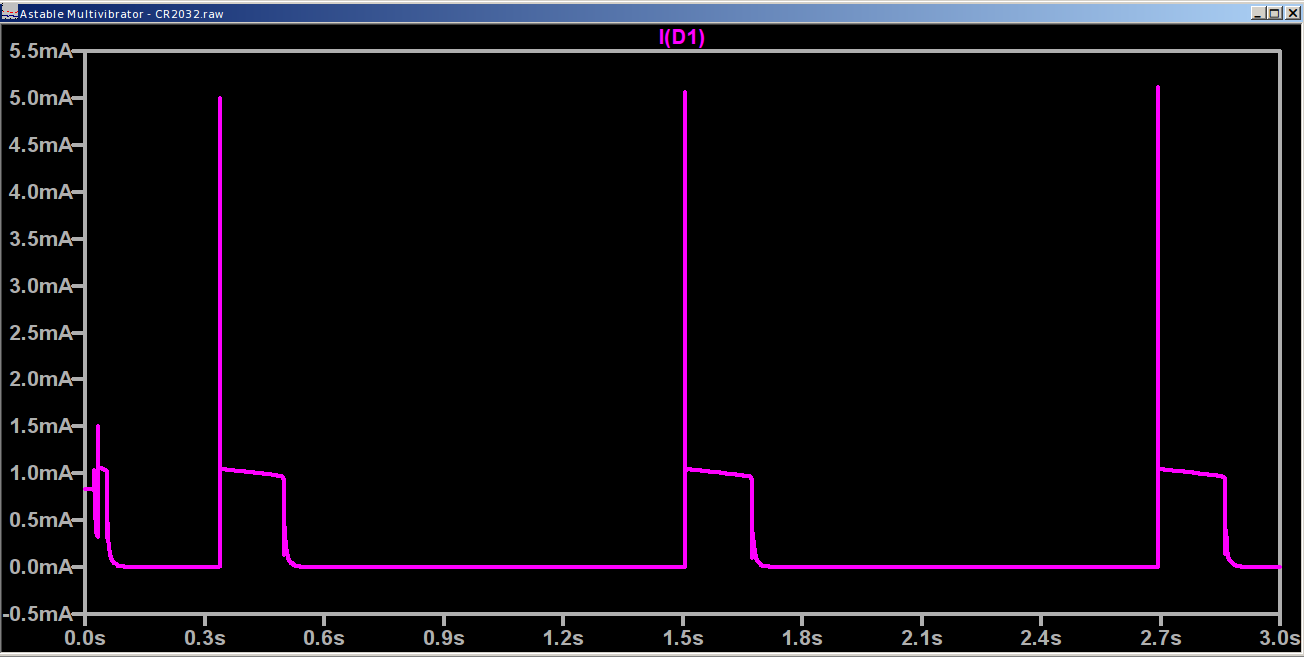
    The actual LED current obviously depends critically on the particular LED and the cell voltage, so this represents more of a serving suggestion than an actual prediction:

    Astable Multivibrator - CR2032 - waveform
    Astable Multivibrator – CR2032 – waveform

    Indeed, a Tek current probe clamped around one of those 10 AWG copper wires shows a much more enthusiastic LED current (1 mA/div):

    Astable - CR123A 2.8 V - 1 mA -green
    Astable – CR123A 2.8 V – 1 mA -green

    I don’t trust the baseline very much. The simulation & back of the envelope agree: the LED-off current should be around 400 µA (which doesn’t depend on the LED at all), so it’s in the right ballpark.

    Your mileage will definitely differ.

    It runs without a trace of software, which everybody at Squidwrench thought was wonderful …

  • Monthly Science: CR2023 Lithium Cells vs. Wearable LEDs

    Those wearable LEDs spent the last five months sitting on the kitchen window sash, quietly discharging their CR2032 lithium cells:

    Wearable LED with CR2023 cell
    Wearable LED with CR2023 cell

    Occasional voltage measurements produced an interesting graph:

    CR2032 vs Wearable LEDs
    CR2032 vs Wearable LEDs

    CR2023 primary lithium cells start out around 3.3 V, so these were pretty much dead (from their previous lives in dataloggers) when I slipped them into their holders. The LEDs seem to be blue LEDs, with threshold voltages around 3.6 V, with colored phosphors / filters, so they started out dim and got dimmer. The green(-ish) LED obviously fell over a cliff and went dark in late January; I have no way to measure long-term microamp currents, alas.

    The reddish LED is still going, mmm, strong.

    If you need a rather dim light for a surprisingly long time, these things will do the trick.

    I should gimmick up another astable multivibrator to blink one LED.

    The original data:

    CR2032 vs Wearable LEDs - data
    CR2032 vs Wearable LEDs – data
  • Eneloop AAA Cells: First Charge

    With an AAA-to-AA adapter in hand, the Eneloop AAA cells looked like this:

    Eneloop AAA - as received - Ah scale - 2017-04-20
    Eneloop AAA – as received – Ah scale – 2017-04-20

    The glitch comes from a not-quite-seated cell, showing that a poor connection matters.

    The package touts “up to 800 mA·h, 750 mA·h min”, with asterisks and superscripts leading to “Based on IEC 61951-2(7.3.2)“, access to which requires coughing up 281 bucks. So it goes.

    A full charge made them happier:

    Eneloop AAA - first charge - Ah scale - 2017-04-22
    Eneloop AAA – first charge – Ah scale – 2017-04-22

    The as-delivered 530 mA·h capacity represents 73% of the 725 mA·h after the first charge, so I suppose they’re more-or-less within the “Maintains up to 70% charge after 10 years of storage” claim. The 16-10 date code suggests they’re hot off the factory charger, so they must ship with somewhat less than a full charge.

    Comparing the capacity in W·h makes more sense, because most devices (other than the Planet Bike blinky light these will go into, of course) use a boost converter to get a fixed voltage from the declining terminal voltage.

    They arrived bearing just over 600 mW·h:

    Eneloop AAA - as received - Wh scale - 2017-04-20
    Eneloop AAA – as received – Wh scale – 2017-04-20

    After charging, that went a bit over 850 mW·h :

    Eneloop AAA - first charge - Wh scale - 2017-04-22
    Eneloop AAA – first charge – Wh scale – 2017-04-22

    Call it 71% of full capacity on arrival. Close enough.

    The Planet Bike blinky will be somewhat dimmer with two NiMH cells delivering 2.3-ish V, compared with the initial 3-ish V from a pair of alkaline cells. I generally burn the alkalines down to 1.1 V apiece, so perhaps they’ll be Good Enough.

    Now, if I were gutsy, I’d install a rechargeable lithium AAA cell, with a dummy pass-through adapter in the other cell socket, and run the blinky at 3.7 V. At least for a few moments, anyhow …

  • Monthly Image: Turkey Mating

    Early spring brings out large turkey flocks and provides a window into their otherwise rather private lives.

    Despite all the strutting and posturing by the males, the ladies call the shots. When we see a hen go hull-down like this, we know what’s about to happen:

     Turkey mating - invitation
    Turkey mating – invitation

    Getting into the right position seems remarkably awkward and requires some cooperation:

    Turkey mating - mounting
    Turkey mating – mounting

    When her head and tail pop up, you know the thing is going right:

    Turkey mating - the moment
    Turkey mating – the moment

    And a back massage always feels so fine:

    Turkey mating - massage
    Turkey mating – massage

    Then he’s back to strutting & posturing:

    Turkey mating - aftermath
    Turkey mating – aftermath

    We hope they’ll show us their chicks

    Taken with the DSC-H5, hand-held through two panes of 1955-era window glass: ya get what ya get.

  • Cheap WS2812 LEDs: Test Fixture Failure 2

    A second WS2812 RGB LED in the test fixture failed:

    WS2812 LED - test fixture failure 2
    WS2812 LED – test fixture failure 2

    The red pixel in the second row from the top sends pinball panic to the six downstream LEDs (left and upward). Of course, it’s not consistently bad and sometimes behaves perfectly. The dark row below it contains perfectly good LEDs: they’re in a dark-blue part of the cycle.

    The first WS2812 failed after about a week. This one lasted 7 weeks = 50-ish days.

    The encapsulation seal went bad on this one and, for whatever it’s worth, the remainder still pass the Sharpie test. Perhaps the LEDs fail only after heat (or time-at-temperature) breaks the seal. Assuming, equally of course, the seal left the factory in good order, which seems a completely unwarranted assumption.

  • Monthly Science: Sonicare Recharge Intervals

    After replacing the NiMH cells in my Sonicare toothbrush in July 2012, they delivered about 21 days = 21 brushings between charges. After a year, I laid a sheet of Geek Scratch Paper on the windowsill (*) and noted pretty nearly every recharge:

    Sonicare recharge - 2013-10 - 2017-01
    Sonicare recharge – 2013-10 – 2017-01

    Anyhow, the original cells crapped out after 2-½ years, when these still delivered 13 days. After 4-½ years, they’re lasting 12 days between charges.

    Color me surprised, because they’re 600 mA·h NiMH cells. The originals were 2000 mA·h cells, which you’d expect would last longer, but noooo.

    No reason to change them yet, which is good news.

    FWIW, I recently bought some cheap brush heads from the usual low-end eBay seller. The OEM brushes have colored bristles which fade to tell you when to change brushes, although I run ’em quite a bit longer than that. The cheap replacements have never-fading colored bristles and, I suspect, all the bristles are much too stiff. The dental hygienist says I’m doing great, so it’s all good.

    Sonicare brush heads - cheap vs OEM
    Sonicare brush heads – cheap vs OEM

    High truth: at best, you get what you pay for.

    (*) Being that type of guy has some advantages, if you’re that guy. Otherwise, it’s a nasty character flaw.