Ed Nisley's Blog: Shop notes, electronics, firmware, machinery, 3D printing, laser cuttery, and curiosities. Contents: 100% human thinking, 0% AI slop.
Category: Science
If you measure something often enough, it becomes science
Perhaps each resonator’s frequency depends on its (laser-trimmed) tine mass and follows a more-or-less normal distribution, but the parallel-serial difference series capacitor changes the frequency based on (well-controlled) etched dimensions producing quantized results from three different masks / wafers / lots, with the motional inductance and capacitance incompletely modeling the physics?
Producing the histograms uses the LibreOffice frequency() array function, which requires remembering to whack Ctrl-Shift Enter to activate the function’s array-ness.
[Update: Faceplant about “parallel” resonance, which is actually the shifted resonant peak due to the 24 pF series cap. Apparently I typo-ed the second histogram subheading and ran with the error; the figures are now correct.]
The usual model for a quartz resonator apportions half the measured both-leads-to-case capacitance to each lead:
AT26 crystal capacitance fixture – Cpar detail
These AT26 / TF26 cases run around 0.6 pF, so each parasitic capacitor is 300 fF:
60 kHz Quartz Resonator – model
For ordinary quartz crystals, you solder the case to the ground plane to get rid of the sneak path around the central capacitor (normally C0, but labeling it properly in LTSpice just isn’t happening), but those little aluminum cans aren’t solderable. One could blob some Wire Glue over them, but …
So I just wrapped a wire around the case and soldered it to a convenient ground point under the board:
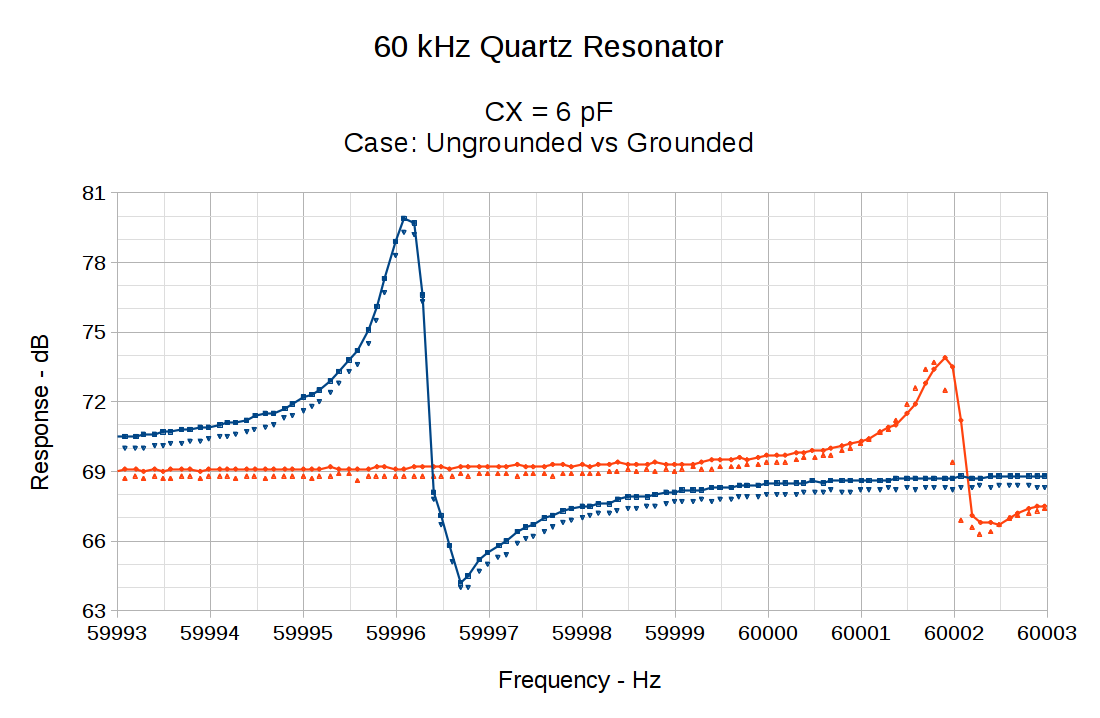
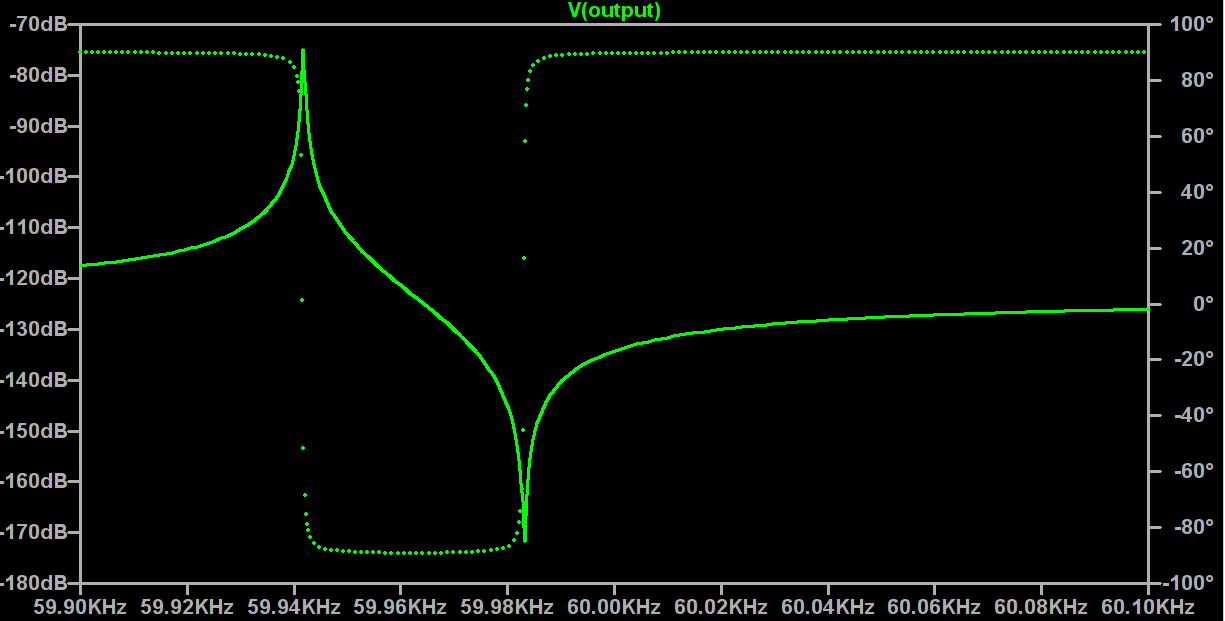
Solid lines = case ungrounded. Dotties = case grounded.
Grounding the case knocks the off-peak response down by less than 1 dB. The on-peak response remains about the same, so eliminating the series capacitance does reduce the blowthrough.
With the case grounded and CX = 6 pF in the circuit, the peaks over on the right seem ever so slightly lower in frequency, which suggests a slightly higher motional capacitance. There’s not much to write home about, though, so I’d say there’s very little effect, even on this scale.
At the frequency resolution of these graphs, none of the standard equations are helpful; this is definitely a “tune for best picture” situation.
So, assuming the same general conditions apply in a filter, a series capacitance around 10 pF should pull the resonant peak to 60.000 kHz. Unfortunately, the cheery 76 dB level is relative to the AD8310‘s nominal -108 dBV intercept at 4 μV: the log amp sees 25 mV after the MAX4255 op amp applies 40 dB (×100) of gain to the 250 μV coming from the resonator. The resonator drive is 1 μW = 150 mV, so the resonator produces a 55 dB loss for a signal dead on frequency.
The off-peak attenuation looks like a mere 7 dB, although I hope plenty of noise masks the true result in this circuit.
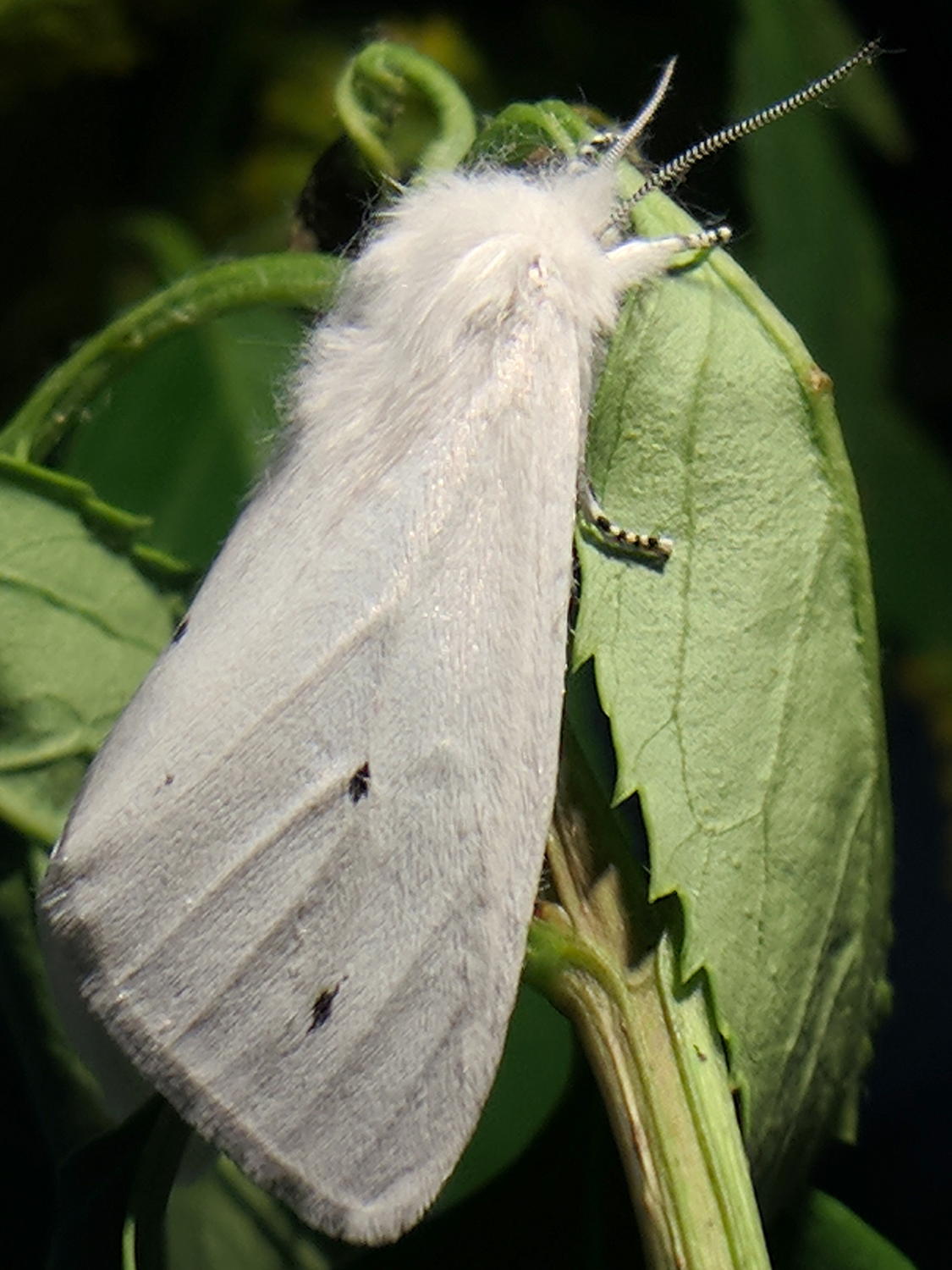
Moth 1, with wonderful antenna fringes identifying him as a male:
Spilosoma virginica 1 – right
Moth 2, a female with smaller antenna:
Spilosoma virginica 2 – right
Moth 3, another male:
Spilosoma virginica 3 – dorsal
The underside is diagnostic (ignore the crud on the aquarium glass):
Spilosoma virginica 3 – ventral
We set each one on the goldenrod plant inside the garden gate, whereupon they charged up in the sun for an hour or so, then flew off about their business. They may eat a few leaves in the garden, but they’re not particularly harmful to anything and entitled to a peaceful life.
I must organize all their pictures into a life history.
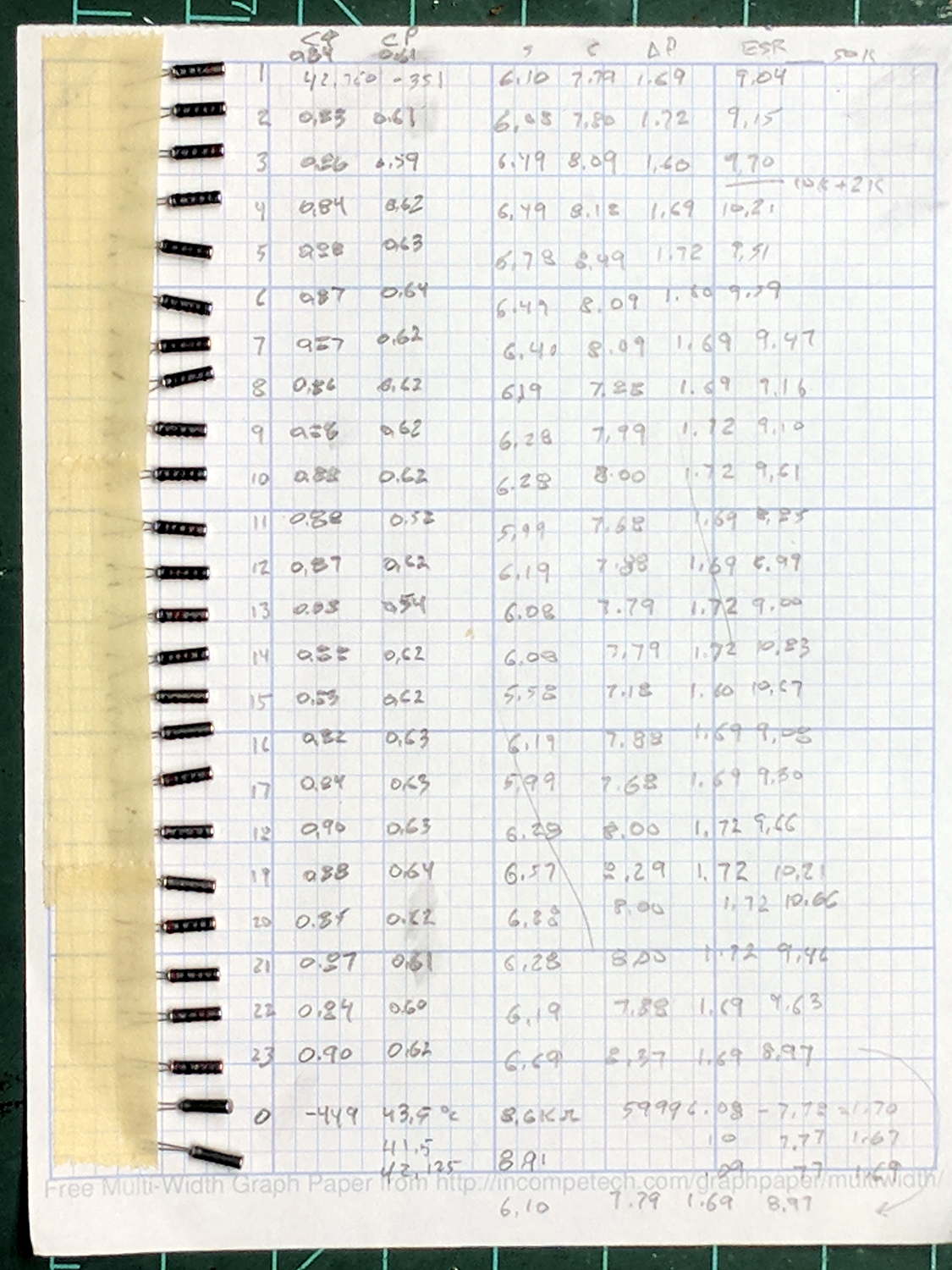
The second batch from the same eBay source arrived a few months later and I finally got around to measuring them:
60 kHz TF26 resonators – Batch 2 data
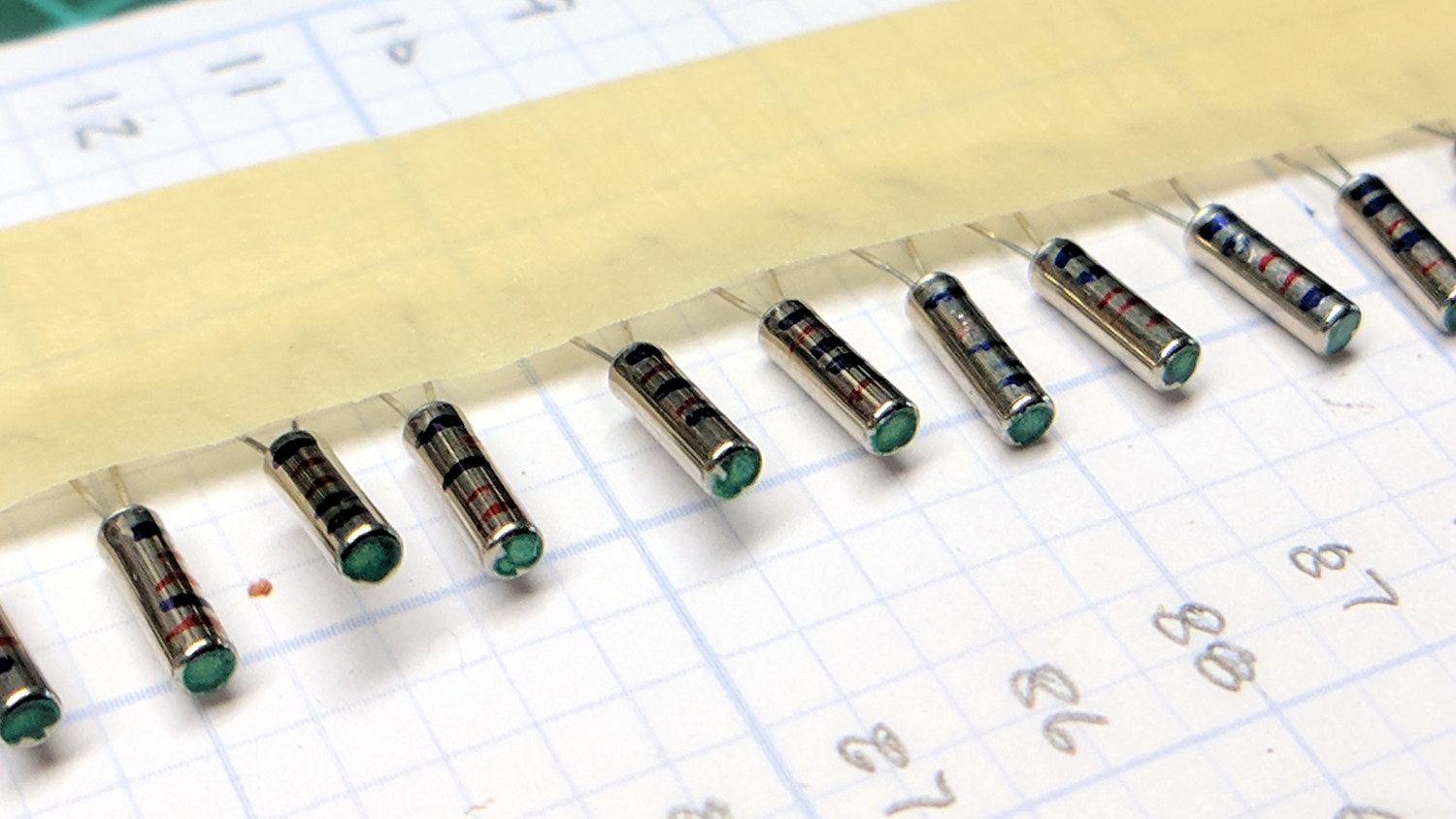
A dot of green Sharpie on the AT26 cans identifies the second batch:
60 kHz TF26 resonators – Batch 2 marking
The alert reader will notice an un-measured 25th resonator at the bottom of the first batch. I dropped one from the second batch under the Electronics Workbench, found it, then also found its long-missing brother; now I have a genuine it’s-never-been-used resonator, just in case the need arises.
A quick-and-dirty simulation shows the series and parallel resonant peaks come out close, but not dead on, the actual measurements:
Simulation – 60 kHz resonator
The model obviously doesn’t exactly match reality, which isn’t too surprising. However, I don’t understand something about tuning fork resonators, because the parallel resonance shouldn’t shift upward with the series resonant peak when the circuit gains a 24 pF series capacitance:
Resonator 0 Spectrum
Suffice it to say that doesn’t happen with the simulation.
The replacement NP-BX1 batteries arrived and, as I expected, perform just as badly as the previous pair:
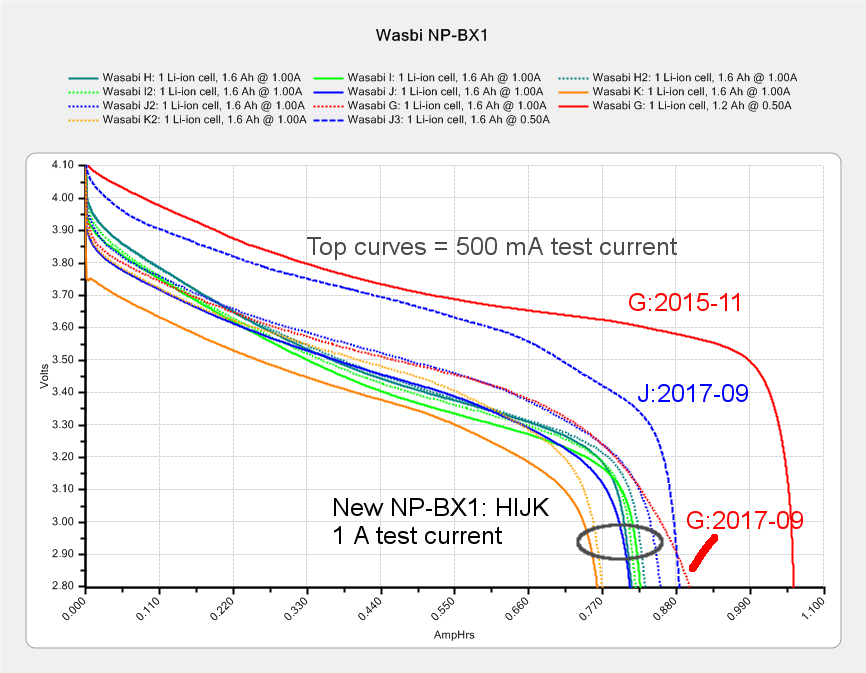
Sony NP-BX1 – Wasabi GHIJK – 2017-09-01 – annotated
The note I sent to Wasabi’s tech support summarizes the details:
The second pair of NP-BX1 batteries are just as bad as the first two. In fact, all four perform worse than the nearly two-year-old Wasabi batteries I’ve been using.
The graph shows the test results from my CBA III analyzer. All batteries were all charged in a Wasabi wall charger.
The top solid red curve shows the as-delivered performance in late 2015 for the battery I labeled “G”, tested at 500 mA. It delivered only 1 Ah, not the claimed 1.6 Ah, even at that relatively low current, but has delivered over one hour of service in the camera.
The top dotted-blue curve shows the as-delivered performance for the NEW battery I labeled “J”, also tested at 500 mA. It delivers only 0.88 Ah, 55% of the claimed 1.6 Ah, at a much lower voltage while discharging.
After two years, OLD battery “G” has more capacity and a higher voltage than the NEW battery “J”!
The lower curves shows the results for the four most recent batteries I labeled H I J K, all tested at 1 A to better match the camera’s actual current; the dotted traces mark the second test of each battery.
The orange traces show battery K has about 0.77 Ah of capacity, less than half of the claimed 1.6 Ah and much worse than the others.
I also re-tested battery old battery G at 1 A, as shown by the dotted red curve labeled “G:2017-09”. It outperforms ALL of the new batteries!
Batteries H and I have date codes BQF22, which I interpret as 2017-06-22: fairly recent stock.
Batteries J and K have date codes BPL28: 2016-12-28. They’ve been sitting around for a while, which may account for the poor performance of battery K.
These Wasabi batteries cost roughly twice (*) as much as they did in late 2015, have /much/ lower capacity, and, to judge from the date codes, they’ve been consistently poor since late last year.
What is going on?
It’s worth noting that Wasabi NP-BX1 batteries are currently $16 for the pair on Amazon and were $9 in late 2015. Allegedly genuine Sony NP-BX1 batteries run $50 MSRP and a suspiciously consistent $37.99 from all the usual big-box sources, including Amazon, where they’re out-of-stock for the next few months. Combining the number of counterfeits in the supply chain with Amazon’s commingled SKU stock bins, I have my doubts about what I’d get by increasing my battery spend by a factor of five.
I think it’s about time to conjure an external 18650 holder / helmet mount for that camera and be done with it.
[(*) Edit: I screwed up the unit of measure: the old invoice had two single batteries. The new order was one pair, so I now pay slightly less for much worse performance. A refund is wending its way through the system.]
An hour before the festivities started, I lashed together an official NASA-approved pinhole eclipse viewer from available materials:
Eclipse 2017-08-21 – pinhole projector
Although the solar disk showed up fine on the white paper screen, the Pixel’s camera can’t show the notch growing on the left side, even with HDR+ mode in full effect:
Eclipse 2017-08-21 – pinhole projector – interior
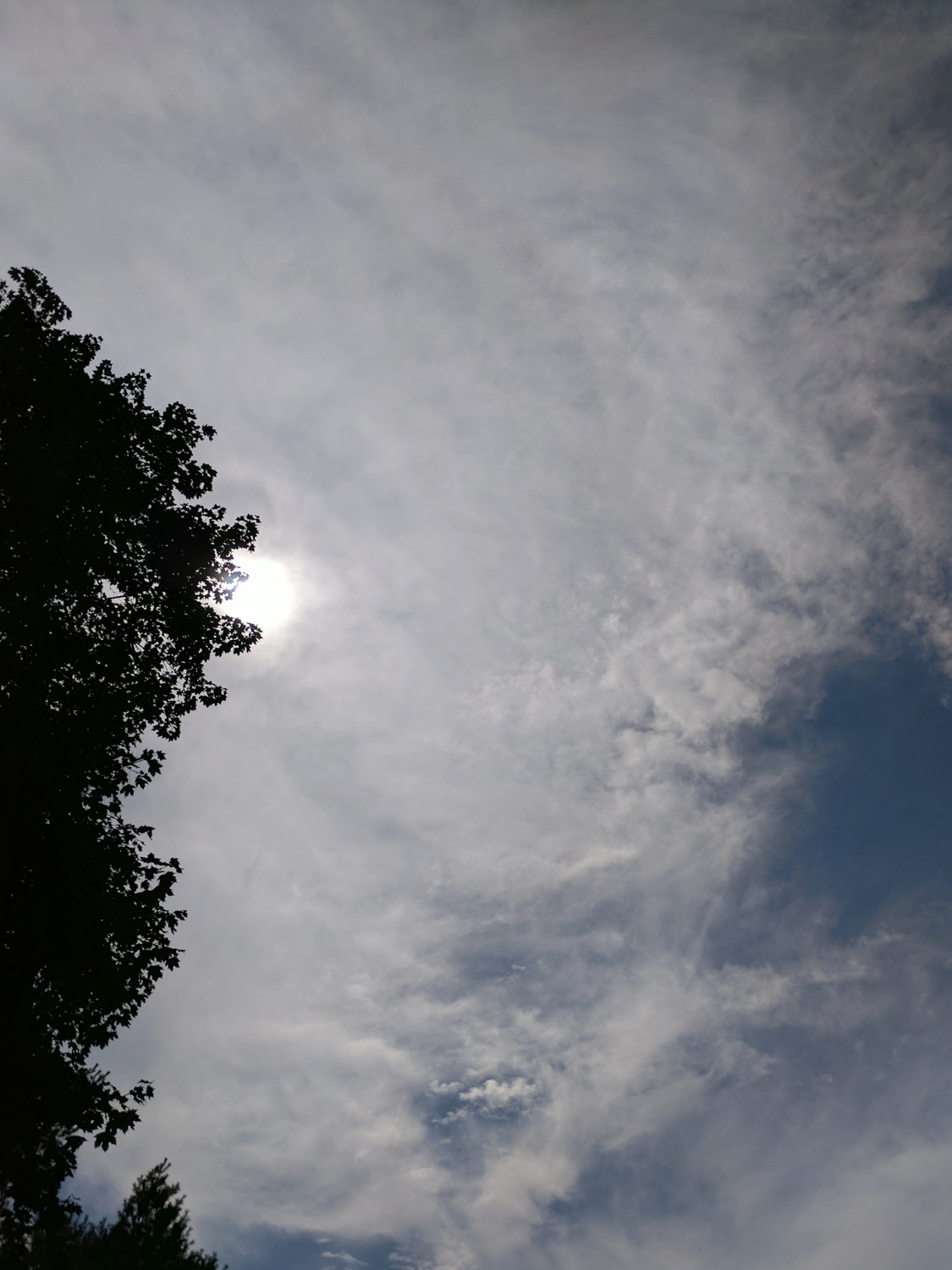
As usual for astronomy around here, clouds threatened the outcome:
Eclipse 2017-08-21 – high clouds
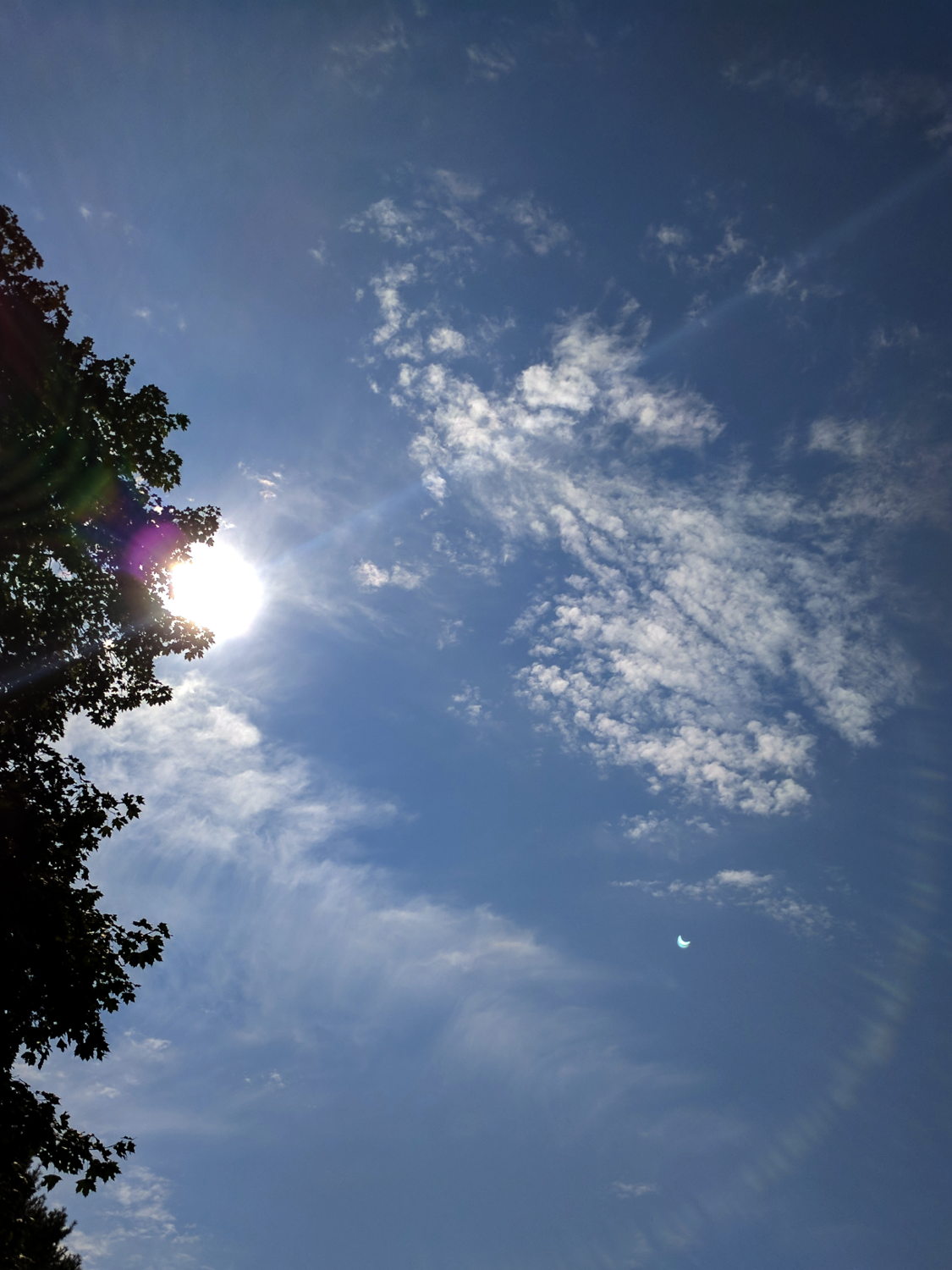
Near the maximum, the skies cleared:
Eclipse 2017-08-21 – maximum – lens flare
Although it’s not proof, there’s a definite bite out of the lens flare at about 4 o’clock:
Eclipse 2017-08-21 – maximum – lens flare – detail
The maples south of the driveway produced lower-contrast images better suited to silicon sensors:
Eclipse 2017-08-21 – maximum – shadows
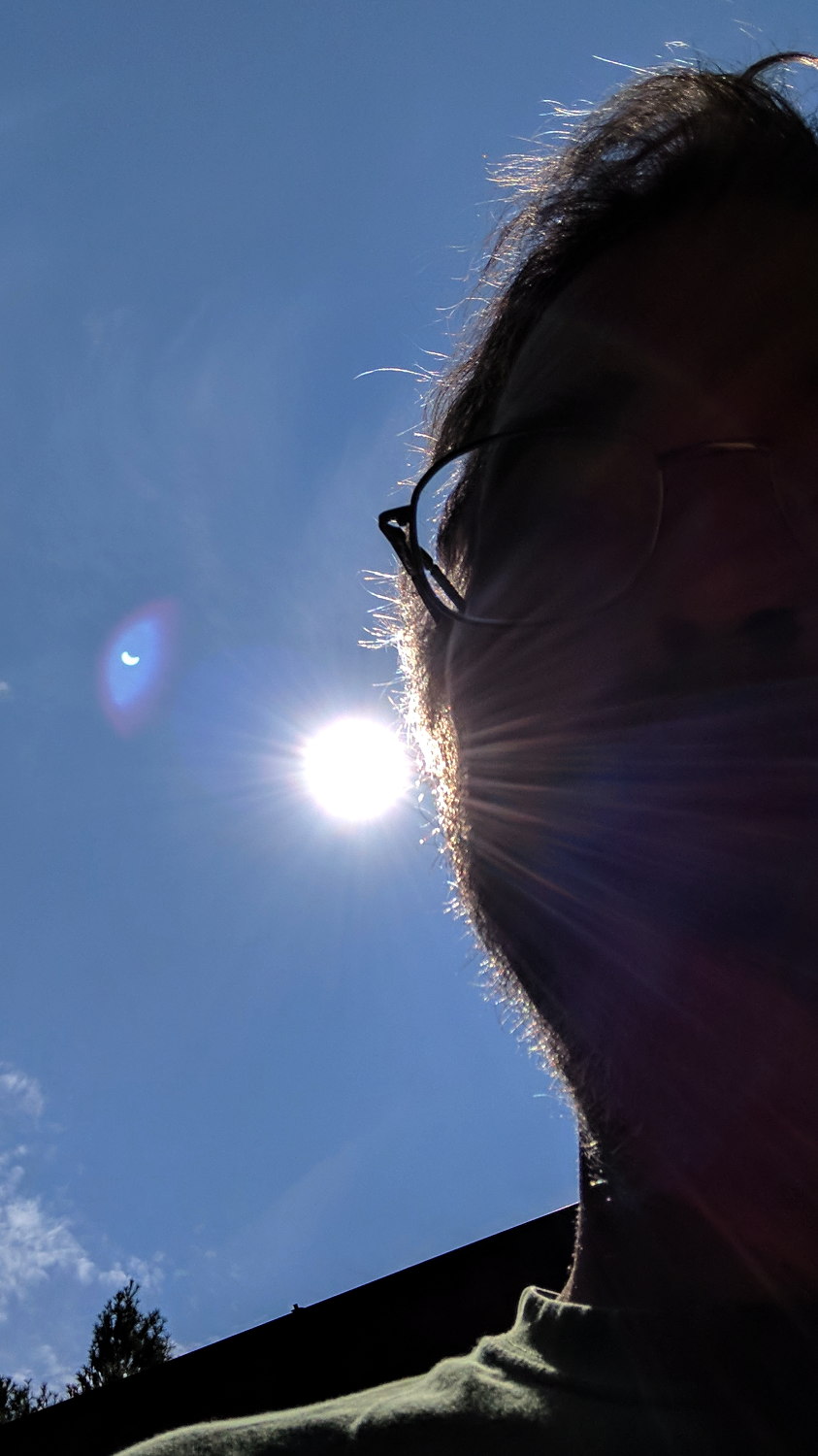
And, although everyone was specifically enjoined not to do this, because UV reflection = blindness, the obligatory solar eclipse selfie:
Eclipse 2017-08-21 – obligatory selfie
I’m sure similar lens flares count as UFOs in someone’s telling of the tale.
We planned to dance naked in the yard, but our neighbor’s lawn crew picked that moment to scalp his grass and we chose discretion over valor …