The Smell of Molten Projects in the Morning

Ed Nisley's Blog: Shop notes, electronics, firmware, machinery, 3D printing, laser cuttery, and curiosities. Contents: 100% human thinking, 0% AI slop.

Category: Science

If you measure something often enough, it becomes science

  • Maximum 3D Printing Speed

    Maximum 3D Printing Speed

    With everybody 3D printing masks these days, the question of “how fast can you print” came up on the Makergear forum.

    Here’s my opinion:

    The fundamental limit comes from the heater’s ability to bring cold plastic up to extrusion temperature inside the 20 mm hot zone.

    Using airscape’s example, the extruded thread is 0.5 mm thick × 0.8 mm wide = 0.4 mm², so laying down that thread at 50 mm/s means the extruder is heating plastic at 20 mm³/s and is “pushing it with PLA”.

    In round numbers, normal printing speeds with a normal nozzle and normal plastics runs around 10 mm³/s, so a practical upper limit is probably around 15 mm³/s.

    As far as thread size goes, the diameter of the flat area around the nozzle orifice sets the maximum thread width, because the nozzle must compress the thread against the previous layer. If the thread is wider than the nozzle, the gooey plastic curls up around the sides of the nozzle and doesn’t bond well. The rule of thumb is to round up the orifice diameter to the next convenient number:

    • 0.35 mm nozzle → 0.4 mm thread
    • 0.75 mm nozzle → 0.8 mm thread

    The maximum thread (= layer) thickness should be about 60% of the thread width, which is why a 0.8 mm wide thread calls for a 0.5 mm layer thickness.

    Assuming the extruder can heat 15 mm³/s of plastic, the maximum printing speed will be 15 mm³/s / 0.4 mm² = 37.5 mm/s: comfortably under airscape’s “pushing it” 50 mm/s.

    A visualization may be helpful:

    Extrusion Dimensions
    Extrusion Dimensions

    Aaaaand, as always, calibrate the Extrusion Multiplier for whatever conditions you’re using to ensure the slicer and the hardware agree on how much plastic is coming out of the nozzle.
  • Monthly Science: Praying Mantis Ootheca

    Monthly Science: Praying Mantis Ootheca

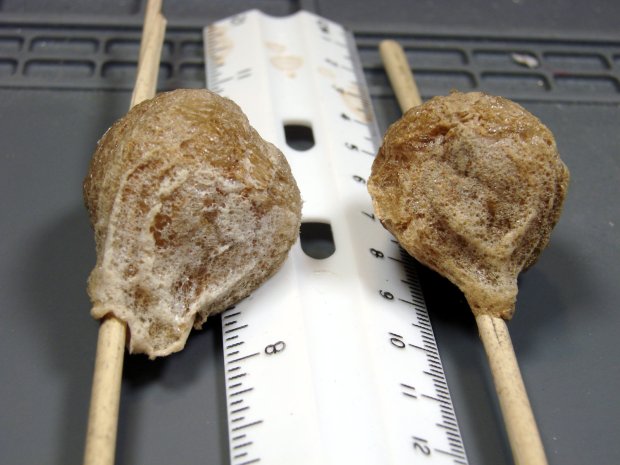
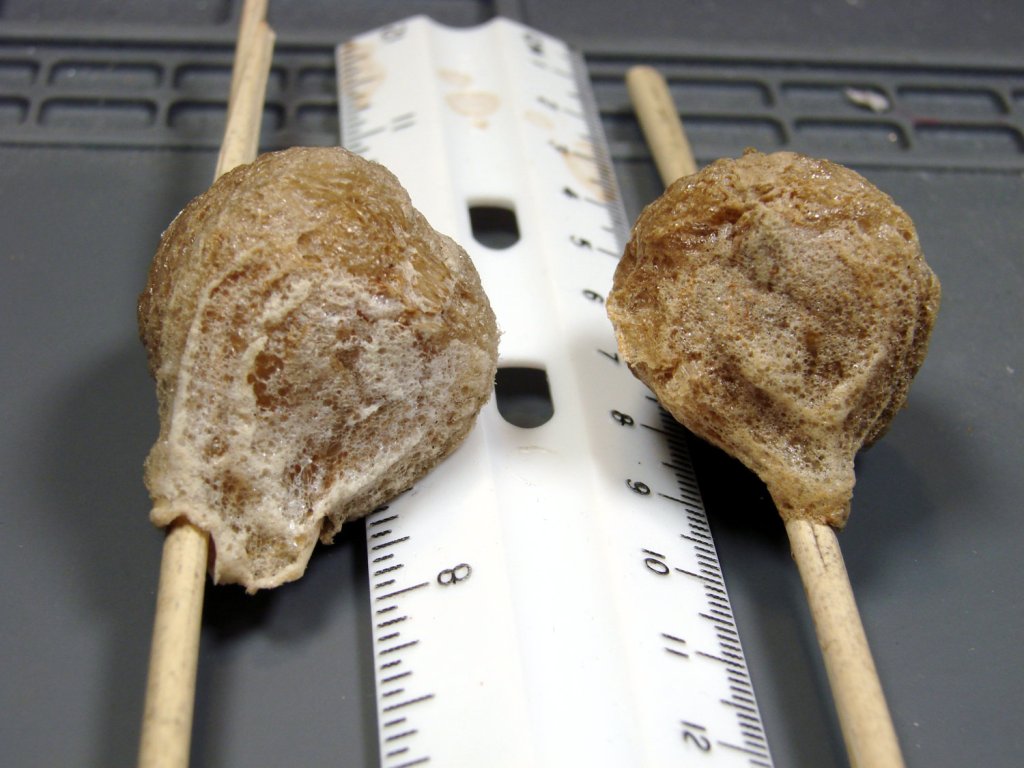
    We extracted the Praying Mantis oothecae while clearcutting the decorative grasses bracketing the front door. As far as I can tell, they’re still charged up and ready for use.

    The masses resemble rigid foam wrapped around grass stems:

    Praying Mantis ootheca - stem side
    Praying Mantis ootheca – stem side

    It’s a mechanical joint, not an adhesive bond, and the dried stems slide freely through the openings:

    Praying Mantis ootheca - bottom
    Praying Mantis ootheca – bottom

    From one side:

    Praying Mantis ootheca - right
    Praying Mantis ootheca – right

    And the other:

    Praying Mantis ootheca - left
    Praying Mantis ootheca – left

    They’re now tied to stems of the bushes along the front of the house, which (I hope) will resemble what the little ones expect to find when they emerge, whenever they do.

  • COVID-19: Elephant Path Prediction

    We now have enough statistics from the USA to draw some useful graphs, so click the Logarithmic options to make the charts comprehensible:

    COVID-19 - USA Total Cases and Total Deaths - 2020-03-25
    COVID-19 – USA Total Cases and Total Deaths – 2020-03-25

    The penciled lines give an eyeballometric fit, but it’s pretty obvious the USA is now dealing with purely exponential infection rates.

    Total Cases, which is the patients tested = people already in the medical system, is growing by a factor of ten every eight days. By next weekend, the USA will have one million Total Cases: average it to 112,000 new cases, every day, over the next eight days.

    Which may not happen, if only because we may not have the intake / testing / recording capacity for that number of patients and maybe, just maybe, Social Distancing will have an effect. I expect the Total Cases line bend downward slightly during the week, but it won’t be anywhere near horizontal. Obviously, the extrapolation fails completely within the next 24 days, because we lack a factor of 1000 more people to infect.

    Total Deaths still equals Total Cases with a delay of fourteen days. By next weekend, the USA will have 10,000 Total Deaths: ramping up to average 1120 new deaths, every day, over the next eight days.

    The 9,000 patients who will die in the next week are already in the medical system (because you take about two weeks to die) and, at least in downstate NY, have essentially filled all available hospital beds; they’re getting the best care possible from the medical establishment.

    The next 900,000 cases, appearing “suddenly” during the next eight days, have nowhere to go; doubling hospital capacity and converting every flat surface into a mass ward are worthwhile goals, but they’re a linear solution to an exponential problem.

    Not every new case becomes a patient, but in the USA we seem to be testing only folks with obvious COVID-19 symptoms, so all the optimistic hospitalization estimates of 10% are off the table and 50% seems more believable. Pick any percentage you like.

    Eight days from now, the rate will ramp toward 10,000 deaths per day, to reach 100,000 Total Deaths in sixteen days, again, as an average.

    Nearly everybody will survive this pandemic, because the overall death rate seems to be a few percent. For those of us in the Boomer-and-up generations, (theme: Aqualung) well, this may be our contribution to solving the Social Security & Medicare budget problems.

  • COVID-19: Elephant Sighting

    As far as this engineer can tell, here’s about all you need to know about the COVID-19 pandemic:

    Total Deaths = Total Cases recorded two weeks earlier

    This also works forward in time: given the total number of cases “today”, I (and you) can predict the total number of deaths in two weeks, give or take a few days.

    Run the numbers for Italy, because it has a relatively long timeline and trustworthy data:

    • 2020-03-01: 1694 cases → 2020-03-15: 1809 deaths
    • 2020-03-02: 2036 cases → 2020-03-16: 2158 deaths
    • 2020-03-03: 2502 cases → 2020-03-17: 2503 deaths

    As the numbers become difficult to comprehend, the time difference slows to 16 days instead of 14:

    • 2020-03-06: 4636 cases → 2020-03-22: 4825 deaths
    • 2020-03-07: 5883 cases → 2020-03-23: 6077 deaths

    On 2020-03-23, Italy had 63,927 confirmed cases. Prediction: Easter will not be celebrated in the usual manner.

    Consider the data for the US, also in March 2020:

    • 2020-03-05: 175 cases → 2020-03-19: 174 deaths
    • 2020-03-06: 252 cases → 2020-03-20: 229 deaths
    • 2020-03-07: 353 cases → 2020-03-21: 292 deaths

    Pop quiz: Given that the US has 32,761 total cases as of today (2020-03-22), estimate the total deaths in two weeks.

    New York State will have similar statistics, although it’s too soon to draw conclusions from today’s 20,875 confirmed cases.

    In addition to the Wikipedia articles linked above, you may find these sites useful:

    Exhaustive tracking and mapping from Johns Hopkins (the GUID gets to reach the JHU data): https://www.arcgis.com/apps/opsdashboard/index.html#/bda7594740fd40299423467b48e9ecf6

    Comprehensive COVID-19 tracking, with logarithmic graph scales: https://www.worldometers.info/coronavirus/

    More raw data: https://virusncov.com/

    CDC National cases, with a per-day graph down the page: https://www.cdc.gov/coronavirus/2019-ncov/cases-updates/cases-in-us.html

    New York State COVID-19 info: https://coronavirus.health.ny.gov/home

    Perhaps more useful for me than you, but the Dutchess County information: https://www.dutchessny.gov/Departments/DBCH/2019-Novel-Coronavirus.htm

    The current recommendation: remain home unless and until you develop COVID-19 symptoms requiring urgent medical attention. Should that happen to me, I fully expect there will be no medical attention to be found and, certainly, all available medical equipment will be oversubscribed.

    Speaking strictly as an Olde Farte looking at the data, the future looks downright grim.

    On the upside, it’s amazing how little an order to remain home changed my daily routine: so many projects, so little time.

    Memo to Self: Wash your hands!

  • Garden Mole: End of Life

    Garden Mole: End of Life

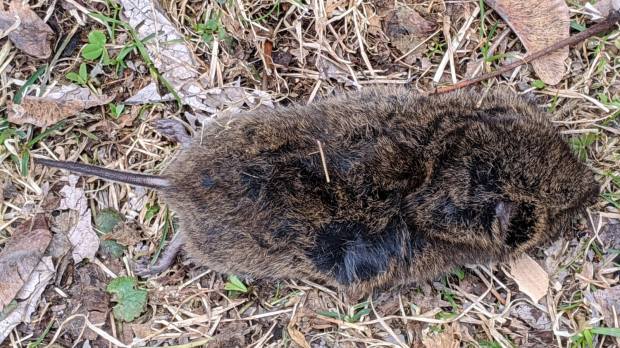
    One of the moles aerating the ground around here ran out of steam beside the garden:

    Mole - dorsal
    Mole – dorsal

    It has wonderfully soft velvety fur!

    Flipping it over:

    Mole - ventral
    Mole – ventral

    A closeup of its digging paws and gnawing teeth:

    Mole - ventral paws - teeth
    Mole – ventral paws – teeth

    Those choppers seem overqualified for a diet of earthworms, but I suppose they know what they’re doing.

    We left it in as-found condition, ready for recycling …

    [Update: The consensus seems to be it’s a vole or shrew, not a mole. It’d be the biggest vole I’ve ever seen and “large shrew” seems oxymoronic, but the teeth are diagnostic. ]

  • Craftsman Hedge Trimmer: Laying on of Hands Repair

    Craftsman Hedge Trimmer: Laying on of Hands Repair

    It being the season for hacking down decorative grasses, our ancient Craftsman Hedge Trimmer woke up dead, a decade after I fixed its switch and predicted it’d be good for another decade.

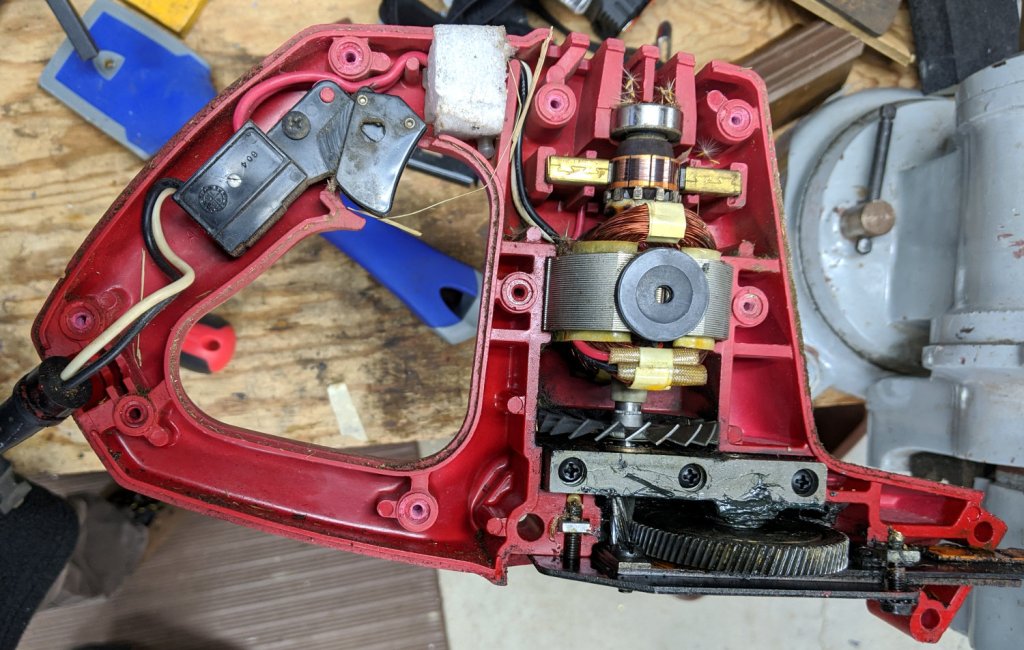
    After verifying the failure isn’t in the wall outlet or the extension cord, haul it to the Basement Laboratory Repair Wing, clamp the blade in the bench vise, remove a myriad screws, and pop the top:

    Craftsman Hedge Trimmer - innards exposed
    Craftsman Hedge Trimmer – innards exposed

    I should have removed the screw in the extreme lower right corner and loosened the similar screw at the rear of the bottom plate; they’re two of the three machine screws engaging nuts embedded in the shell. Everything is greasy enough to let the nuts slide right out of the plastic and no harm was done, but that need not be so.

    After poking around a bit and finding nothing obvious, I checked the resistance across the plug: open-circuit with the switch OFF and nearly shorted with the switch ON.

    Huh.

    Put the case back together with just enough screws to prevent heartache & confusion, unclamp the blade, plug into the bench outlet, discover it works fine again, reinstall the rest of the screws, and continue the mission:

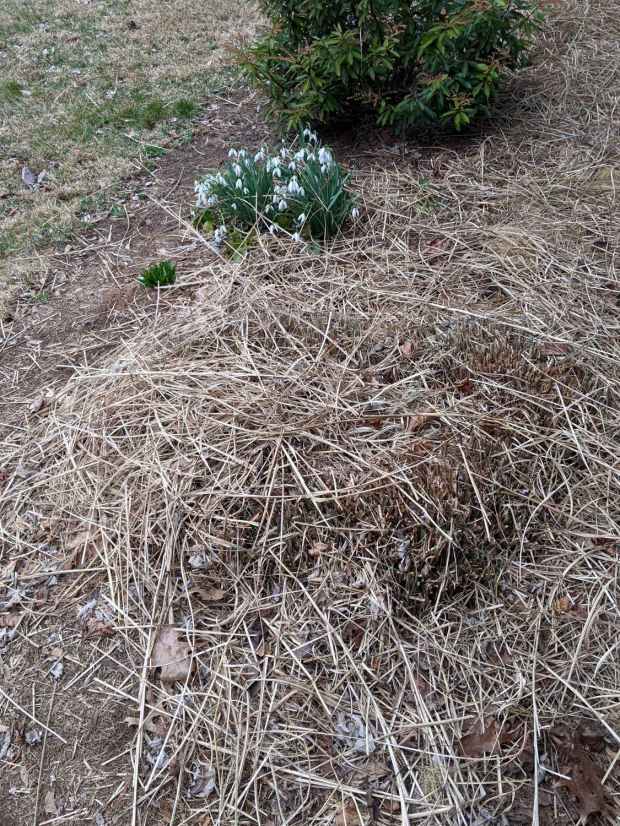
    Decorative grass bunches - early spring clearcut
    Decorative grass bunches – early spring clearcut

    We moved the Praying Mantis oothecae to nearby bushes for science!

  • Batmax NP-BX1 Batteries

    Batmax NP-BX1 Batteries

    Having recently lost one of the year-old DOT-01 batteries, a quartet of Batmax NP-BX1 batteries for the Sony HDR-AS30V helmet camera just arrived:

    Batmax DOT-01 Wasabi NP-BX1 - 2020-04
    Batmax DOT-01 Wasabi NP-BX1 – 2020-04

    The orange curve is the last surviving (“least dead”) Wasabi battery from the 2017-08 batch and the dark green curve just above it is another DOT-01 from 2019-02. The problem is not so much their reduced capacity, but their grossly reduced voltage-under-load that triggers a premature camera shutdown.

    The Batmax batteries measure better than the craptastic Wasabi batteries, worse than the STK batteries, and should survive the next year of riding. As before, I have zero belief that Amazon would send me a “genuine” Sony NP-BX1 battery, even at six times the nominal price, nor that it would perform six times better.

    Batmax is one of many randomly named Amazon Marketplace sellers offering seemingly identical NP-BX1 batteries: Newmowa, Miady, Powerextra, Pickle Power, LP, Enegon, and so forth. Mysteriously, it’s always cheaper to get a handful of batteries and a charger, rather than just the batteries, so I now have a two-socket USB charger:

    Batmax NP-BX1 - USB dual charger
    Batmax NP-BX1 – USB dual charger

    Despite the “5 V 2 A – 10 W” and “4.2 V 0.6 A – 5 W” label on the back, charging a pair of batteries after a ride started at 700 mA from a USB 3.0 port. The charger makes no claims about USB 3 compliance, so I’d expect it to top out around 1 A from a generously specified port.