The Smell of Molten Projects in the Morning

Ed Nisley's Blog: Shop notes, electronics, firmware, machinery, 3D printing, laser cuttery, and curiosities. Contents: 100% human thinking, 0% AI slop.

Category: Recumbent Bicycling

Cruisin’ the streets

  • Bicycle Tube: Complete Failure

    Glass shard in tire
    Glass shard in tire

    On my way back from a ride around the block the back tire went pfft thump thump thump. I’m 1.5 miles from home: fix or walk?

    The first step: always examine the tire to find the puncture, before you move too far. Finding something sticking out of the tire means you’re well on your way to fixing the flat. Lose the entry point and you’re left to blow up the tire and listen for escaping wind. So I picked up the butt end of the bike, spun the wheel, and this little gem heaved into view…

    That area of the road has seen several collisions in recent months that left the shoulder littered with broken automotive glass. The shard in my tire glistened like a diamond, because one side was flat and mirrored; perhaps it’s from a headlamp reflector or side mirror. The pointy end went into the tire, of course…
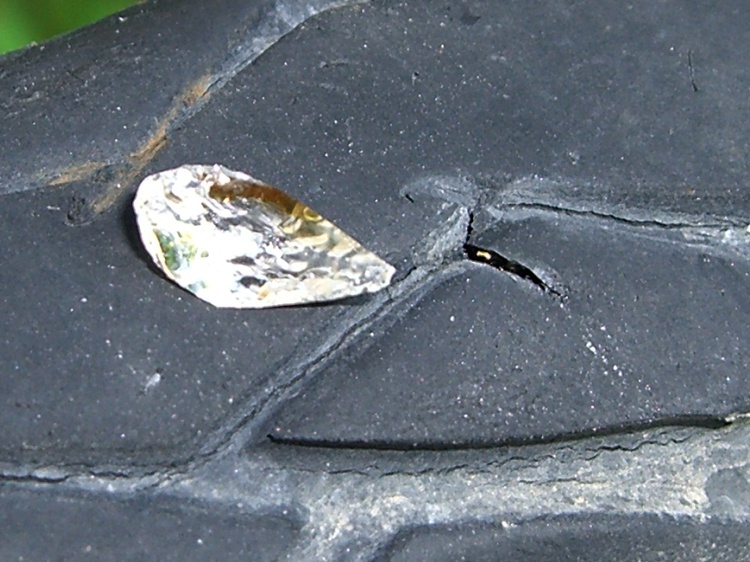
    Glass fragment and puncture
    Glass fragment and puncture

    Well, a single-point failure like that is easy to fix, so:

    • remember that the hole is a few inches spinward of the label
    • shift to small chainring / small sprocket
    • get the tool bag out
    • lay the bike down (it’s a recumbent, this is no big deal)
    • release the rear brake
    • release the skewer and whack the hub out of the dropouts
    • apply tire irons to get the tire off
    • pop the tube out and examine the innards

    No pix of any of that, but suffice it to say I was astonished to discover that the glass penetrated the Marathon tire’s Kevlar belt just barely far enough to poke the Slime tire liner, but not enough to leave more than a hint of a mark on the tube. Definitely not a puncture and certainly nothing that would account for a sudden flat.

    That glass shard is not why the tire went flat! Tire liners FTW!

    Examining the rest of the tube revealed this situation a few inches anti-spinward of the glass fragment.
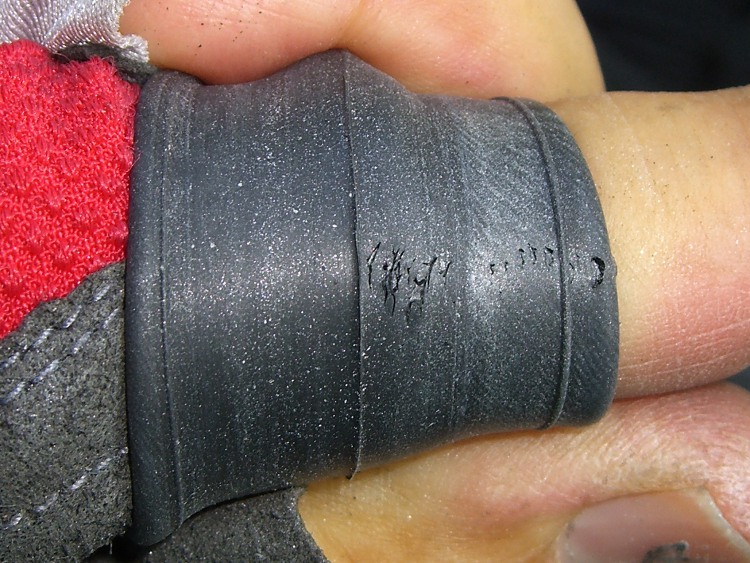
    Failed tube rubber
    Failed tube rubber

    There’s a row of holes across the tube, with no corresponding tire or liner damage at all. As nearly as I can tell, the tube rubber simply pulled apart across that line, all at once, and the air went pfft just like you’d expect.

    That’s not survivable, but I don’t carry a spare tube (well, two spare tubes: 700x35C rear and 20×1.25 front) on rides around the block. Long bike tours? Yup, spare tires & tubes because I’m that type of guy.

    Anyway, I’ve got the tube in hand, so what’s to lose? Scuff it up with the sandpaper and yipes

    Tube after scuffing
    Tube after scuffing

    What’s not obvious in the picture is that all those little spots around the big holes are pinholes. The whole area of the tube must have gotten just barely enough rubber to cover the mold.

    I know as well as you do this isn’t going to have a happy outcome, but I slobber on the cement, let it dry, squash on a big patch, install the tube & tire, fire a 16-gram CO2 cartridge into it, and … it doesn’t seal.

    The tube is several-many years old, probably from whoever was supplying Nashbar at the time, and it served well, so it gets a pass. I’d rather tubes fail in the garage than on the road and sometimes they do, but that’s not the usual outcome.

    My ladies were out gardening at the time and a long wheelbase ‘bent isn’t the sort of thing you can stuff into a friend’s car. Not to mention that my ladies had the magic phone.

    So I walked home.

    Sometimes a man’s gotta do what a man’s gotta do.

    Memo to Self: Schwalbe tube at 8910. Reversed(*) the Marathon’s direction.

    (*)They’re directional, but when they get about halfway worn I don’t see that it makes much difference. The rear tire on my bikes wears asymmetrically: probably too many tools in the left underseat bag.

  • Third Eye Hardshell Mirror Repair

    Alas, the mirror I installed this spring didn’t survive our bicycling vacation; it succumbed to the second of three stuff-all-the-bikes-in-a-truck schleps arranged by the tour organizers. Being that sort of bear, I had a spare mirror, duct-taped it in place, lashed it down with some cable ties, and we completed the mission.

    So.

    Back to the Basement Laboratory Plastic Repair Wing.

    The strut broke just behind the ball at the mirror, which implies the mirror plate got stuffed against something, rather bending the strut. The ball joint still worked, so I maneuvered the stub perpendicular to the mirror.

    Drilling the strut
    Drilling the strut

    Normally I’d try to re-glue the joint as-is to get the best fit, but past experience shows that if it breaks once, it’ll break there again. I wanted to put some reinforcement into the strut, not just depend on a solvent glue joint. Some rummaging in the brass tubing stock produced a 1/16-inch diameter aluminum (!) tube about 18 mm long: just what’s needed.

    So I filed the deformed plastic flat & perpendicular to the stubs, mounted the strut in the 3-jaw chuck on the Sherline’s table, lined the spindle up with the axis, and poked a 1/16-inch hole into the strut. The alignment looks decidedly off in the picture, but it’s actually spot on: what you’re seeing is some swarf clinging to the far edge. Honest!

    Then I grabbed the mirror plate in the 3-jaw, lined up on the stub, and drilled maybe 4 mm down, which was roughly to the middle of the ball. The tubing was a firm push-fit in the hole and I hope it won’t over-stress the plastic into cracking.

    Gluing the mirror strut
    Gluing the mirror strut

    Run the spindle up, remove the drill, grab the strut in the chuck (actually, I had to swap in the larger chuck first), dab some Plastruct solvent glue on both ends, align the strut with the stub (they’re actually square in that section), run the spindle down to ram the tubing into the strut, then a bit more to apply pressure to the joint. I made the total hole depth about 2 mm longer than the tubing, so as to avoid the embarrassment of having the ends not quite meet in the middle.

    No CNC; pure manual Joggy Thing action.

    Let it cure overnight.

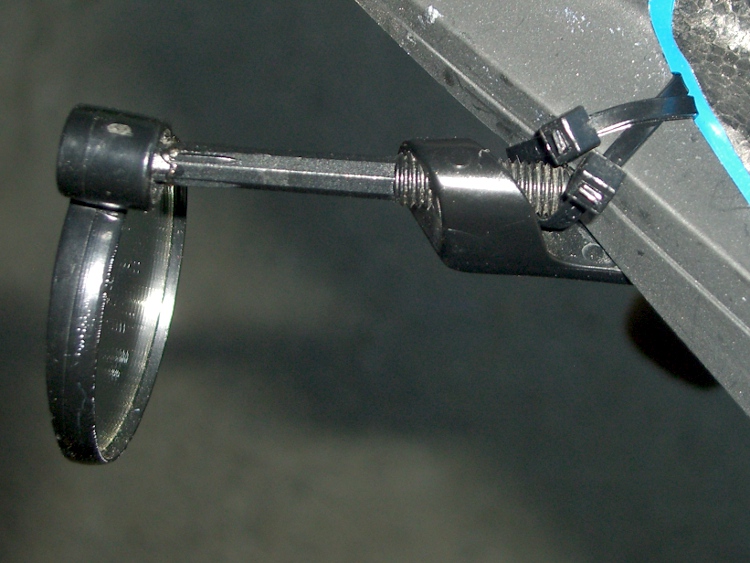
    It’s now back on Mary’s helmet, with a pair of black cable ties ensuring that it won’t pop off, and seems to be working fine. I’m sure the ball joint will fail later this year, although that won’t be due to this repair.

    Mirror on helmet again
    Mirror on helmet again
  • Improved Tour Easy Chain Tensioner

    A discussion on that post reminded me of this old project: replacing the chain pulleys in the midships chain tensioner on my Tour Easy recumbent.

    The problem is that the original pulleys used steel bearings in a plastic race, for reasons that I cannot fathom. They last for a few thousand miles, then get very wobbly and noisy. The solution, as nearly as I can tell, is to replace them with pulleys using cartridge bearings.

    This is what one looks like after four years slung below my bike. Surprisingly, the bearings still feel just fine, even though they’re not really sealed against the weather.

    Tour Easy - Cartridge Bearing Chain Tensioner
    Tour Easy – Cartridge Bearing Chain Tensioner

    Gotcha: the OEM pulleys are not the same OD / number of teeth as pulleys found in rear derailleurs.

    Soooo, after a bit of Quality Shop Time, I had these…

    Tour Easy Replacement Idler Pulley
    Tour Easy Replacement Idler Pulley

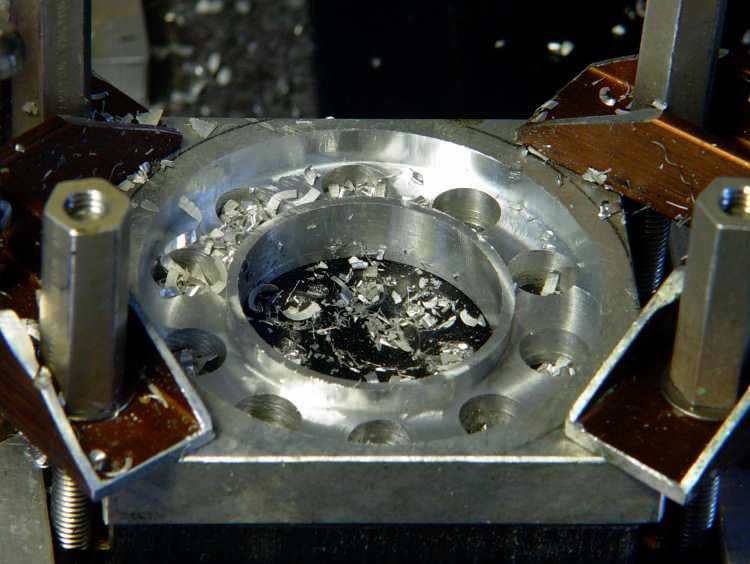
    This is where you really want an additive machining process, as I turned most of a big slab of aluminum into swarf while extracting each pulley.

    The first step is to drill holes around the perimeter where the chain rollers will fit, plus drill out as much of the center bore as possible. Then mill down to the finished thickness across the roller holes and helix-mill the bore to size.

    Side 1
    Side 1

    Flip it over and mill the other side to the proper thickness.

    Run it through the bandsaw to chop off all the material beyond the outer diameter.

    Grab what’s left in the three-jaw chuck and mill around the perimeter to get a nice clean edge.

    Side 2
    Side 2

    And then it Just Works. I made another for Mary’s bike, but she said it was too noisy (which is why they used plastic rather than aluminum) and I swapped it for a Terracycle idler.

    This is from back in the Bad Old Days before EMC2’s version of G-Code supported loops. You don’t need to see that code, trust me on this.

  • Banishing a Mysterious Rear-Wheel Squeak

    So the bike started making a weird whistling squeak. Noises on a bike are never a good sign, but it took me nearly two weeks to banish this one…

    Differential diagnosis:

    • Toward the rear: not pedals, not chainring
    • Only while pedaling: not sprocket cluster bearings
    • Depends on chain speed: not sprocket

    Conclusion: it’s the chain.

    My shop assistant had done a massive chain-cleaning and lubricating exercise when we got back from vacation, so I guessed that a few links (of 250-ish) had escaped proper lube. I gave ’em a dose that didn’t help, so I went Old Skool on the thing.

    Coiled it flat in a saucer, immersed it in denatured alcohol to displace air and water-based cleaner inside the links, then drained the alcohol. Poured a generous layer of light machine oil over the whole affair, let it sit for a day. Drained for a pair of rainy days by hanging from a floor joist in the basement. Used up a bunch of rags while wiping the thing down (I have an oily-waste can, they’re not sitting in a wastebasket).

    Misrouted chain in rear derailleur
    Misrouted chain in rear derailleur

    Put it back on the bike, only to discover the chain was now vibrating something awful. Checked the rear end and found that I’d managed to route the chain through the rear derailleur along almost the right path…

    Fixed that and the squeak was still there. OK, it’s not the chain.

    The only remaining possibility: derailleur jockey pulleys.

    Took ’em off without dismounting the derailleur and, lo and behold, the steel-on-plastic bearing surfaces were bone dry and a bit dusty. They’re supposed to be self-lubricating, which is probably true for the first few thousand miles, but I cleaned ’em out and added a dab of grease.

    Problem solved… for a while, at least.

    The only downside is that the chain will be flinging oil for the next month, no matter how often I wipe it down. There’s a good reason I stopped using light machine oil on chains!

  • Stopping Bike Helmet Strap Creepage

    My bike helmet sports a mirror, microphone boom, and earbud, so I generally hang it from the top of the seat on my Tour Easy. There’s a convenient peg seemingly made for capturing the triangle of strap that normally goes over my ear and, up to the point where I set up this helmet, everything was good.

    Helmet hanging on Tour Easy seat
    Helmet hanging on Tour Easy seat

    After about a week, I noticed that the buckle was grossly off-center under my chin: the straps had shifted to one side.

    Come to find out that the front strap on this helmet passes through an opening across the central member, below the plastic covering. Judging from the teardown of an older helmet, Bell used double-stick tape to hold the strap in place. Applying a constant force in one direction (I’m a creature of habit, the helmet always hangs from its right-side triangle) gently pulls the strap through the passage.

    Front strap passing through helmet
    Front strap passing through helmet

    So I cut two slabs of closed-cell foam and jammed them into the opening atop the strap, one from each side, with a screwdriver. That forced the strap against the adhesive and mechanically wedged it in place.

    Problem solved!

  • APRS SmartBeaconing Parameters for Bicycling

    Setting relatively prime beacon times for the GPS-to-APRS trackers on our three bikes worked quite well, but I wondered how much better SmartBeaconing would be. The trick is getting the numbers right for typical bicycling speeds.

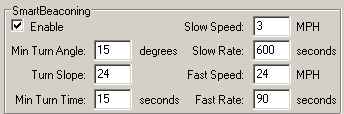
    Here’s some settings (from the TinyTrack3+ config program display) that seem to work reasonably well…

    SmartBeaconing Parameters
    SmartBeaconing Parameters

    The general idea is to beacon every 10 minutes at rest and about three / mile in motion.

    The only time I hit 3 MPH is up a really nasty hill, the likes of which I avoid with all due diligence. On the other end, 24 MPH is pretty much as fast as I can go for any length of time; faster, certainly, on downhills, but those are rare & precious commodities on most rides around here. The Slow and Fast parameters control both ends of that range. The beacon rate increases linearly below the Fast speed: 180 seconds at 12 MPH, which is roughly what I used for the constant-time setting.

    Note that the Rate parameters are actually periods. Rate is thing/time, period is time/thing. The period varies as 1/speed, while the rate varies directly with speed. See the SmartBeaconing writeup or the TinyTrak3+ doc for the algorithm.

    The Turn Slope parameter is the most confusing. It has units of degrees/MPH degree·MPH and serves to modify the Min Turn Angle so that you must turn more sharply at lower speeds to generate a beacon. This works better for vehicles with a wider dynamic range: our bikes tend to stay within 5-20 mph and a factor-of-four doesn’t affect the basic angle very much at all.

    My track through a residential area shows pretty good “Corner Pegging” for those settings and, in any event, it’s much better than the simple every-three-minutes beaconing I’d been using before. On the other hand, this is in a low-RF-traffic area with a digipeater about a mile away across the Northway, so very few packets get clobbered.

    APRS Track with SmartBeaconing
    APRS Track with SmartBeaconing

    Perhaps setting Turn Slope to 240 degrees/MPH degree·MPH with a Fast Speed of 24 MPH and a Turn Angle of 10 degrees would be slightly better. At top speed the minimum turn angle would be 10 + 240/24 = 20 degrees and nose-pickin’ speed relaxes the angle to 10 + 240/6 = 50 degrees. On the other hand, that track looks pretty good as-is!

    One problem with three bikes in close proximity (the track above is just me) is that we’ll all be turning at about the same time and, thus, sending beacons almost simultaneously. This will take a while to sort out, given that many beacons never make it to a receiver…

    [Update: A correction shows why the units aren’t what I expected.]

  • Getting More Clearance While Bicycling

    Some cyclists complain that motorists don’t give them enough room while passing. That’s less of a problem for recumbent bikes, but this gets me a lot more clearance:

    Bike trailer with propane tank
    Bike trailer with propane tank

    There’s one section of very nice and totally gratuitous 6-lane highway (NY Route 55 near the NYS DOT Region 8 HQ; I think they’re just showing off) where drivers normally edge over to the left side of the right-hand lane where I’m riding. With a 20-lb propane tank lashed to my bike trailer, most folks have no trouble whatsoever with a double lane change into the far left lane…