Ed Nisley's Blog: Shop notes, electronics, firmware, machinery, 3D printing, laser cuttery, and curiosities. Contents: 100% human thinking, 0% AI slop.
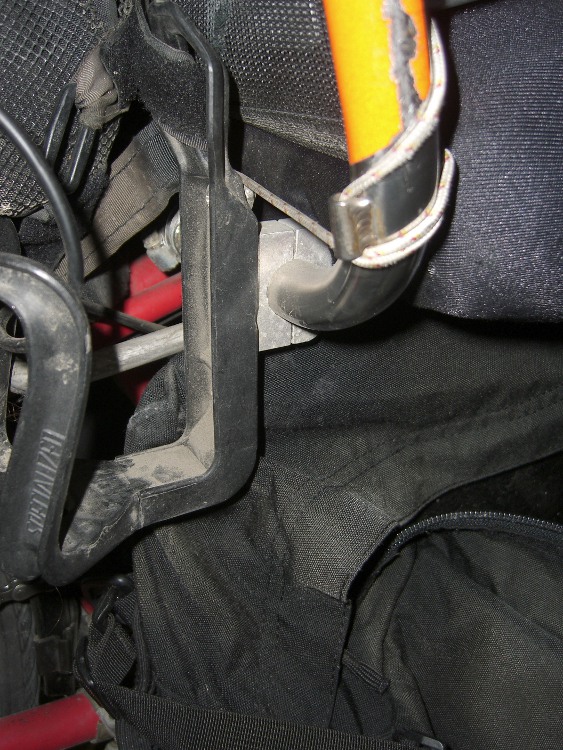
My bike helmet sports a mirror, microphone boom, and earbud, so I generally hang it from the top of the seat on my Tour Easy. There’s a convenient peg seemingly made for capturing the triangle of strap that normally goes over my ear and, up to the point where I set up this helmet, everything was good.
Helmet hanging on Tour Easy seat
After about a week, I noticed that the buckle was grossly off-center under my chin: the straps had shifted to one side.
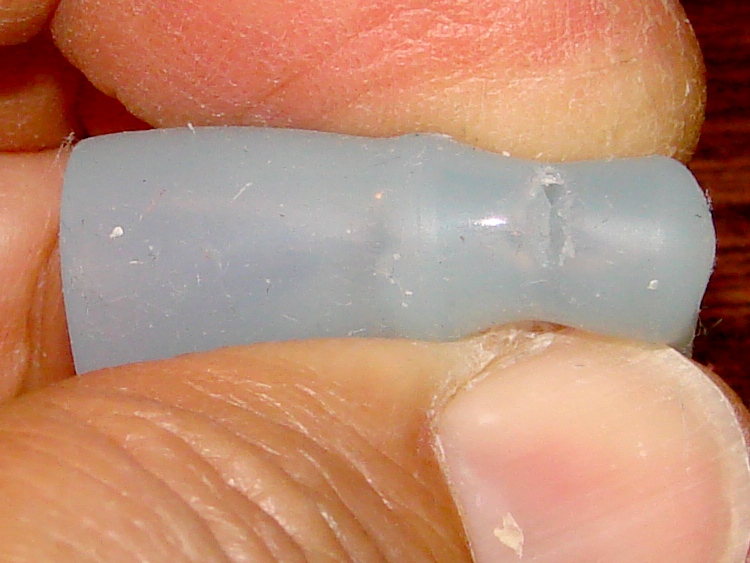
Come to find out that the front strap on this helmet passes through an opening across the central member, below the plastic covering. Judging from the teardown of an older helmet, Bell used double-stick tape to hold the strap in place. Applying a constant force in one direction (I’m a creature of habit, the helmet always hangs from its right-side triangle) gently pulls the strap through the passage.
Front strap passing through helmet
So I cut two slabs of closed-cell foam and jammed them into the opening atop the strap, one from each side, with a screwdriver. That forced the strap against the adhesive and mechanically wedged it in place.
Setting relatively prime beacon times for the GPS-to-APRS trackers on our three bikes worked quite well, but I wondered how much better SmartBeaconing would be. The trick is getting the numbers right for typical bicycling speeds.
Here’s some settings (from the TinyTrack3+ config program display) that seem to work reasonably well…
SmartBeaconing Parameters
The general idea is to beacon every 10 minutes at rest and about three / mile in motion.
The only time I hit 3 MPH is up a really nasty hill, the likes of which I avoid with all due diligence. On the other end, 24 MPH is pretty much as fast as I can go for any length of time; faster, certainly, on downhills, but those are rare & precious commodities on most rides around here. The Slow and Fast parameters control both ends of that range. The beacon rate increases linearly below the Fast speed: 180 seconds at 12 MPH, which is roughly what I used for the constant-time setting.
Note that the Rate parameters are actually periods. Rate is thing/time, period is time/thing. The period varies as 1/speed, while the rate varies directly with speed. See the SmartBeaconing writeup or the TinyTrak3+ doc for the algorithm.
The Turn Slope parameter is the most confusing. It has units of degrees/MPH degree·MPH and serves to modify the Min Turn Angle so that you must turn more sharply at lower speeds to generate a beacon. This works better for vehicles with a wider dynamic range: our bikes tend to stay within 5-20 mph and a factor-of-four doesn’t affect the basic angle very much at all.
My track through a residential area shows pretty good “Corner Pegging” for those settings and, in any event, it’s much better than the simple every-three-minutes beaconing I’d been using before. On the other hand, this is in a low-RF-traffic area with a digipeater about a mile away across the Northway, so very few packets get clobbered.
APRS Track with SmartBeaconing
Perhaps setting Turn Slope to 240 degrees/MPH degree·MPH with a Fast Speed of 24 MPH and a Turn Angle of 10 degrees would be slightly better. At top speed the minimum turn angle would be 10 + 240/24 = 20 degrees and nose-pickin’ speed relaxes the angle to 10 + 240/6 = 50 degrees. On the other hand, that track looks pretty good as-is!
One problem with three bikes in close proximity (the track above is just me) is that we’ll all be turning at about the same time and, thus, sending beacons almost simultaneously. This will take a while to sort out, given that many beacons never make it to a receiver…
[Update:A correction shows why the units aren’t what I expected.]
Some cyclists complain that motorists don’t give them enough room while passing. That’s less of a problem for recumbent bikes, but this gets me a lot more clearance:
Bike trailer with propane tank
There’s one section of very nice and totally gratuitous 6-lane highway (NY Route 55 near the NYS DOT Region 8 HQ; I think they’re just showing off) where drivers normally edge over to the left side of the right-hand lane where I’m riding. With a 20-lb propane tank lashed to my bike trailer, most folks have no trouble whatsoever with a double lane change into the far left lane…
I ran into an amusing situation on a recent family bike ride with our GPS-to-APRS trackers running: my ladies were transmitting a few seconds apart. As a result, I had to listen to a pair of very short data bursts in quick succession throughout the whole ride.
Under normal circumstances that doesn’t happen, because I set the TinyTrak3+ trackers to delay during and wait a second after a voice PTT that collides with an automatic beacon. Somehow they never managed to delay an APRS beacon to knock the synchronization off kilter.
So I tweaked the automatic transmission intervals to make us relatively prime: 179, 181, and 191 seconds. That’s close enough to the original 180 seconds as to make no difference, while now ensuring that we won’t collide with each other for very long even if we should get aligned.
An alternative is SmartBeaconing, which I’ll turn on in a while after I collect a bit more data.
If you have some spare CPU and power, you can join the Great Internet Mersenne Prime Search and help find new primes, albeit ones much larger than I need…
The rear wheel of my bike popped a spoke while I was riding along a section of unimproved trail trail. Actually, it’d be more accurate to say “as-abandoned” railway line; they ripped out the ties and graded the baby-head ballast more-or-less level. It wasn’t really suitable for a long-wheelbase recumbent bike, but I really hate white-water rafting, which was the other choice.
Anyhow.
Of course, the broken spoke was on the sprocket side of the rear wheel. I discovered this when we were out of the most rugged section, so I have no idea how long I’d actually been abusing the wheel.
I released the rear brake, gingerly rode to the campsite, then installed the FiberFix emergency spoke I’ve been carrying around for a few years. After snugging the cord and tightening the nipple, I added a turn to each of the two adjacent spokes, making the wheel true enough to continue the mission.
FiberFix spoke in action
The other end simply passes through the spoke hole in the hub. It doesn’t mind the deformation pressed into the hub.
Hub end of FIberFix spoke
Much easier than removing the sprocket cassette under field conditions, that’s for sure!
Back home in the shop, I installed a new spoke, tightened it up to match the others, backed out the extra turn in the adjacent spokes, and the wheel trued right up.
I originally built the wheel using a Park Spoke Tension Meter, which is a wonderful tool. If you build wheels, even occasionally, you really, really need one. Lace ’em up, tighten uniformly, then tweak just a little bit for a perfectly true wheel.
And, yeah, Phil hubs on all three bikes. I hate adjusting bearings. The man is gone; may his legacy live forever.
Mary’s feet are exquisitely sensitive to irregularities in the insoles of her shoes, which poses a real problem with her bike shoes: those SPD cleat recesses are no good at all.
This is a view down into one shoe, with the SPD cleats adjusted all the way to the rear. That leaves a large recess in the front, which was painfully obvious to her sole. The white shape is the gap filler…
I pressed a sheet of paper across the gap to get the general shape, traced it twice onto a slab of 0.060-inch aluminum with a nice pebbly paint job, and cut the two pieces out. A few conversations with Mr Belt Sander, a few licks with a rat-tail file, and they dropped right onto place. The recess is slightly curved, but I didn’t have to bend the pieces to fit.
I laid duct tape across the whole affair, put the insoles back in place, and it was all good.
The backing plate is 0.072 inch thick and she was content with the difference.
In previous shoes, with the cleat near the middle of the adjustment range, I’ve stuffed epoxy putty into the gaps. That works, but it doesn’t bond to the (miracle engineering plastic) soles and tends to crumble. This is Not A Good Thing…
We spent the night aboard BB62 in Camden NJ, with our bikes lashed to a post on the dock. Follow the light-color brick track from the upper-left GPS point across the dock to the black dot marking a memorial stone: we tied up just to the left of that spot.
Position Jitter – ZNU at NJ2BB-15
NJ2BB-15 is the APRS digipeater aboard BB62 with an antenna high in the superstructure. While I didn’t have any trouble with RF reception, packet collisions pose a problem in a dense urban environment. For what it’s worth, essentially everything in the superstructure is an antenna; the NJ2BB ham shack is a wonder to behold.
BB62 starboard side
The point-to-point jitter is about 20 meters (18.52, says the GPS info dump), so you’re looking at the un-augmented GPS accuracy of a long-term stationary object. I’m sure there’s a slight registration mismatch between the satellite imagery coordinates and the GPS coordinates, enough to put the upper-left point across the dock.
If you get the chance, take the tour. The guides are retired Navy, some served aboard BB62, and they take their storytelling duties very seriously. The bunk space, even with air conditioning, is claustrophobic at best; a tip of the bike helmet to you folks who live in these machines!
[Update: Our daughter discovered three itchy bites in a line across her tummy the morning after spending a night in the bunks. That means BB62 has bedbugs, which you do not want to bring home in your luggage. As a result, I cannot recommend an overnight on BB62, alas. We wish she’d mentioned that before we got home…]
[Further update: when I reported this to the folks at BB62, they had an exterminator check out the berthing spaces and conclude they have no bedbugs on board. That’s encouraging, but I still heartily recommend that you follow the same decontamination procedures that you should use after all trips.]
It turned out one rider in our group was an active-duty Rear Admiral who, evidently, could (or should) have supervised the signal gun firing after Colors and Taps. She was traveling incognito, though, and didn’t stand on ceremony.