Ed Nisley's Blog: Shop notes, electronics, firmware, machinery, 3D printing, laser cuttery, and curiosities. Contents: 100% human thinking, 0% AI slop.
Spring Road, the only route between Vassar Road and the Galleria / South Hills malls, had fallen into poor repair over the last few years, to the point where we rode to the end of Vassar Rd, crossed all seven lanes of Rt 9, low-geared up the southern access road to South Hills, then traversed the two-lane ring road. We had high hopes for the recently completed reconstruction project that closed Spring Rd for several weeks.
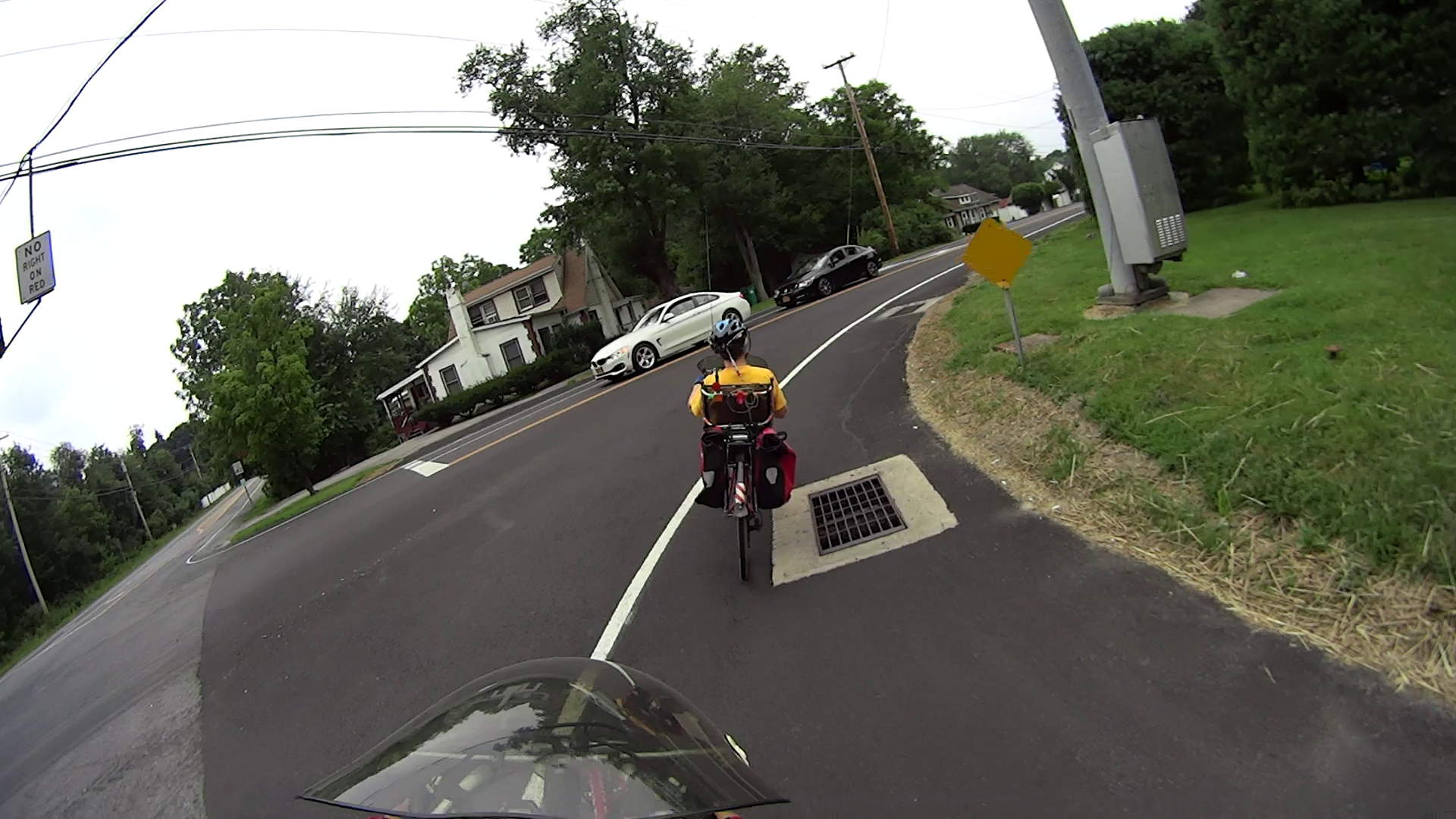
Although the paving is much better and the reconstruction removed a blind curve over a hill, the “rideable” shoulder now spans every single drain grate along both sides of the road. You encounter the first pair at speed in the turn from southbound Vassar Rd onto Spring Rd:
Spring Rd 2015-07-30 – Westbound at Vassar
Don’t cross either grate at full speed or you’ll flip over the high side into traffic.
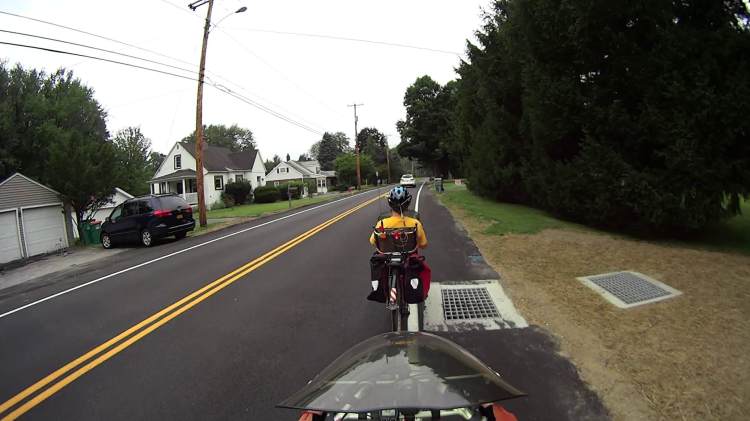
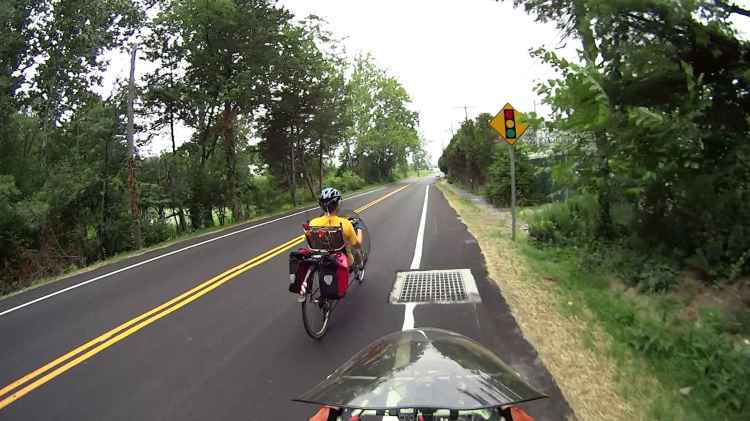
A gallery of some of the other fine grates on offer along Spring Road:
Spring Rd 2015-07-30 – WB – grate 1
Spring Rd 2015-07-30 – WB – grate 2
Spring Rd 2015-07-30 – WB – grate 3
Spring Rd 2015-07-30 – EB – grate 1
They’re not nearly as smooth-and-level-at-grade as you might expect from the pictures; some are recessed two inches into the pavement. I rode over some that looked passable and they’re definitely not the sort of obstacle you want to cross without thinking. Forsooth: steel bars and bike tires do not a stable encounter have.
I’m also certain, based on past experience, that motorists won’t understand why we’re (still) riding in the lane, rather than using the new, most-wonderful shoulder.
Like, for example, when Mary elected to jounce over a grate and I rode the fog line along the abrupt slope down to the concrete box:
Spring Rd 2015-08-01 – EB – grate front view
The rear view shows why bicycle-friendly design matters:
Spring Rd 2015-08-01 – EB – grate rear view
FWIW, I generally ride slightly to Mary’s left, because I figure that way they’ll almost certainly miss her.
Oh, well. The new Spring Road is about as good as road design and paving gets around here…
This marks the end of my infatuation with tire liners:
Schwalbe 20 inch tube – tire liner damage
There seems to be no way to eliminate tube erosion at the end of the liner. I’ve tried tapering the thickness, taping the joint, and so forth and so on.
Fortunately, the tire went flat in the garage and I did a quick swap before our morning ride.
Searching for tire liner will reveal the rest of the stories, both good and bad.
My Sony HDR-AS30V is an action camera, but requires an external case / frame to mount it on anything. Here’s the camera inside its AKA-SF1 Skeleton Frame atop my helmet:
Sony HDR-AS30V camera on bike helmet – inverted
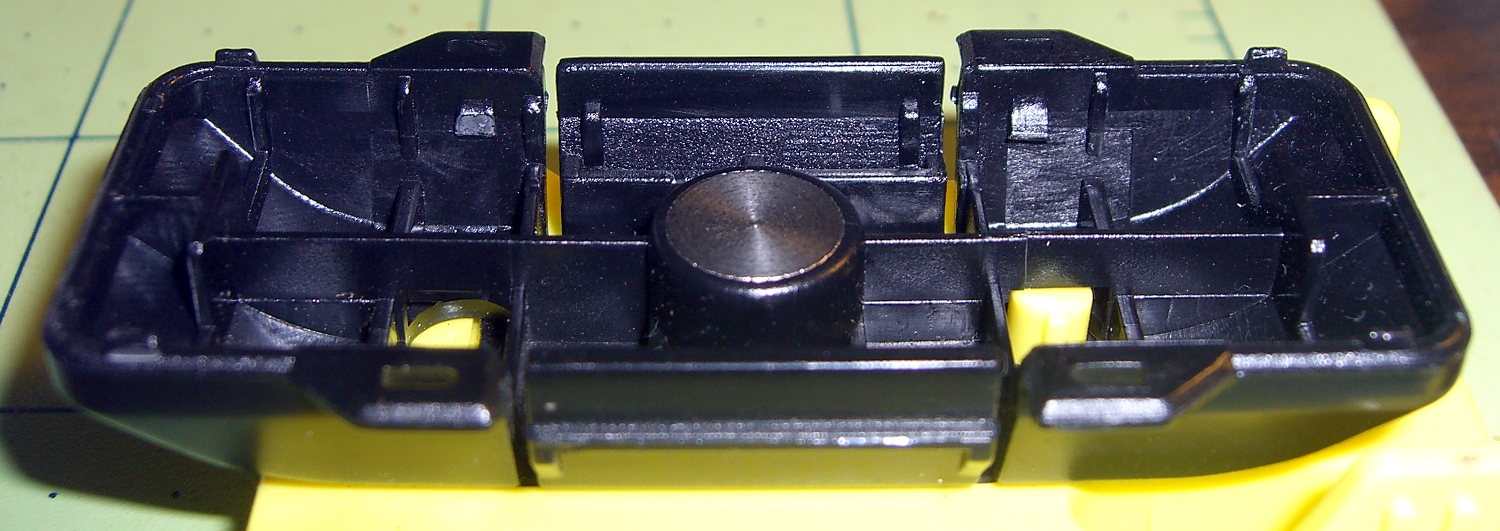
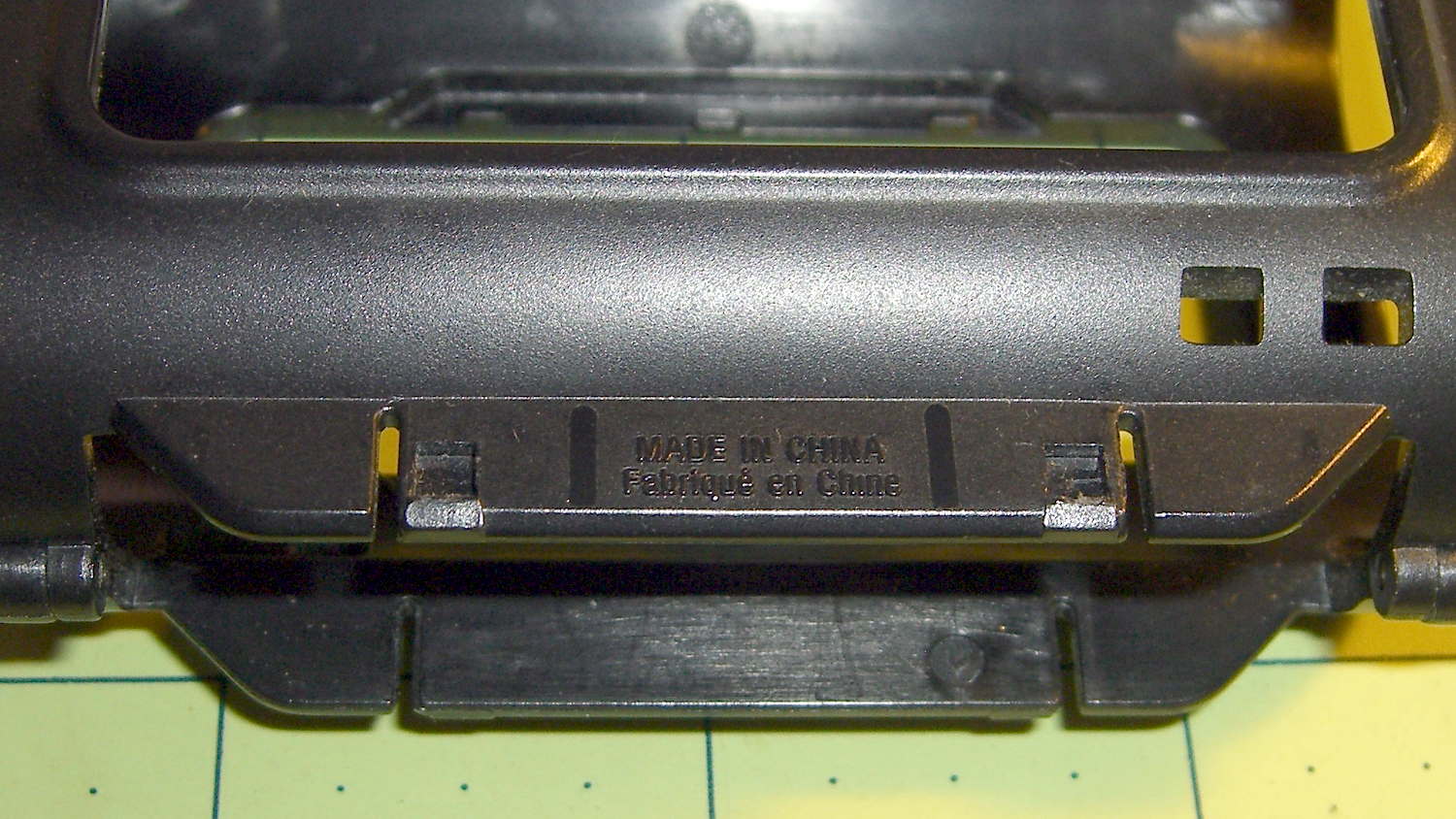
Four 1 mm tall ramps on the inside of the black base (the part just above the yellow sled) snap into 2.6 mm square sockets in the skeleton frame surrounding the camera. For an unknown reason(s) that surely involves applying forces I don’t remember, an opposing pair of those ramps broke off, leaving the other pair to loosely hold one end of the camera in place.
In this picture, the left ramps (one visible) are missing, leaving a square-ish gray scar that’s nearly indistinguishable from the reflection on the intact ramp on the right:
Sony HDR-AS30V Skeleton Mount – broken latch ramps
Surprisingly, the round head of a brass 0-80 machine screw fits neatly inside the square socket on the frame; they’re a bit more than 1 mm deep. The approach ramps visible below the sockets guide the latches on the base:
Sony HDR-AS30V Skeleton Mount – frame sockets
So I figured I could just shave off the remaining two latch ramps, drill four holes at the proper spots, and replace the plastic ramps with metal screws.
I clamped the skeleton frame to the Sherline’s tooling plate, aligned it parallel to the X axis, put the laser spot dead center in the square socket, then snapped the base onto the frame. The laser spot shows where the drill will hit:
Sony HDR-AS30V Skeleton Mount – laser hole alignment
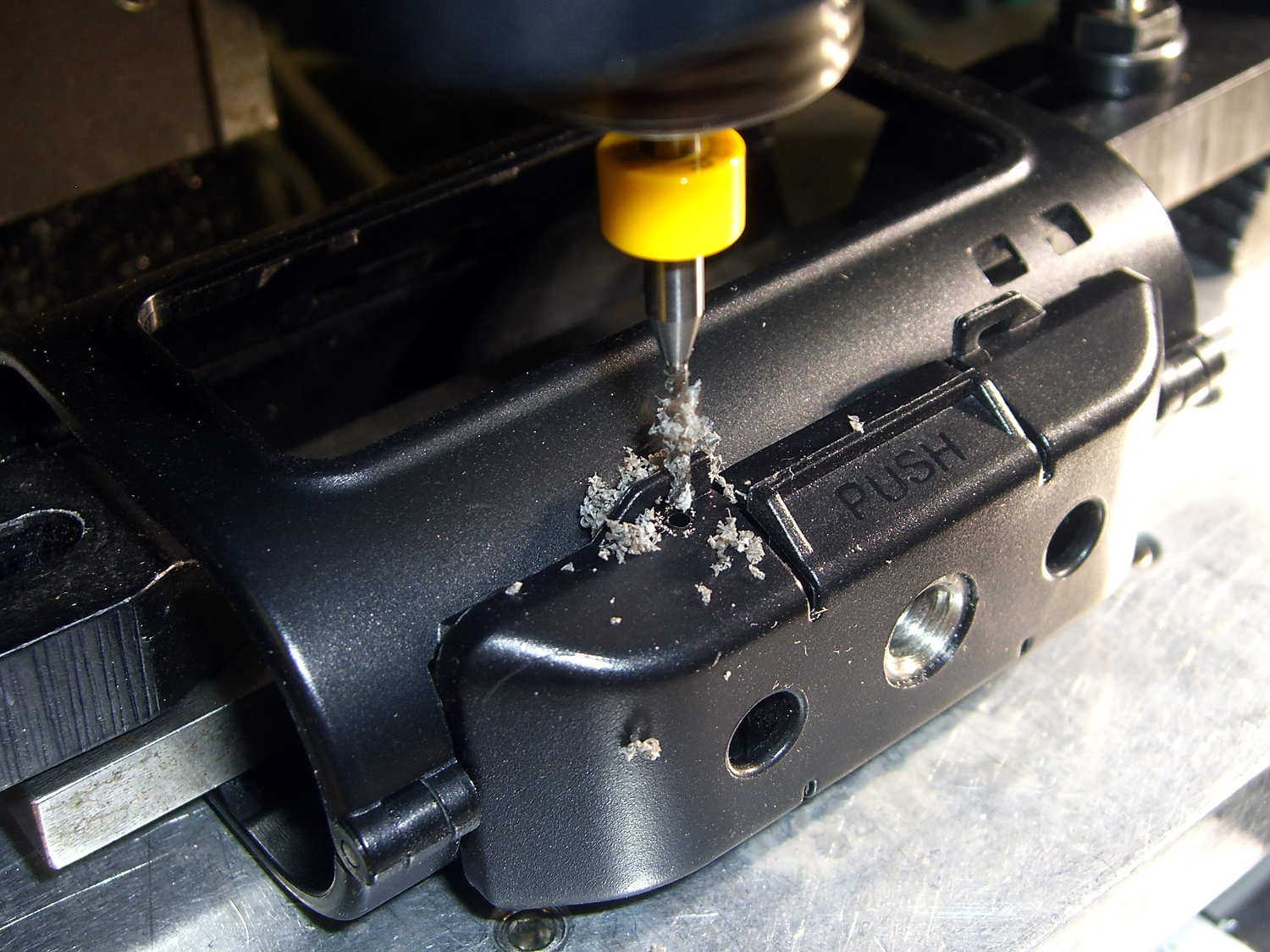
A carbide drill did the honors:
Sony HDR-AS30V Skeleton Mount – 0-80 hole drilling
That’s a #55 = 0.0520 hole for 50% thread, rather than the proper 3/64 = 0.0469 hole for 75% thread, because that’s the closest short carbide drill I had; an ordinary steel twist drill, even in the screw-machine length I use on the Sherline, would probably scamper away. The hole isn’t quite on the sloped bottom edge of the base, but it’s pretty close.
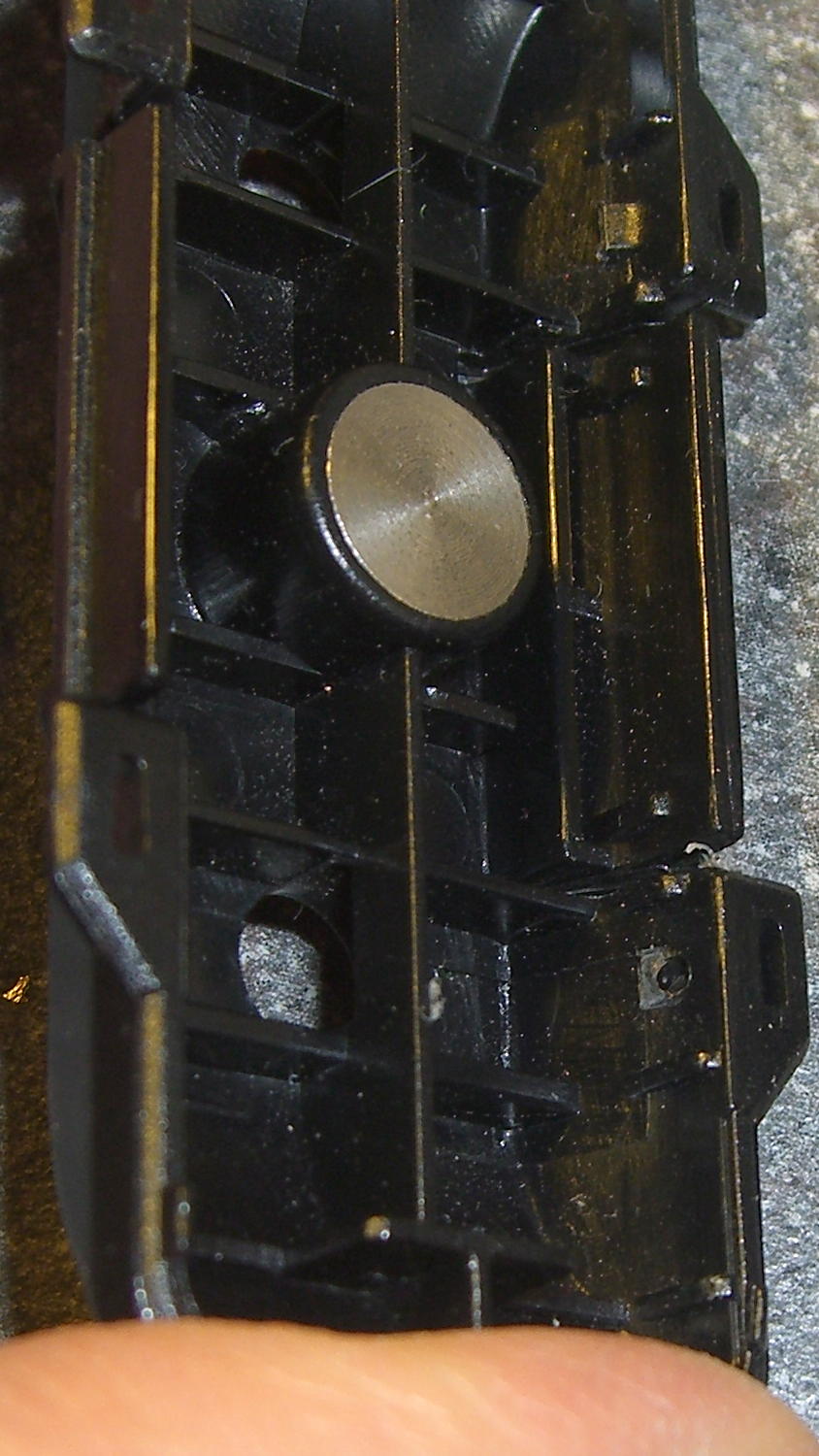
The first hole didn’t emerge quite in the center of its ramp scar:
Sony HDR-AS30V Skeleton Mount – hole position – interior
Which made sense after I thought about it: the ramp tapers to nothing in the direction of the offset, so the hole actually was in the middle of the matching socket.
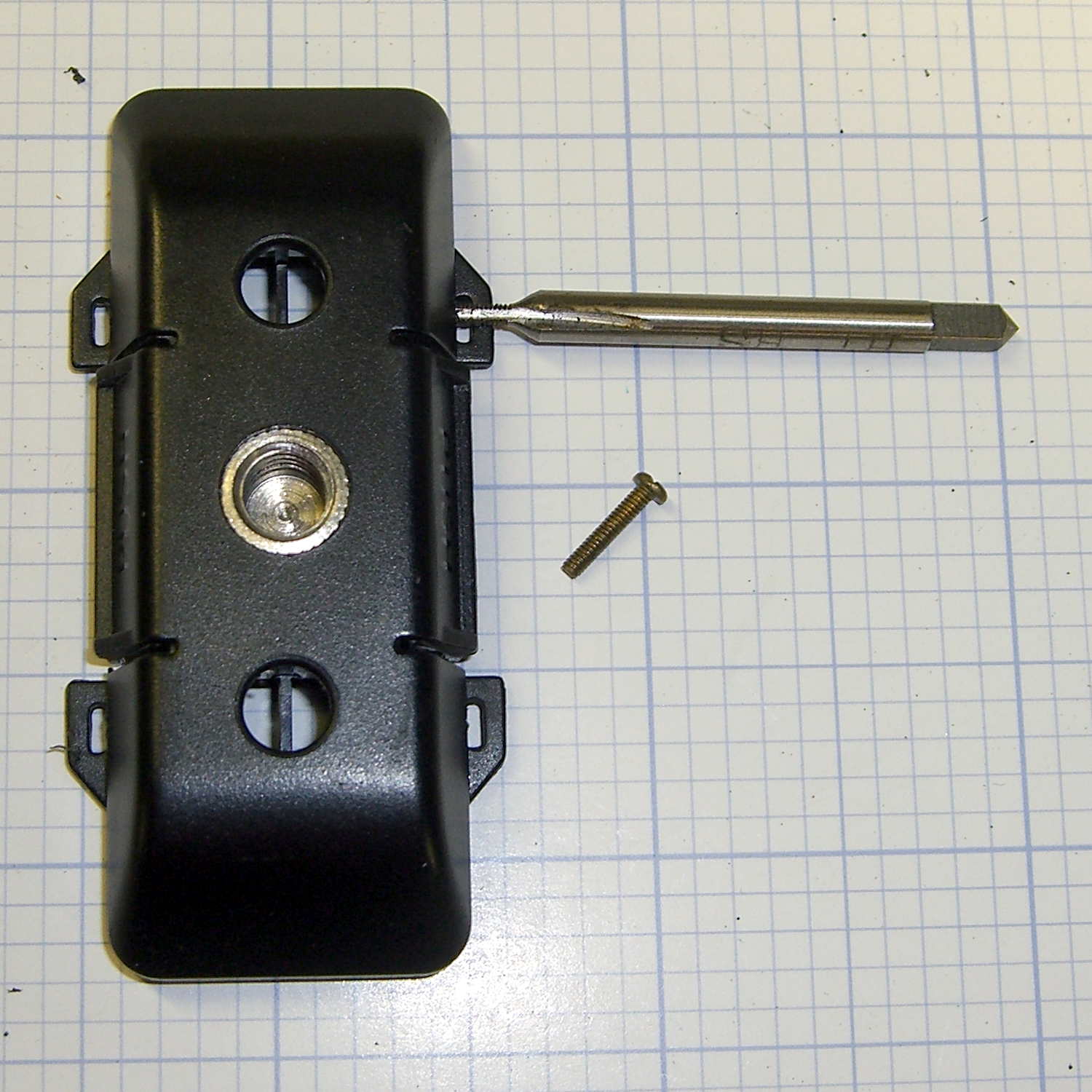
Threading the holes required nothing more than finger-spinning an 0-80 tap:
Sony HDR-AS30V Skeleton Mount – tapping 0-80
The feeble thread engagement didn’t matter, because those mysterious tabs-with-slots (possibly for tie-down strings?) just above the holes were a perfect fit for 0-80 brass nuts:
Sony HDR-AS30V Skeleton Mount – reassembled
The screw heads extend into the sockets, hold the frame solidly in the base, and make it impossible to pull out. Although the frame still slides / snaps into the base, that seems like it will wear out the sockets in fairly short order, so I’ll unlatch the frame (with the yellow slide latch on top), open it up, ease it into position, and then latch it in place. That was the only way to remove it from the original latches, so it’s not a big deal.
I should add a drop of epoxy to each of those nuts and perhaps fill the screw slots with epoxy to keep them from abrading the plastic inside the sockets. Maybe a dab of epoxy on the heads, followed by latching the frame in place, would form four square pegs to exactly fill the sockets.
This was a straightforward repair that should not have been necessary…
The elevation tension adjustment on both our bike helmet mirror mounts have become a bit sloppy. That’s no surprise, because I expected the tiny set screw in the tiny square hole near the top to eventually wear a depression in the ABS plastic arc upon which it bears:
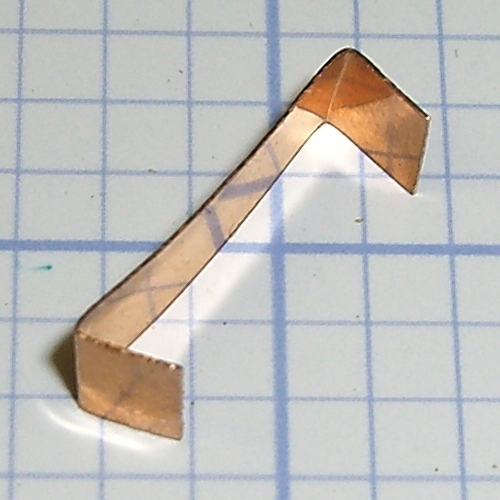
So I got to do something I planned pretty much from the beginning of the project: cut a snippet of phosphor bronze spring stock to go between the Elevation mount and the arc, then bend the ends bent inward so they don’t slash an errant fingertip:
Helmet mirror mount – elevation slide
Slipped in place, the ends look like they stick out anyway, but they’re really just about flush:
Helmet mirror mount – El slide in place
Tightening the set screw pushes the strip against the arc, where it provides enough resistance to prevent slipping and enough smoothness for easy adjustment.
While I had the mounts up on the repair stand, I unscrewed the mirror shaft and snugged up the Azimuth pivot screw by a micro-smidgen to tighten that motion.
Four years ago, those ABS parts popped off the much-hacked Thing-O-Matic’s platform. The M2 produces somewhat better-looking results, but that yellow plastic has a certain charm…
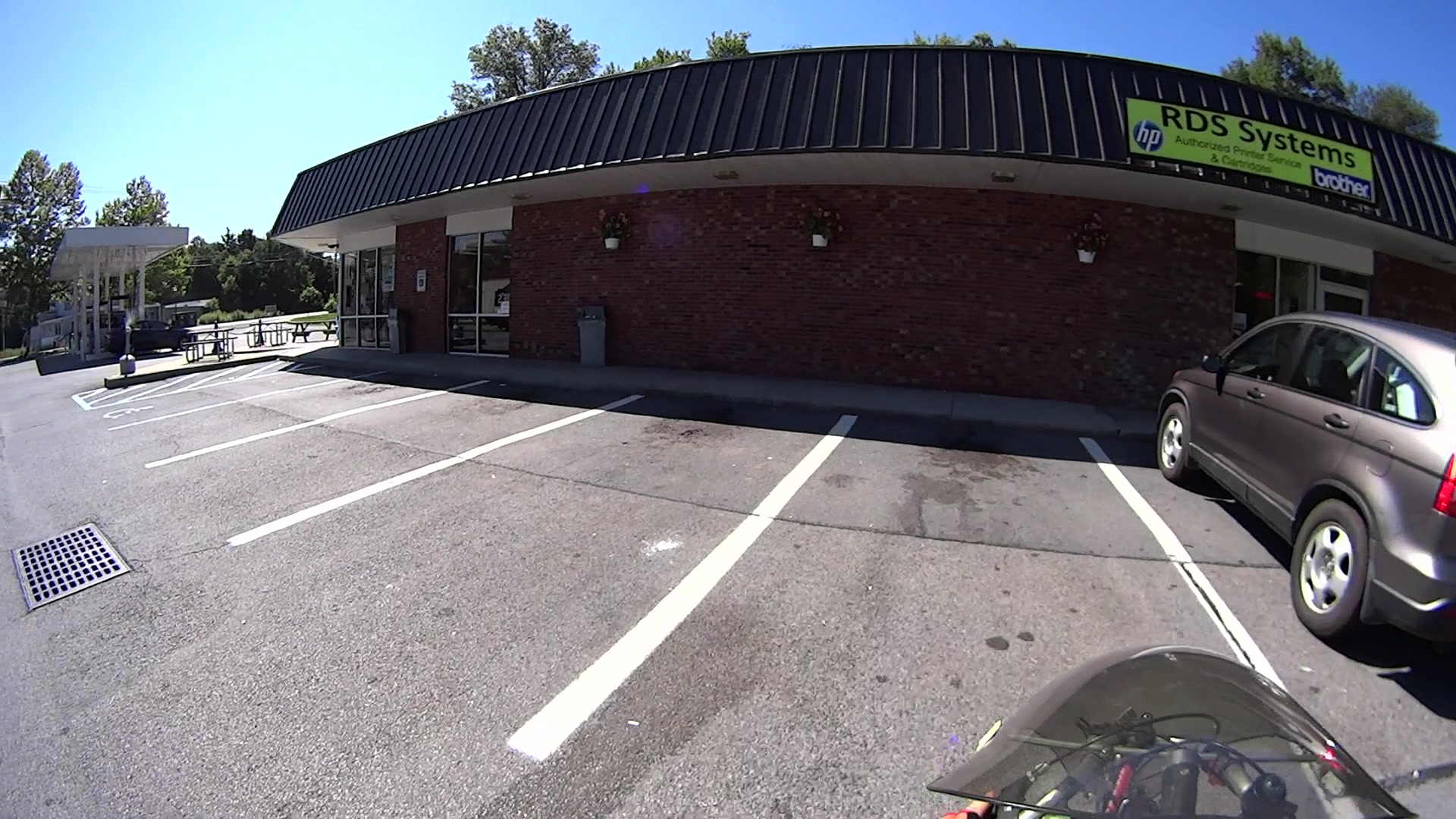
As I rolled into the Stewart’s Shop on a milk-and-eggs run, a plume of smoke spiraled out of the cigarette butt station near the door, way off on the left side:
Smoldering Cigarette Dump
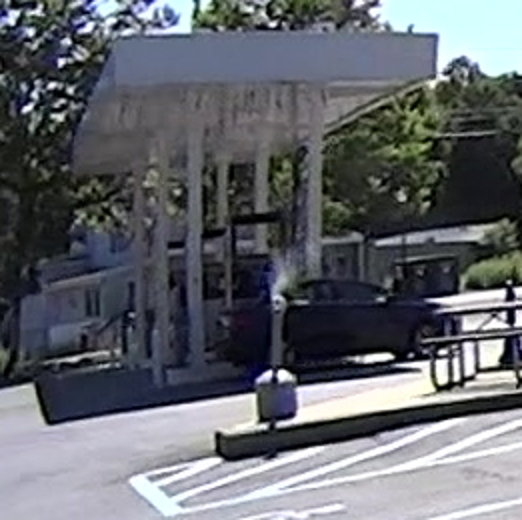
A closer look:
Smoldering Cigarette Dump – Detail
By the time I unhitched myself from the bike and reached the door, two smoke jets squirted from the top and a pall of breathtakingly foul smoke filled the parking lot. I mooched a big cup of water from the folks behind the counter and pulled off the container’s lid, which let in enough oxygen to ignite a full-up fire in the heap of cigarette packs, plastic wrappers, butts, lottery tickets, receipts, and other combustible junk atop the sand bucket in the base of the butt dump. Sprinkling the water over the blaze knocked it back; I replaced the lid and declared victory.
I always take a shower after returning home from a ride, but, this time, we also ran all my bike clothing through the washer right away.
Phew…
Verily, it is written: Kissing a smoker is like licking an ashtray.
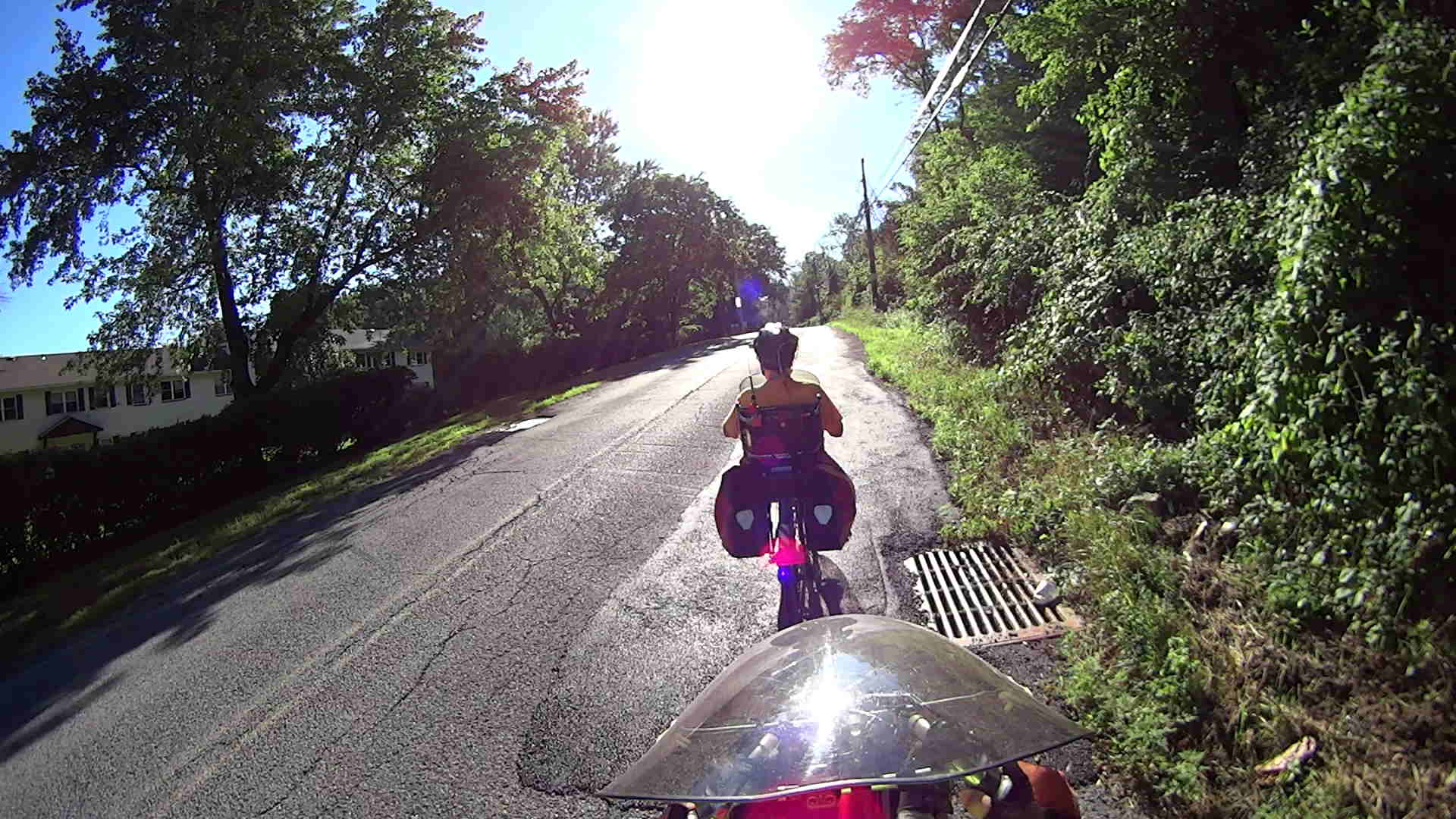
Commercial truck drivers generally know what they’re doing, what their vehicle can do, and drive both responsibly and carefully. This driver waited patiently until an oncoming car passed beside us, then eased around us as we pedaled slowly up the hill from Rt 376 on Maloney Rd:
Maloney Rd 2015-07-24 – Truck 1
As usual, we were as far to the right as we could get:
Maloney Rd 2015-07-24 – Truck 2
Those parallel bar drain grates along the side of the road just add a bit more tension when the timing doesn’t work out this nicely:
Maloney Rd 2015-07-24 – Truck 3
Other than that, it was a fine day for a ride.
Shortly after sending these pictures to the Town of Wappingers, this happened:
Maloney Rd 2015-08-02 – Patched
A series of long, smooth patches over the worst parts of the uphill grade definitely improved the situation. With a fair wind and some money, they’ll repave the entire section from Rt 376 to well beyond the Dutchess Rail Trail during next year’s maintenance season.