The Smell of Molten Projects in the Morning

Ed Nisley's Blog: Shop notes, electronics, firmware, machinery, 3D printing, laser cuttery, and curiosities. Contents: 100% human thinking, 0% AI slop.

Category: Recumbent Bicycling

Cruisin’ the streets

  • Road Conditions: BPAC Presentation

    The PDF of my presentation to the Dutchess County Bicycle and Pedestrian Advisory Committee on what happens after a bicyclist reports a hazardous road condition:

    BPAC Presentation – 2015-08-27

    It doesn’t have my patter, but you’ve already seen most of the pictures and stories here, tagged Tax Dollars Asleep and can probably fill in the blanks.

    To quote from the PDCTC Master Plan linked above:

    The Plan establishes the following vision: In Dutchess County, walking and bicycling will be part of daily life, providing safe and convenient transportation and recreation.

    Chekkitout:

    Rt 376 SB 2015-08-25 - North of Maloney - 2
    Rt 376 SB 2015-08-25 – North of Maloney – 2
    Spring Rd 2015-08-01 - EB - grate rear view
    Spring Rd 2015-08-01 – EB – grate rear view

    Mary says it was one of my more impassioned presentations…

  • Rail Trail Riding, With Road Rash

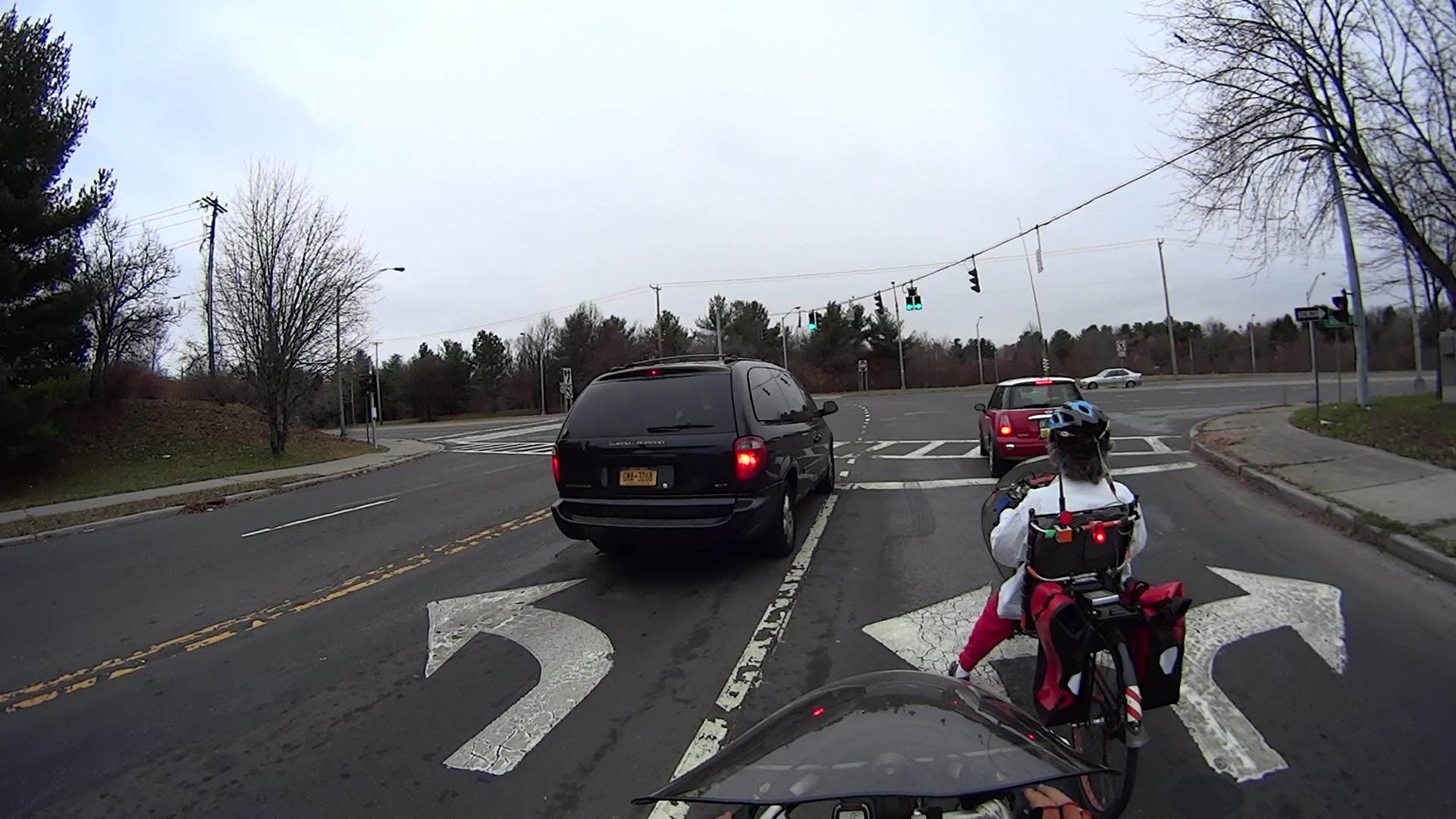
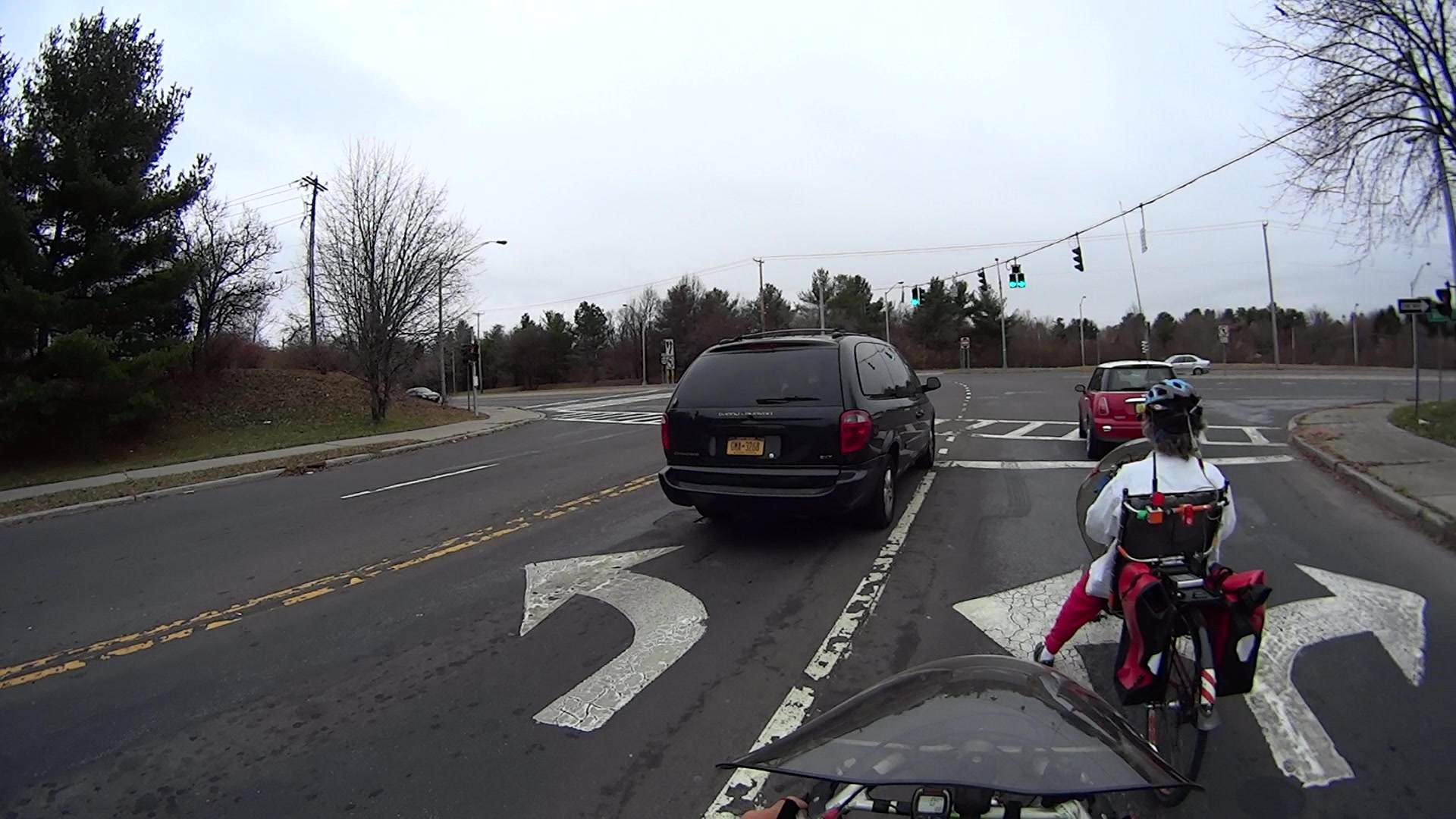
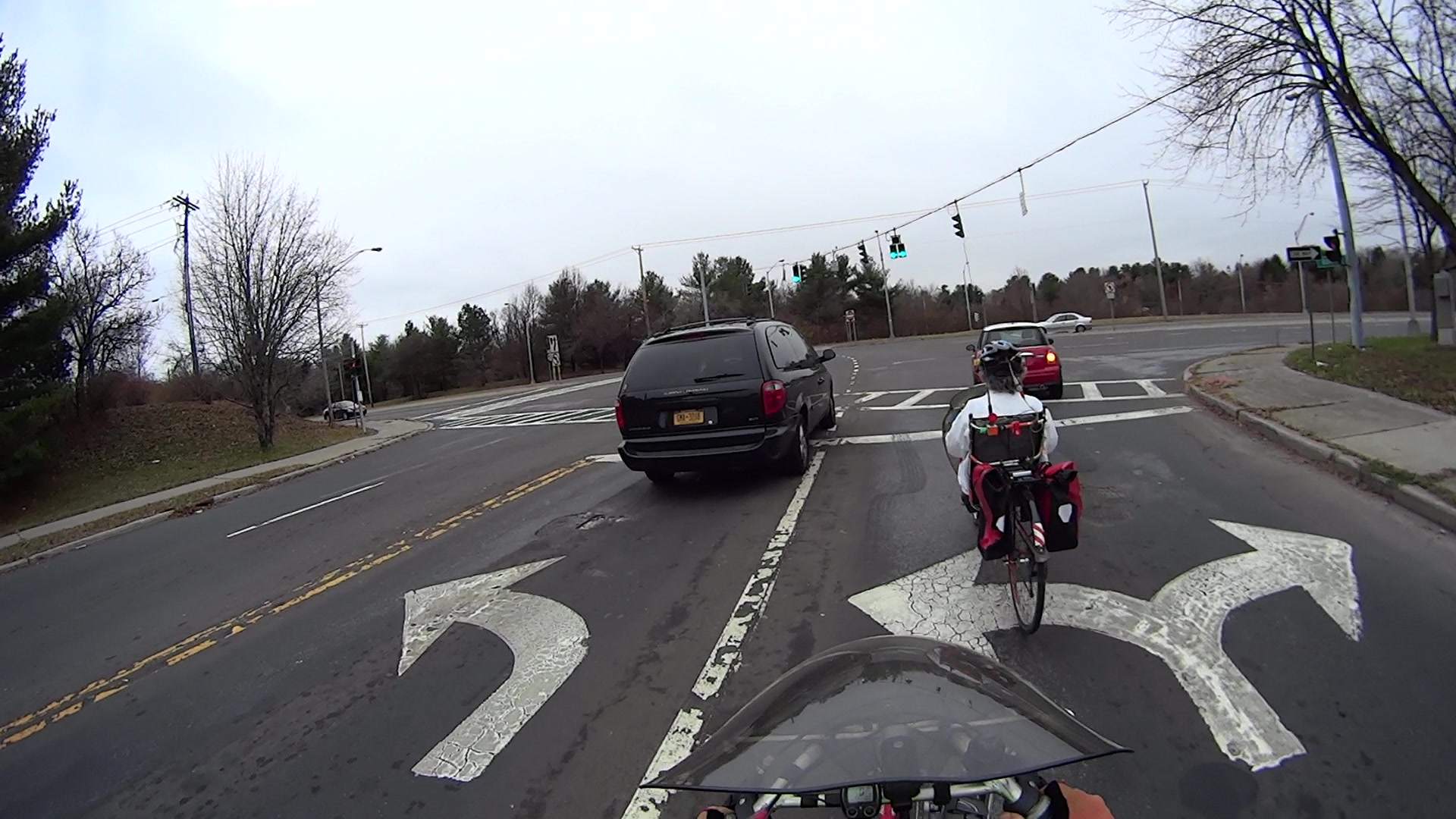
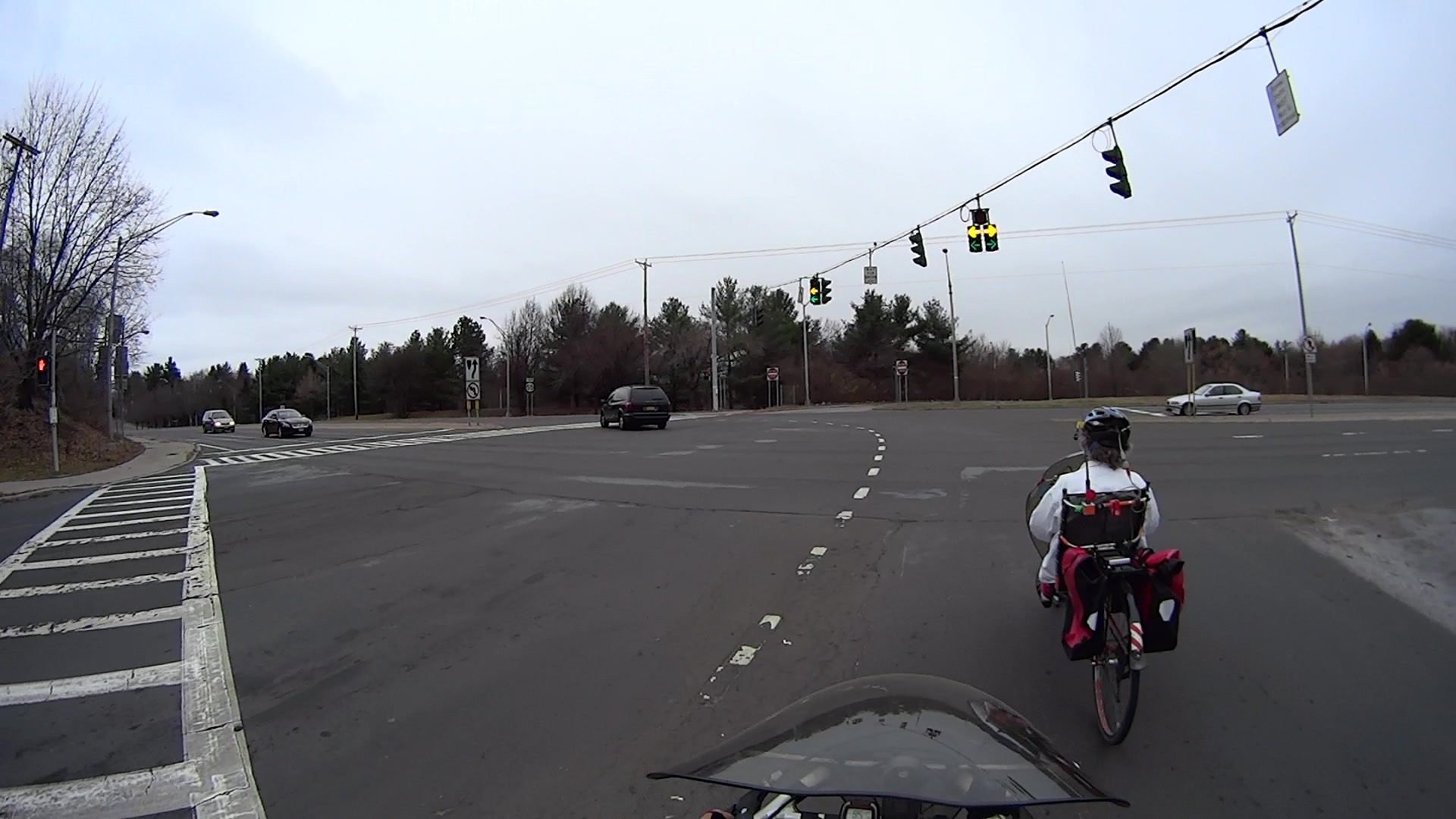
    The Dutchess Rail Trail sits atop a pipeline carrying water from the treatment plant in the City of Poughkeepsie to the GlobalFoundries (neé IBM East Fishkill) complex. For good engineering reasons, the mid-line pumping station (equipment yard visible to our left) in Page Industrial Park sits directly athwart the pipe, which forced an abrupt S-curve on a relatively steep slope into the rail trail layout.

    T=0.000 s — The lead cyclist just cut in front of her companion and isn’t leaning into the turn, at which point Mary and I both realize this isn’t going to end well:

    Road Rash 2015-08-15 - 131
    Road Rash 2015-08-15 – 131

    T=0.750 s — Newton grabs control of her bike and he’s not gonna let go:

    Road Rash 2015-08-15 - 176
    Road Rash 2015-08-15 – 176

    T=1.633 s — The rear wheel locks as she passes Mary, she’s far off-center and falling to her left, the bike has gone inertial, and it’s obvious we’re about to arrive at the same place at the same time:

    Road Rash 2015-08-15 - 229
    Road Rash 2015-08-15 – 229

    T=2.100 s — Collision Alarm! I’m veering off the pavement, which is the only reason we didn’t have an offset frontal collision:

    Road Rash 2015-08-15 - 257
    Road Rash 2015-08-15 – 257

    T=2.333 s — Impact! I’m stopped and balanced on the bike, with my left foot out of the pedal cleat and heading for the ground. She’s sliding past me, pivoting around her bike’s left pedal skidding on the asphalt:

    Road Rash 2015-08-15 - 271
    Road Rash 2015-08-15 – 271

    She ended up sprawled atop her bike, facing up the slope, with the front wheel just beside the rear wheel of my bike; her foot or some part of her bike whacked my left-side underseat bag in passing, but there was no bike-on-bike collision. No injuries for her, other than perhaps a bit of road rash, but only by sheer raw good fortune.

    Reviewing the video shows she lost control at the transition from the trail to the downward S-curve, a few seconds before the first picture here and about five seconds before she stopped sliding past my bike, but the problem wasn’t obvious until the scene in the first picture. Mary never had a chance to react and, with less than two seconds until the not-quite-collision, my gross-motor reaction time just barely got me out of the way.

    Brake early and always wear a helmet.

  • Invisible Asterisk: Motorized Sidewalk Traffic

    From the NYS DMV:

    You cannot register or operate any of the motorized devices from the list below on any street, highway, parking lot, sidewalk or other area in New York State that allows public motor vehicle traffic. You may be arrested if you do.

    [List of things]

    Golf Cart (also referred to as Golf Car or Neighborhood Electric Vehicle) – a small motorized device with four wheels designed to carry people.  You can’t register a golf cart as an ATV.  Many low speed vehicles are similar in appearance to a golf cart, and can be registered and driven on New York State highways. 1

    [More things]

    1. For a low speed vehicle to be registered in New York

    • it must meet federal motor vehicle safety standard 500 (49 CFR 571.500)
    • its maximum performance speed must be certified by the manufacturer
    • it must appear on the list of approved limited use vehicles

    With that in mind, here’s a fairly common sight along Raymond Avenue…

    Vassar College regards as Raymond as its private driveway, with its fleet of golf-cart-class and tiny-pickup vehicles traveling the web of sidewalks and pedestrian crossings on and off campus. In point of fact, Vassar does own all of the property on both sides of Raymond from Hooker to Collegeview, but Raymond itself unquestionably has “public motor vehicle traffic”.

    Vassar’s Annual Sidewalk Sodding Week occurs shortly before their graduation / alumnae homecoming ceremonies. The sidewalks and paths obviously weren’t designed for shared vehicular & pedestrian use, so the cart tires gouge unsightly ruts along the pavement edges; the sod prevents those muddy strips from marring the festivities.

    The concrete sidewalks along Raymond take a beating from the vehicles, too, but the overall concrete quality (or lack thereof) may have something to do with that.

    This spiffy tiny-pickup golf cart used by the NYS OPRHP sports a Limited Use Auto plate:

    Limited Use Auto 2015-08-21
    Limited Use Auto 2015-08-21

    It’s sucking a socket at the west end of the Walkway Over the Hudson.

  • APRS Electronics Case Power Contacts

    Mary reported hearing occasional beeps during a recent ride that indicated the Wouxun KG-UV3D radio on her bike was rebooting. It turned out that the nut soldered to the lug atop the screw contacting the radio’s battery contacts had turned itself slightly loose on the stud:

    HT-GPS Case - PCB and battery contacts - end view
    HT-GPS Case – PCB and battery contacts – end view

    Snugging it up against the PCB made everything happy again.

    However, while I had the APRS box off, I added strips of copper tape to enhance the connection to the radio:

    KG-UV3D APRS interface - power contacts
    KG-UV3D APRS interface – power contacts

    Mostly, those gadgets just keep working…

  • Road Conditions: Spring Rd, Repaved

    Spring Road, the only route between Vassar Road and the Galleria / South Hills malls, had fallen into poor repair over the last few years, to the point where we rode to the end of Vassar Rd, crossed all seven lanes of Rt 9, low-geared up the southern access road to South Hills, then traversed the two-lane ring road. We had high hopes for the recently completed reconstruction project that closed Spring Rd for several weeks.

    Although the paving is much better and the reconstruction removed a blind curve over a hill, the “rideable” shoulder now spans every single drain grate along both sides of the road. You encounter the first pair at speed in the turn from southbound Vassar Rd onto Spring Rd:

    Spring Rd 2015-07-30 - Westbound at Vassar
    Spring Rd 2015-07-30 – Westbound at Vassar

    Don’t cross either grate at full speed or you’ll flip over the high side into traffic.

    A gallery of some of the other fine grates on offer along Spring Road:

    They’re not nearly as smooth-and-level-at-grade as you might expect from the pictures; some are recessed two inches into the pavement. I rode over some that looked passable and they’re definitely not the sort of obstacle you want to cross without thinking. Forsooth: steel bars and bike tires do not a stable encounter have.

    I’m also certain, based on past experience, that motorists won’t understand why we’re (still) riding in the lane, rather than using the new, most-wonderful shoulder.

    Like, for example, when Mary elected to jounce over a grate and I rode the fog line along the abrupt slope down to the concrete box:

    Spring Rd 2015-08-01 - EB - grate front view
    Spring Rd 2015-08-01 – EB – grate front view

    The rear view shows why bicycle-friendly design matters:

    Spring Rd 2015-08-01 - EB - grate rear view
    Spring Rd 2015-08-01 – EB – grate rear view

    FWIW, I generally ride slightly to Mary’s left, because I figure that way they’ll almost certainly miss her.

    Oh, well. The new Spring Road is about as good as road design and paving gets around here…

  • The End of Tire Liners

    This marks the end of my infatuation with tire liners:

    Schwalbe 20 inch tube - tire liner damage
    Schwalbe 20 inch tube – tire liner damage

    There seems to be no way to eliminate tube erosion at the end of the liner. I’ve tried tapering the thickness, taping the joint, and so forth and so on.

    Fortunately, the tire went flat in the garage and I did a quick swap before our morning ride.

    Searching for tire liner will reveal the rest of the stories, both good and bad.

  • Sony HDR-AS30V: AKA-SF1 Skeleton Frame Latch Repair

    My Sony HDR-AS30V is an action camera, but requires an external case / frame to mount it on anything. Here’s the camera inside its AKA-SF1 Skeleton Frame atop my helmet:

    Sony HDR-AS30V camera on bike helmet - inverted
    Sony HDR-AS30V camera on bike helmet – inverted

    Four 1 mm tall ramps on the inside of the black base (the part just above the yellow sled) snap into 2.6 mm square sockets in the skeleton frame surrounding the camera. For an unknown reason(s) that surely involves applying forces I don’t remember, an opposing pair of those ramps broke off, leaving the other pair to loosely hold one end of the camera in place.

    In this picture, the left ramps (one visible) are missing, leaving a square-ish gray scar that’s nearly indistinguishable from the reflection on the intact ramp on the right:

    Sony HDR-AS30V Skeleton Mount - broken latch ramps
    Sony HDR-AS30V Skeleton Mount – broken latch ramps

    Surprisingly, the round head of a brass 0-80 machine screw fits neatly inside the square socket on the frame; they’re a bit more than 1 mm deep. The approach ramps visible below the sockets guide the latches on the base:

    Sony HDR-AS30V Skeleton Mount - frame sockets
    Sony HDR-AS30V Skeleton Mount – frame sockets

    So I figured I could just shave off the remaining two latch ramps, drill four holes at the proper spots, and replace the plastic ramps with metal screws.

    I clamped the skeleton frame to the Sherline’s tooling plate, aligned it parallel to the X axis, put the laser spot dead center in the square socket, then snapped the base onto the frame. The laser spot shows where the drill will hit:

    Sony HDR-AS30V Skeleton Mount - laser hole alignment
    Sony HDR-AS30V Skeleton Mount – laser hole alignment

    A carbide drill did the honors:

    Sony HDR-AS30V Skeleton Mount - 0-80 hole drilling
    Sony HDR-AS30V Skeleton Mount – 0-80 hole drilling

    That’s a #55 = 0.0520 hole for 50% thread, rather than the proper 3/64 = 0.0469 hole for 75% thread, because that’s the closest short carbide drill I had; an ordinary steel twist drill, even in the screw-machine length I use on the Sherline, would probably scamper away. The hole isn’t quite on the sloped bottom edge of the base, but it’s pretty close.

    The first hole didn’t emerge quite in the center of its ramp scar:

    Sony HDR-AS30V Skeleton Mount - hole position - interior
    Sony HDR-AS30V Skeleton Mount – hole position – interior

    Which made sense after I thought about it: the ramp tapers to nothing in the direction of the offset, so the hole actually was in the middle of the matching socket.

    Threading the holes required nothing more than finger-spinning an 0-80 tap:

    Sony HDR-AS30V Skeleton Mount - tapping 0-80
    Sony HDR-AS30V Skeleton Mount – tapping 0-80

    The feeble thread engagement didn’t matter, because those mysterious tabs-with-slots (possibly for tie-down strings?) just above the holes were a perfect fit for 0-80 brass nuts:

    Sony HDR-AS30V Skeleton Mount - reassembled
    Sony HDR-AS30V Skeleton Mount – reassembled

    The screw heads extend into the sockets, hold the frame solidly in the base, and make it impossible to pull out. Although the frame still slides / snaps into the base, that seems like it will wear out the sockets in fairly short order, so I’ll unlatch the frame (with the yellow slide latch on top), open it up, ease it into position, and then latch it in place. That was the only way to remove it from the original latches, so it’s not a big deal.

    I should add a drop of epoxy to each of those nuts and perhaps fill the screw slots with epoxy to keep them from abrading the plastic inside the sockets. Maybe a dab of epoxy on the heads, followed by latching the frame in place, would form four square pegs to exactly fill the sockets.

    This was a straightforward repair that should not have been necessary…