|
// Kenmore vacuum cleaner nozzle adapters |
|
// Ed Nisley KE4ZNU December 2015 |
|
|
|
// Layout options |
|
|
|
Layout = "LuxBrush"; // MaleFitting CoilWand FloorBrush CreviceTool ScrubbyTool LuxBrush |
|
|
|
//- Extrusion parameters must match reality! |
|
// Print with +1 shells and 3 solid layers |
|
|
|
ThreadThick = 0.25; |
|
ThreadWidth = 0.40; |
|
|
|
HoleWindage = 0.2; |
|
|
|
function IntegerMultiple(Size,Unit) = Unit * ceil(Size / Unit); |
|
|
|
Protrusion = 0.1; // make holes end cleanly |
|
|
|
//———————- |
|
// Dimensions |
|
|
|
ID1 = 0; // for tapered tubes |
|
ID2 = 1; |
|
OD1 = 2; |
|
OD2 = 3; |
|
LENGTH = 4; |
|
|
|
OEMTube = [35.0,35.0,41.7,40.5,30.0]; // main fitting tube |
|
EndStop = [OEMTube[ID1],OEMTube[ID2],47.5,47.5,6.5]; // flange at end of main tube |
|
|
|
FittingOAL = OEMTube[LENGTH] + EndStop[LENGTH]; |
|
|
|
$fn = 12*4; |
|
|
|
//———————- |
|
// Useful routines |
|
|
|
module PolyCyl(Dia,Height,ForceSides=0) { // based on nophead's polyholes |
|
|
|
Sides = (ForceSides != 0) ? ForceSides : (ceil(Dia) + 2); |
|
|
|
FixDia = Dia / cos(180/Sides); |
|
|
|
cylinder(r=(FixDia + HoleWindage)/2, |
|
h=Height, |
|
$fn=Sides); |
|
} |
|
|
|
|
|
//——————- |
|
// Male fitting on end of Kenmore tools |
|
// This slides into the end of the handle or wand and latches firmly in place |
|
|
|
module MaleFitting() { |
|
|
|
Latch = [40,11.5,5.0]; // rectangle latch opening |
|
EntryAngle = 45; // latch entry ramp |
|
EntrySides = 16; |
|
EntryHeight = 15.0; // lower edge on *inside* of fitting |
|
|
|
KeyRadius = 1.0; |
|
|
|
translate([0,0,6.5]) |
|
difference() { |
|
union() { |
|
cylinder(d1=OEMTube[OD1],d2=OEMTube[OD2],h=OEMTube[LENGTH]); // main tube |
|
|
|
hull() // insertion guide |
|
for (i=[-(6.0/2 – KeyRadius),(6.0/2 – KeyRadius)], |
|
j=[-(28.0/2 – KeyRadius),(28.0/2 – KeyRadius)], |
|
k=[-(26.0/2 – KeyRadius),(26.0/2 – KeyRadius)]) |
|
translate([(i – (OEMTube[ID1]/2 + OEMTube[OD1]/2)/2 + 6.0/2),j,(k + 26.0/2 – 1.0)]) |
|
sphere(r=KeyRadius,$fn=8); |
|
|
|
translate([0,0,-EndStop[LENGTH]]) // wand tube butts against this |
|
cylinder(d=EndStop[OD1],h=EndStop[LENGTH] + Protrusion); |
|
} |
|
|
|
translate([0,0,-OEMTube[LENGTH]]) // main bore |
|
cylinder(d=OEMTube[ID1],h=2*OEMTube[LENGTH] + 2*Protrusion); |
|
|
|
translate([0,-11.5/2,23.0 – 5.0]) // latch opening |
|
cube(Latch); |
|
|
|
translate([OEMTube[ID1]/2 + EntryHeight/tan(90-EntryAngle),0,0]) // latch ramp |
|
translate([(Latch[1]/cos(180/EntrySides))*cos(EntryAngle)/2,0,(Latch[1]/cos(180/EntrySides))*sin(EntryAngle)/2]) |
|
rotate([0,-EntryAngle,0]) |
|
intersection() { |
|
rotate(180/EntrySides) |
|
PolyCyl(Latch[1],Latch[0],EntrySides); |
|
translate([-(2*Latch[0])/2,0,-Protrusion]) |
|
cube(2*Latch[0],center=true); |
|
} |
|
} |
|
} |
|
|
|
//——————- |
|
// Refrigerator evaporator coil wand |
|
|
|
module CoilWand() { |
|
|
|
union() { |
|
translate([0,0,50.0]) |
|
rotate([180,0,0]) |
|
difference() { |
|
cylinder(d1=EndStop[OD1],d2=42.0,h=50.0); |
|
translate([0,0,-Protrusion]) |
|
cylinder(d1=35.0,d2=35.8,h=100); |
|
} |
|
translate([0,0,50.0 – Protrusion]) |
|
MaleFitting(); |
|
} |
|
} |
|
|
|
|
|
//——————- |
|
// Refrigerator evaporator coil wand |
|
|
|
module FloorBrush() { |
|
|
|
union() { |
|
translate([0,0,60.0]) |
|
rotate([180,0,0]) |
|
difference() { |
|
union() { |
|
cylinder(d1=EndStop[OD1],d2=32.4,h=10.0); |
|
translate([0,0,10.0 – Protrusion]) |
|
cylinder(d1=32.4,d2=30.7,h=50.0 + Protrusion); |
|
} |
|
translate([0,0,-Protrusion]) |
|
cylinder(d1=28.0,d2=24.0,h=100); |
|
} |
|
translate([0,0,60.0 – Protrusion]) |
|
MaleFitting(); |
|
} |
|
} |
|
|
|
|
|
//——————- |
|
// Crevice tool |
|
|
|
module CreviceTool() { |
|
|
|
union() { |
|
translate([0,0,60.0]) |
|
rotate([180,0,0]) |
|
difference() { |
|
union() { |
|
cylinder(d1=EndStop[OD1],d2=32.0,h=10.0); |
|
translate([0,0,10.0 – Protrusion]) |
|
cylinder(d1=32.0,d2=30.4,h=50.0 + Protrusion); |
|
} |
|
translate([0,0,-Protrusion]) |
|
cylinder(d1=28.0,d2=24.0,h=100); |
|
} |
|
translate([0,0,60.0 – Protrusion]) |
|
MaleFitting(); |
|
} |
|
} |
|
|
|
//——————- |
|
// Mystery brush |
|
|
|
module ScrubbyTool() { |
|
|
|
union() { |
|
translate([0,0,60.0]) |
|
rotate([180,0,0]) |
|
difference() { |
|
union() { |
|
cylinder(d1=EndStop[OD1],d2=31.8,h=10.0); |
|
translate([0,0,10.0 – Protrusion]) |
|
cylinder(d1=31.8,d2=31.0,h=50.0 + Protrusion); |
|
} |
|
translate([0,0,-Protrusion]) |
|
cylinder(d1=26.0,d2=24.0,h=100); |
|
} |
|
translate([0,0,60.0 – Protrusion]) |
|
MaleFitting(); |
|
} |
|
} |
|
|
|
|
|
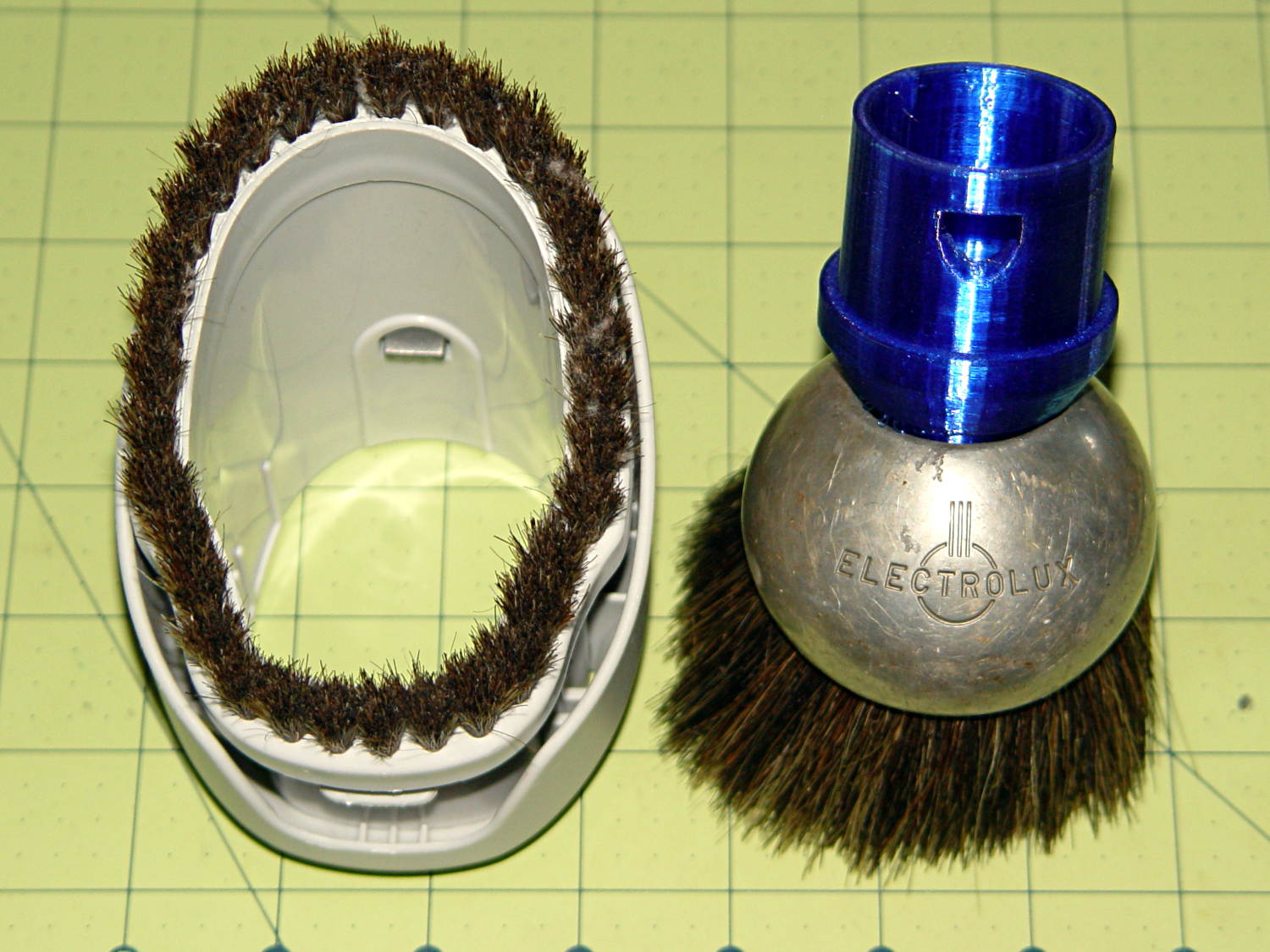
//——————- |
|
// Electrolux brush ball |
|
|
|
module LuxBrush() { |
|
|
|
union() { |
|
translate([0,0,30.0]) |
|
rotate([180,0,0]) |
|
difference() { |
|
union() { |
|
cylinder(d1=EndStop[OD1],d2=30.8,h=10.0); |
|
translate([0,0,10.0 – Protrusion]) |
|
cylinder(d1=30.8,d2=30.0,h=20.0 + Protrusion); |
|
} |
|
translate([0,0,-Protrusion]) |
|
cylinder(d1=25.0,d2=23.0,h=30 + 2*Protrusion); |
|
} |
|
translate([0,0,30.0 – Protrusion]) |
|
MaleFitting(); |
|
} |
|
} |
|
|
|
|
|
|
|
//———————- |
|
// Build it! |
|
|
|
if (Layout == "MaleFitting") |
|
MaleFitting(); |
|
|
|
if (Layout == "CoilWand") |
|
CoilWand(); |
|
|
|
if (Layout == "FloorBrush") |
|
FloorBrush(); |
|
|
|
if (Layout == "CreviceTool") |
|
CreviceTool(); |
|
|
|
if (Layout == "ScrubbyTool") |
|
ScrubbyTool(); |
|
|
|
if (Layout == "LuxBrush") |
|
LuxBrush(); |




 The Smell of Molten Projects in the Morning