Ed Nisley's Blog: Shop notes, electronics, firmware, machinery, 3D printing, laser cuttery, and curiosities. Contents: 100% human thinking, 0% AI slop.
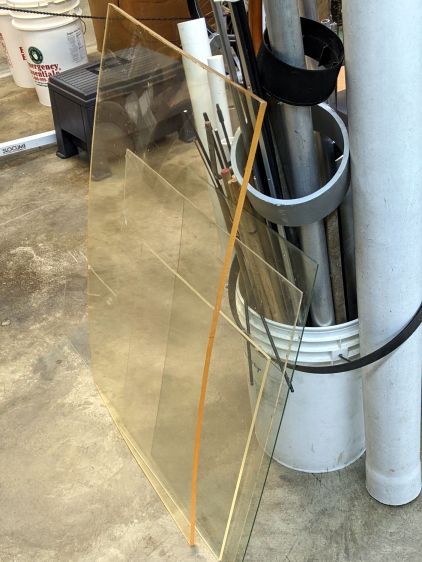
That big yellowed sheet is 9 mm = 3/8 inch thick, with an inch of warp, entirely enough to keep it out of the laser cutter.
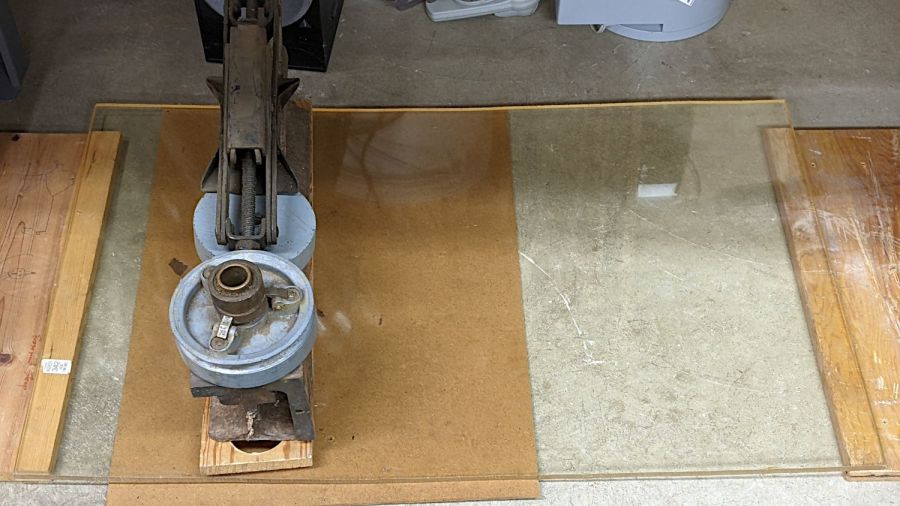
So I cleared some floor space and loaded the sheet with a collection of scrap steel sufficient to bend it the other way:
Acrylic sheet unwarping
The main weight comes from a perfectly sized snippet of railroad rail, topped off with steel disks, angle iron, and a rugged scissors jack
The sheet didn’t touch the floor, so the weight kept stress on the plastic and it gradually flowed the other way:
Mostly unwarped acrylic sheet
The center remains 5 mm higher than the edges and, given that cold-flowing is at best an exponential process, I recently declared victory and added it to the stockpile. I’ll gnaw off small pieces for any given project, so the remaining warp won’t matter.
The rule of thumb says a CO₂ laser cutters needs 10 W per millimeter of acrylic, so my 60 W laser will be somewhat underpowered. Two or three passes should suffice and, for sure, nobody will kvetch about edge quality.
Mary persuaded the squash vine to run along the top of the garden fence, where it would get good sun, stay out from underfoot, and produce what we call aerosquash:
The black smudge matches a scuff on the right sidewall of the front tire. I think I hit it in that orientation and it pivoted clockwise while lifting the bike and shoving the tire to the left.
Another look from what was likely the right side of the shoulder:
The Stone – B
I’ll give it a decent burial out back … and be glad our roles aren’t reversed!
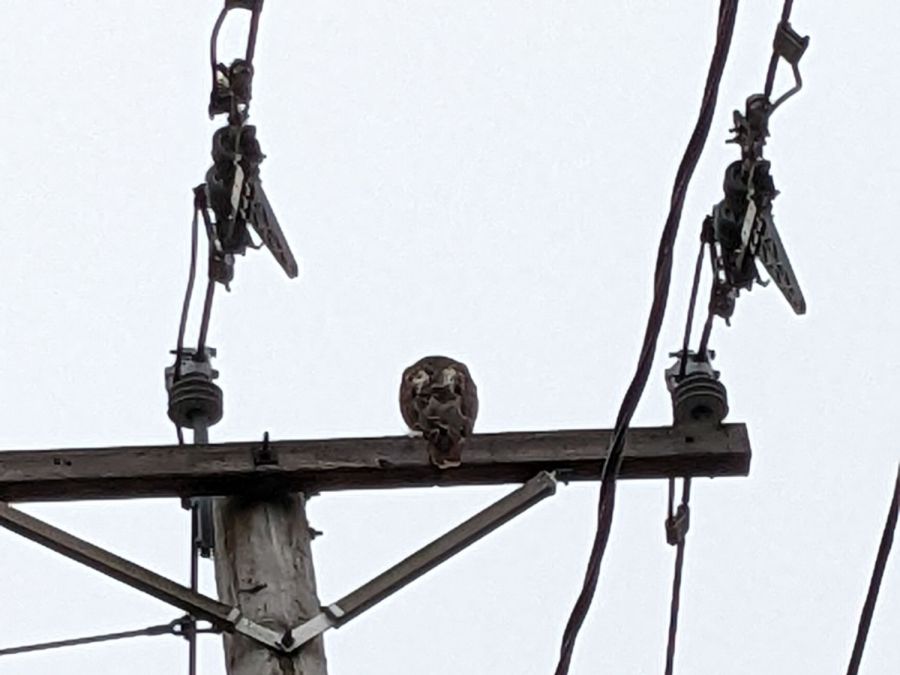
Despite the crappy image (Google Pixel 6a, digitally zoomed as tight as it’ll go), it’s a second-year juvenileBald Eagle. It followed ahead of us along Rt 376, landing atop successive utility poles as we walked toward the intersection:
Red Oaks Mill Eagle – B
It sometimes perched on the (presumably) live primary wires, so a few kV of electric field doesn’t ruffle its feathers enough to worry about.
Its duties included keeping an eye on us down by the creek:
Red Oaks Mill Eagle – C
It eventually decided we needed no further supervision:
Red Oaks Mill Eagle – D
Earlier this year it swooped along our driveway and landed atop a utility pole in our yard, causing great concern among the songbirds and rodents.
Having an eagle in the neighborhood seems like a good sign …
Their camouflage works better in the wild than atop a trash can lid:
Tree frog – on trash can lid
They are much smaller than you’d expect from their voices in the night:
Tree frog – on trash can lid – thumb for scale
We think the drought brings them closer to the house in search of water, as Mary collects rainwater in the trash cans where the frogs easily walk up & down the inside surfaces.
I set up my pobox.com account set up with two-factor authentication through my Yubikey, so logging in requires my user ID, password, and a Time-based One-time Password generated through the Yubikey Authenticator program. A few weeks ago, pobox occasionally rejected the TOTP and it eventually became a hard failure. Oddly, other sites I’ve set up with TOTP 2FA continued to work fine.
My initial trouble report:
The last couple of times I’ve tried to sign in, the usual TOTP copy-n-paste from my Yubikey authenticator has failed.
Up to that point, it worked flawlessly.
Manually typing the TOTP also fails.
I have reset my (complex!) password to no avail; I use Firefox’s password manager to fill it in.
I do have a set of lockout codes, but they’re a solution to a different problem.
Given the constant updates to Firefox (102.0.3), it’s almost certain the hole is in my end of the boat. I have disabled all the usual ad blocking for pobox.com, although there may be other domains I’ve overlooked.
Other than that, my email seems to be working just fine …
Any suggestions on how to proceed? (Obviously, I’m not going to be able to sign on to look at the ticket.)
Thanks …
This is the fastest I’ve ever reached Tier 2:
We’re happy to help you with this. I’ve escalated your ticket to our Tier 2 agents, as they are best suited to assist with this issue.
There is nothing like a good new problem to take your mind off all your old problems:
I’ve had a chat with our Tier 2 agents about this and they’ve suggested I escalate it to our developers to have a look at.
Somewhat later:
I am afraid to say that our developers were unable to find any clear reason as to why your Yubikey failed.
Yubikey devices verify by connecting with Yubikey’s server, and it is possible that this connection failed.
Can you please try using the Yubikey again to see if the issue is still occurring?
If it’s still failing, can you please try adding a new Yubikey device to see if it works?
Of course, the problem didn’t magically Go Away, but I did more experimentation and figured out where the hole was in my end of the boat:
Ah-HA! It’s a PEBKAC error!
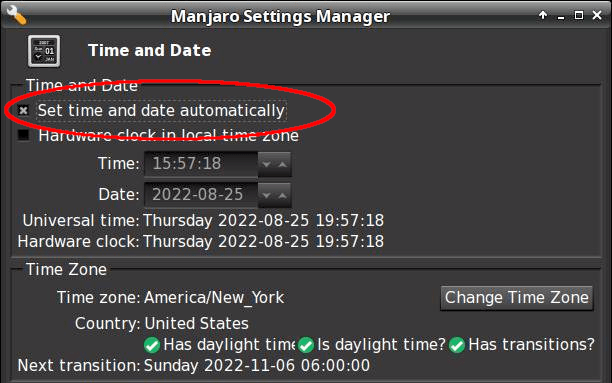
For unknown reasons, this PC was not set for automatic NTP time updates(*). Its time had drifted (presumably since I installed it back in June 2021) and was now 58 seconds behind real time, exceeding pobox’s tolerance.
Other websites apparently allow a few more seconds of slop before disallowing a TOTP, so I had not yet run afoul of their limit.
Some lesser-used sites threw me out, however, but I had not looked beyond the most common sites.
The default TOTP interval is 30 seconds, so perhaps pobox allows only ±1 interval and the other sites allow ±2? Frankly, I think pobox has it right: everybody else prioritizes customer sat over security.
Got the clock set correctly and, gosh, TOTP works fine.
Mark it solved, but definitely add “Soooo, is your PC’s clock set for automatic updates?” to the debugging protocol.
Thanks …
(*) I’ve installed all of the boxen here and would not ever have picked “Yeah, sure, I want to dink with the clock.”
How you make sure time synchronization is enabled goes like this:
$ systemctl status systemd-timesyncd.service
● systemd-timesyncd.service - Network Time Synchronization
     Loaded: loaded (/usr/lib/systemd/system/systemd-timesyncd.service; enabled; preset: enabled)
     Active: active (running) since Thu 2022-08-25 06:49:31 EDT; 10h ago
       Docs: man:systemd-timesyncd.service(8)
   Main PID: 355 (systemd-timesyn)
     Status: "Contacted time server 23.157.160.168:123 (2.manjaro.pool.ntp.org)."
      Tasks: 2 (limit: 19063)
     Memory: 2.2M
        CPU: 188ms
     CGroup: /system.slice/systemd-timesyncd.service
             └─355 /usr/lib/systemd/systemd-timesyncd

Aug 25 06:49:31 shiitake systemd[1]: Starting Network Time Synchronization...
Aug 25 06:49:31 shiitake systemd[1]: Started Network Time Synchronization.
Aug 25 06:50:12 shiitake systemd-timesyncd[355]: Timed out waiting for reply from 162.159.200.123:123 (2.manjaro.pool.ntp.org).
Aug 25 06:50:12 shiitake systemd-timesyncd[355]: Contacted time server 23.157.160.168:123 (2.manjaro.pool.ntp.org).
Aug 25 06:50:12 shiitake systemd-timesyncd[355]: Initial clock synchronization to Thu 2022-08-25 06:50:12.850444 EDT.
If it’s enabled and running, then it’s all good.
Whereupon all my TOTP passwords began working again.
I checked two other Manjaro systems: one had auto updates enabled, one didn’t. I have no explanation.