The Smell of Molten Projects in the Morning

Ed Nisley's Blog: Shop notes, electronics, firmware, machinery, 3D printing, laser cuttery, and curiosities. Contents: 100% human thinking, 0% AI slop.

Category: Machine Shop

Mechanical widgetry

  • OMTech 60 W Laser: Controlling the Air Assist Pump

    OMTech 60 W Laser: Controlling the Air Assist Pump

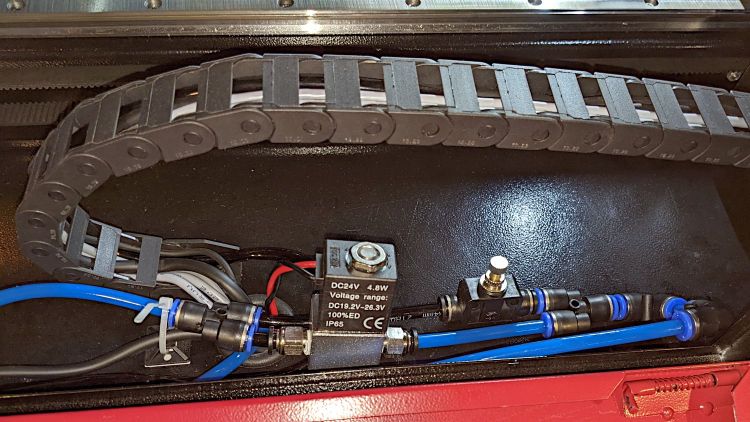
    The OMTech 60 W laser gets its air assist from an aquarium-style air pump in the right rear of the cabinet:

    OMTech 60W laser - Z motor - air pump
    OMTech 60W laser – Z motor – air pump

    Since that picture, I’ve sealed the slots for the Z-axis belt tensioner pulleys.

    The pump is connected directly to the AC line at the main barrier block (blue and brown on leftmost two terminals):

    OMTech 60W laser - AC barrier strip
    OMTech 60W laser – AC barrier strip

    Even though the pump has very flexy rubber feet, it’s annoyingly noisy and should be off when the laser beam is off.

    The knockoff RuiDa KT332N controller (possibly by Ryxon, based on a LightBurn forum thread, but without a visible name anywhere on the hardware or in the manual) has an Aux.Air output terminal:

    KT332N Controller - output wiring plug- glued
    KT332N Controller – output wiring plug- glued

    Yes, the controller is mounted that way inside the electronics bay.

    Chipping away the hot-melt glue over the terminals lets you pry the terminal block out of the controller:

    KT332N Controller - output wiring plug
    KT332N Controller – output wiring plug

    The KT332N manual describes the Aux.Air pin 2 function:

    Dedicated output. When auxiliary air control is enabled, this port outputs a control signal to control the valve or other relay to release auxiliary air. This port is multiplexed with pen control signal. When auxiliary air control is disabled, this port is assigned as pen control. The output type is open collector. The output can be set to be synchronized with laser or synchronized with work.
    Section 4.6 — General and dedicated output

    The word “pen” does not occur anywhere else in the manual, so I have no idea what it might mean. Perhaps the controller can also become a pen plotter?

    A configuration screen (MenuPara SettingAuxi.Air) gives the options:

    KT332N Controller - Air Assist Config screen
    KT332N Controller – Air Assist Config screen

    Section 9.2 of the manual describes the choices, although not quite in the same words:

    • Blowing method:The way of the air is blown during processing. Can be configured to output fire, process gas, and manual gas.
    • Blow on delay:Delay time after turning on air blowing
    • Blow off delay:Delay time before turning off the blow

    Section 7.2 gives the electrical parameters:

    All output signals of this controller are output based on opto-coupler isolation technology and OC gate output. Its maximum driving capacity is 300mA, which can directly drive 6V / 24V relays, light-emitting indicators, buzzer alarm devices, etc.
    Section 7.2 — Output

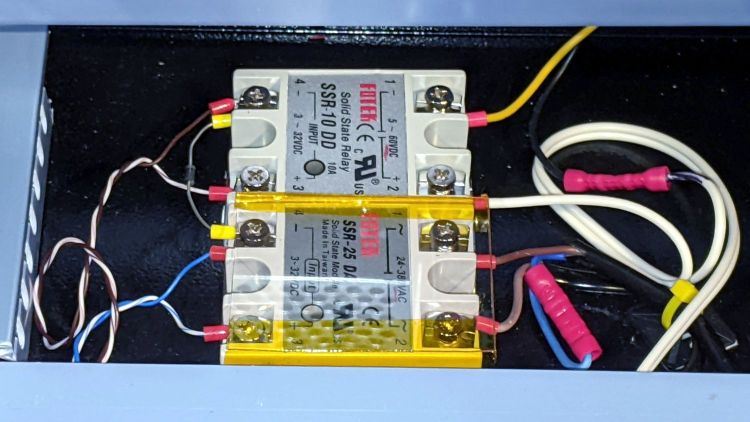
    I wired an AC solid state relay (surely a counterfeit Fotek) in series with the pump’s AC Line wire:

    KT332N Controller - Air Assist SSR installed
    KT332N Controller – Air Assist SSR installed

    It’s firmly stuck to the bottom of the electronics bay with heatsink tape, not that it gets particularly warm switching a few dozen watts of pump.

    Because the output pin is active low, the SSR + input comes from a ferrule jammed into the 24 V supply pin on the controller, along with the original ferrule holding three other wires:

    KT332N Controller - Air Assist SSR wiring
    KT332N Controller – Air Assist SSR wiring

    With all that in place, I turned it on and … the air pump did not turn on when I ran the next job. I could manually turn the pump on with the front panel Aux Air button, but it shut off as soon as I ran a file.

    The “enable” setting referred to in Section 4.6 appears in the Vendor Parameters:

    Enable the auxiliary air control : If you want to use the Wind signal of the output port to control the fan switch in layers, you must enable this parameter. Otherwise, the Wind signal outputs other signals.
    Section 9.1 — Vendor Parameters

    The Vendor Settings are protected by a password I don’t know do not appear in the section of settings I assumed they would be in, based on the manual’s wording. It seems an external program connected to the controller by USB or the network provides the only way to access these settings.

    Fortunately, LightBurn exposes the Vendor settings after you click through a warning dialog:

    LightBurn Vendor Config - Air Assist Enable
    LightBurn Vendor Config – Air Assist Enable

    And then It Just Works™.

    The “Blow when laser” option turns on the pump whenever the laser power supply is producing a beam, so it switches on and off at a furious pace. This is not the option you are looking for.

  • OMTech 60 W Laser: Improved Lighting

    OMTech 60 W Laser: Improved Lighting

    The OMTech 60 W laser arrived with an LED strip light under the gantry:

    OMTech 60W laser - OEM lighting
    OMTech 60W laser – OEM lighting

    That works reasonably well, if only because the pool of light travels with the gantry, but it’s always behind the area where you’re (well, I’m) setting up the Thing To Be Cut. An overhead can lamp with a warm-white CFL bulb contributes the yellowish foreground lighting, although I cast a big shadow when leaning into the cutter.

    Adding three COB LED strips along the sides definitely improved the situation:

    OMTech 60W laser - COB LED strips
    OMTech 60W laser – COB LED strips

    The glare will require shades along their top, but that’s in the nature of fine tuning.

    I got 24 V COB LEDs to match the cutter’s power supply and reduce the overall current along the strips, but upon further inspection the OEM power supply seems under-specified for its job. The XY stepper drivers each draw 3.5 A peak, the Z (they call it U) axis driver is set for 5.1 A peak, and the knockoff RuiDa controller also runs at 24 V with an unspecified current.

    Rather than stress the OEM supply, some rummaging in the Big Box o’ Wall Warts produced the 24 V 2 A power brick shown in the first picture. The previous owner had cut off the no-doubt specialized connector, so I had no qualms about splicing in a 5.1 mm coaxial power plug.

    On the other end, I amputated the AC line plug, crimped on a pair of ferrules, and inserted them into the AC power barrier strip inside the electronics bay:

    OMTech 60W laser - LED power supply
    OMTech 60W laser – LED power supply

    Yes, that little smudge in the middle of the brick is an Genuine Embossed Apple logo, so you know it’s gotta be good.

  • OMTech 60 W Laser: Focus Check

    OMTech 60 W Laser: Focus Check

    The OMTech 60 W laser cutter has an 18 mm lens with a 2 inch = 50.8 mm focus distance:

    OMTech 60W laser beam test - focus point
    OMTech 60W laser beam test – focus point

    The tip of the cone sits 18 mm over the focal point.

    The red “pen” is the auto-focus probe switch. It has essentially zero overtravel after tripping, with enough pretravel to hover barely 6 mm above the focal point.

    Lightburn can produce a focus test pattern:

    OMTech 60W laser - focus test patterns
    OMTech 60W laser – focus test patterns

    The left pattern comes from a piece of paper with the focus point at the surface, corresponding to the “0.0” line.

    The right pattern is on another piece of paper atop a 3 mm cardboard sheet, so the “0.0” line sits 3 mm above the focal point. The pen tip brushed a protruding corner after the “1.0” line, showing the need for a really really flat sheet of whatever you’re engraving / cutting and definitely limiting the height of any clamps / fixtures you might think of applying to the sheet.

    I ran a manual test firing 50 ms pulses into thin cardboard atop a 9+ mm (3/8 inch + protective papers) sheet of plastic (distance to lens increases to the right, the numbers are the nominal surface elevation relative to the autofocus level):

    OMTech 60W laser beam test - Focus Check
    OMTech 60W laser beam test – Focus Check

    The “0” pinhole may have happened near the actual focal point, but the true distance isn’t particularly accurate.

    A closer look suggests the focal point sat 1 mm above the nominal zero:

    OMTech 60W laser - focus check - detail
    OMTech 60W laser – focus check – detail

    In round numbers, the lens produces decent focus within ±1 mm of the focal point. The smallest hole is 0.3 mm, with the scorched ring bringing the mark to 0.4 mm, although the blast radius depends on the material and laser current setting.

    A closer look at the focal point target from the beam alignment tests:

    OMTech 60W laser - beam alignment - focus detail - 2022-03-22
    OMTech 60W laser – beam alignment – focus detail – 2022-03-22

    The hole is slightly off-center because I hadn’t yet tweaked the red dot laser.

    The hole came from two pulses, one at the autofocus level and another with the platform 10 mm lower. Comfortingly, the beam hit the same spot, with the slightly defocused beam chewing the rim a little larger, showing that the beam path is perpendicular to the platform motion.

    So far, so good!

  • OMTech 60 W Laser: Beam Alignment Check Targets

    OMTech 60 W Laser: Beam Alignment Check Targets

    The canonical beam alignment target seems to involve tape stuck on the mirror bracket:

    OMTech 60W laser beam test - tape target
    OMTech 60W laser beam test – tape target

    With a full-power beam burned through it:

    OMTech 60W laser beam test - mirror 1
    OMTech 60W laser beam test – mirror 1

    The roll of “white masking tape” supplied by OMTech turned out to be knockoff tapeless sticky adhesive film. After sticking a length to the mirror bracket, the white backing tape peels right off, leaving the adhesive film stuck to the bracket. Well, my tapeless sticky roll was running low, so this roll won’t go to waste.

    A laser cutter can make intricate paper doodads, so I conjured better targets from the Vasty Digital Deep:

    OMTech 60W laser - beam alignment - 2022-03-22
    OMTech 60W laser – beam alignment – 2022-03-22

    They’re burned into an ordinary manila file folder in “dot mode”: 2 ms pulses at 30% power separated by 0.25 mm. The 1 mm graticule locates the beam relative to the center, which is pretty close to the actual center of the opening, because the outer 17 mm cut fits neatly into the 17.5 mm hole. The label tells you where it goes and which line should point up.

    Your mileage will vary, but the general idea is to have a disk held in place by actual masking tape:

    OMTech 60W laser beam test - mirror 1
    OMTech 60W laser beam test – mirror 1

    Admittedly, orienting the graticule requires a bit of dexterity, but getting it pretty close is pretty easy.

    Set the laser to fire a single 10 ms pulse when you press the front-panel button, thereby toasting a spot at the most intense part of the beam:

    OMTech 60W laser beam test - mirror 1 fired
    OMTech 60W laser beam test – mirror 1 fired

    Repeat to record the beam position at all three mirrors:

    OMTech 60W laser beam test - mirror 3 fired
    OMTech 60W laser beam test – mirror 3 fired

    The focal point target serves to verify the focused beam size and its alignment with respect to the aiming laser spot:

    OMTech 60W laser beam test - focus point
    OMTech 60W laser beam test – focus point

    That target came from a scrap of cardboard while I was figuring out how to make the things.

    All in all, OMTech did a pretty good job of aligning the beam, although the red laser dot needed a nudge. Now I have a record of where the beam was before I mess with clean the mirrors and lenses.

    The SVG image as a GitHub Gist:

    Loading
    Sorry, something went wrong. Reload?
    Sorry, we cannot display this file.
    Sorry, this file is invalid so it cannot be displayed.

  • OMTech 60 W Laser: Platform Alignment Check

    OMTech 60 W Laser: Platform Alignment Check

    The honeycomb grid panel doesn’t have a perfectly flat surface, but the bench block kinda sorta averages things out:

    OMTech platform alignment setup
    OMTech platform alignment setup

    I jogged the platform down until the nozzle just cleared the block, then measured the space at various spots across the grid. Somewhat to my surprise, it’s just about as good as you can expect:

    OMTech platform alignment - 2022-03-17
    OMTech platform alignment – 2022-03-17

    You could argue that the left side is lower by half a millimeter.

    The four stout single-start leadscrews moving the platform have a 4 mm lead (= pitch for single-start), driven by a belt with a 0.2 inch (!!) tooth spacing around 14 tooth sprockets, so moving the belt by one tooth produces 0.286 mm of vertical motion. I could loosen the belt and turn the left rear leadscrew one tooth to raise that corner, but not right now.

    The laser lens has enough depth of field to cover a millimeter without too much spot size variation, unless you’re being very fussy. A quick focus check:

    OMTech 60W laser - focus check - detail
    OMTech 60W laser – focus check – detail

    The center hole happened pretty close to the lens focal point, with the adjacent holes 1 mm above / below that point. An accurate initial focus setting is obviously important, but varying by half a millimeter on either side seems survivable.

  • OMTech 60 W Laser: Hatch Latch Phasing

    OMTech 60 W Laser: Hatch Latch Phasing

    The OMTech laser cutter has six access hatches, each with one or two latches. These are not locks, although you do need a triangular “key” to turn the latch plug:

    OMTech laser - latch - cylinder point up
    OMTech laser – latch – cylinder point up

    Being that type of guy, I want all the latches to have the same plug orientation when they’re closed, so that I can hold the key one way, poke it into any latch without thinking too hard, and have it fit onto the plug:

    OMTech laser - latch key - latched position
    OMTech laser – latch key – latched position

    A quarter-turn clockwise (remember clocks with hands?) then releases the latch:

    OMTech laser - latch key - unlatched position
    OMTech laser – latch key – unlatched position

    Inside the hatch, the closed position corresponds to a tongue capturing a flange around the cabinet opening (not shown):

    OMTech laser - latch - latched position
    OMTech laser – latch – latched position

    After the quarter-turn, the tongue releases the flange:

    OMTech laser - latch - unlatched position
    OMTech laser – latch – unlatched position

    So, we’re not talking high security here.

    As delivered, the plugs had more-or-less random orientations when they were closed and some required a counterclockwise quarter-turn to release.

    It turns out the latches aren’t a complete unit that simply drops into a hole in the hatch:

    OMTech laser - latch parts
    OMTech laser – latch parts

    I sympathize with whoever must assemble ten handfuls of parts into ten latches on a production line and I also understand why orienting the plug wasn’t on that person’s to-do / QC checklist. I further understand why two cylinders lacked the big toothed washer under the nut; it’s not essential to the function and nobody will ever miss it.

    The plug has a triangle on one end (for the key) and a square on the other (for the tongue), with one triangle point aligned to a side of the square:

    OMTech laser - latch plug
    OMTech laser – latch plug

    To my way of thinking, that point must be upward, as shown in the first picture, when the latch is secured.

    The cylinder can fit into the square(-ish) hatch hole in four possible ways, but its symmetry allows only two unique orientations. It must look like this in order to put that point upward when the plug is maximally counterclockwise (my finger is pointing upward):

    OMTech laser - latch cylinder
    OMTech laser – latch cylinder

    So I devoted a pleasant half-hour to reducing the latch entropy.

    The screw attaching the tongue to the plug also controls the friction of that spring against the plug as you (well, I) turn it. All the screws now sport a dab of Loctite to ensure the tension remains mostly constant (at least for a while), as do the two large nuts lacking corresponding toothed washers.

    The “key” has no marking to indicate its “point-up” orientation, so I stuck a snippet of label on one side, with a jaunty red highlight marking the point. Something better will surely occur to me, but it’s no longer in the critical path.

  • OMTech 60 W Laser: Ventilation

    OMTech 60 W Laser: Ventilation

    The best place for the OMTech laser cutter seems to be snuggled at base of the chimney, venting into the long-disused fireplace through the steel plate adapting a long-gone wood stove to the opening:

    Duct fan installed
    Duct fan installed

    The short run of flexible tubing allows some give-and-take at the cutter’s vent outlet. The elbow on the duct fan’s output terminates in a blast gate to cut off the draft blowing up (or down!) the flue with the fan off.

    The cutter arrived with a huge high-speed axial blower screwed to its output baffle:

    OMTech 60W laser - OEM vent fan
    OMTech 60W laser – OEM vent fan

    The noise from that fan had to be heard to be believed.

    The cylindrical exhaust duct attached directly to the motor with four screws, only two of which matched holes in the baffle plate:

    OMTech 60W laser - modified vent
    OMTech 60W laser – modified vent

    A trial fit revealed the assembly rattled something awful: those two screws let the duct vibrate against the baffle. Match-drilling two more holes into the baffle let me mount the duct with three screws and, in combination with the foam gasket, it is now solid and quiet.

    A quick check shows the duct fan draws 10 to 11 m/s through the baffle at full throttle, roughly 400 CFM. That’s pretty close to the flow measured through a long pipe and, with only 6 ft³ of stink inside the laser’s cabinet, ought to exhaust the fumes just fine.