The Smell of Molten Projects in the Morning

Ed Nisley's Blog: Shop notes, electronics, firmware, machinery, 3D printing, laser cuttery, and curiosities. Contents: 100% human thinking, 0% AI slop.

Category: Machine Shop

Mechanical widgetry

  • Kenmore 158: Frame Pivot Pins

    The entire Kenmore Model 158 sewing machine tilts on a pair of pivots extending from the rear of the base, just below the top surface. Mary’s slightly more recent machine has all-steel pivots:

    Kenmore 158 - steel pivot pin
    Kenmore 158 – steel pivot pin

    The older crash test dummy machine has two-part pivots, with a plastic housing molded around a steel pin:

    Kenmore 158 - plastic pivot pins
    Kenmore 158 – plastic pivot pins

    Obviously, plastic was the wrong material for the cross pins that rest in the base, leading to the all-steel redesign. Sears no longer stocks replacement parts for those pins, sooo …

    Both machines have a large plastic base that’s gradually disintegrating. The plan is to embed the machine frames in countertops, with those cross pins resting on plastic plugs set flush with the surface.

    The frame sockets aren’t quite 1/4 inch in diameter; the rest of the hardware uses hard metric sizes, so they’re most likely 6 mm. A 15/64 inch (5.95 mm) drill bit fits snugly and a length of 0.228 inch (5.79 mm) drill rod fits loosely. The round pins are 18 mm long from the shoulder.

    The square section is 8.5 mm wide, 9.5 mm tall, and 16 mm long. I have no idea what that mysterious tab on the end is supposed to do.

    The cross pins are 5 mm diameter, a scant 15 mm end-to-end, stand 3 mm proud of the central block, and are centered 11 mm out from the edge of the block. I’d make them longer, to distribute the machine’s weight over more of the plugs in the countertop when it’s tilted back.

    I can’t duplicate the newer forged steel pins and, for sure, they’re not good candidates for 3D printing. Perhaps:

    • Saw off 16 mm of 3/8 inch (9.5 mm) square stock
    • Blind drill 16/64 inch for the 0.228 main pin
    • Cross drill #12 for a 3/16 inch pin
    • Epoxy everything together
    • File off the sharp edges

    For the moment, the crash test dummy sits happily on the three legs that the designers thoughtfully cast into its frame.

  • Kenmore 158: Handwheel Clutch Orientation

    The handwheel on the Kenmore Model 158 sewing machine has a shiny knurled knob in the middle:

    Kenmore 158 handwheel - knob
    Kenmore 158 handwheel – knob

    Turning the knob clockwise screws the knob inward and clamps a friction clutch that locks the handwheel to the main shaft; the motor belt drives the handwheel, the handwheel drives the shaft, and the shaft drives everything inside the sewing machine.

    Remove the small screw, turn the knob counterclockwise to remove it, and you see the clutch:

    Kenmore 158 - handwheel clutch - detail
    Kenmore 158 – handwheel clutch – detail

    Yes, the black stamped metal part is the clutch.

    Those three projections around the exterior limit the knob’s travel to a bit under 1/3 turn, with the little screw you just removed traveling between two of the projections. When you reinstall the knob:

    • Turn it until it’s snug
    • Insert and tighten the screw
    • Done!

    The two dogs in the middle project outward from the shaft notches: the bases engage the notches, the tips bears on the knob’s inner surface. Tightening the knob compresses the dogs, presses the clutch against the handwheel, and locks everything together.

    It’s entirely possible to install the clutch backwards and, while it’ll come pretty close to working, it’s not quite right.


  • Kenmore 158: Stepper Motor Max Speeds

    Having a NEMA 23 stepper fit almost exactly into the spot vacated by the sewing machine’s AC motor was too good to pass up:

    Kenmore 158 - NEMA 23 stepper - on adapter
    Kenmore 158 – NEMA 23 stepper – on adapter

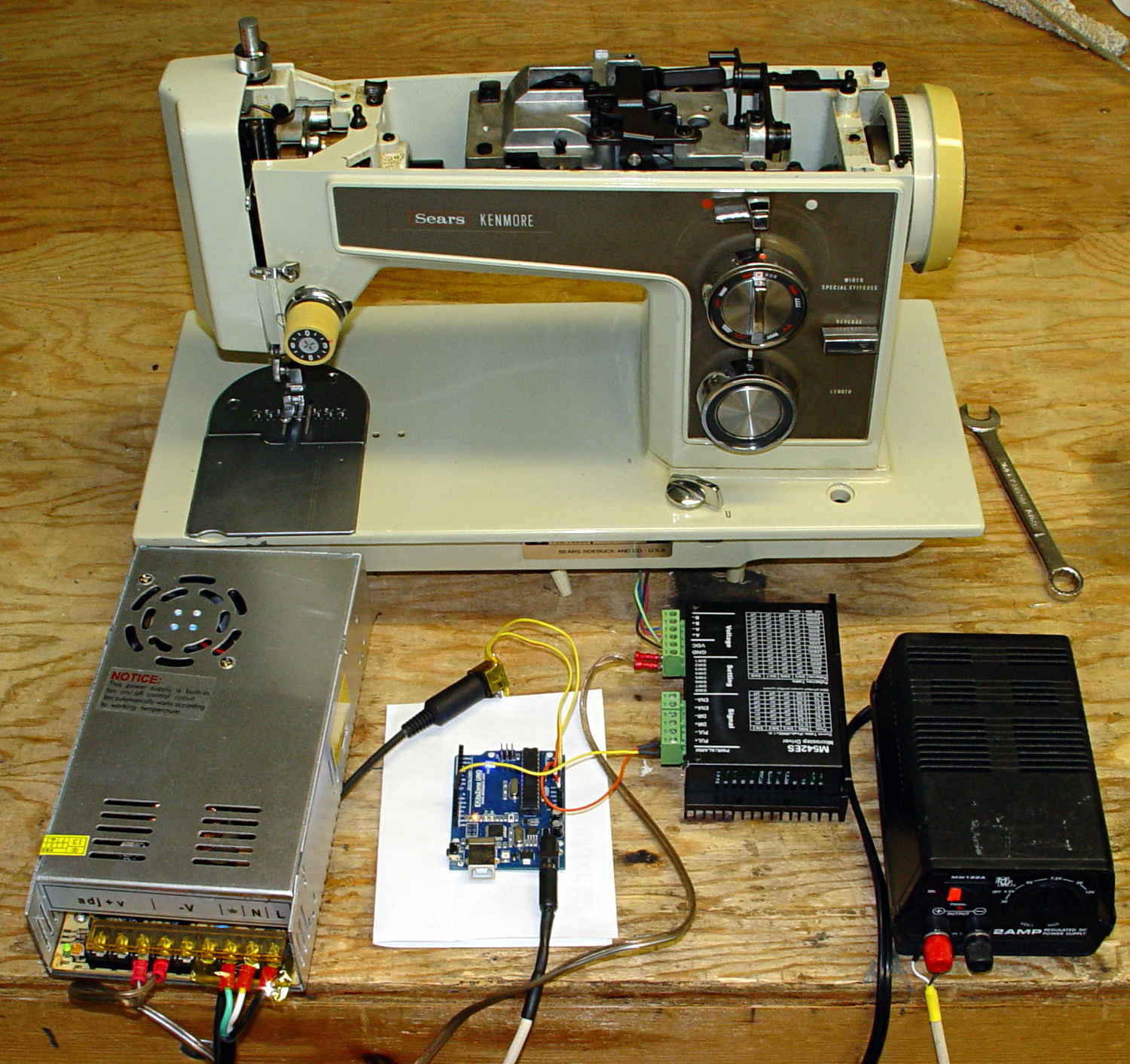
    So I wired a power supply to an M542 stepper driver brick, connected the pulse output of a function generator to the brick’s STEP inputs, swapped motor leads until it turned the proper direction (CCW as seen from the shaft end), and turned the function generator knob:

    Kenmore 158 - NEMA 23 stepper test
    Kenmore 158 – NEMA 23 stepper test

    The object was to find the step frequency where the motor stalls, for various winding currents and supply voltages. The motor won’t have enough torque to actually stitch anything near the dropout speed, but this will give an indication of what’s possible.

    With a 24 V DC supply and 1/8 microstepping (40 k step/s = 1470 RPM):

    • 1.00 A = 11 k step/s
    • 1.91 A = 44 k/s
    • 2.37 A = 66 k/s
    • 3.31 A = 15 k/s

    With a 36 V DC supply and 1/8 microstepping:

    • 1.91 A = 70 k/s
    • 3.31 A = 90 k/s

    With a 36 V DC supply and 1/4 microstepping (40 k step/s = 2900 RPM):

    • 1.91 A = 34 k/s
    • 2.37 A = 47 k/s
    • 2.84 A = 47 k/s
    • 3.31 A = 48 k/s

    The motor runs faster with a higher voltage supply, which is no surprise: V = L di/dt. A higher voltage across the winding drives a faster current change, so each step can be faster.

    The top speed is about 3500 RPM; just under that speed, the motor stalls at the slightest touch. That’s less than half the AC motor’s top speed under a similarly light load and the AC motor still has plenty of torque to spare.

    90 k step/s at 1/8 microstepping = 11 k full step/s = crazy fast. Crosscheck: 48 k step/s at 1/4 microstepping = 12 k full step/s. The usual dropout speed for NEMA 23 steppers seems to be well under 10 k full step/s, but I don’t have a datasheet for these motors and, in any event, the sewing machine shaft provides enough momentum to keep the motor cruising along.

    One thing I didn’t expect: the stepper excites howling mechanical resonances throughout its entire speed range, because the adapter plate mounts firmly to the cast aluminum frame with absolutely no damping anywhere. Mary ventured into the Basement Laboratory to find out what I was doing, having heard the howls upstairs across the house.

    She can also hear near-ultrasonic stepper current chopper subharmonics that lie far above my audible range, so even if the stepper could handle the speed and I could damp the mechanics, it’s a non-starter for this task.

    Given that the AC motor runs on DC, perhaps a brute-force MOSFET “resistive” control would suffice as a replacement for the carbon disk rheostat in the foot pedal. It’d take some serious heatsinking, but 100 V (or less?) at something under 1 A and intermittent duty doesn’t pose much of a problem for even cheap surplus MOSFETs these days.

    That would avoid all the electrical and acoustic noise associated with PWM speed control, which counts as a major win in this situation. Wrapping a speed control feedback loop around the motor should stiffen up its low end torque.

  • Gutting a Laser Pointer

    A small and defunct laser pointer emerged from the back of the workbench. There being no way to repair the thing, I filed a slit in the soft aluminum case and peeled it back to extract the guts:

    Gutted laser pointer
    Gutted laser pointer

    The corrosion on the spring adequately explains the “defunct” situation; that’s the – terminal for a trio of LR44 watch batteries. The + terminal is the glossy (aluminum flashed?) molded shape with the threads, which friction-jams into the outer tube with a tiny spur for “good” contact.

    Hotwiring a power supply to the appropriate terminals shows that the laser still works fine, even if the contacts are shot.

    The ribbed gray plastic ring on the business end of the laser adjusts a focusing lens. Behind that lies a cylindrical lens that corrects the beam’s astigmatism. It was a nice pointer, back in the day … and might work its way into an art project, if I ever get finished with the practical stuff.

  • Silicone Caulk + Desiccant = Win!

    After doing the second batch of quilting pin caps, I dropped the newly opened silicone caulk tube into a jar with some desiccant, which worked wonderfully well. Unlike the usual situation where the caulk under the cap hardens into a plug after a few weeks, the tube emerged in perfect condition. In fact, even the caulk in the middle of the conical nozzle was in good shape, with just a small cured plug on either end; it had been sitting inside a cloth wrap with no sealing at all.

    Here’s what it looked like after finishing the last of the most recent caps:

    Silicone caulk tube with silica gel
    Silicone caulk tube with silica gel

    The indicator card says the humidity remains under 10%, low enough to keep the caulk happy and uncured. Well worth the nuisance of having a big jar on the top shelf instead of a little tube next to the epoxy.

    Although I thought the desiccant was silica gel, it’s most likely one of the clay or calcium desiccants.

  • Kenmore 158: AC Motor Running on DC!

    The sewing machine had a three-contact plug / terminal block that joins all the wiring:

    Kenmore 158 - terminal block
    Kenmore 158 – terminal block

    For completeness, the matching socket (not shown) joins two cords:

    • AC line cord (two wire, not polarized, no ground)
    • Foot pedal

    Extract the motor wiring from that block and connect it to a 50 V / 3 A bench supply, with the positive lead to the marked wire conductor:

    Kenmore 158 AC motor - DC power
    Kenmore 158 AC motor – DC power

    Cranking the voltage upward from zero:

    Kenmore Model 158 AC Motor on DC - RPM vs V
    Kenmore Model 158 AC Motor on DC – RPM vs V

    So that’s about 200 RPM/V, offset by 2800 RPM. Totally unloaded, of course.

    The original data:

    DC V DC A RPM Notes
    15 0.29 690 Barely turning
    20 0.28 1380 Finger-stoppable
    25 0.29 2350
    30 0.29 3450
    35 0.30 4450
    40 0.29 5740
    45 0.29 6780 Still finger-holdable at start
    50 0.29 8000

    I can hold the shaft stopped between my fingers up through 45 V, with 0.54 A locked-rotor current at 25 V. The motor doesn’t have a lot of torque, although it’s operating at less than half the normal RMS voltage.

    I should take those numbers with the motor driving the sewing machine to get an idea of the actual current under a more-or-less normal load.

    Reversing the power supply leads shows that the motor rotates only counterclockwise, which is exactly what you’d expect: both polarities of the normal AC sine wave must turn the motor in the same direction.

  • Kenmore 158: Needle Position Sensing

    Fancy new sewing machines can stop with the needle either up (so you can remove the fabric) or down (to nail it in place while you rotate it). This requires sensing the needle position, which prompted me to spend far too long contemplating all the mechanical gadgetry driven by the motor.

    As nearly as I can tell, the crank counterweight behind the handwheel produces the most unambiguous position reports. Here’s what it looks like with the needle down:

    Kenmore 158 - main shaft counterweight
    Kenmore 158 – main shaft counterweight

    As you’d expect, with the shaft rotated exactly 180° from that point, the needle is up.

    The inviting space just above the shaft provides room for the bobbin winder that engages a knurled ring on the back of the handwheel, but the lower space seems to be available. The counterweight sits about halfway into the back of the handwheel, so the sensors must look at the frame side of the counterweight.

    Two adjacent sensors could detect the edge of the counterweight, which would be enough to uniquely identify both positions. If they were spaced across the lower-left edge in that picture:

    • 01 = trailing edge = bottom dead center = needle down (as shown)
    • 00 = open air = needle rising
    • 10 = leading edge = top dead center = needle up
    • 11 = solid steel = needle falling

    Either sensor gives you one pulse per handwheel revolution and the combination gives you a quadrature output of both position and direction. The top speed of 1000 RPM produces 17 Hz square waves.

    An additional pulse/rev sensor on the motor shaft would give better control over the motor speed, as the handwheel runs at 1/10 the motor speed with belt slip built right in. Figure 10 kRPM → 170 Hz pulses.

    From a cold start, you know the shaft angle to within a bit under 180°. If the motor can turn in both directions (as would a stepper or DC motor), you can always move the needle upward. If it turns only forward (as does the AC motor) and the needle is falling, then you probably don’t want to move the motor until you get a button push indicating that all fingers are clear.

    A pair of Hall effect sensors might suffice to detect that big hunk of steel, perhaps with a pair of teeny magnets glued to the face or a magnetic circuit closed by the counterweight.

    More pondering is in order.