The Smell of Molten Projects in the Morning

Ed Nisley's Blog: Shop notes, electronics, firmware, machinery, 3D printing, laser cuttery, and curiosities. Contents: 100% human thinking, 0% AI slop.

Category: Machine Shop

Mechanical widgetry

  • Pan Lid Handle Quieting

    Pan Lid Handle Quieting

    A surprisingly heavy stainless steel pan lid from the local ReStore has only one fault: when placed upside-down on the counter while we’re tending the pan contents, it will rock back and forth for nearly a minute. The lid has a rubberized insert for finger protection:

    Pan lid - original handle
    Pan lid – original handle

    However, the inserts cover only the side of the handle, so the metal arch rests on the counter. Setting it up in the shop let me scuff up the handle contact points:

    Pan lid - contact point
    Pan lid – contact point

    Then some Dremel grinding wheel work recessed the handle just barely below the inserts and changed the arch enough to keep it off the counter:

    Pan lid - recessed handle crest
    Pan lid – recessed handle crest

    The lid now stops rocking after a few seconds and is much quieter while doing so. It may require a bit more grinding, but it’s much better after this small intervention.

  • Miniblind Cord Caps: White PETG

    Miniblind Cord Caps: White PETG

    I managed to smash another miniblind cord cap and used white PETG this time around:

    Miniblind cord caps - white PETG
    Miniblind cord caps – white PETG

    It’s the same solid model as before, sliced with whatever improvements have transpired during the last four years.

    Made four of ’em, preemptively replaced the cap on the adjacent window, and tucked the last two away against future need.

  • Makergear M2 V4 Nozzle: Silicone Refresh

    Makergear M2 V4 Nozzle: Silicone Refresh

    After a year and a half, the silicone coat I’d applied to the M2’s nozzle had pretty much worn away, so I peeled off the remnants, buffed up the brass, and mushed on another coat:

    Makergear M2 V4 Nozzle - High-temp silicone coat
    Makergear M2 V4 Nozzle – High-temp silicone coat

    The coverage isn’t even, particularly in the direction I can neither see nor reach with the hot end still in the printer, but it’s way less hassle than recalibrating the Z=0 position. The very thin layer over the brass around the nozzle will vanish immediately on the skirt surrounding the first part.

    I should definitely recoat the nozzle more often, because PETG doesn’t stick to silicone nearly as well as it does to brass: a nice new coat makes the PETG burned-snot problem Just Go Away.

  • Can Opener Re-Gearing

    Can Opener Re-Gearing

    Six years on, I just deployed the last of the aluminum spares from the original CNC project:

    Can opener - new gear installed
    Can opener – new gear installed

    I swear the cutter gear on the left does not show that rust in person!

    This can opener has a slightly larger bolt than the previous ones, so I embiggened the hole with a step drill:

    Can opener - redrilling new gear
    Can opener – redrilling new gear

    Having run out of aluminum gears, I’ll be forced to make a hob to make a steel gear. Drat!

  • Motor Starting vs. Long Wires

    A recent email conversation may prove relevant to someone else …

    I have a pole barn which has approximately 100′ run of 10 gauge copper supplying power to the building. I … did not care to pay … $12,000 for a new 200′ line from the road … [with] only lights and 2 door openers for demand.

    I … put a 30 gallon air compressor in […]. When I first put it in, it struggled to start @<40 F. They called it a 1.6 running h.p. (whatever that means) motor. Nameplate shows 15/7.5 F.L.A. I switched it to 240v and the problem went away.

    Aren’t I likely to get the same problem as I had before or do 240 volt motors start easier?

    I screwed up when they buried the wire – in retrospect I would have buried 6ga to the barn to lessen the voltage drop.

    After running a few numbers, here’s what I came up with …

    do 240 volt motors start easier?

    The trouble with motors is they draw far more current while starting than they do while running. A factor of ten more is a good rule of thumb.

    So a “1.6 running HP” motor draws 1.2 kW while running at full load:
     – 10 A at 120 V
     –  5 A at 240 V

    The “full load amps” will be higher than that, because the motor isn’t 100% efficient. You can plug the FLA values into the calculation for an even more depressing result.

    During the fraction of a second when it’s starting, however, it will (try to!) draw 100 A or 50 A, depending on which line voltage you’ve wired it for.

    100′ run of 10 gauge copper

    That’s 200 feet of wire out-and-back.

    Look up the resistance per foot in a wire table, finding 10 AWG wire has a (convenient!) resistance of 1 mΩ/ft, so a 200 ft length has 0.2 Ω of resistance:

     – A 10 A load drops 2 V
     – A  5 A load drops 1 V

    Both of which are survivable in normal operation at their respective line voltages.

    However, the motor starting currents will be completely different. A 100 A current will (try to!) drop 20 V, reducing the line voltage to 100 V and stalling the motor. Running the motor from 240 V means the 50 A starting current drops only 10 V and the remaining 230 V can get the motor up to speed.

    Now, 240 V service isn’t a complete solution. The new compressor draws 15 “full load amps”, so it’ll drop 3 V while it’s running and 30 V while starting. It’ll probably start at 210 V, but it may grunt for a bit longer than you like as the speed comes up and the current goes down.

    in retrospect I would have buried 6ga to the barn

    There’s a Pennsylvania Dutch saying: “We grow too soon old and too late smart.” [grin]

  • Mini-Lathe ER Collet Chuck Drawbar

    Mini-Lathe ER Collet Chuck Drawbar

    The ER-16 and ER-32 collet chucks use an M12×1.75 bolt to snug their MT3 tapers in the Mini-Lathe spindle. As nearly as I could figure, I needed a 190 mm bolt to get enough thread engagement, but the nearest available sizes were either too short or too long.

    Fortunately, making round things is what a lathe is all about:

    MT3 drawbar - assembled
    MT3 drawbar – assembled

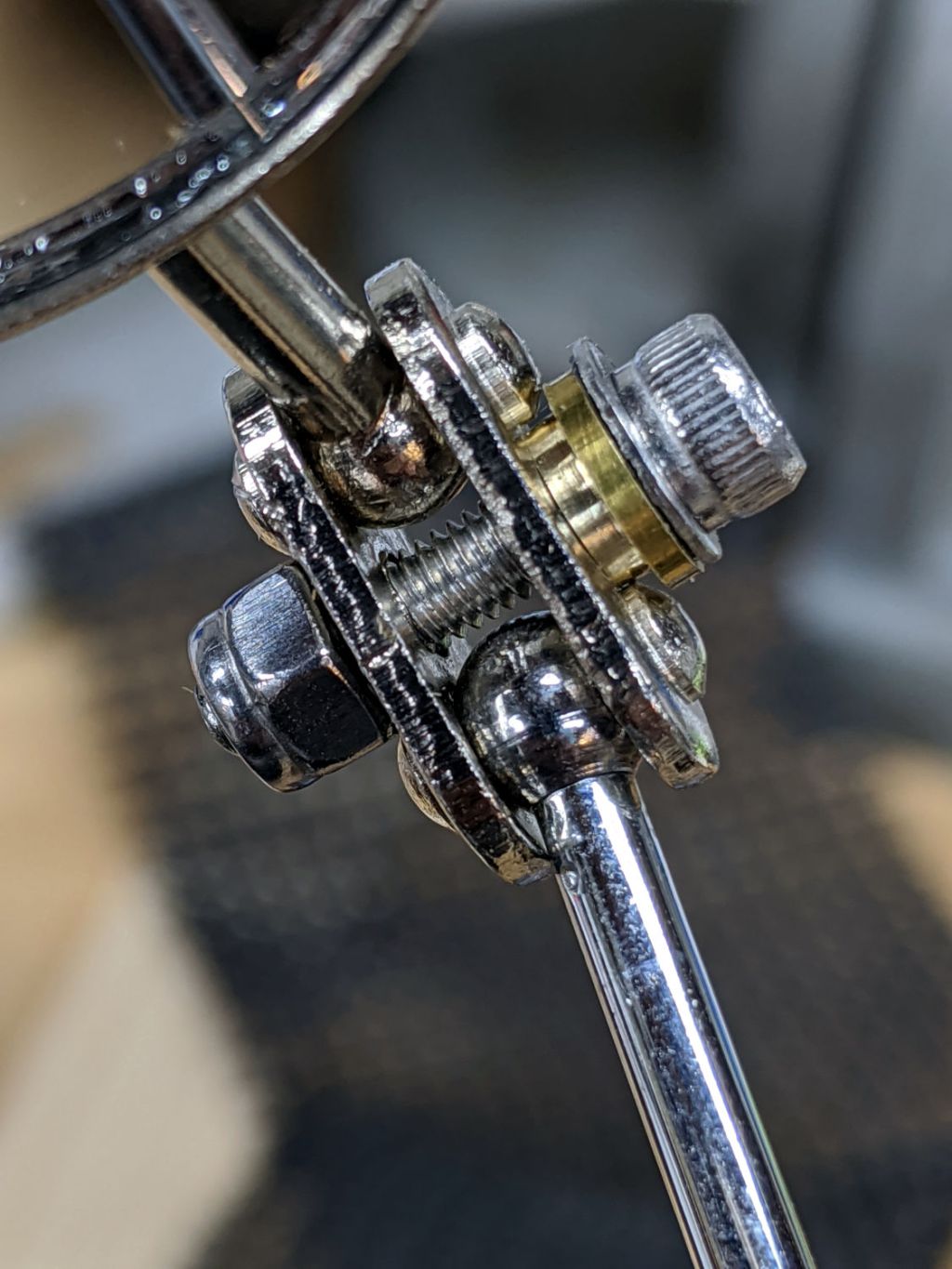
    The aluminum bellyband adds 30 mm to the length and aligns the bolt sections, with the threaded section from a long 5/16-18 bolt inside holding the metric bolt together:

    MT3 drawbar - parts
    MT3 drawbar – parts

    Although I got it right on the first try (!), the bellyband lets me fine-tune the length as needed.

    The original dimension doodle and some in-flight updates:

    ER Collets - MT3 drawbar bolt - dimension doodles
    ER Collets – MT3 drawbar bolt – dimension doodles

    The fancy brass / bronze washer comes from a battered rod with mushroomed ends. A pair of V-blocks let me cut a chunk off one end with negligible drama:

    Bronze Bar Stock - support fixture
    Bronze Bar Stock – support fixture

    It’s clamped firmly to the right block and a few licks with a file knocked off enough of the mushroom on the left end to put it flat(-ish) into the V; the near side of the right block is barely raised off the surface.

    Face off the mushroom to get a flat spot for a center drill:

    MT3 drawbar - battered bronze rod
    MT3 drawbar – battered bronze rod

    Some peaceful turning & boring produces a pretty washer:

    MT3 drawbar - washer cutoff
    MT3 drawbar – washer cutoff

    The bore needed a bit of relief to seat the bolt head squarely on the outer surface:

    MT3 drawbar - spindle washer
    MT3 drawbar – spindle washer

    And then It Just Fit™:

    MT3 drawbar - installed
    MT3 drawbar – installed

    Loctite on the inner bolt threads should keep everything together.

  • Bathroom Door Retainer: Bigger and Stronger

    Bathroom Door Retainer: Bigger and Stronger

    After three years, the retainer holding the front bathroom door open against winds blowing through the house on stormy days finally fractured, right at the top of the towel rack where you’d expect it:

    Bathroom Door Retainer - fractured
    Bathroom Door Retainer – fractured

    I was all set to add reinforcing pins and whatnot, then came to my senses and just made the whole thing a few millimeters larger:

    Bathroom Door Retainer - stronger
    Bathroom Door Retainer – stronger

    Customer feedback indicates white blends better with the background.

    I made a few minor tweaks to the original design, including slightly larger bumps to hold it against the towel bar that, regrettably, put corresponding gouges into the bar. Who knew they used such soft plastic back in the day?

    The OpenSCAD source code as a GitHub Gist:

    // Bathroom Door Retainer
    // Ed Nisley KE4ZNU – May 2017
    // 2020-07 beef up, particularly at top of bar
    Layout = "Show"; // [Show, Build]
    //——-
    //- Extrusion parameters must match reality!
    /* [Hidden] */
    ThreadThick = 0.20;
    ThreadWidth = 0.40;
    HoleWindage = 0.2;
    Protrusion = 0.1; // make holes end cleanly
    function IntegerMultiple(Size,Unit) = Unit * ceil(Size / Unit);
    //——-
    // Dimensions
    /* [Dimensions] */
    TowelBarSide = 20.5; // towel bar across flat side
    TowelBarAngle = 45; // rotation of top flat from horizontal
    BumpOD = 2.0; // retaining ball
    DoorOffset = 14.0; // from towel bar to door
    DoorThick = 37.0;
    WallThick = 8.0; // minimum wall thickness
    PlateThick = 4.0; // … slab
    RetainerDepth = 15.0; // thickness of retaining notch
    NumSides = 6*4;
    CornerRad = WallThick;
    BarClipOD = TowelBarSide*sqrt(2) + 2*WallThick;
    BarClipRad = BarClipOD/2;
    OAH = RetainerDepth + PlateThick;
    module LatchPlan() {
    union() {
    linear_extrude(height=OAH,convexity=4)
    difference() {
    union() {
    circle(d=BarClipOD,$fn=NumSides);
    hull()
    for (i=[0,1], j=[0,1])
    translate([i*(BarClipRad + DoorOffset + DoorThick + WallThick – CornerRad),j*(BarClipRad – CornerRad)])
    circle(r=CornerRad,$fn=4*4);
    }
    rotate(TowelBarAngle) // towel bar shape
    square(size=TowelBarSide,center=true);
    translate([0,-TowelBarSide/sqrt(2)]) // make access slot
    rotate(-TowelBarAngle)
    square(size=[2*TowelBarSide,TowelBarSide],center=false);
    }
    for (a=[0:180:360])
    rotate(a + TowelBarAngle)
    translate([TowelBarSide/2,0,OAH/2])
    rotate([90,0,45])
    sphere(d=BumpOD,$fn=4*3);
    }
    }
    module Latch() {
    difference() {
    LatchPlan();
    translate([BarClipRad + DoorOffset,-BarClipRad/2,-Protrusion])
    cube([DoorThick,BarClipOD,RetainerDepth + Protrusion],center=false);
    }
    }
    //——-
    // Build it!
    if (Layout == "Show") {
    Latch();
    }
    if (Layout == "Build") {
    translate([0,0,OAH])
    rotate([180,0,0])
    Latch();
    }

    Done!