The Smell of Molten Projects in the Morning

Ed Nisley's Blog: Shop notes, electronics, firmware, machinery, 3D printing, laser cuttery, and curiosities. Contents: 100% human thinking, 0% AI slop.

Category: Home Ec

Things around the home & hearth

  • Whirlpool Refrigerator Fan Noise: Final Fix

    Well, that fix didn’t take long to fail; they sure don’t make ’em like they used to:

    OEM Replacement fan in freezer
    OEM Replacement fan in freezer

    The “new” fan’s bearing failure sounded more like an owl than a dog, but it was certainly not what we wanted to hear in the middle of the night. A replacement fan costs on the order of $60, which seems like an absurdly high number for what’s basically a clock motor, a plastic fan blade, and some stamped steel.

    After mulling the situation for a bit, I concluded that the refrigerator has reached that age where stuffing more money into it doesn’t make much sense: the compressor will drop dead in fairly short order. It’s time for a gonzo fix that also slightly reduces the clutter in the Basement Laboratory Warehouse: stick a PC case fan and wall wart into the freezer, ignore their temperature ratings, and see what happens.

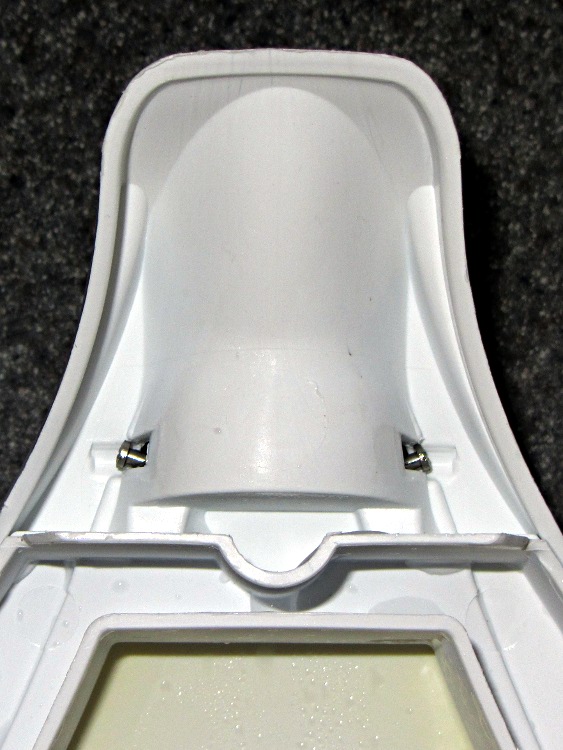
    A polycarbonate sheet, a band saw, some step drills, a big hole saw, and an hour of Quality Shop Time produced a perfectly serviceable space transformer to mate the fan to the airflow director:

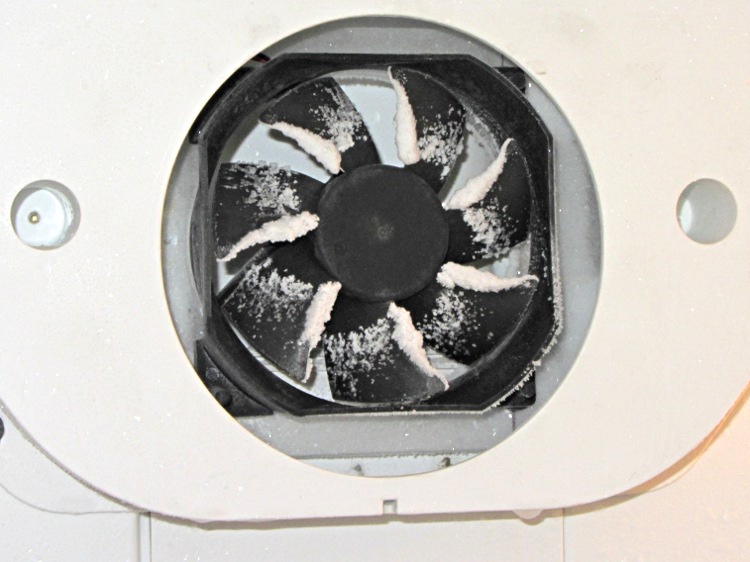
    PC case fan in air flow director
    PC case fan in air flow director

    The plate surrounds the squishy foam washers from the OEM motor mount, with the fan on its own rubbery posts: there won’t be any vibration transmitted to the plastic air flow director! The obligatory Kapton tape on the right holds a closed-cell foam wrap around the wires to prevent rattling; I’d done much the same when I tore the thing apart after the first OEM fan failure.

    The air flow is toward you out of the screen: the fan draws air from the refrigerator compartment through the evaporator coils, then directly into a square duct that leads back to the refrigerator. Whatever doesn’t make it into the duct flows into the freezer compartment through the row of vents at the top of the picture.

    I assume some serious modeling went into choosing the OEM fan blade configuration and spacing so as to optimize the distribution. I hope just moving some air in roughly the right direction will suffice; I have no way to measure any interesting numbers, so this is entirely cut-and-try.

    The PC case fan expects 12 VDC, which comes from a standard wall wart conspicuously labeled “For Indoor Use Only”. Well, this is certainly indoor, even if it’s not quite what they expected. The wart plugs into a cobbled-together extension cord receptacle with male 1/4 inch quick-disconnect tabs that match the female QD connectors on the OEM wiring harness that originally plugged into the fan:

    PC case fan with adapted wall wart
    PC case fan with adapted wall wart

    All that fits into the space behind the rear panel, with the wart wrapped in a sheet of closed-cell foam to prevent rattling and provide a bit of protection:

    PC case fan installed in freezer
    PC case fan installed in freezer

    The rear panel covers the mess, exposing only the row of vent holes along the top. The air flow is upward through the evaporator coil and fins, through the fan, and back to the two compartments.

    One question remains: will the fan continue to start below 0 °F (-20 °C)?

    Given the ball bearings in the fan, it ought to remain quiet, but I’ve thought that before. Now, however, I have a generous supply of case fans and wall warts that plug into the mechanical and power adapters, so I can replace fans for a long time.

  • Whirlpool Refrigerator Fan Noise: Solved Again and Again

    Back in 2006, our ancient (19-ish years old) Whirlpool refrigerator started making weird howling noises suggested someone broke into the house and stuffed a dog inside the freezer. Turned out to be the fan behind the rear panel of the freezer compartment that moves air across the cooling coils and down into the refrigerator compartment; evidently the sintered bronze bearings wore just enough to let the shaft oscillate side-to-side while rotating.

    I ordered a replacement, but then decided to try an old fix: put a dollop of STP in the bearings. That added enough damping to kill the resonance and let the old fan turn freely. It worked so well that I put the new fan on the shelf in case it came in handy later on.

    Years passed… and then, as if by magic, the freezer dog reappeared.

    Mary moved the contents to the downstairs chest freezer (she’s much more organized than I and wanted to find things again), I pulled the old fan out, installed the “new” fan, buttoned up the freezer, and it ran fine.

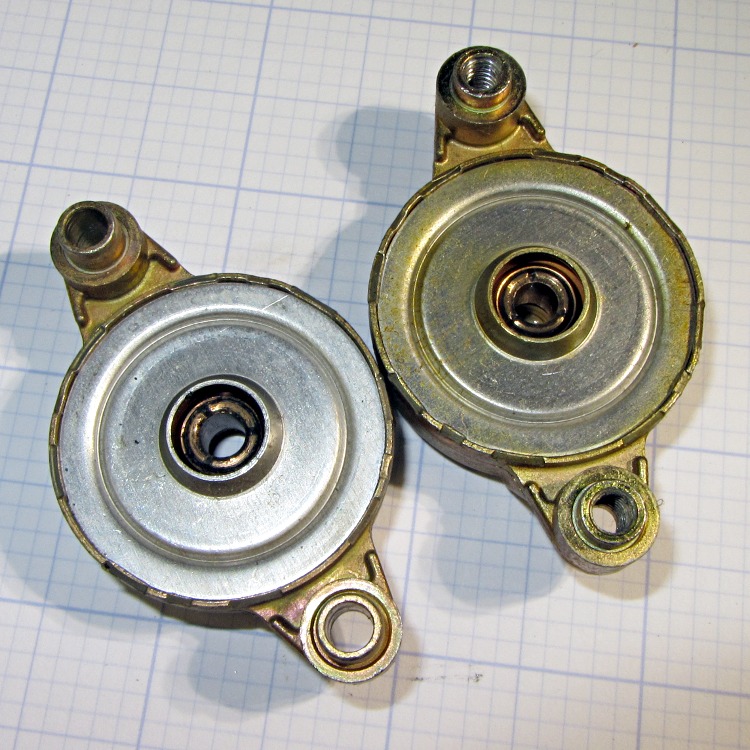
    Whirlpool refrigerator fans
    Whirlpool refrigerator fans

    Until about two in the morning, when the freezer dog began howling again…

    As nearly as I can tell, the new fan’s bearings arrived just slightly oversize; I doubt they’re pre-worn.

    So I applied the STP fix to the new fan:

    • Remove the compression fitting from the fan blade hub
    • Remove the fan blades from the shaft
    • Remove the screws & nuts holding the frame together
    • Remove motor shaft from bearings
    • Put a drop of STP into the rear bearing
    • Slather a ring of STP around the front bearing
    • Deliberately misalign the self-aligning bearings to redistribute the slack
    • Reassemble in reverse order

    It’s been running silently for a day, which suggests it’ll be good for quite a while…

  • Colgate-to-Crest Toothpaste Cap Adapter

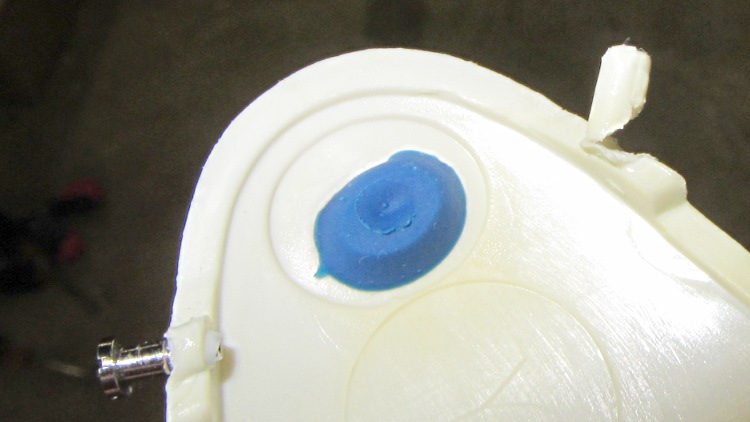
    I’ve always liked flip-top toothpaste tube caps, which Colgate tubes have and Crest tubes don’t. I’m sure there’s a reason why they use different threads; perhaps there’s a standard for toothpaste tube threads that encompasses both?

    Anyhow, after years of pondering this dilemma, I jammed a Colgate cap and the top of a Crest tube onto a length of 5/16″ drill rod and eased some epoxy into the joint:

    Colgate-Crest adapter - gluing
    Colgate-Crest adapter – gluing

    It turns out that the minor diameter of the Colgate cap is just slightly smaller than the major diameter of the Crest tube, so they don’t quite slide together. The epoxy makes for a perfect, zero-clearance fit that’s so tight you must crunch the tube to unscrew it:

    Colgate-Crest adapter - thread form
    Colgate-Crest adapter – thread form

    For what it’s worth, that buttress thread form provides a leakproof seal in the original tube.

    I have no idea whether this will actually work, because the closet has a three-pack of Colgate that should last for quite a while. Yes, we tend to buy whatever toothpaste seems cheapest on a per unit basis when we’re restocking the closet…

  • Why I Don’t Like Hotel Networks

    Perhaps this indicates most folks can’t configure network encryption with known parameters, but advising everybody to just turn that pesky WEP stuff off seems, well, misguided:

    Disable WEP
    Disable WEP

    Sniffing a guest’s private bits from an unencrypted link doesn’t pose any challenge at all and, given the hotel’s location in Hartford’s hot urban core, I’d expect absolutely no security-by-obscurity whatsoever.

    On the other paw, Dragorn of Kismet points out the triviality of a man-in-the-middle WiFi attack no matter what encryption you might (think you) have in effect. So maybe it doesn’t make much difference.

    And if you think the wired network is inherently more secure, that should change your mind.

  • Tea Ball Revivial: Redux

    That tea ball (OK, infuser) hasn’t killed me yet, but it was looking rather grody despite a more-or-less monthly run through the dishwasher. So when Mary made up a bleach solution to sterilize her plant starting pots, I tossed it into the bottom of the pan for half an hour:

    Bleached tea ball
    Bleached tea ball

    Zowie! All the organic schmutz vanished, leaving it as good-looking as new.

    No before picture, alas, but maybe next time…

    Memo to Self: Do that more often.

  • DIY Vanilla Extract: Batch 2 On the Shelf!

    After decanting the homebrew vanilla extract from those bottles, I added enough vodka to cover the spent beans, ran them through the blender, and drained the liquid:

    Draining the vanilla dregs
    Draining the vanilla dregs

    It’s rather muddy and probably not worth keeping, but we’ll see what settles out:

    DIY Vanilla dregs
    DIY Vanilla dregs

    The Good Stuff looked like this before it went into a dark corner of the Basement Laboratory Storage Warehouse:

    DIY Vanilla Extract - Batch 2 Done
    DIY Vanilla Extract – Batch 2 Done

    It turns out you (well, I) cannot run vanilla extract through an ordinary coffee filter: it just doesn’t drain well at all. Cheesecloth didn’t seem worth the effort, so I combined all the clear liquid in a single jar, let it settle for a few days, then decanted it back into those three bottles again. The bottom of the rightmost bottle has a layer of what Breyers calls “real vanilla bean specks” in their ice cream.

    In round numbers, $20 for half a pound of beans and $16 for a 1.75 l bottle of 80 proof vodka adds up to $36 for maybe 1.4 l of DIY vanilla extract = $26/l. Commercial vanilla extract runs about $72/l, so that’d be $100 in those bottles.

    One could drive the DIY price down by processing more beans at a time, but this should keep us in vanilla for quite a while; that cup of hot cocoa in the afternoon smells really good now!

  • Kensington Expert Mouse: Unit 3

    A week or so ago, the scroll ring on the Kensington Expert Mouse trackball at my left hand failed completely. Unlike the previous repair attempts, tweaking the IR emitter-detector pair positions did nothing. Tried it on three different PCs and five different operating systems with the same result: the ring stayed dead.

    Fortunately, this one was a warranty replacement for the dead Unit 1 I bought some years back and was still within its 5 year warranty, so when I contacted Kensington tech support with the story they immediately shipped a replacement. It just arrived and works fine.

    The scroll ring detents seem much smoother on this one, so I haven’t taken it apart to remove the magnetic latch and don’t know if they’re using a different quadrature sensor. One can but hope.

    Kensington Expert Mouse - ball bearing
    Kensington Expert Mouse – ball bearing

    For what it’s worth, an absolutely brand new ball barely moves on those three jeweled bearings (one marked with the yellow oval in the picture). Just rub the ball on one side of your nose to add some skin oil: shazam it spins like glass on ice.

    They don’t mention that trick anywhere in the meager instructions…

    Update: Eight years in the future, a real fix appears!