Ed Nisley's Blog: Shop notes, electronics, firmware, machinery, 3D printing, laser cuttery, and curiosities. Contents: 100% human thinking, 0% AI slop.
Mary has been listening to library books while she quilts and sews; some of the older books actually come on cassette tapeand our tape players still work. The newer books come on CDs, but it seems the library hasn’t gotten into audio e-reader files yet. She actually prefers tapes, because she can simply stop the tape and restart it from the same place without any further intervention.
In any event, a recent tape stalled about 1/4 of the way through and refused to either rewind or fast forward.
Rather than returning it to the library, which I’m certain all previous borrowers did, I took the cassette apart. This is no big deal, I’ve done it many times before cassettes fell into the dustbin of history.
That made the failure quite obvious:
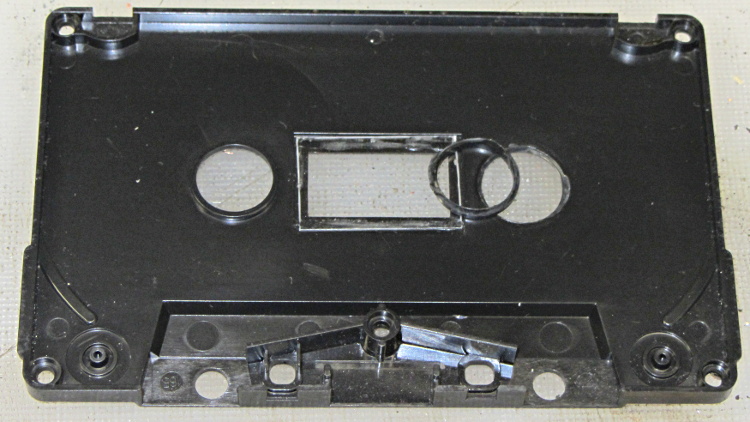
Cassette tape case – detached bushing
The bushing around one of the hub openings had completely fractured and come loose, jamming the tape hub in place.
A ring of solvent adhesive around both parts, a few minutes of clamping, and it’s all good again.
Don’t tell the library; they get tetchy about DIY repairs…
It turns out that dropping a dark-gray USB flash drive on a dark carpet under a table in a dimly lit room doesn’t produce a net increase in happiness. The next time that happens, we’ll be able to find the thing:
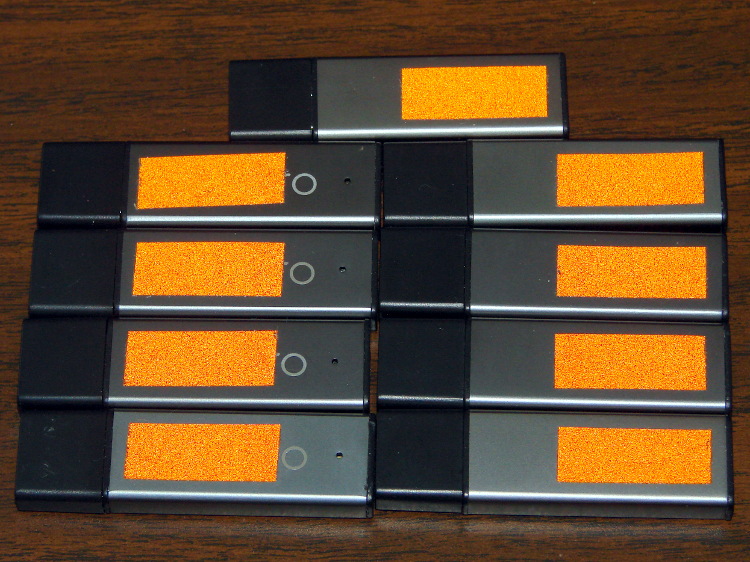
Centon 4 GB USB Flash Drives – reflectorized
Each side has a snippet of retroreflective orange tape; the tenth drive lives with the Token Windows Laptop. Done!
In related news, the Dremel Wrench went missing despite its high-viz tape. I vaguely recalled tucking it into a tool bag for a remote house-call repair jog, but a week later it turned up in the breast pocket of my demin jacket. Maybe it needs a bulky lanyard?
This is not made obvious at the outset, but a video card with a DMS-59 connector that can drive a pair of Single Link DVI monitors cannot drive a single Dual Link DVI monitor: the DMS-59 connector doesn’t have the required signals.
The fact that each of the Single Link DVI connectors on the end of the DMS-59 Y-splitter cable have enough pins (well, holes) to mate with a Dual Link DVI cable doesn’t clarify the situation.
Of course, you can’t combine two separate Single Link outputs into a Dual Link input.
An HDMI 1.4 cable can support a single 2560×1440 monitor, but not from this resolutely low-res video card.
Yes, thank you so much! Everything you said was true. Apparently someone’s USB drive was infected and infected many computers here. We are very appreciative for your technological detective work. The head of IT was very incredulous because everything is deep frozen after it is shut down. But it was all true and I am very grateful
The part about “many computers here” seems worrisome; they’re apparently not running any defensive software at all.
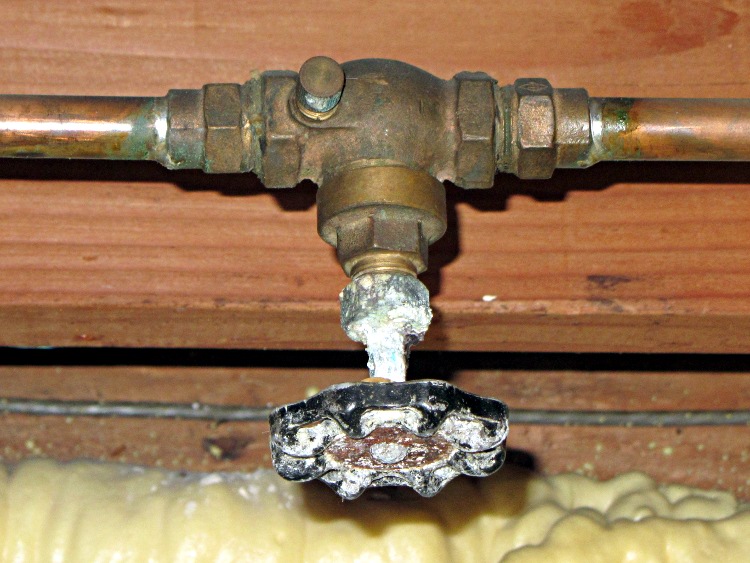
After replacing the hose valve in the garage, I promised to repair its leaky upstream shutoff valve:
Corroded gate valve
I shut off the hard water supply, dismantled the valve, and let everything soak in a cup of white vinegar for a few hours. The fizzing was a wonder to behold and the parts came out much cleaner without any effort at all.
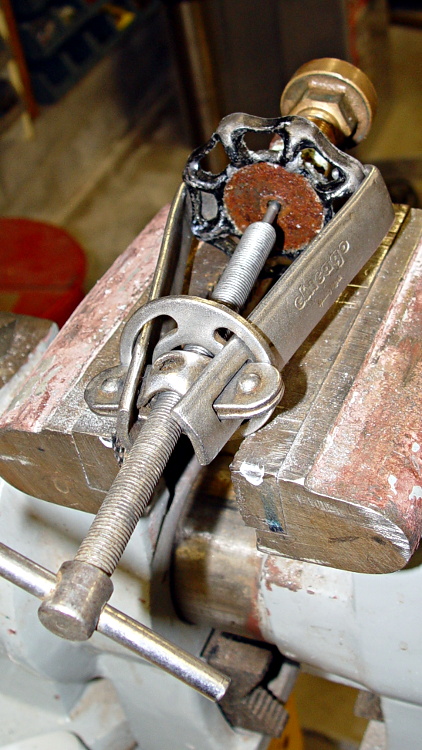
Removing the handle required the handle puller and considerable rapping on the corroded-in-place handle at the tapered shaft. That reddish disk used to be a tin-plated steel data plate, but now it’s just a corroded sheet:
Shutoff valve – handle puller
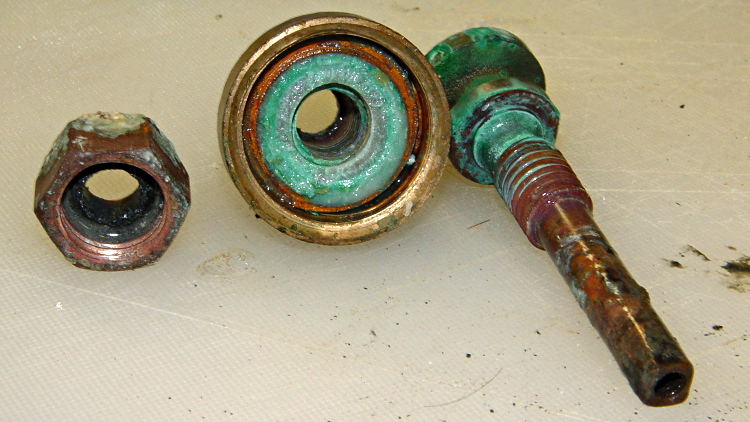
Because a shutoff valve will be open nearly all the time, it has a large washer that seals the cap and valve stem in addition to the usual stem packing:
Shutoff valve – full-open washer
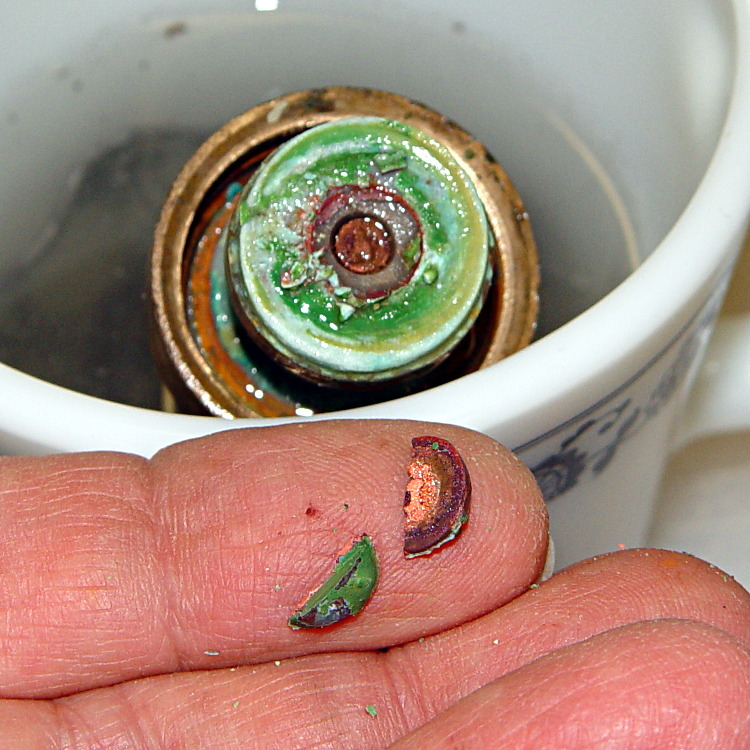
Attempting to remove the screw from the stem broke the head into two pieces:
Shutoff valve – broken washer screw
Worse, the screw shaft was a soft mass of corroded brass, so I had to drill it out and chase the threads with a 10-32 tap. I replaced the full-open washer with a slightly smaller one from the supply box, which required drilling out the hole to suit, adding some packing string under the main cap, and replacing the packing around the stem. But, eventually, putting everything back together works fine with no leaks at all.
This turned out to be slightly less horrible than I expected, which probably doesn’t justify procrastinating until the evening before the coldest night of the season.
Strange though it may seem, the kitchen faucet handle broke while Mary was using it. The rear wall of the socket that fits over the cartridge valve stem fractured:
American Standard Faucet Handle – broken mount
Having no water in the kitchen is not to be tolerated, so I applied a redneck fix while pondering the problem:
Kitchen Faucet – redneck handle repair
Based on that comment, I called the American Standard hotline (800-442-1920), described the situation, and they’re sending a replacement handle and cartridge. Evidently the new handle won’t fit the old cartridge, which makes me feel better about not stockpiling repair parts, even while I now wonder what the new cartridge part number might be and how you’d tell them apart.
Anyhow, the redneck fix wouldn’t suffice for the next week; I needed something slightly more permanent. The broken wall fit neatly in place on the mount, but:
It must withstand far more force than a simple glue joint can provide
I can’t machine square holes
Wrapping a metal sleeve around the mount seemed like too much work
You undoubtedly saw this coming a while ago:
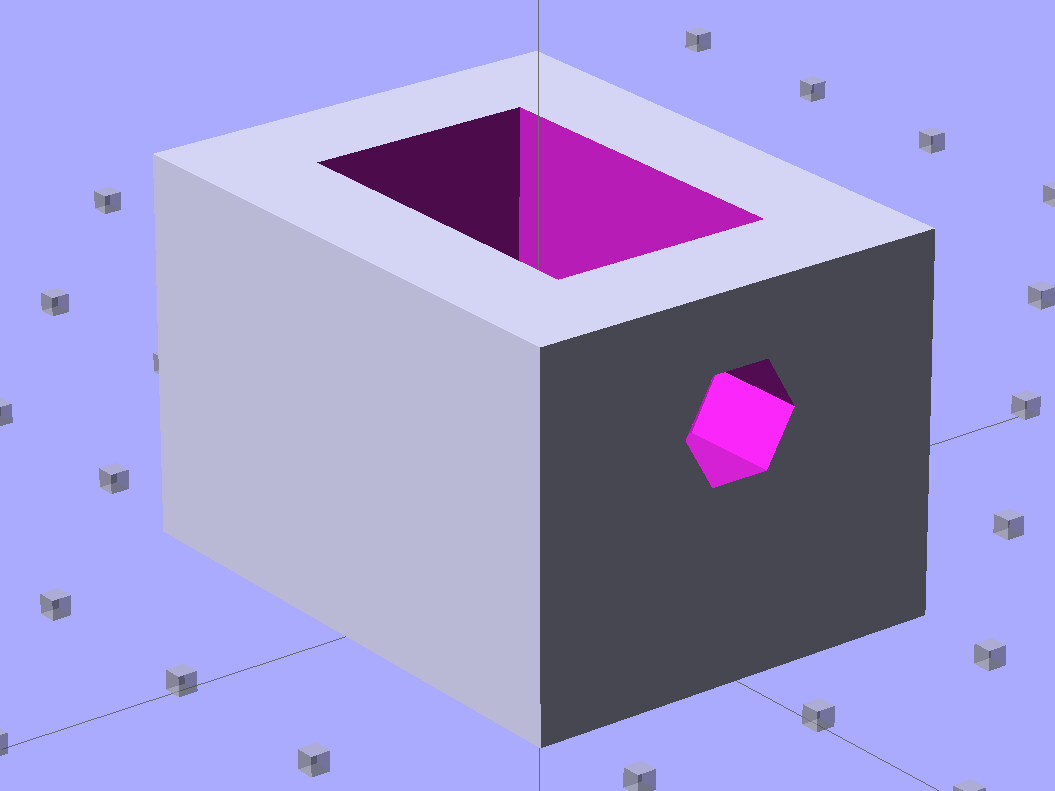
Am Std Faucet Handle Sleeve – solid model
The mount tapers slightly from the handle body toward the open end to provide draft for the molding process. I applied a hull() operator to two thin rectangles spaced the right distance apart along the Z axis to create a positive model of the mount, which then gets subtracted from the blocky outer rectangle. The hole clears a 10-32 screw that fits the standard setscrew threads (normally hidden behind the handle’s red-and-blue button).
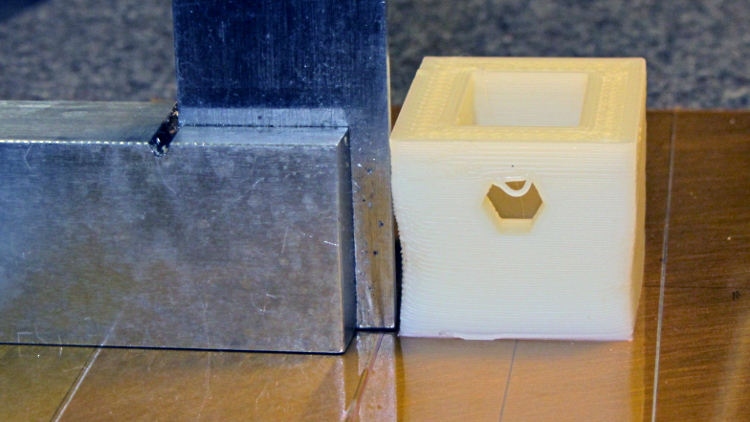
Unlike most printed parts I’ve done recently, the sleeve suffered from severe shrinkage along the outside walls:
Faucet handle sleeve – build distortion
The inside maintained the right shape, so I cleared the nubs with a file and pressed it in place around the mount with the rear wall snapped into position. The black plastic socket evidently isolates the handle from the valve stem and I used a stainless 10-32 screw to prevent the nightmare scenario of having the sleeve slide downward along the tapered mount and block the setscrew. Overall, it came out fine:
American Standard faucet handle – compression sleeve
However, the chunky sleeve didn’t clear the opening in the escutcheon cap, which put the cap on the windowsill for the next week. The result works much better than the redneck fix and looks almost presentable. It’s certainly less conspicuous:
American Standard faucet handle – temporary repair
I hope the new handle has a much more robust socket…
The OpenSCAD source code:
// Quick fix for broken American Standard Elite 4454 faucet handle
// Ed Nisley KE4ZNU February 2013

//- Extrusion parameters must match reality!
//  Print with +2 shells and 3 solid layers

ThreadThick = 0.25;
ThreadWidth = 2.0 * ThreadThick;

HoleFinagle = 0.4;
HoleFudge = 1.00;

function IntegerMultiple(Size,Unit) = Unit * ceil(Size / Unit);
function HoleAdjust(Diameter) = HoleFudge*Diameter + HoleFinagle;

Protrusion = 0.1;           // make holes end cleanly

//----------------------
// Dimensions

Wall = 5.0;

Slice = ThreadThick;                // minimal thickness for hull object

ShaftEnd = [11.6,17.8,Slice];
ShaftBase = [12.1,18.8,Slice];
ShaftLength = 19.0;

Block = [(ShaftBase[0] + 2*Wall),(ShaftBase[1] + 2*Wall),ShaftLength - Protrusion];

ScrewOffset = 6.5;          // from End
ScrewDia = 5.0;             // clearance

//----------------------
// Useful routines

module ShowPegGrid(Space = 10.0,Size = 1.0) {

    Range = floor(50 / Space);

    for (x=[-Range:Range])
        for (y=[-Range:Range])
            translate([x*Space,y*Space,Size/2])
            %cube(Size,center=true);

}

module PolyCyl(Dia,Height,ForceSides=0) {           // based on nophead's polyholes
  Sides = (ForceSides != 0) ? ForceSides : (ceil(Dia) + 2);
  FixDia = Dia / cos(180/Sides);
  cylinder(r=HoleAdjust(FixDia)/2,h=Height,$fn=Sides);
}

//----------------------
// Model the handle's tapered shaft

module Shaft() {

    hull() {
        translate([0,0,ShaftLength - Slice/2])
            cube(ShaftEnd, center=true);
        translate([0,0,Slice/2])
            cube(ShaftBase, center=true);
    }

}

//----------------------
// Build it!

ShowPegGrid();

difference() {
    translate([0,0,ShaftLength/2])
        cube(Block,center=true);
    Shaft();
    translate([0,0,ShaftLength - ScrewOffset])
        rotate([-90,0,0])
            PolyCyl(ScrewDia,ShaftBase[1],6);
}