Ed Nisley's Blog: Shop notes, electronics, firmware, machinery, 3D printing, laser cuttery, and curiosities. Contents: 100% human thinking, 0% AI slop.
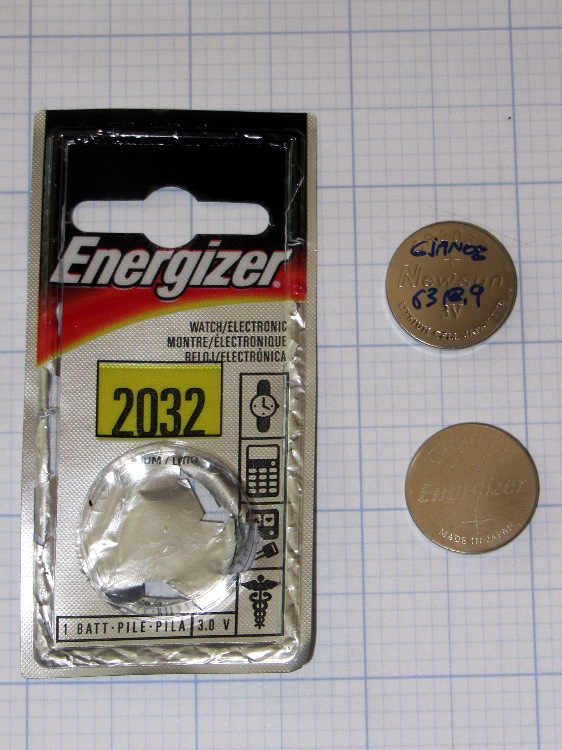
The display on Mary’s Cateye Astrale cyclocomputer (remember cyclocomputers?) faded to gray, which meant a new CR2032 lithium cell was in order. I grabbed one from the heap, popped out the old cell, inserted the new cell, and … the display stayed blank.
Quick like a bunny, I reinserted the old cell to save the odometer (15524 miles) and wheel circumference (1475 mm) data; the display returned to dim gray.
The “new” cell, which came from an unopened pack, read 0.45 V with no load…
The cell didn’t have a date code, but the package sports a cryptic MU that might encode the date of manufacture or the date of packaging or the copyright date or something; the various search results aren’t forthcoming and the Energizer site gives no explanation.
I’m pretty sure I haven’t owned that package for more than a few years and it’s been in a shirtsleeve environment (plus the occasional hot van) ever since.
Another Energizer cell from a more recent lot, bearing CA on the package and YA on the cell, worked fine.
Being that sort of bear, I wrote the date and mileage on the previous cell (a Newsun, whoever they are, with a 3Y code), because the last time around the odometer value didn’t survive the cell change. The current total works out to 277 miles/month = 3300 miles/year, including winter downtime, which is fine with us; we mostly ride the bikes around town on errands and take the occasional tour.
After un-bending the top of a pole lamp that suffered an untimely collision with the floor, I discovered that the entire stock of three-way bulbs in the heap had at least one burned-out filament each; I’d acquired them when Mom moved out of the Ancestral House, so they dated back a long time. So I figured I’d insert a decently sized single-filament bulb and be done with it.
Three-way lamp sockets have an additional tab contact between the usual central contact and the outer shell:
Interior of 3 way lamp socket
The shell forms the common contact for the filaments and the switch counts in binary: off / off, off / on, on / off, on / on. In principle, the tab sits low enough to not contact the shell of an ordinary bulb.
I was doing this in the Basement Laboratory Workshop Wing, with the lamp plugged into the outlet strip along the front edge of the bench; that way, I simply poked the power strip button to remove line voltage from the lamp while swapping bulbs. So I:
turned the power strip off
unscrewed the last dead three-way bulb
threw it away
screwed in an ordinary bulb
turned the strip on
At which point all the fluorescent overhead lights in the Laboratory went dim, the shop resounded with a deep resonant groan, and the acrid smell of electrical death filled the air. Elapsed time less than a second, tops.
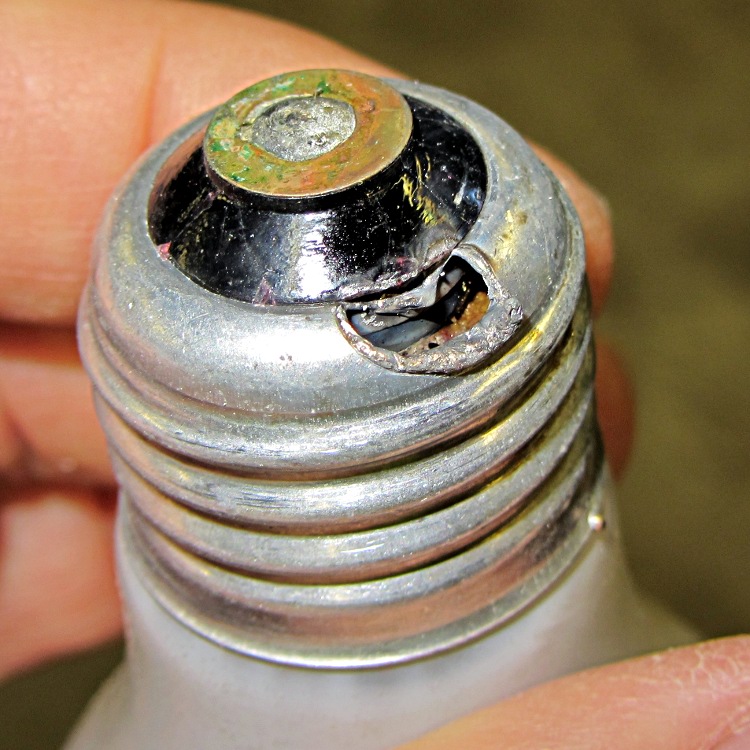
Come to find out that the socket’s contact tab stuck up a little bit further than it should, producing a dead short across the line:
Melted bulb base
Of interest: the branch circuit breaker didn’t trip, the GFI on the circuit didn’t trip, and the pop-out breaker in the power strip didn’t trip.
Huh.
I harvested the pole sections, the base counterweight, and the line cord. The rest of the corpse joined the bulbs in the trash…
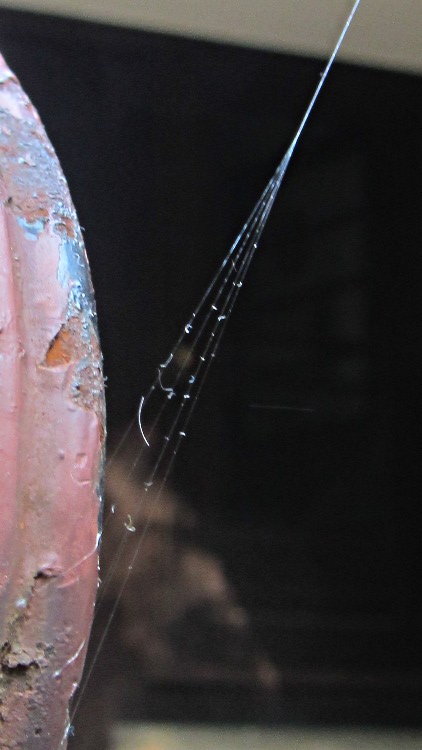
August was the month for giant orb weaving spiders; a pair of thumb-sized monsters took up residence under the gutter over the patio. One started by anchoring its web to the handrail by the steps:
Web anchor on handrail
While we like and encourage spiders, that anchorage didn’t last long and, yes, I must strip and repaint that railing…
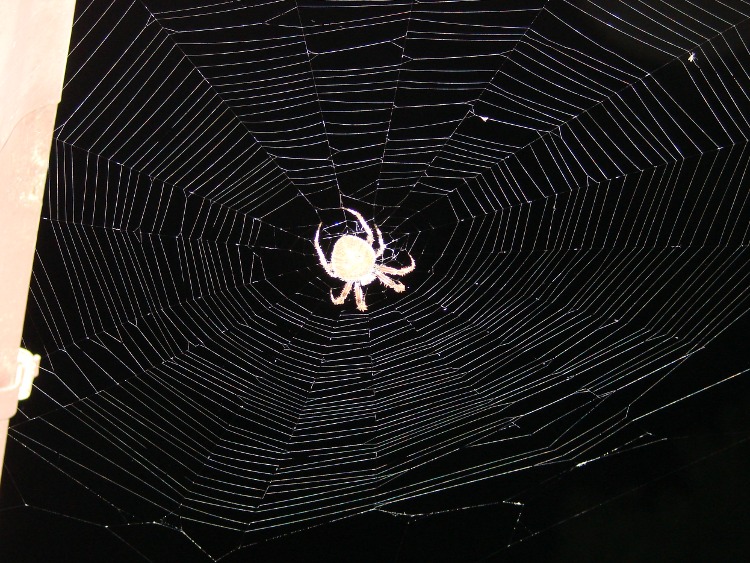
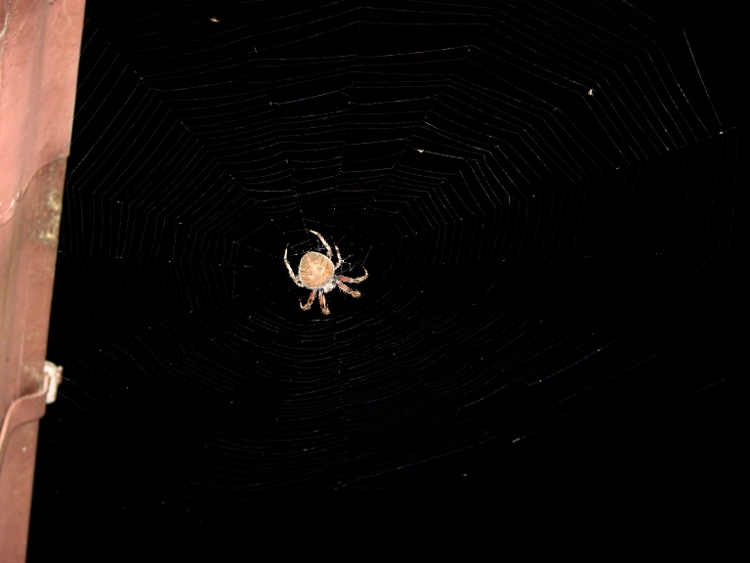
There’s a horizontal web at the corner of the gutter over the back door:
Orb spider at gutter – light
Changing the exposure to favor the spider loses the web strands:
Orb spider at gutter – dark
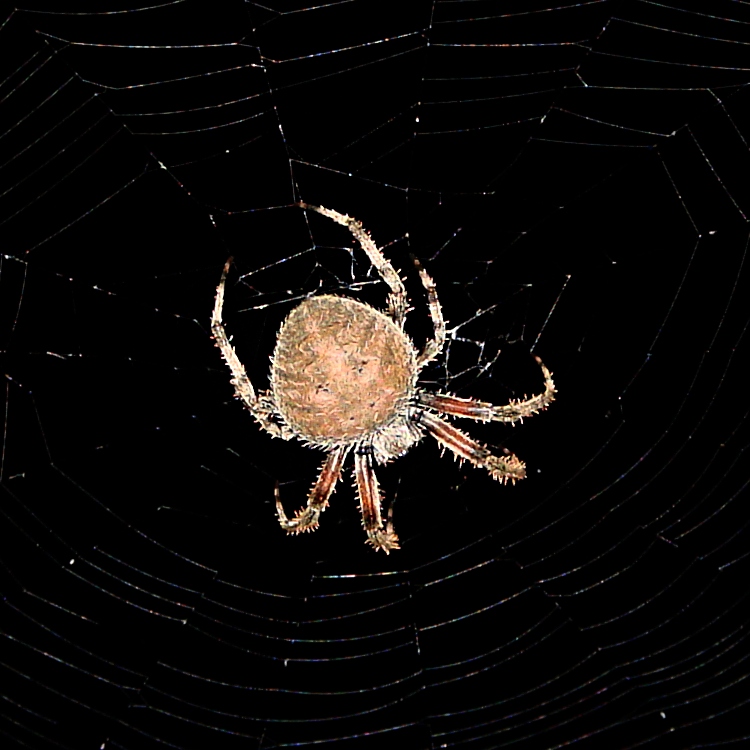
Cropping that one down around the spider shows they really are the stuff of nightmare:
Orb spider – detail
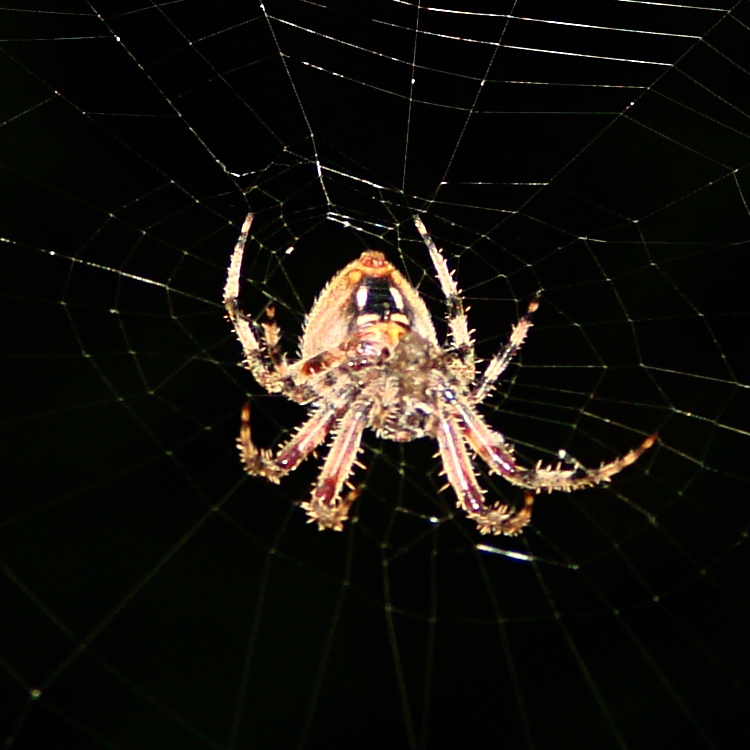
The other spider prefers a vertical web attached along the gutter and anchored to a patio chair, which means I can get between the house and the web to see the spider’s tummy:
Orb spider – ventral
We leave the lights on in the evening for their benefit…
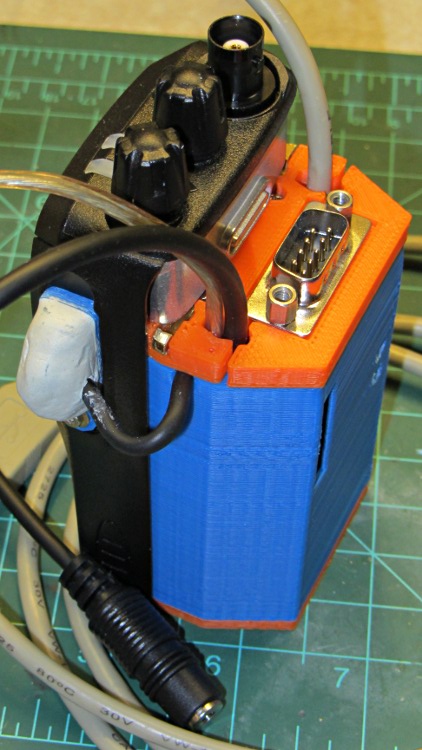
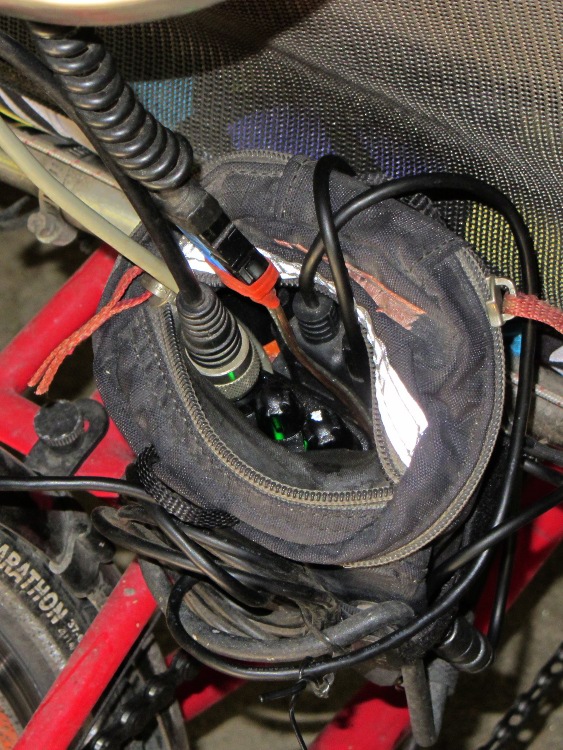
Both of the GPS+voice interfaces for the Wouxun KG-UV3D radios have been working fine for a while, so I should show the whole installation in all its gory detail.
If you haven’t been following the story, the Big Idea boils down to an amateur radio HT wearing a backpack that replaces its battery, combines the audio output of a Byonics TinyTrak3+ GPS encoder with our voice audio for transmission, and routes received audio to an earbud. Setting the radios to the APRS standard frequency (144.39 MHz) routes our GPS position points to the global packet databaseand, with 100 Hz tone squelch, we can use the radios as tactical intercoms without listening to all much of the data traffic.
The local APRS network wizards approved our use of voice on the data channel, seeing as how we’re transmitting brief voice messages using low power through bad antennas from generally terrible locations. This wouldn’t work well in a dense urban environment with more APRS traffic; you’d need one of the newfangled radios that can switch frequencies for packet and voice transmissions.
So, with that in mind, making it work required a lot of parts…
The flat 5 A·h Li-ion battery pack on the rack provides power for the radio; it’s intended for a DVD player and has a 9 V output that’s a trifle hot for the Wouxun radios. Some Genuine Velcro self-adhesive strips hold the packs to the racks and have survived surprisingly well.
Just out of the picture to the left of the battery pack sits a Byonics GPS2 receiver puck atop a fender washer glued to the rack, with a black serial cable passing across the rack and down to the radio bag.
A dual-band mobile antenna screws into the homebrew mount attached to the upper seat rail with another circumferential clamp. It’s on the left side of the rail, just barely out of the way of our helmets, and, yes, the radiating section of the antenna sits too close to our heads. The overly long coax cable has its excess coiled and strapped to the front of the rack; I pretend that’s an inductor to choke RF off the shield braid. The cable terminates in a PL-259 UHF plug, with an adapter to the radio’s reverse-polarity SMA socket.
The push-to-talk button on the left handgrip isn’t quite visible in the picture. That cable runs down the handlebar, along the upper frame tube, under the seat, and emerges just in front of the radio bag, where it terminates in a 3.5 mm audio plug.
The white USB cable from the helmet carries the boom mic and earbud audio over the top of the seat, knots around the top frame bar, and continues down to the radio. USB cables aren’t intended for this service and fail every few years, but they’re cheap and work well enough. The USB connector separates easily, which prevents us from being firmly secured to a dropped bike during a crash. I’d like much more supple cables, a trait that’s simply not in the USB cable repertoire. This is not a digital USB connection: I’m just using a cheap & readily available cable.
I long ago lost track of the number of Quality Shop Time hours devoted to all this, which may be the whole point…
In other news, the 3D-printed fairing mounts, blinky light mounts, and helmet mirror mounts continue to work fine; I’m absurdly proud of the mirrors. Mary likes her colorful homebrew seat cover that replaced a worn-out black OEM cover for a minute fraction of the price.
My buddy Duggles, from far-off NH, restored his ’83 Vanagon to its original hippie-chick-magnet state. Late in the process, he realized that the once-fancy CD+radio widget in the dashboard lacked a line input for his iPod / iPad / iDingus. Knowing my foibles, he asked for advice.
Fortunately, he’d already discovered the service manual, without which life is always much more difficult. Search for PIONEER DEH2850MP SERVICE MANUAL and pick the site you prefer.
The trouble with jamming a new line input into the existing circuitry is that you must match the DC levels as well as the audio amplitude. The schematic on page 19 shows the selector IC has capacitor-coupled inputs and outputs to strip off the DC level.
It would be very easy if the multiplexer (IC151, top of page 19, detail shown) had separate control inputs that we could override, but it uses a serial control stream from the CPU. No practical way to mess with that, alas.
As nearly as I can tell, the best way to do this would be to hack a DPDT switch between the FM/AM tuner and the amp, upstream of the mux. You pick the Radio input, flip the DPDT switch, and the iDingus plays through the Radio inputs.
However, an easier way is to simply inject the iDingus audio in parallel with the tuner audio, but set the tuner to an FM frequency without a radio station. The radio output should mute, leaving the field clear for the iDingus audio. This might not work, but it’ll be dead simple to try. If it’s acceptable, then you’re done.
The obvious problem is that we don’t know if the iDingus line level matches the tuner’s line level. The mux is upstream of the volume settings, so there’s hope that this will all Just Work. If it’s way too loud, that’s fixable. If it’s too soft, that’s a problem.
So, to begin…
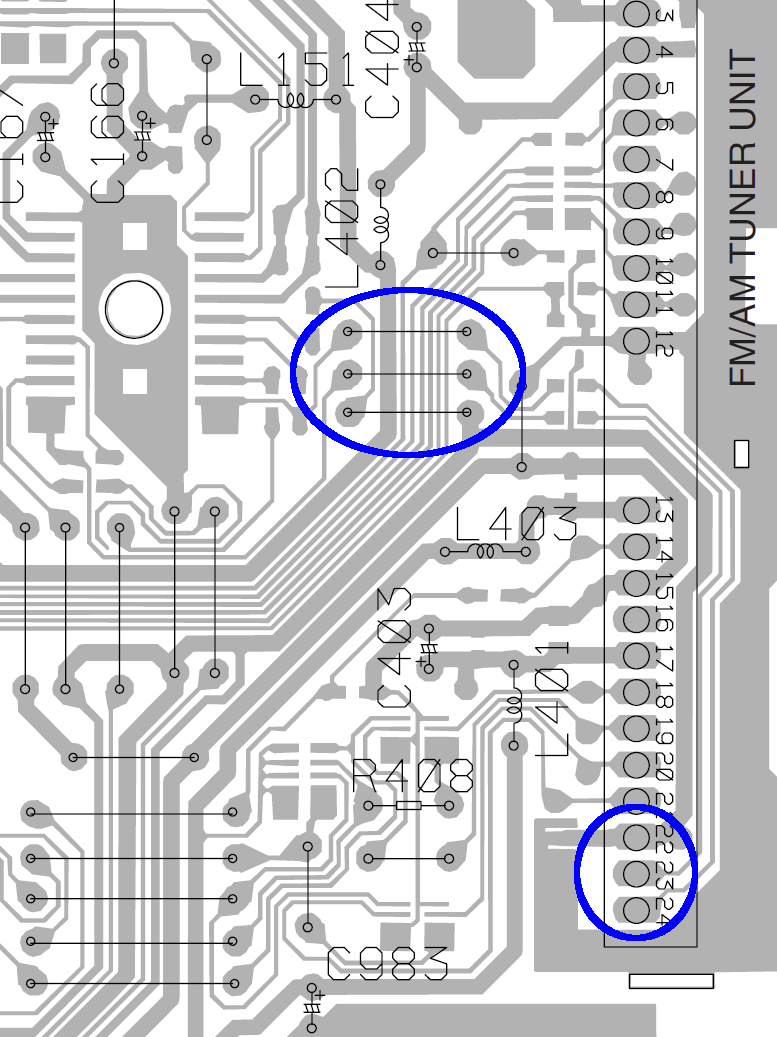
DEH2850MP PCB Radio Jumpers
The diagram on page 36/37 shows the A side of the PCB, with all the connectors & suchlike. The FM/AM Tuner Unit is over along the right side, with the audio output on pins 23/24 near the bottom and ground on pin 22. The traces proceed upward along the edge of the PCB, cross the connector near its middle, the audio passes through caps C151/152 on the B side, go through two jumpers on the A side across a mess of traces, and then dive to the B side and wriggle into the IC151 mux.
Quite conveniently, the ground trace follows along with them and is the lower of the three traces just to the right of the mux.
If I interpret the part number for C151 correctly (page 45, top right):
C 151 ... CKSRYB224K10
it’s a 220 nF cap. Anything around that value should work. This one from Radio Shack is grossly overpriced; anything with the same or larger value is OK (voltage rating doesn’t matter): NTE MLR224K100 – 0.22MF 100V Mylar Capacitor
Solder one lead of each cap to the top two jumpers, solder suitable wires to the other cap leads, solder the ground / shield wire to the bottom jumper, solder a suitable jack to the cable, plug iDingus into jack, fire that mother up, and see what happens.
The right channel is on pin 24, which goes to the top jumper of the three. Don’t bother trying to figure out which pin of the iDingus corresponds to that channel; just solder the damn wires and fix it later if it’s wrong enough to be objectionable.
I have no idea where or if you can drill hole(s) to snake the cable(s) through the housing. If the Vanagon doesn’t have a rear power amp, you could probably cut the traces under those RCA jacks (CN352, top right on page 37, above the FM/AM tuner) and repurpose them.
Give it a go…
We both attended Lehigh U, but Duggles realized early on that he lacked the personality flaws common to engineers and bailed out before damaging himself too badly. So his reply didn’t surprise me in the least…
I read your instructions carefully, examined the kindly supplied circuit diagram, and pored over the circuit boards with a magnifier. Then I blew you off (!!), threw caution to the winds, hacked off an old headphone cord, snaked the wires in, and soldered right to the very convenient L/R outputs on the RF board. Fired it up ,,, shitz, tons of background hiss, no quieting on the FM signal! A skein of obscenities was loosed in the mountain air until I thought to turn the iThang on … boom, full quieting, no hiss, and a quite substantial sound. No level issues at all, quite clean and detailed, and I didn’t even use the capacitors! (What was their purpose btw?)
The mux has a DC bias on its signal lines, with caps on both the input and output to isolate it from the surrounding circuitry. Back in the day, analog switches were fussy about their DC bias, so you had to go overboard to make them work at all.
I don’t know if the iDingus also has DC blocking caps on its output and figured that injecting raw DC from the mux into its guts could be a Bad Thing. But, eh, those engineers at Apple (‘s contractor) are smart folks and (probably) anticipated this sort of (mis)behavior.
The hiss you get with the iDingus turned off probably comes from dragging the mux bias to ground. I don’t know that’s a Truly Bad Thing, but adding those caps should eliminate any future problems.
You could even play DJ by combining radio & iDingus audio!
Rock on…
Seeing as how Duggles actually was a DJ for quite some years, I wouldn’t be surprised in the least to hear he does exactly that. We’ll be visiting him later this Autumn and I’ll inspect his work.
Each of the three chandeliers in the Poughkeepsie Train Station sports 36 bulbs in two rings. When the station opened in 1918 they installed those newfangled incandescent bulbs that were all the rage at the time. The color of the bulbs in this Wikipedia picture, dated October 2007, suggests that tungsten ruled for at least nine decades:
Poughkeepsie Train Station Interior
Since then, they installed chunky compact fluorescent bulbs that probably provide the same amount of light, minus the pinpoint highlights from tungsten filaments in clear bulbs. This view from below the central chandelier shows the layout and some detail of the carving & decorative sockets:
Pok RR Station Middle Chandelier – detail
In addition to being decorative, those chandeliers also give useful data on the reliability of compact fluorescent bulbs. With the contrast stretched the other way to make the bulbs easier on the eye, count the number of deaders in …
Chandelier 1:
Pok RR Station Chandelier 1
Chandelier 2:
Pok RR Station Chandelier 2
Chandelier 3:
Pok RR Station Chandelier 3
I took each picture from a vantage point showing all the deaders; the bulbs hidden behind the central dingus work.
Let us assume all 108 bulbs were installed at the same time and, given the number of deaders, haven’t been touched since then (although they’re not covered in fuzz, which suggests that they’ve been dusted within living memory). I was there in mid-afternoon, so the bulbs probably burn 24 hours/day and aren’t subject to early failure from frequent starts.
So, in no more than five years, 108 CFL bulbs have a 4.6% failure rate, which works out to 0.9%/year, more or less, ignoring any infant mortality. If they’ve been up there for the last 2.5 years, then it’s 1.8%/year. Replacing deaders since installation, of course, makes it worse than that.
Over the course of a decade, a compounded 0.9% failure rate will kill 9.4% of the bulbs. After 20 years, 20% will be dead. A 1.8% annual failure rate kills 20% and 43%, respectively.
Now, I’ll grant you that tungsten bulbs burn far more energy over that time, but replacing a percent or two of those complex and somewhat eco-hostile CFL bulbs every year cuts away a big chunk of the rainbows-and-pink-unicorns delight involved in Saving The Planet.
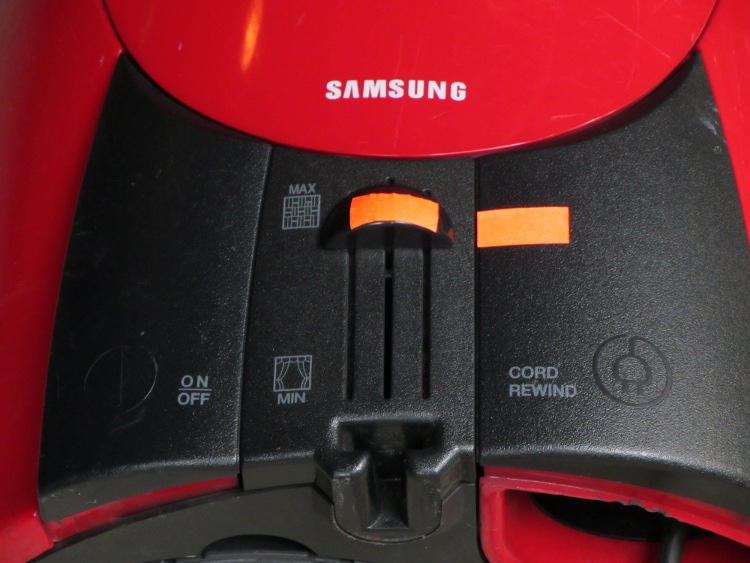
After having discovered, once again, that the vacuum cleaner wasn’t cleaning very well because the suction control was knocked halfway down the scale, I made the normal setting on the damn thing visible:
Samsung vacuum cleaner control labeling
I don’t know why a label in dark-gray-on-black is such a wonderful idea, given that SAMSUNG stands out in pure white-on-red. Designers love subtle touches; I suppose they expect you to just puzzle it out and memorize the right answer.
The embossed / raised black-on-black symbols don’t work for me, either. Did you spot the one to the left of the ON/OFF label? Didn’t think so.









 The Smell of Molten Projects in the Morning