The Smell of Molten Projects in the Morning

Ed Nisley's Blog: Shop notes, electronics, firmware, machinery, 3D printing, laser cuttery, and curiosities. Contents: 100% human thinking, 0% AI slop.

Category: Electronics Workbench

Electrical & Electronic gadgets

  • Tour Easy: Bafang 11.6 A·h Range

    Tour Easy: Bafang 11.6 A·h Range

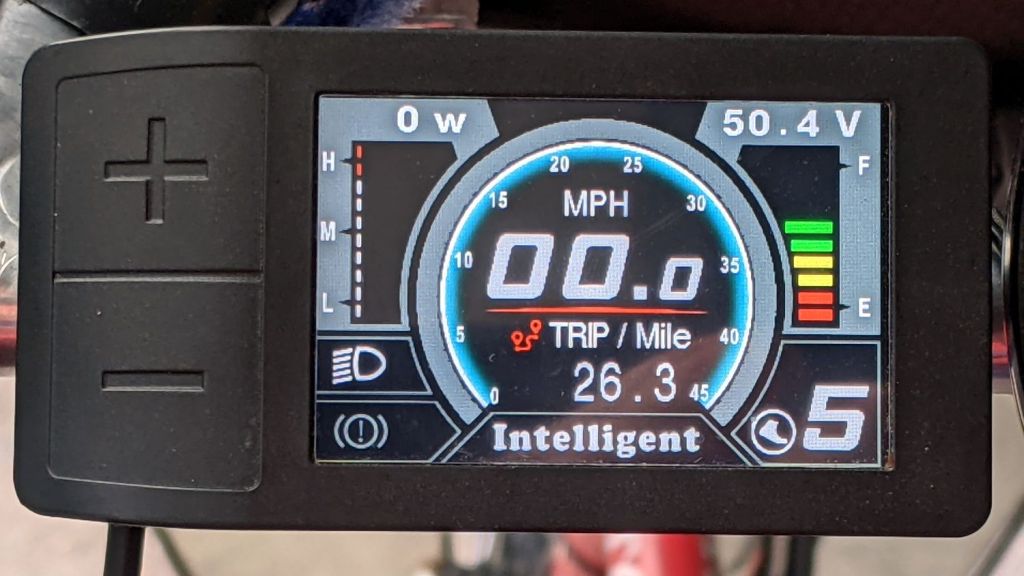
    After a few days of riding, the Bafang 500C display on Mary’s bike gives the battery status:

    Bafang 500C display - 48 mi 30 pct
    Bafang 500C display – 48 mi 30 pct

    The thermometer scale on the right shows 30% remaining battery capacity after 48.3 miles of riding, with the 11.6 A·h battery at 47.3 V.

    For our type of riding, each 10% increment of battery charge delivers about 7 miles of range. Although we could probably get 70 miles between charges, recharging the battery at 20 to 30% makes more sense; the bike is in the garage, so why not?

    Our typical 10 to 15 mile rides now average 12+ mph, with some level sections ticking along at 18 mph (giving me some serious exercise), which isn’t much by pro rider standards.

    Computing the lithium battery charge state by measuring its voltage isn’t particularly accurate, but it’s about as good as you’re going to get.

  • Amber 1 Watt LED: MP1584 Hackery

    Amber 1 Watt LED: MP1584 Hackery

    The PCB wrapping a buck regulator around an MP1584 chip uses a tiny trimpot to set the output voltage:

    MP1584 buck regulator PCB
    MP1584 buck regulator PCB

    The 01D resistors use the EIA-96 identifier series and are 100 kΩ.

    Based on simpleminded testing, a 1 W amber LED drops about 2.5 V at 430 mA. A 1 Ω ballast resistor drops another half volt and burns a quarter of a watt, sufficient to cover some LED forward drop variation.

    The trimpot is entirely too twitchy, so I replaced it with an SMD resistor:

    Amber 1W LED - fixed voltage SMD
    Amber 1W LED – fixed voltage SMD

    The trimpot read 26.5 kΩ after I extracted it, but I surely nudged it a smidgen in the process.

    For the record (first column is SMD topmark, second is measured resistance):

    • 3012 = 29.9 kΩ (!!) → 3.67 V into a 100 Ω resistor
    • 2492 = 24.9 kΩ → 3.19 V : 2.63 V @ 550 mA = 1.45 W
    • 2362 = 22.6 kΩ → 2.97 V : 2.52 V @ 450 mA = 1.13 W
    • 223 = 22.0 kΩ → 2.91 V : 2.484 V @ 425 mA = 1.06 W

    With 6.3 V @ 210 mA = 1.3 W from the bench regulator, the resistor now burns 180 mW at 425 mA and the LED burns 82% of the input power.

    Letting it cook overnight settled out with the LED at 2.47 V and 440 mA = 1.09 W, with 6.3 V at 220 mA = 1.4 W from the bench supply. The LED dissipates 78% of the input power and the resistor burns 190 mW = 14%, so the regulator uses 120 mW = 8%.

    I can come close to the final output voltage by plugging the new resistor value and the 8.2 kΩ resistor (on the PCB) into the MP1584 datasheet equations, but figuring the resistor to get a specific output voltage seems largely empirical.

  • Amber 1 Watt LED: First Light

    Amber 1 Watt LED: First Light

    After the rather disappointing results of the truck side marker LED light, this seems more promising:

    Amber 1W LED - test heatsink
    Amber 1W LED – test heatsink

    The 1 watt amber LED is soldered to an aluminum heat spreader stuck to a scrap heatsink with thermally conductive tape. The PCB is a buck converter build around an MP1584 regulator. The lens on the left claims a 5° beam angle, which seems aspirational at best.

    Not counting the heatsink, you’re looking at less than three bucks of parts; living in the future is great.

    Fitting the lens over the LED produces a shatteringly bright beam, at least in the Basement Laboratory:

    Amber 1W LED - lens test
    Amber 1W LED – lens test

    The lens has a conical cavity surrounding the LED lens to capture the light and redirect it to the beam forming reflector. It’s done with total internal reflection, there are no coatings, and it’s a wonder to behold: one-shot molded aspheric optics at work.

    Not seating the lens firmly against the LED produces a dark spot in the middle of the beam. I soldered the leads directly to the LED and cut out the sides of the black lens holder, as soldering them to the convenient side pads would prevent the lens from seating properly.

    The LED drops about 2.5 V at 430 mA (1.08 W). The bench supply delivered 6.3 V at 190 mA (1.2 W) to simulate the headlight output of the Bafang motor controller.

    The headlight output is good for 6-ish V and 3 W = 500-ish mA, so burning half the power in a simple dropping resistor or linear current regulator is a Bad Idea™. You can get constant current LED drivers, but apparently not with 6 V input and 1 W output, so stepping the voltage down makes more sense. You’d want at least a little ballast resistor in there to soak up small forward drop changes with temperature variations.

    The regulator can handle up to 28 V input and the tiny trimpot must cover nearly that range of output voltages, so the 2.5 V output jams it near the minimum end of its rotation (which is, of course, backwards). This calls for a fixed resistor to eliminate the effects of vibration on a trimpot at 10% of its range.

  • Amber Side Marker Light Hackery

    Amber Side Marker Light Hackery

    Start with the amber side marker light sporting a cataract and distorted beam:

    Side Marker - beam test - E
    Side Marker – beam test – E

    Part off the lens:

    Side Marker E - cutting case
    Side Marker E – cutting case

    The cut is just in front of the PCB and went slowly to avoid clobbering the SMD resistors very near the edge.

    The cataract turned out to be crud adhered to the LED lens:

    Side Marker E - LED cataract
    Side Marker E – LED cataract

    Brutal surgery removed the LED and installed a replacement:

    Side Marker E - replacement LED
    Side Marker E – replacement LED

    The PCB had two 150 Ω SMD resistors for use with 12-ish V automotive batteries. While I had the hood up, I removed one and shorted across its pads to make the LED work with the 6 V switched headlight supply from the Bafang motor.

    In round numbers, 6 V minus 2.2 V forward drop divided by 150 Ω is about 25 mA. The original LED ran at 35-ish mA, but it’s close enough.

    Glue the lens back in place:

    Side Marker E - clamping case
    Side Marker E – clamping case

    The bubbly stuff is solid epoxy from the original assembly, which is why removing the PCB is not an option.

    The new LED is no more off-center than any of the others:

    Side Marker E - new LED - front
    Side Marker E – new LED – front

    It does, however, sit much closer to the lens, due to the ring of plastic I cut away to get inside. As a result, the beam is mostly a single centered lobe with only hints of the five side lobes; there isn’t much waste light from the side of the LED into those facets.

    Replace the one I originally put in the new fairing mount:

    Side Marker E rebuilt - installed
    Side Marker E rebuilt – installed

    However, it’s still not much more than a glowworm in the daytime, so we need more firepower …

  • Bafang Charger Cord Anchor

    Bafang Charger Cord Anchor

    The Bafang battery charger uses an AC line cord “binocular” connector with what must be the weakest spring contacts ever made, which finally annoyed me enough to fix:

    Bafang charger - AC line cord anchor
    Bafang charger – AC line cord anchor

    Also, the case now sports four thick fuzzy felt feet to keep it from sliding around quite so easily.

    Another customer-does-the-last-ten-percent product …

  • Power Outage

    Power Outage

    A gusty thunderstorm knocked out power across Dutchess County, including half the service to our house. Being glad the refrigerator and freezer were on the live phase, I shut off the affected breakers on the dead phase, as well as all the 240 V breakers, and, with the living room darkened, we skipped our evening storytime.

    By the next morning, a quick lamp test showed the recloser out on the pole had worked its magic, so I flipped all the breakers back on. The living room remained dark, prompting an investigation of the fuse box feeding the original house wiring:

    Blown 20 A glass fuse
    Blown 20 A glass fuse

    Yup, another blown fuse.

    Given what happens while wind and falling branches knock power lines askew, anything is possible. I have no idea where the fault current went, but replacing the fuse brought the living room back to normal.

    None of the various UPS / lamps / phones seem damaged; I admit not peering inside the outlets to check for arc damage.

  • Side Marker Beam Patterns: FAIL

    Side Marker Beam Patterns: FAIL

    The truck side marker lights I’m thinking of using as daytime running lights have a pentagonal lens, so they should have a pattern with a bright central beam surrounded by five lobes. The one on Mary’s Tour Easy produced an oddly shaped blotch on the garage wall, so I ran the others though a simple test setup:

    Side Marker - beam test setup
    Side Marker – beam test setup

    The lights sit horizontally in a small vise to keep them level and in the same position, although in no particular rotational orientation, and 100 mm from the graph paper. It’s running at 6 v to keep the brightness down enough to avoid blowing out the image. All of the images were exposed based on the central spot, so the surrounding paper gives some idea of the relative brightness: darker paper = brighter LED spot.

    The front view of the lights comes from the stereo zoom microscope, with the wires gripped in a Third Hand and rotated to put the (inverted) TOP label where you’d expect it. They’re all roughly at the same position and pretty nearly lined up with the lens axis. The bubble-looking thing behind the central pentagon is the lens on the Piranha LED package, which should be centered but rarely is. You can see the dark orange square of the amber LED chip in some of the pictures.

    Without further ado, the nine truck side marker lights that aren’t on her bike:

    Side Marker E has a blob that looks like a cataract atop the LED lens, but it might be a mold imperfection.

    Obviously, paying a buck a light doesn’t get you much in the way of build quality these days.