Ed Nisley's Blog: Shop notes, electronics, firmware, machinery, 3D printing, laser cuttery, and curiosities. Contents: 100% human thinking, 0% AI slop.
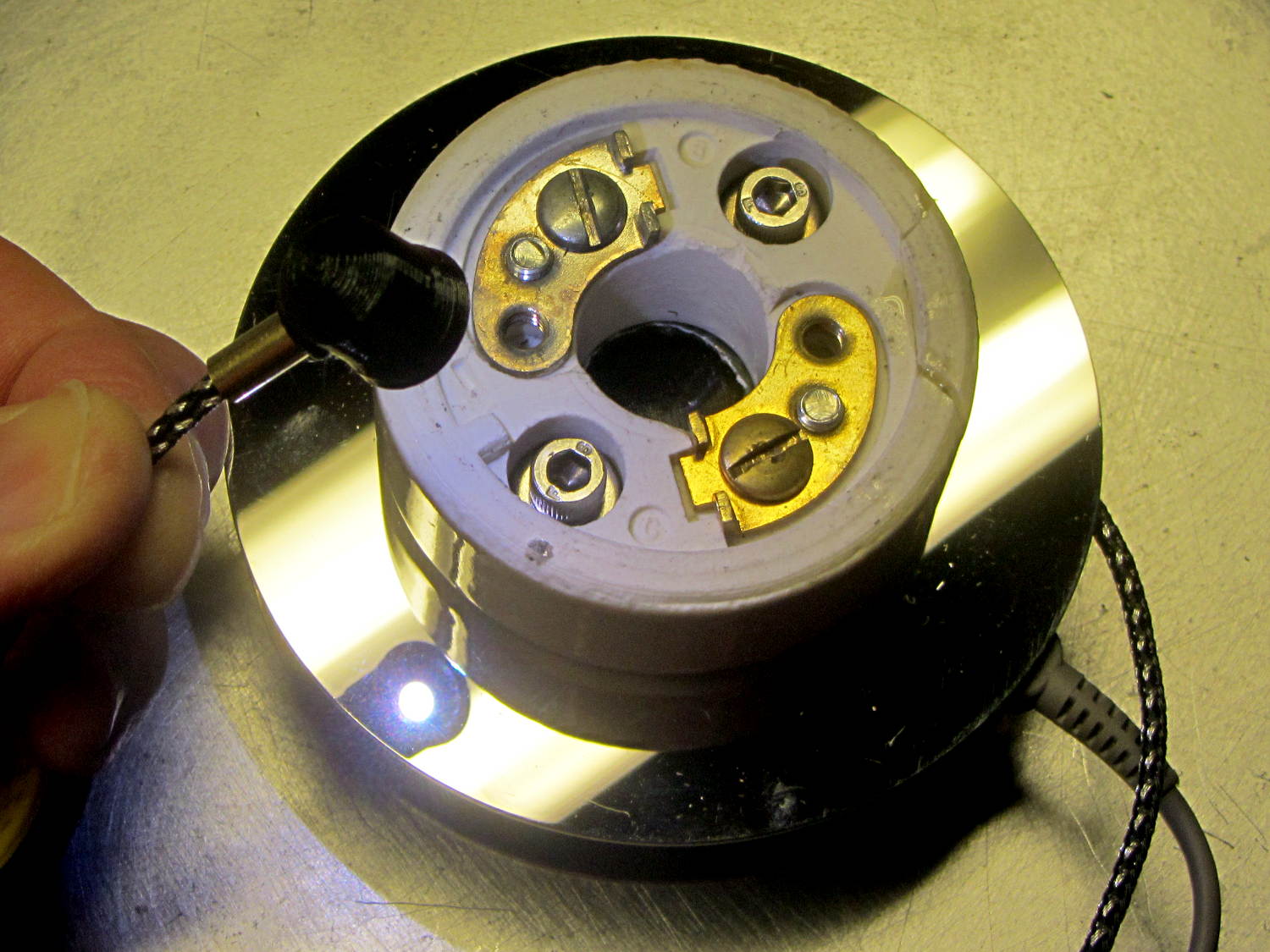
The nice 1-¼ inch stainless socket-head cap screws replace the 1 inch pan-head screws that engaged maybe one thread due to the additional spacer between the USB port and the upper hard drive platter I added for good looks.
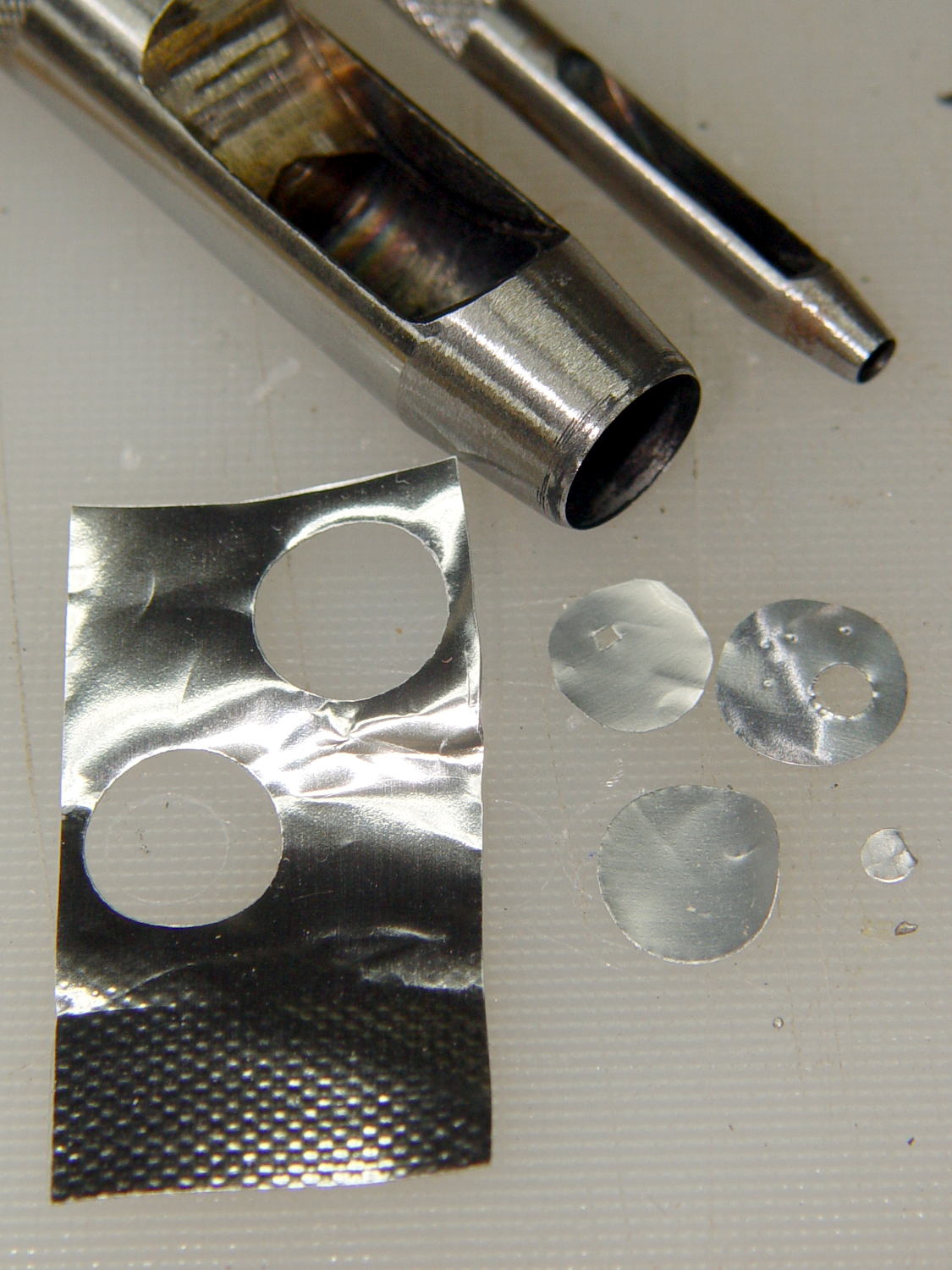
I tried a few iterations of an aluminized Mylar (*) disk with various sized pinholes over the RGB trio to crisp up the filament shadow, because the SK6812 LED casts a more diffuse light than the W2812 LEDs:
Aluminized Mylar pinholes for SK6812 RGBW LED
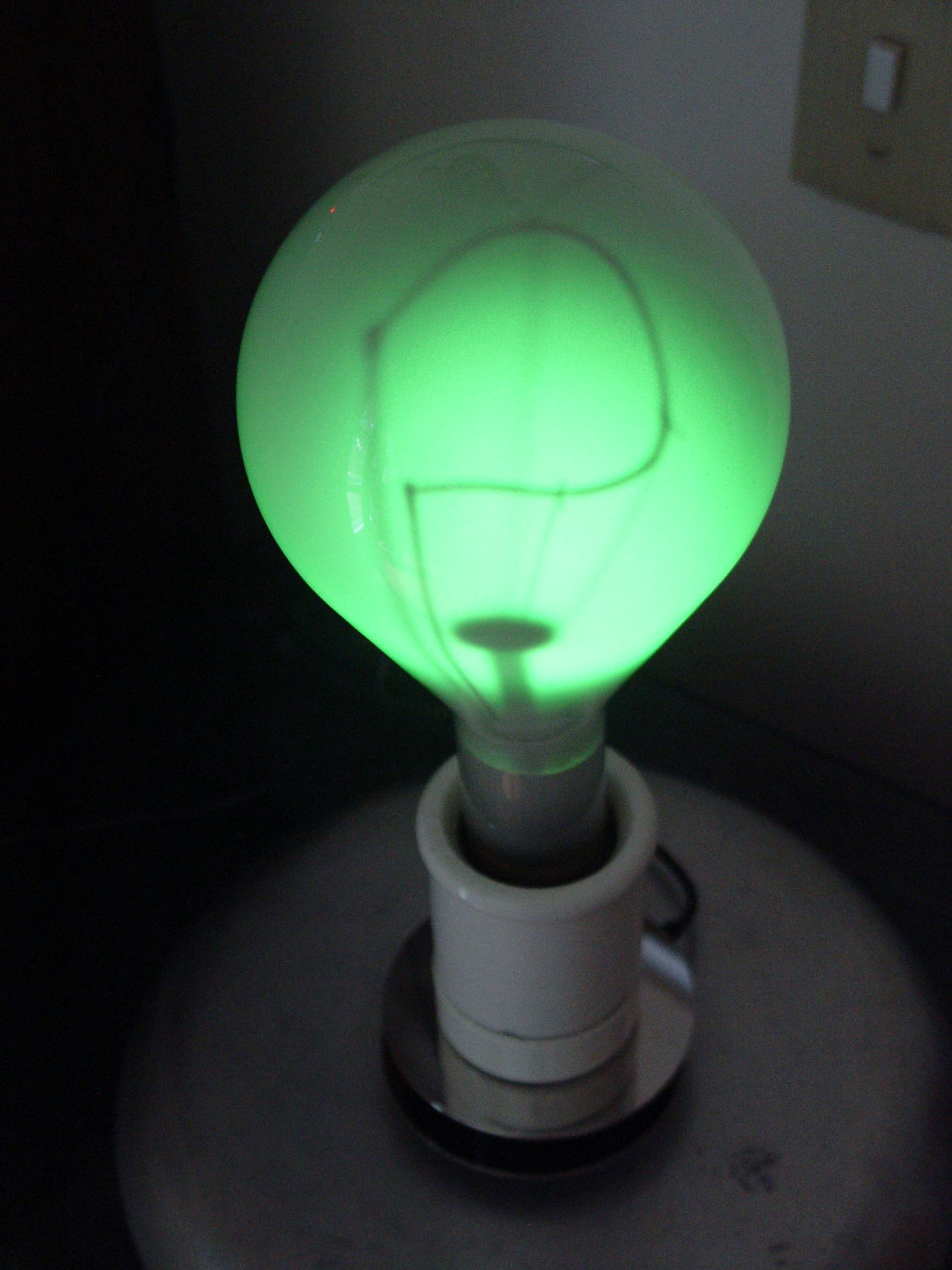
Even the ⅛ inch pinhole made the bulb too dim, so I settled for a fuzzy shadow:
500 W Mogul bulb – SK6812 RGBW LED – no pinhole – green phase
The firmware has a tweak forcing the white LED to PWM=0, because this bulb looks better in saturated colors.
Some weeks ago, the APRS + voice adapter on my radio began randomly resetting during our rides, sending out three successive data bursts: the TinyTrak power-on message, an ID string, and the current coordinates. Mary could hear all three packets quite clearly, which was not to be tolerated.
I swapped radios + adapters so that she could ride in peace while I diagnosed the problem, which, of course, was both intermittent and generally occurred only while on the road. The TinyTrak doc mentions “… a sign of the TinyTrak3 resetting due to too much local RF energy”, so I clamped ferrite cores around All! The! Cables! and the problem Went Away.
Removing one core each week eventually left the last core on the GPS receiver’s serial cable, which makes sense, as it plugs directly into the TT3. The core had an ID large enough for several turns (no fool, I), another week established a minimum of three turns kept the RFI down, so I settled for five:
KG-UV3D APRS – ferrite on TT3 GPS cable
Prior to the RFI problem cropping up, nothing changed. Past experience has shown when I make such an assertion, it means I don’t yet know what changed. Something certainly has and not for the better.
I swapped the radios + adapters and all seems quiet.
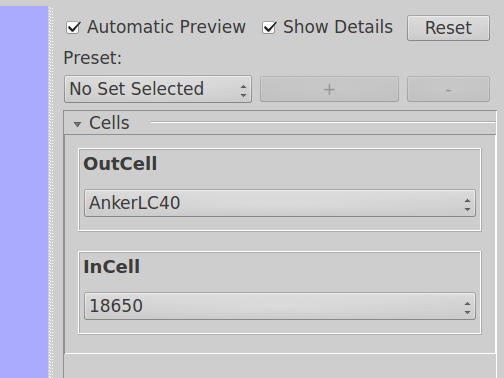
Anker LC40 flashlights can use either one lithium 18650 cell or an adapter holding three AAA cells. I now prefer 18650 cells, but they’re nigh onto 4 mm smaller than the flashlight ID and rattle around something awful.
The bottom trace comes from the 100× = 40 dB MAX4255 amplifier boosting the crystal output to a useful level. The fuzz on the waveform is actually the desired (off resonance) 60 kHz signal at maybe 30 mVpp, so the input is 300 µVpp.
The worst part of the OLED noise looks like 100 mVpp, for about 1 mVpp at the crystal output, call it +10 dB over the desired signal. Some high-pass filtering would help, but it’s easier to just shut the display off while measuring the crystal.
The top trace is the log amp output at (allegedly) 24 mV/dBV. The input bandwidth obviously extends way too low, as it’s neatly demodulating the input signal: the peaks correspond to both the positive and negative signal levels, so reducing the 1 µF input coupling caps will be in order.
In between those 100 Hz groups, the input signal shines through to the log amp output at the V1 cursor. The peak noise rises 290 mV above that, so the log amp thinks it’s 12 dB higher. Pretty close to my guesstimated 10 dB, methinks.
So, turning off the OLED should help a lot, which is feasible in this situation. If you must run the display while caring deeply about signal quality, you must devote considerably more attention to circuit construction quality.
Came up from the Basement Laboratory to find my Dell Optiplex 980 PC had failed, with the power button and diagnostic 1 + 3 LEDs blinking amber. They built it back in June 2010, so section 3 of the Dell reference applies, the power supply status LED on the back panel was off, and, going straight to the heart of matter, I popped the top, disconnected the internal power supply cables, and poked the power supply test button:
Optiplex 980 Power Supply – rear panel test button
… and it’s dead.
Inside, the system board sports a Mini-ATX power supply connector:
Optiplex 980 – Mini-ATX power connector
I originally hoped to swap a supply from an Optiplex 755 (also in a Small Form Factor case) residing on the recycle heap, but it has an ordinary ATX connector:
Optiplex 755 – ATX power connector
So I moved the 980’s SSD and dual-Displayport video card into the 755, fired that devil up, and … it worked!
With my desktop back in action, albeit somewhat slower, I popped the dead supply’s case by violating the Warranty Void If This Label Removed sticker to unscrew the last screw:
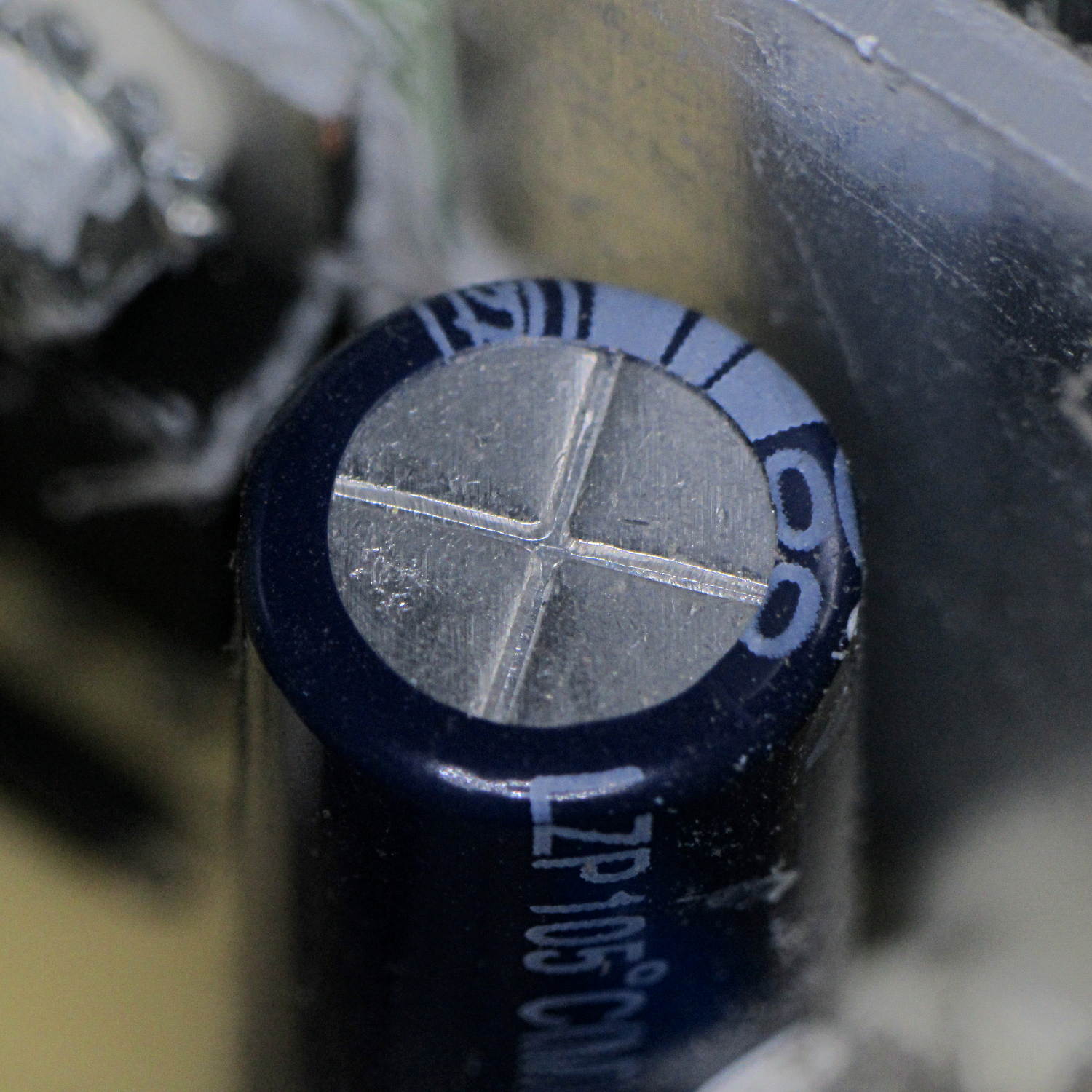
The cluster of caps on the upper right have bulged pressure-relief lids, like this:
Optiplex 980 – Bulging capacitor 1
And this:
Optiplex 980 – Bulging capacitor 2
And this:
Optiplex 980 – Bulging capacitor 3
None had ruptured, but they’re obviously feeling a bit nauseous.
Given the 980’s mid-2010 manufacturing date, this probably isn’t capacitor plague, just simple overheating from operating in a dead-air zone amid all those heatsinks and wires. Some of the Usual Unnamed Sources suggest overheating the capacitors is how manufacturers ensure their hardware doesn’t last forever, without being obvious about planned obsolescence; I’m loathe to ascribe to malice what can be explained by design desperation.
A Genuine Dell replacement supply from eBay ($25 delivered) came from yet another “small form factor” Dell chassis, so it isn’t quite the same size, lacks a supply test button / LED status light, and doesn’t quite fit:
Optiplex 980 – replacement supply misfit
Nothing a sheet metal nibbling tool can’t fix, though, given I haven’t developed a deep emotional attachment to the chassis. I gnawed off the left side of the frame and squared up the rim around the lower screw, after which the opening fit the supply pretty well, although the latching tab bent up from the bottom of the chassis didn’t quite engage the far end of the supply. No big deal: it’s not in a high-vibration environment.
The new-to-me supply also carries an ATX connector, but the eBay seller included a Mini-ATX adapter. Jamming the adapter + wires into the space available required concerted muttering, assisted by tucking the SSD under the DVD-RW drive. No pictures, as it’s a classic seven pounds in a five pound box situation.
There’s not much room on an AT26 / TF26 can for a readable label, unless one owns a metal-marking laser, but a simple bar code should let me identify each one:
Quartz Resonators – binary marking
The empty “0” slot down at the bottom will hold the crash-test dummy resonator I’ve been using to get the tester working.
The red-and-blue stripes from plain old fine-point Sharpie pens will rub off under duress, which I hope to avoid. After finishing up, I’m still not sure blue makes a better zero than red; you can make a convincing argument either way:
Binary marked AT26 Quartz Resonators
The bag allegedly contained 25 resonators, although I’m willing to agree the last one escaped into the clutter on or under the Electronics Workbench.
A Circuit Cellar reader asked for a better explanation of the parasitic capacitors inside a quartz crystal can than I provided in my April 2017 Circuit Cellar column. Here’s the schematic, with values for a 32 kHz tuning fork resonator and the original caption:
Figure 1 – The mechanical properties of quartz resonators determine the values of the “motional” electrical components in the bottom branch of its circuit model. These values correspond to a 32.768 kHz quartz tuning fork resonator: the 10.4 kH inductor is not a misprint!
I wrote this about the caps:
The value of C0 in the model’s middle branch corresponds to the capacitance between the electrodes plated onto the quartz. The 3.57954 MHz crystal in the title photo, with two silver electrodes deposited on a flat insulating disk, closely resembles an ordinary capacitor. You can measure a crystal’s C0 using a capacitance meter.
However, each of those electrodes also has a capacitance to the resonator’s metal case. The top branch of the model shows two capacitors in series, with Cpar representing half the total parasitic capacitance measured between both leads and the case. Grounding the case, represented by the conductor between the capacitors, by soldering it to the ground plane of an RF circuit eliminates any signal transfer through those capacitors. They will appear as shunt capacitors between the pins and ground; in critical applications, you must add their capacitance to the external load capacitors.
With the resonator case captured under the clip on the far right and both its leads held by the clip to the upper left, the meter measures Cpar, the lead-to-case parasitic capacitance. The meter will display twice the value of each parasitic capacitor, at least to a good approximation, because they are in parallel. The five resonators averaged 0.45 pF, with each lead having about 0.25 pF of capacitance to the case. Obviously, measuring half a picofarad requires careful zeroing and a stable fixture: a not-quite-tight banana jack nut caused baffling errors during my first few measurements.
With the resonator repositioned as shown in Photo 2, with one lead under each clip, the meter measures C0, the lead-to-lead capacitance. After careful zeroing, the resonators averaged 0.85 pF.
Although the parasitic lead-to-case capacitors are in parallel with C0, their equivalent capacitance is only Cpar/4 = 0.1 pF. That’s close enough to the measurement error for C0, so I ignored it by rounding C0 upward.
He quite correctly pointed out:
With both leads connected together on one side, then that essentially constitutes a single electrical element inside the case. And with the case being a single element, this configuration in the test fixture seems like a single capacitor with one lead being the case and the other lead being the pins, with a vacuum dielectric.
I would think the meter would display the total capacitance rather than twice the value … It makes sense to me to later say Cpar/2 when the leads are not connected together.
Here’s my second pass at the problem:
… the two-capacitor model comes from the common-case condition, where each lead displays a (nominally equal) parasitic capacitance to the case, because the crystal mounting is reasonably symmetric inside the can. It’s easiest to measure the total capacitance with the leads shorted together, because it’s in the low pF range, then divide by two to get the value of each lead-to-case cap.
[…]
For “real” RF circuits with larger (HC-49 -ish) crystals in parallel-resonance mode, you ground the case and subtract the parasitic capacitance at each lead from the external load capacitors. That’s the usual situation for microprocessor clock oscillators: the crystal sits across the clock amplifier pins, with two more-or-less equal caps from the pins to ground. You should subtract the internal parasitic caps from the clock’s specified load caps, but in practice the values are so small and the cap tolerance so large that it mostly doesn’t matter.
[…]
Un-grounding the case puts those two parasitic caps in series, just as with two discrete caps, so the lead-to-lead capacitance is (or should be!) half of each: 1/4 of the both-leads-to-case value.
Re-reading yet again says I glossed over the effect of having C0 in parallel with the Cpar/2 caps, but methinks dragging those complications into the model benefits only the theoreticians among us (or those working very close to the edge of the possible).
To make it worse, I also botched the QEX reference, which should be Jan/Feb 2016, not 2017. Verily, having a column go read-only makes the errors jump right off the page. [sigh]






 The Smell of Molten Projects in the Morning