Ed Nisley's Blog: Shop notes, electronics, firmware, machinery, 3D printing, laser cuttery, and curiosities. Contents: 100% human thinking, 0% AI slop.
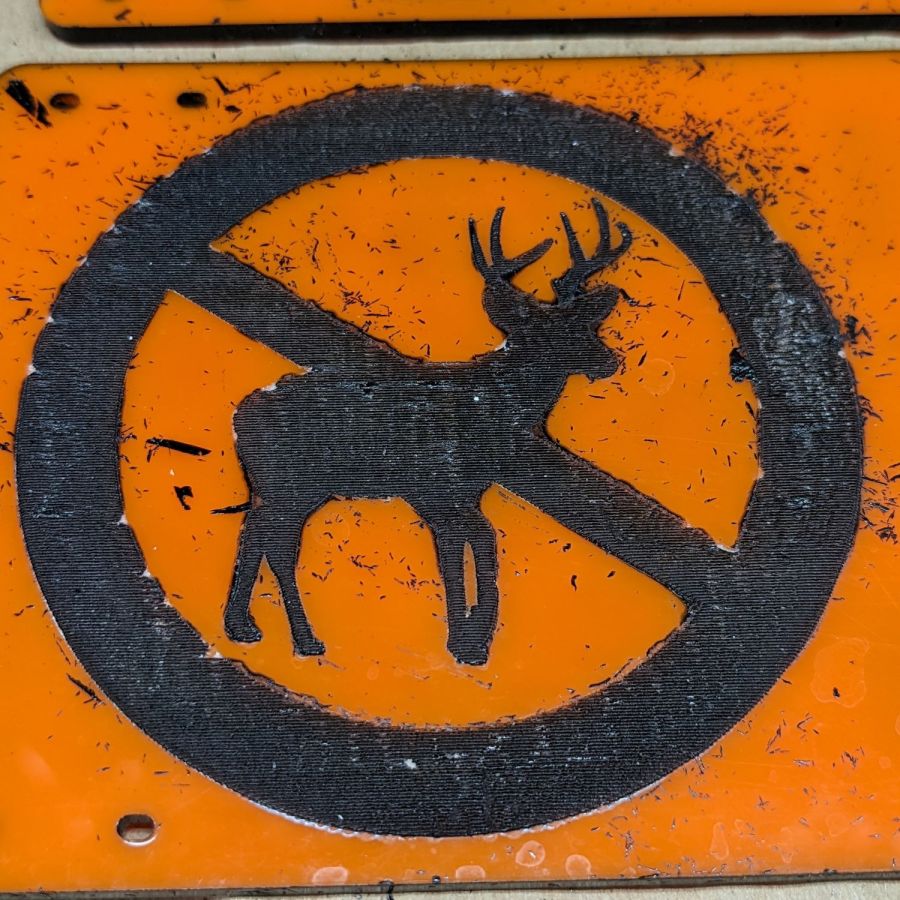
That’s eight months of weathering on MDF covered with indoor urethane sealant and it’s not as awful as I expected: the MDF didn’t actually disintegrate, it just collected some mold / mildew / crud.
A closer look:
Please Close The Gate – weathered MDF – detail
The black paint survived surprisingly well.
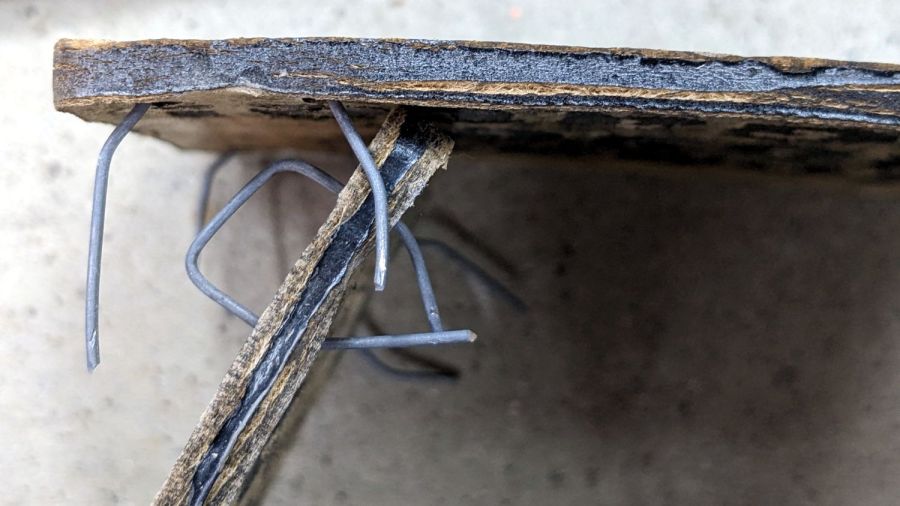
I hadn’t paid much any attention to the edges, so they got covered with random amounts of black paint and urethane. It seems that’s where the disintegration starts:
Please Close The Gate – weathered MDF – side view
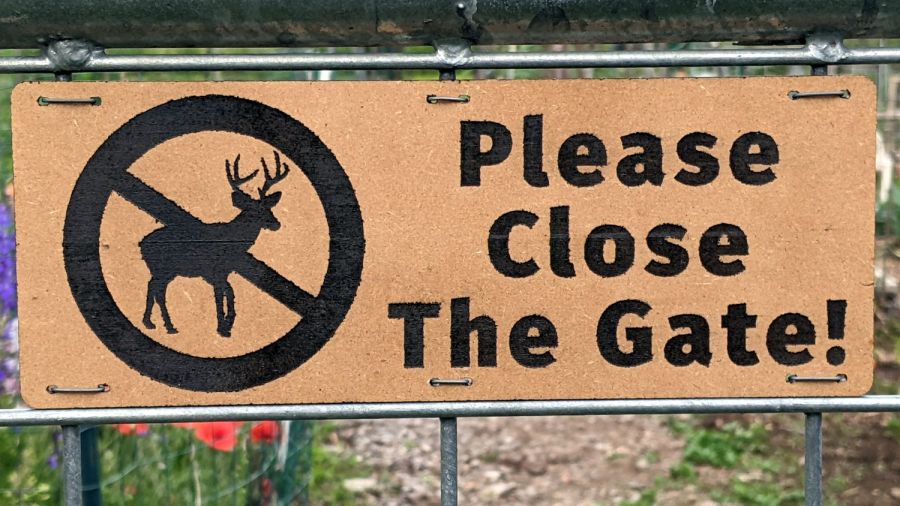
MDF definitely isn’t the right material for an outdoor sign and I knew that going in, but it’s cheap and readily available, which makes up for a lot.
For comparison, they looked nice right after installation:
A warm day let me shoot the engraved signs for the Vassar Community Garden gates with rattlecan black:
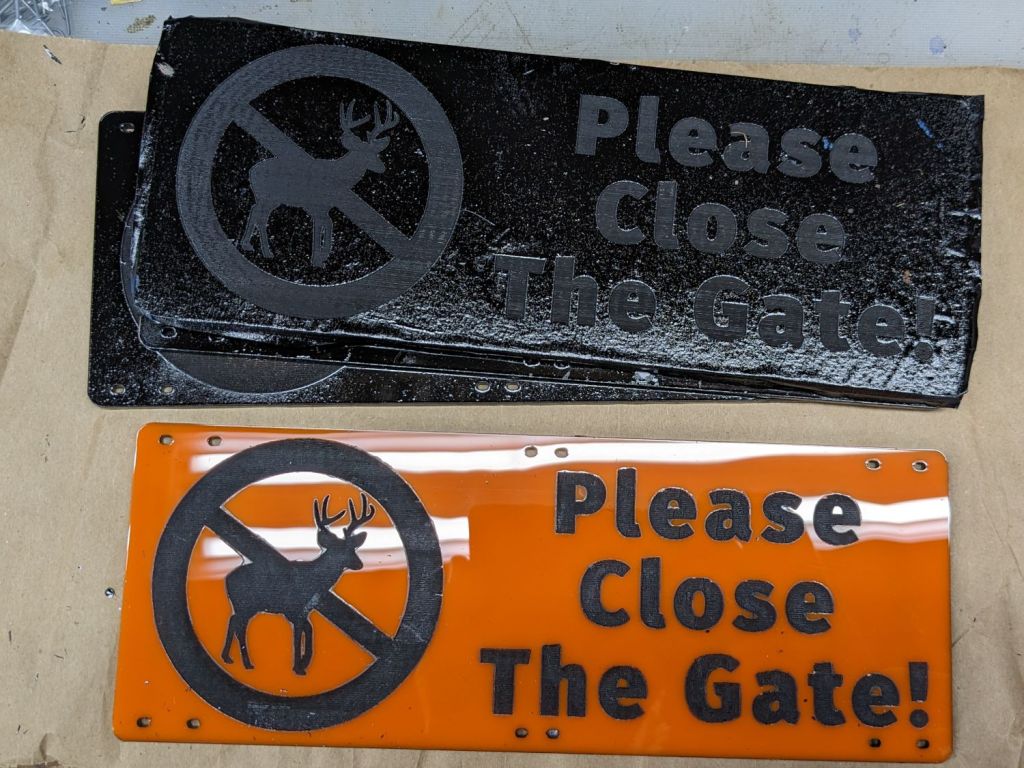
Please Close The Gate – masking tape peeled
The full sheet of orange acrylic arrived with plastic protective film on both sides, which I planned to use for paint masking. Alas, one side also had a wrinkle running its length that ended up on two signs, so I replaced that film with blue masking tape.
As fate would have it, the first side of the first sign I peeled had masking tape and produced what you see above.
Things went bad in a hurry. The paint had no adhesion whatsoever to the plastic film and fell off in flakes as I peeled the film away:
Please Close The Gate – plastic peeled
I assumed the flakes would just fall off the signs, perhaps with a little persuasion, so I peeled and weeded all the signs before cleaning them up.
Although the paint was fully dry, when the molecularly smooth surface of each paint flake touched the molecularly smooth surface of the newly exposed acrylic, the two instantly and permanently fused together.
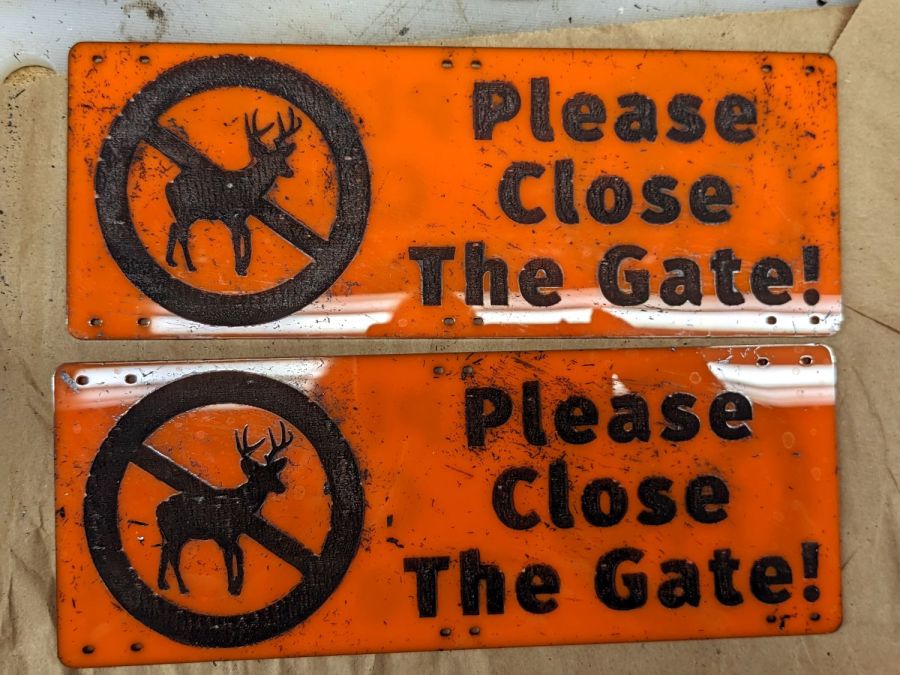
There were a lot of flakes:
Please Close The Gate – plastic peeled – detail
Removal techniques that did not work:
Vacuuming with a brush
Gentle rubbing with a soft cloth
Firm rubbing after spraying with acrylic cleaner
Scraping with a plastic razor blade
So I deployed a P220 grit sanding block and wrecked the glossy surface of both sides of all six signs. I briefly considered trying to recover the finish by sanding them all up through about 2000 grit, then came to my senses: my sanding arm is weak.
Careful examination of the last picture shows several places around edges of the circle where the plastic film melted into a blob that blocked the paint, rather than vaporizing. I used enough power to engrave only about 0.3 mm deep (because they’re engraved on both sides), but the transition wasn’t fast enough for a clean edge.
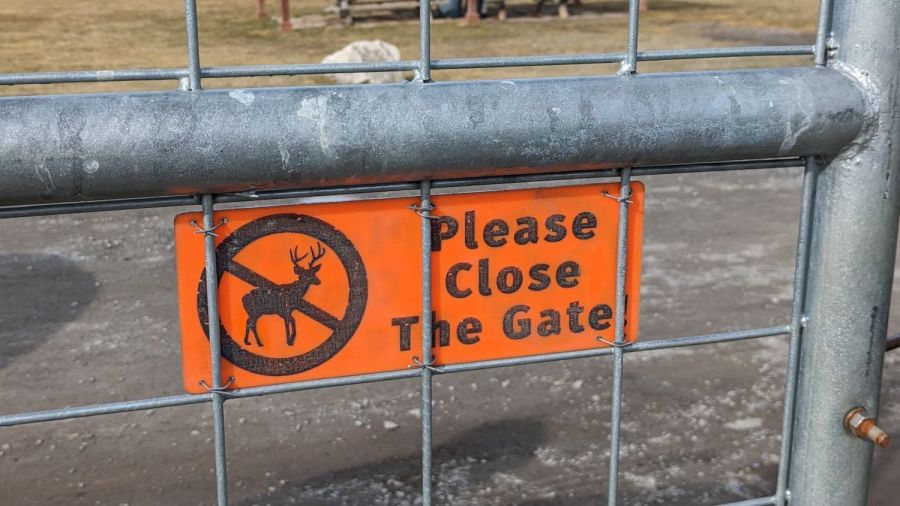
They don’t look as nice as I’d like, but they’re good enough for the purpose:
Please Close The Gate – installed
The acrylic sheet is more see-through than I expected, at least when backlit by bright sunlight.
Please Close The Gate – seethrough
Next: we discover what happens to UV-stabilized orange acrylic and black outdoor paint over the course of a year in garden sunshine.
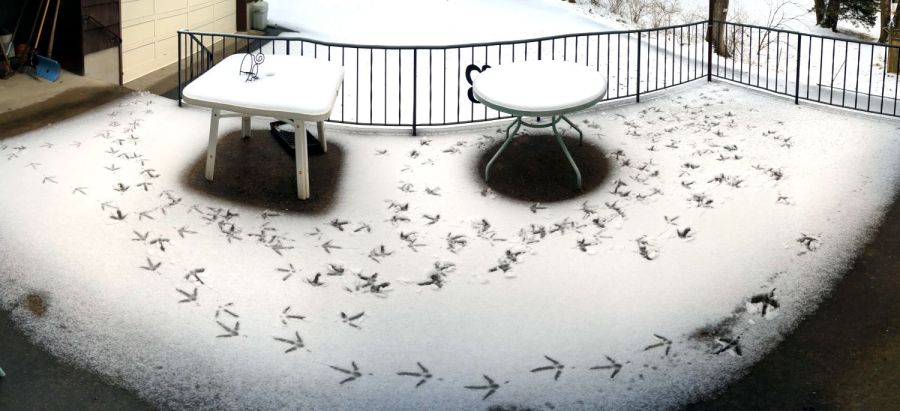
Jake, our affectionate term for whichever turkey is having trouble, eventually walked from right to left closest to the house, down the patio steps, and rejoined the flock. The tip of his “arrow” tracks aims backwards, because all three toes point forward.
It turns out turkeys panic when they’re behind a barrier and see the rest of their flock moving away. A panicked turkey makes a lot of noise while rushing back and forth, the rest of the flock contributes what must be advice, and the resulting tumult suffices to wake the dead.
That would be me, in the bedroom off to the left, but my cold-boot sequence takes long enough that I missed the action.
Some years ago, we discovered how distressed a trapped turkey can get when the flock descended from trees in an adjacent yard, with (a different) Jake landing in the garden, on the other side of the fence from the flock. Over the course of the next several hours, Jake ran back and forth along the fence while the rest of the flock alternated between sympathetic honking and disinterested feeding, until eventually he remembered his wings and managed a short-field takeoff over the fence.
A new ResMed ClimateLine headed CPAP hose arrived on schedule and let me measure the old hose:
ResMed ClimateLine heated hose ends
The center two they-are-not-USB contacts on the input end of the hose (on the right) are for the heating element spiraling around the tube and measure 10.0 Ω.
The outer two contacts report back from what must be a 10 kΩ thermistor embedded in the dingus sticking into the hose lumen at the output end (on the left). It reads 12 kΩ in a 68 °F room and responds to warmth with a lower resistance, which is what you’d expect.
Plugging the ClimateLine hose into the AirSense 11 unit enables temperature sensing at the end of the hose, with closed loop control from 60 °F to 86 °F. Mary set it to 80 °F in manual mode, which apparently produces different results from the same temperature in Auto mode, and declared victory.
A humidity setting of 4, in the middle of the 1 – 8 range, works for her.
Both the AirSense 11 and its power brick claim 24 VDC at a suspiciously exact 2.71 A. The hose heater could soak up 2.4 A of that, but the AirSense 11 also heats the humidifier’s water tank (“tub”), so it’s unlikely they’re both seeing the full 24 V.
I am prohibited from further investigation. [grin]
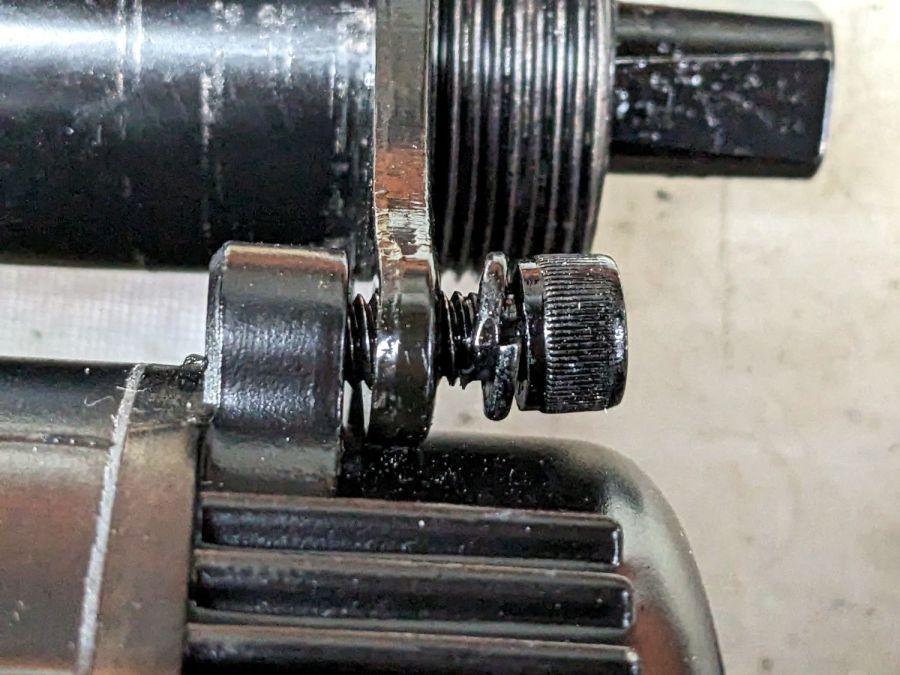
The time has come to add a Bafang mid-drive motor to my Tour Easy recumbent, much like the one Mary has been using for the last two years. When I got to the point of installing the motor in the bottom bracket shell, this happened:
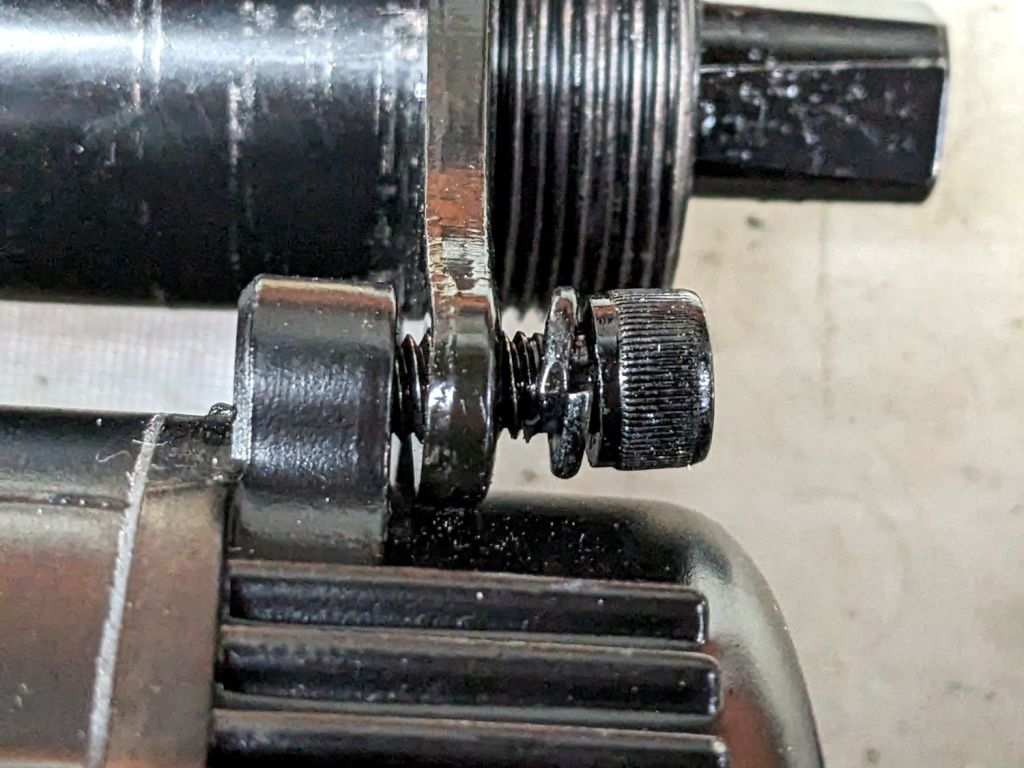
Bafang Triangle Plate – jammed screw
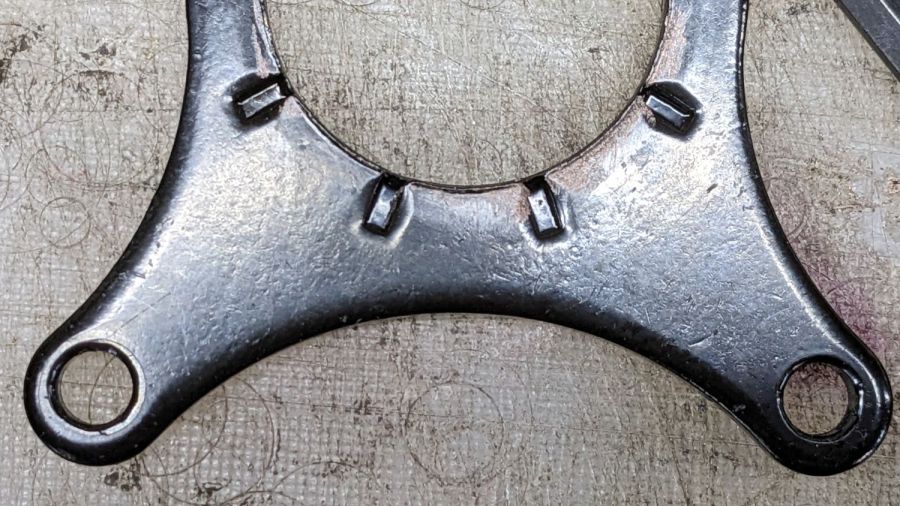
It turns out the triangle plate has slightly misplaced bolt holes:
Bafang Triangle Plate – misplaced bolt holes
If you look very carefully, you’ll see the holes sit just slightly above the midline of those ears. The additional fractional millimeter below the holes touches the motor end bell and prevents them from lining up with the tapped holes.
Normally, you’d just hit the plate with a file and be done with it, but it’s ferociously hardened steel: a file bounces right off.
I deployed a Dremel sanding drum above the ShopVac’s snout to catch the abrasive dust, eroded just enough steel to line up the holes, and everything now fits the way it should.
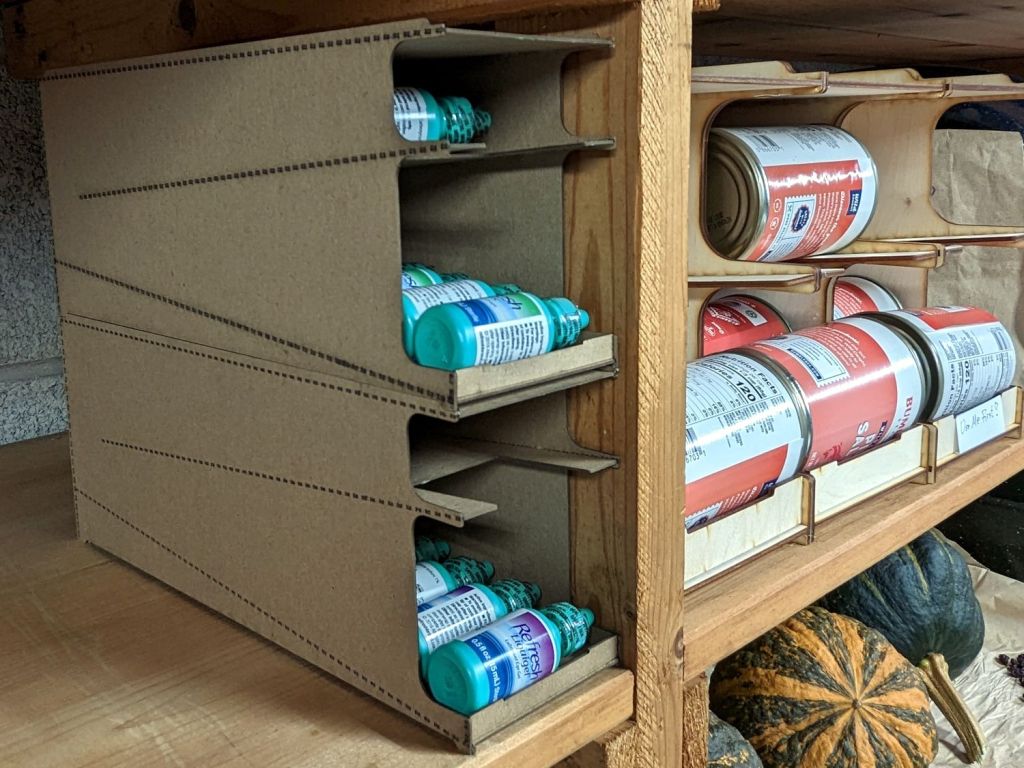
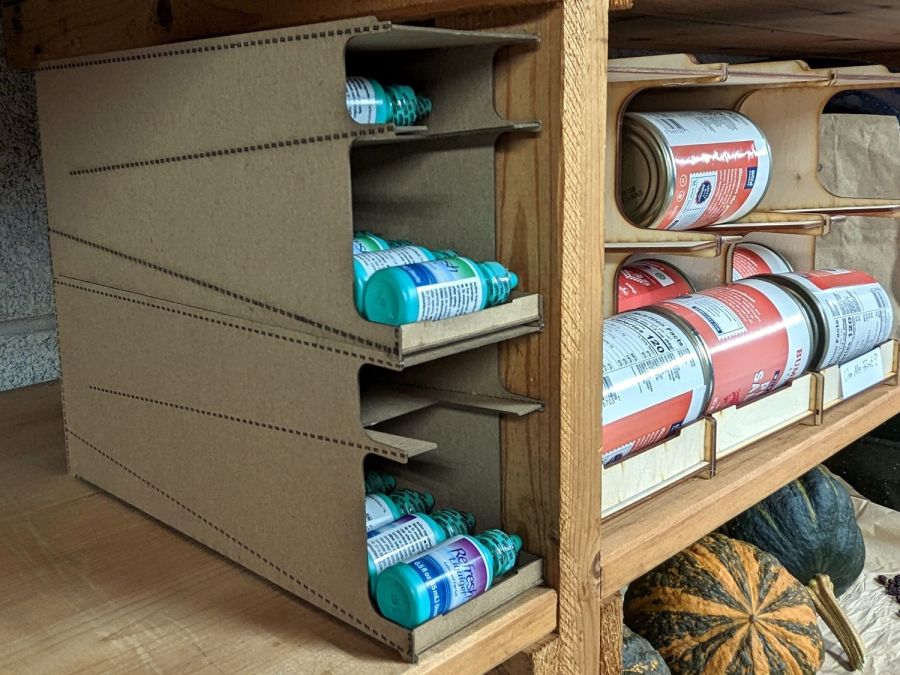
A recent Squidwrench meeting provided the opportunity to make a couple of racks for an assortment of Refresh Tears / Liquigel bottles:
Refresh eye lube – storage cases
I used chipboard to find out if the cross plates would stiffen the floppy 1.1 mm sheets enough for this light duty. Indeed, the overall structure becomes a nice rigid box, even though the feet and corners can’t withstand much abuse.
The finger joints use the default settings, which produce a lot of fingers along the edges. This turns out to be a Good Thing, as it gave the yellow wood glue plenty of opportunities to bond the sheets together.
Combining the default 5° slope with nine bottles along each level wastes a tremendous amount of vertical space. The adjacent racks hold three much larger cans per level, so roughly the same space doesn’t look like much. In retrospect, a 3° slope should work for smaller bottles.
And, yes, the squash on the lower shelf store nicely and become yummy meals all winter long.
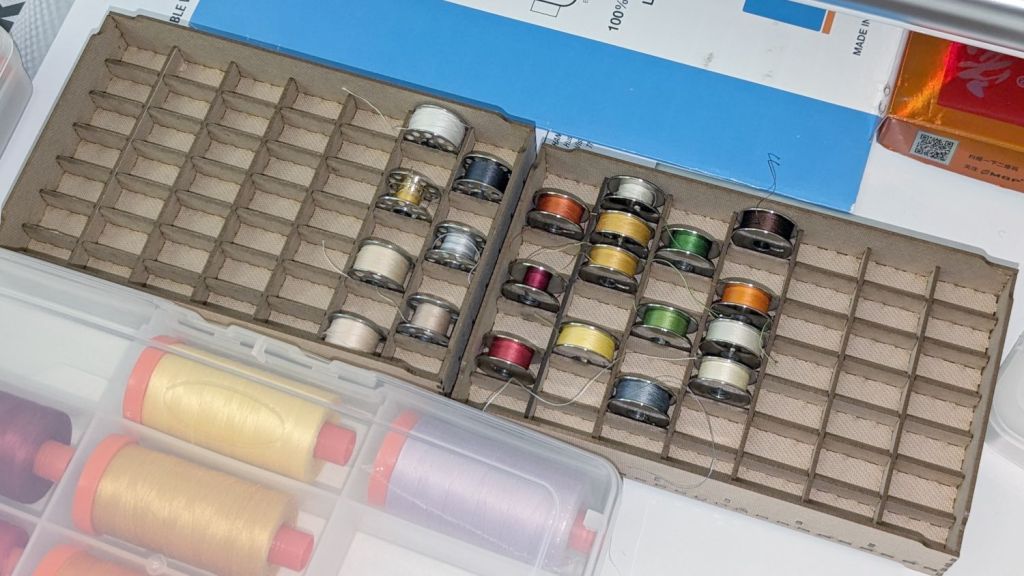
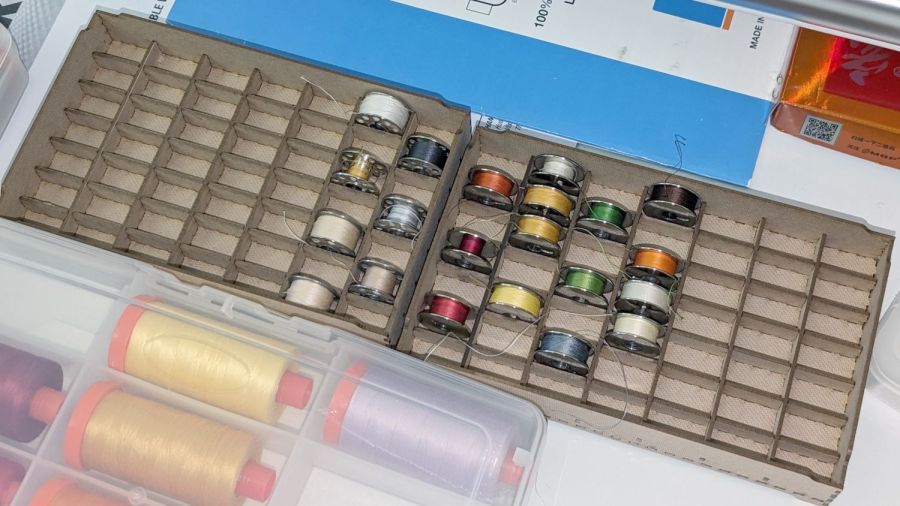
Long ago, I gave Mary a box of 100 empty bobbins for her Kenmore 158 sewing machine, with the intent she would never again have to unwind a bobbin to put new thread on it. This worked so well I did the same thing for her Juki, with the result she needed somewhere to store all those filled bobbins.
Her work table has a shallow drawer, so we tried this out:
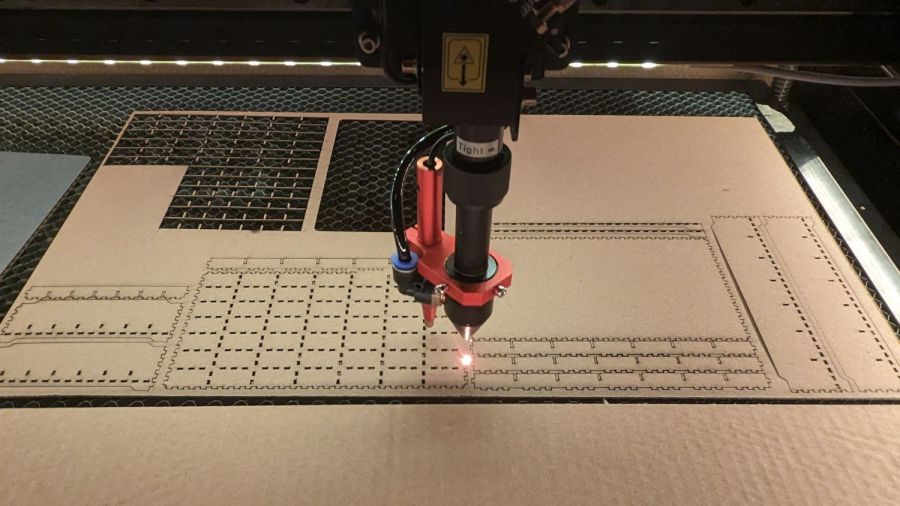
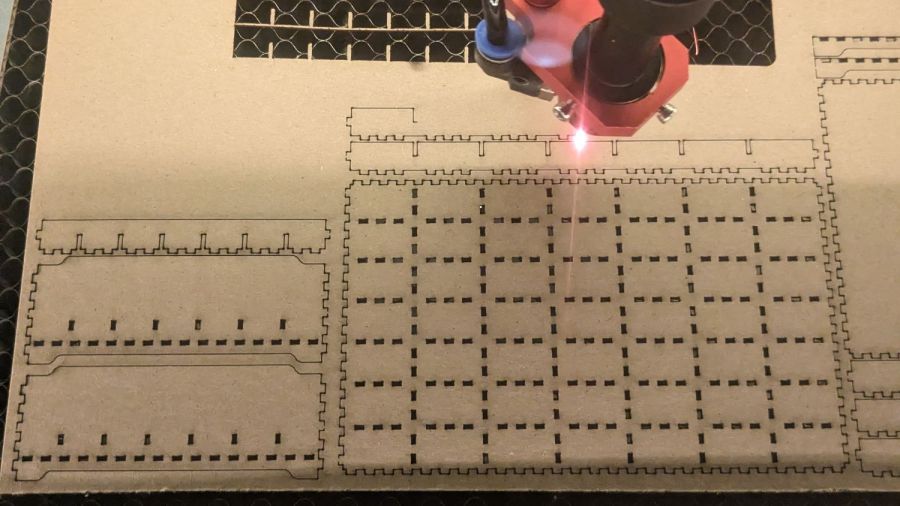
Watching all those little rectangles fall out just never gets old:
Bobbin Storage Case – cutting detail
I ran off a test tray in ordinary chipboard that works just as well, but lacks the pleasant appearance and feel of the TroCraft. Clear 1.5 mm acrylic would probably work, at the cost of requring a much neater glue job where the dividers meet the walls.
The spacing is a bit tight to pluck a bobbin from its slot between two others, but now she has enough space to arrange them as needed, with empty spaces around the most-used colors. I offered to carpet the drawer with bobbin trays, but she suggested waiting until these fill up.









 The Smell of Molten Projects in the Morning