Ed Nisley's Blog: Shop notes, electronics, firmware, machinery, 3D printing, laser cuttery, and curiosities. Contents: 100% human thinking, 0% AI slop.
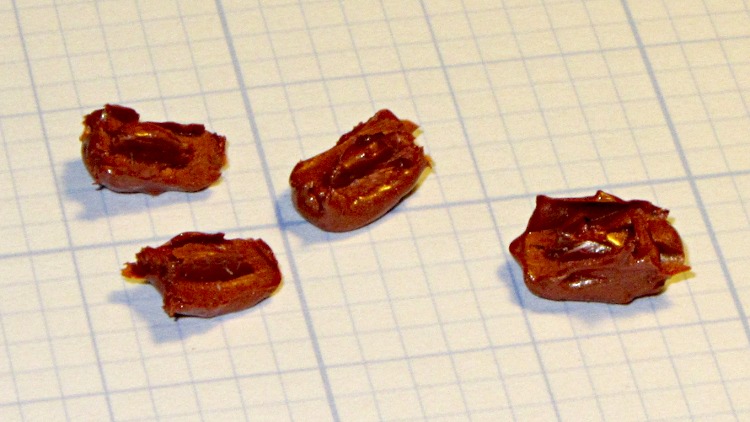
I’d waited for a few days for the silicone to cure, then put the clamps back in their home. When I went to use them, the pads were firmly affixed to the plate. Evidently, the copper-loaded silicone gasket compound takes a few days longer than forever to cure, which is not what I gathered from reading the label.
It may well be that adhesive has aged out, because when I went to try it again, the first half-inch inside the tube had turned into solid gum. Yes, it cures inside the tube and not outside.
Other than that, it seems like good stuff; I may pick up another tube and give it a second chance. Who knows? It might be useful in a plastic extruder or something like that.
As described there, the buttons on the back of my pocket camera stopped working, but the obvious laying-on-of-hands repair (i.e., wiggling the cables) didn’t improve things. I later discovered out that two other buttons on the side that didn’t go through the same flex cable were also dead, which suggested that the common failure was on the CPU board deep inside the camera. I gave it to my Shop Assistant with some handwaving about how she could maybe fix it by delving deep inside, tracing the cables, and doing some jiggling: if she could fix it, she could have it.
The first step was to take both covers off, which required a Philips 00 bit:
EX-Z850 front cover removed
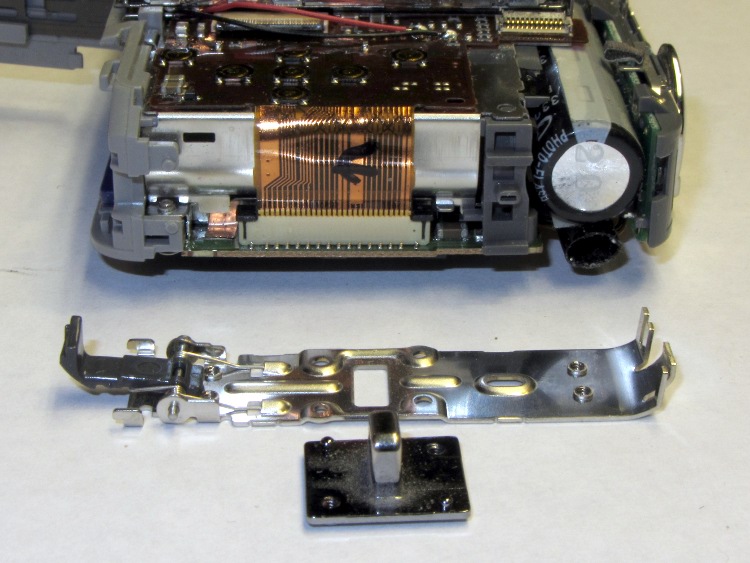
Then the side plate comes off, which requires maneuvering the spring-loaded battery latch out of its recess, at which point the lug for the carry strap will fall out:
EX-Z850 battery latch and carrying lug
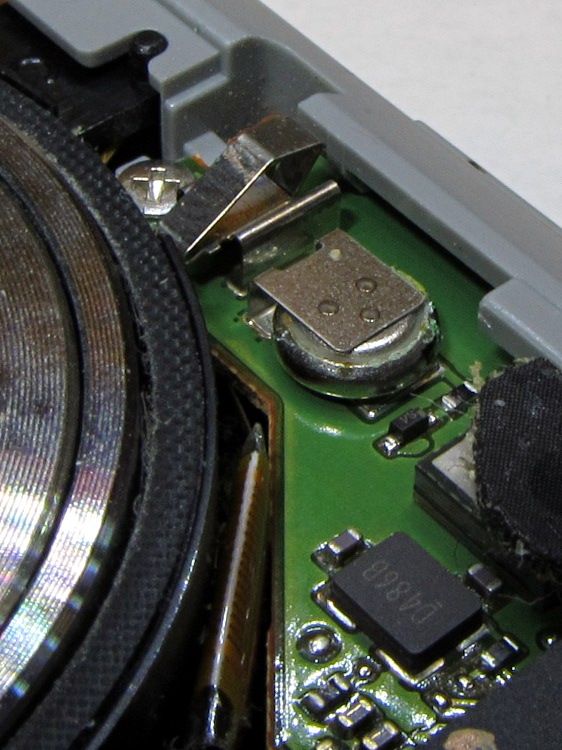
En passant, we discovered why the clock dies while changing the battery pack. It seems the miniature rechargeable lithium (?) NiMH (?) cell has rotted out:
EX-Z850 internal battery corrosion
Fortunately, it charges in a cradle, so the main battery can remain in place indefinitely. We’ll replace that thing at some point.
The CPU board has two flex cable connectors on the front surface and two on the back. My Shop Assistant released the clamps, removed the cables, wiped down the contacts with DeoxIT Red, gave it a test run with the covers off, and came bounding up the stairs as happy as I’ve ever seen her: the camera worked perfectly again!
Not being used to these things, though, she managed to crack one of the side latches on the far connector. I’ll admit to doing exactly the same thing, so I knew how to fix it: a dab of acrylic adhesive holds the fragment in place with a bit of springiness to hold the latch down.
EX-Z850 connector repair
The connector in question comes from the flash control board, to which those other two buttons (Ex and Drive mode) connect. The inside of the camera is a maze of connections, so I guess that was the simplest way to get the conductors through the body.
She reassembled the camera and it continued to work; we declared the job a complete success.
Shortly after that, I promoted her from Shop Assistant to Larval Engineer, First Instar, and we installed her in her new socket at college, where that camera should come in handy for something.
I think she’ll ace the Freshman Engineering Practicum, wherein her compadres will learn how to solder components to circuit boards, use multimeters & oscilloscopes & other instruments, and generally survive in a laboratory. Maybe she can wrangle a job as a Lab Assistant?
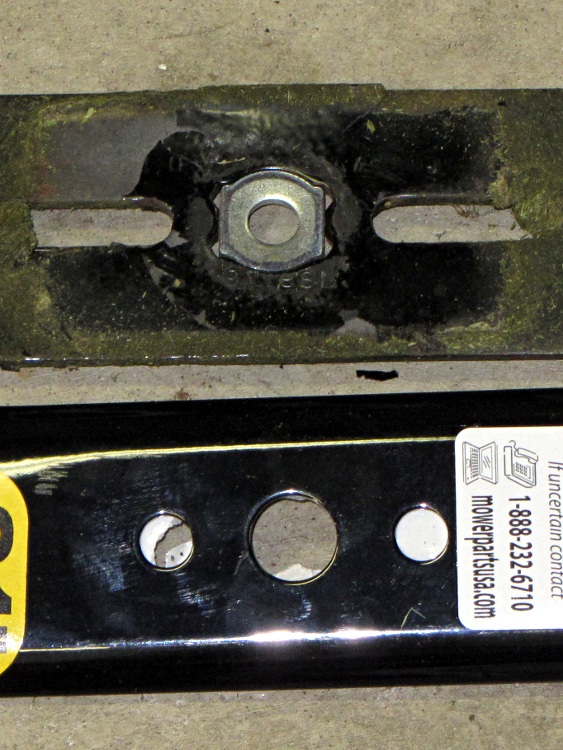
So I picked up a new mower blade that sported a sticker claiming it probably fit my Craftsman mower. Got it home, took off the old blade, and it actually fit the mower; the holes matched the hub’s drive pins, although the bolt hole was oversized.
The old blade was a replacement, too, with a square hub hole and an adapter to fit the bolt. The blade had slots for the drive pins, so the adapter was required.
Seeing as how nothing exceeds like excess, I rummaged around in the heap to find something that would serve as an adapter in the central hole. It’s not really necessary, but I’m that type of guy.
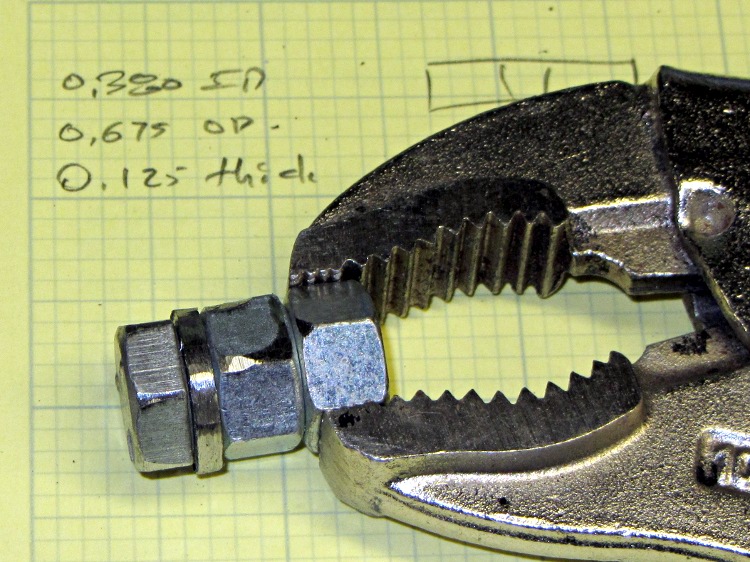
As it turned out, an ordinary lockwasher for a 3/8 inch bolt was just about perfect. I crunched one in a short bolt with two nuts jammed in place …
Lockwasher ground for mower blade
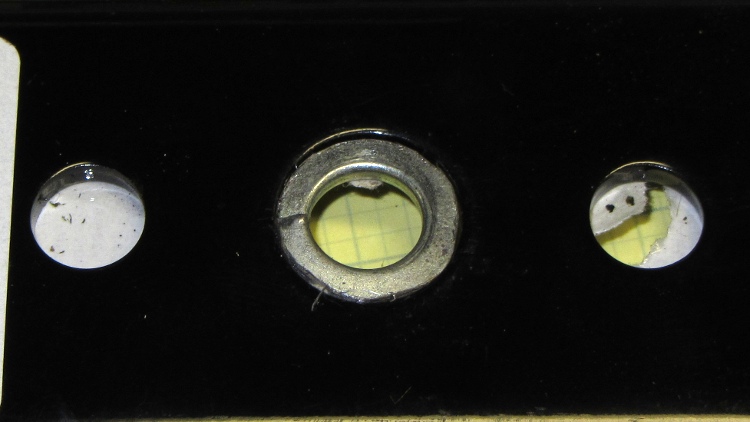
… introduced it to the coarse side of Mr Grinding Wheel, and, after a few shots with a hammer, it became a perfect fit:
Lockwasher in blade
Bolted it on the mower, put in two hours of yard aerobics, and it worked just fine. Sliced the top off a root that evaded the attention of the previous blade, too.
Before trashing (*) all those caps from the Ampeg, I marched them past a capacitance meter that gives the dissipation factor D. As D = tan δ = ESR / ¦X¦, we know ESR = D*¦X¦ at the meter’s 1 kHz test frequency. We don’t know the magnitude of the total reactance X (the meter doesn’t tell us that) and in this case we can’t assume the ESR will be small with respect to the capacitive reactance Xc = 1/2πfC.
Ampeg capacitors
The smaller green 0.022 µF Cornell-Dubilier caps all came in with D=0.05, so they’re marginal.
The larger green 0.15 µF Cornell-Dubilier caps had D=0.00 and the black 0.1 µF was D=0.01. Those are OK.
The small black caps had D=0.14. Yikes! The larger one and the yellow cap had D= 0.01 or 0.02.
The blue Ducati (!) electrolytics ranged from 0.06 to 0.48. That was without reforming, as the last time Phil turned it on, the finals about melted down: I wasn’t going to risk that again just to find out if you can reform all the electrolytic caps without the tubes in place.
So, yeah, some of the coupling caps were exceedingly bad. If you’d like to rub the values & data against the schematic to find out which one(s) were killing the finals, go ahead.
All of the measured capacitance values were within spitting distance of their nominal values.
[Update: Eks points out that I really should measure the leakage at operating voltage, so as to find the current that would drive the grids off their normal bias points. That’s a project for another day… ]
(*) They’re in the e-waste recycling box, of course.
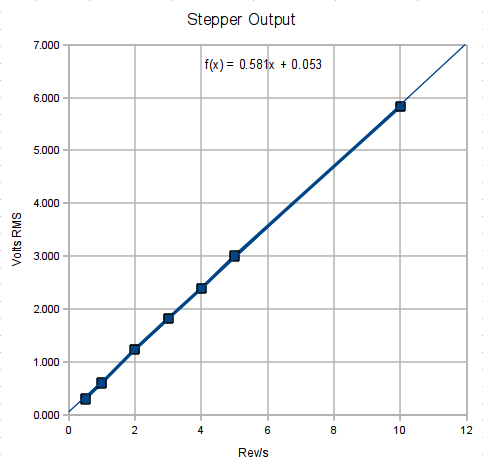
Now, if that isn’t suspiciously linear, I don’t know what is!
The slope is 0.583 v/(rev/s).
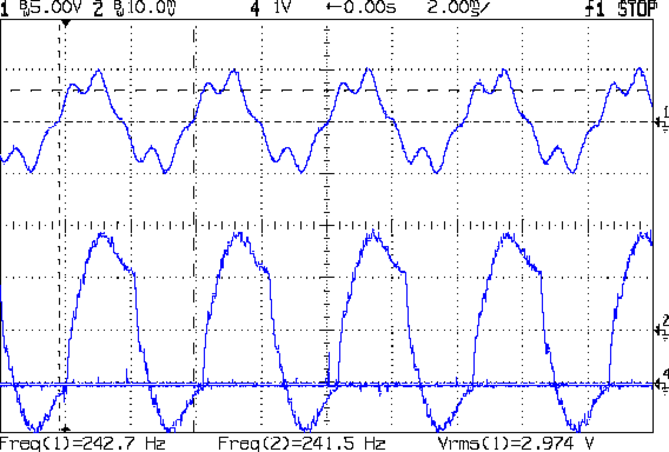
I used the scope’s RMS trace calculator, which smushes out the non-sinusoidal nature of the lower speed waveforms. As expected, there are several nasty mechanical resonances that appear in the output waveform while they’re tormenting my ears:
Stepper Resonance – 4.82 rps
Top trace is the winding output voltage, bottom trace is the drive input current, plus a line of junk I forgot to turn off.
Useful conversions:
Drive waveform frequency / 50 = rev/s
Drive waveform frequency * 6/5 = rev/min
So it works. Now I must figure out how to connect load resistors with something more reliable than crappy alligator clips.
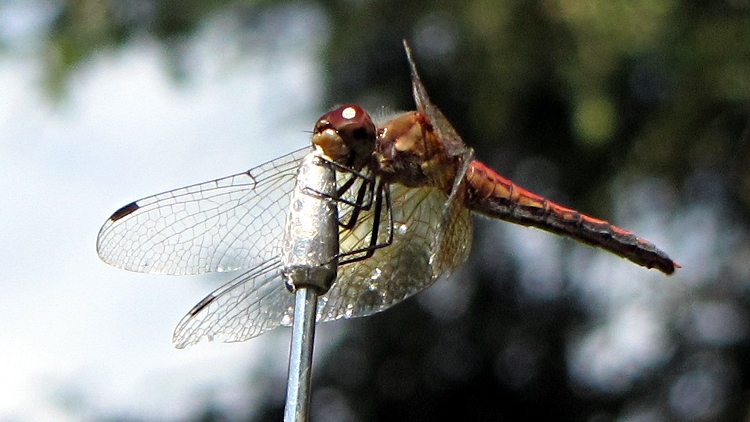
This dragonfly decided that the tip of the 2 m / 70 cm antenna on Mary’s bike was the best place around to survey the area; it periodically zipped off to snag a meal, then returned to stand watch again.
Those wraparound compound eyes don’t miss much!
Dragonfly on antenna – detail
A few weeks ago, a much larger dragonfly bounced off my helmet and snagged itself in the delay line coil near the middle of the antenna: the dragonfly’s head slid 1/4 turn around the coil and latched firmly in place. Amid much buzzing of wings and thrashing of legs, I managed to unscrew the poor critter, whereupon it flew off undamaged.






 The Smell of Molten Projects in the Morning