Ed Nisley's Blog: Shop notes, electronics, firmware, machinery, 3D printing, laser cuttery, and curiosities. Contents: 100% human thinking, 0% AI slop.
After getting everything configured, I hauled the Atom to the Basement Laboratory Computational Center, set the IP address, brought it up as the new file server, backed up the changed files, and everything worked fine. Then I plugged in all three printers, lit up the CUPS configuration screen, and configured the, uh-oh, two printers it could find.
So I shut everything down, yanked out the Atom, plugged in the old AMD box, reconnected everything, restored the changed files from backup, and we’re back to where we were a few days ago. I’ll swap in the old drive and slide the Atom underneath the Thing-O-Matic again.
Come to find out that Ubuntu 11.10 uses NFS V4 by default, which means the various clients scattered around here, all of which use NFS V3 by default, report all files have user & group 232 – 2: an awkward and unforgettable unsigned 4294967294. That’s -2 in 2’s complement notation with 32 bit hex numbers, corresponding to the unsigned 16-bit 65534 = -2 for the nobody user & group.
Fix that by editing /etc/default/nfs-common to set NEED_IDMAPD=yes. Unmount the NFS share, do sudo start idmapd, remount, and it’s all good. The next time the client boots, the idmapd daemon starts automagically, and that’s all good, too.
Adding the -t nfs4 filetype in /etc/fstab seems to be not necssary.
How I got into this mess: the Intel Atom D525 that had been driving the Thing-O-Matic has a bog-standard Intel graphics chip that, despite (or perhaps because of) having an open-source video driver, reports doing only OpenGL 1.4. OpenSCAD, however, requires OpenGL 2.0 and those hacks don’t allow it to run properly, which makes it awkward for demos. The AMD that’s currently the file server has, IIRC, better graphics that might improve the situation; I think it sports a somewhat peppier processor, too. The fact that it’s running Ubuntu 8.10 says that it’s time for an update.
Soooo, I swapped in a new 1.5 TB SATA drive, installed hot-from-the-oven Ubuntu 11.10, replaced Unity with XFCE, inhaled all the current data from the file server’s external USB backup drive, configured ssh / nfs / etc, and I’m now doing some simpleminded tests before I swap the IP addresses.
Now, if the AMD has craptastic graphics hardware, it’s unhappy dance time…
As part of sawing a kitchen countertop apart to fit it into the bathroom, this happened:
Sawed-off sawhorse
I’d very carefully checked the clearance for the first two cuts, but …
The sawhorse is polyethylene, which cannot be glued, so I drilled holes in the internal bulkheads, slobbered JB Industro-Weld epoxy through them, and filled the gaps with wood blocks:
Wood-epoxy PE repair
The goal being to not have metallic fasteners where the saw blade can find them.
This should work for a while:
Sawhorse cap repaired
If that’s never happened to you, I’d say you aren’t doing enough circular saw work…
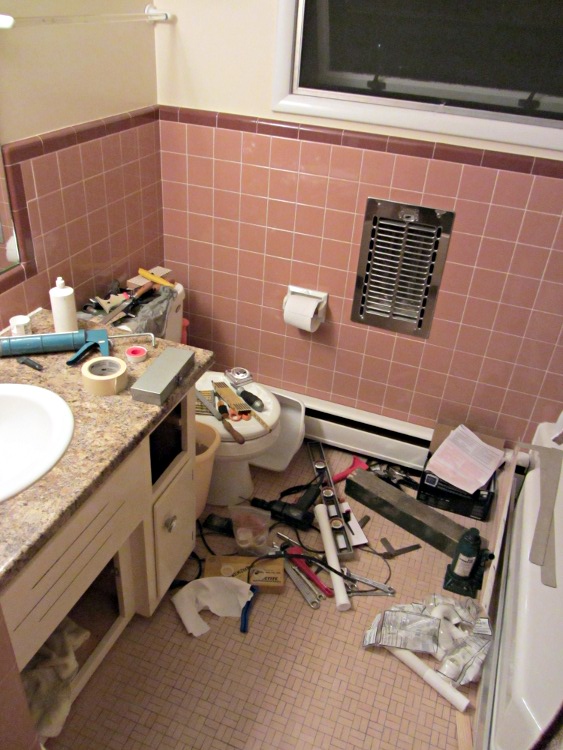
I finally got around to replacing the sink in the front bathroom, which required a surprising number of tools:
Bathroom tool midden heap
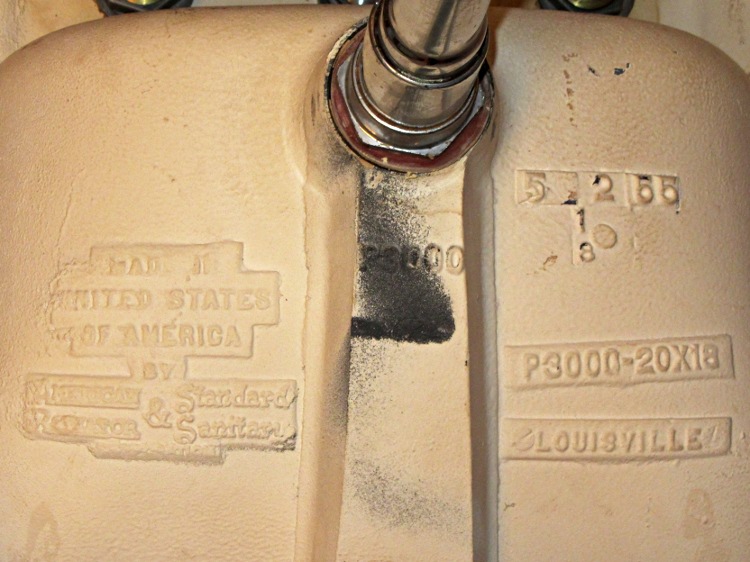
As with the three other sinks I’ve replaced over the years, this one was a beautiful cast-iron monster made by the American Regulator & Standard Sanitary company, back before the name mushed into American Standard. This casting shows the original typography:
Bathroom sink by American Regulator and Standard Sanitary
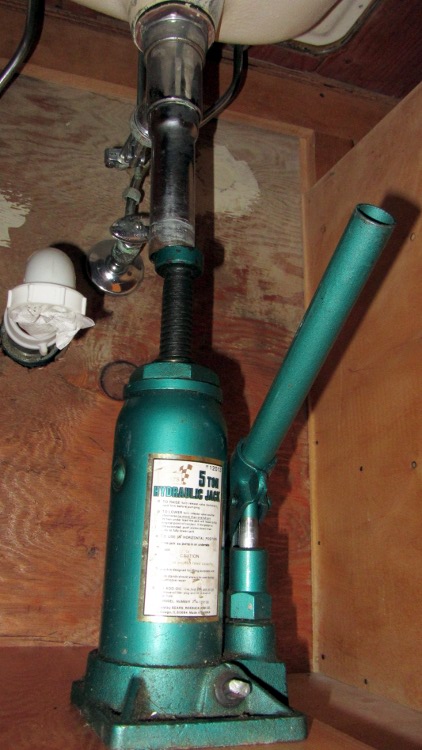
A thin stainless steel trim ring and 16 (!) clamps held the sink in place on the countertop. Harsh experience taught me to support the sink while removing the clamps, because without the clamps there is nothing holding the sink up and I no longer enjoy stopping the tailpiece of a cast-iron sink with my chest…
Supporting the old sink
As it turned out, the sink required two pumps on the jack to break it free from the gunk gluing it in place; I was pleased to be wrong. I toted it to the end of the driveway, put a FREE sign on it, wherefrom it vanished within two hours. We’ll never know if it became someone’s precious antique or just a source of heavy brass fittings at the scrap metal recycler.
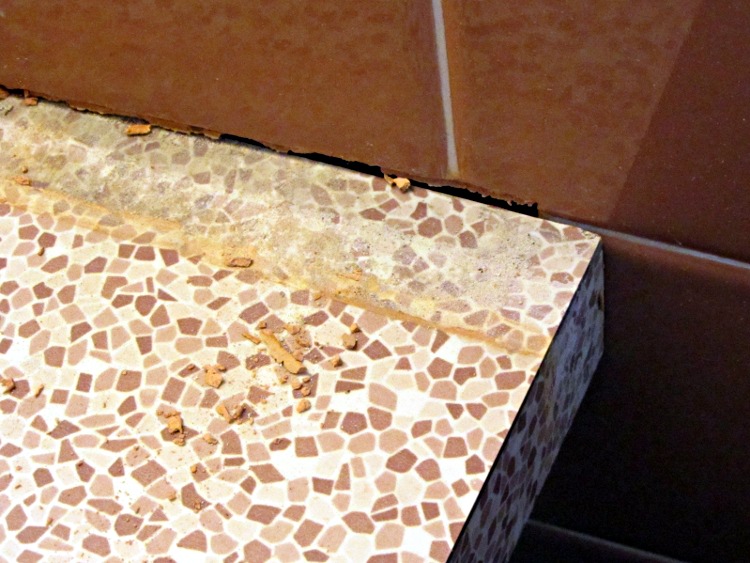
The original vanitory countertop had been recessed into the corner walls before the tiles went up, so I sawed out a chunk of the front edge and bent the plywood enough to tap it out without destroying anything. The countertop rotated around the left-front corner and the right-rear corner looked like this when the dust settled:
Extracted vanitory countertop
Half a century ago, the tile installers did a lovely mud job; the tiles adjoin and the grout is barely 1/16 inch wide. The vanitory case top was dead level, but the tiles weren’t quite aligned and my carefully applied and very neat 5 mm stripe of new caulk looks downright amateurish.
For what it’s worth, the new countertop started life as a stock kitchen countertop. I sawed off the backsplash, trimmed the length, cut a pair of notches to match the recesses, sawed a hole for the sink, rotated it into place, and screwed it down. You can go the custom-top route, but given that you only see about two square feet when you’re done, dropping $400 for 6 ft2 of fancy material with a gaping sink hole or over a kilobuck for a countertop with built-in recessed sink didn’t make enough sense to us.
And, no, vanitory is not a misspelling; I learned a new word during this project:
Vanitory job label
After we sell the house, the new owners will rip all this out without a second thought. After all, Dusky Rose went out of style a long time ago, a perfect hand-set array of 3/4 x 1-5/8 inch floor tiles isn’t attractive, and nobody cares about mud jobs. We’d rather keep that nice work around (even if we’re willing to put up with a simple countertop), but that’s just us; we’re the type of people who think keeping the original spring-loaded turned-wood dowel in the toilet paper holder is charming.
They’ll junk that space heater recessed into the wall, too: it has a long coily 120 V heating element strung inside, easily within the reach of questing little fingers. I added a GFI to that circuit, but I can’t imagine anybody else tolerating it. Times change.
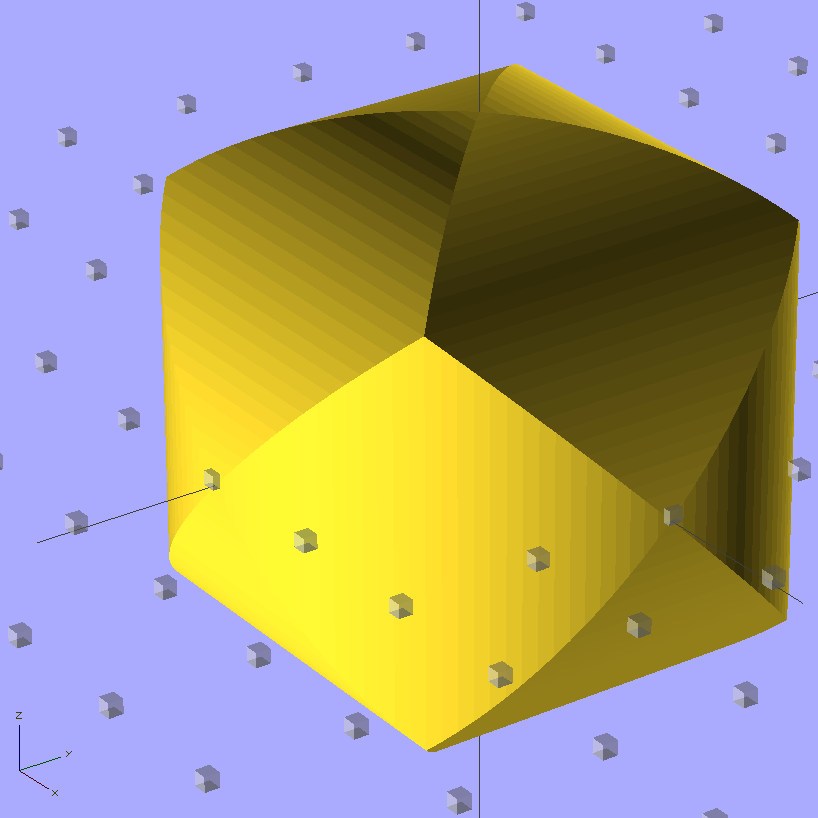
My buddy Mark One asked me to make a golf-ball sized Thing that’s the intersection of three mutually orthogonal cylinders. He claims I (subtractively) machined one from solid plastic, many many years ago, but I cannot imagine I ever had that level of machine shop fu; right now, I’m not sure how I’d fixture the thing.
Cylinder Thing – solid model
It’s much easier with a 3D printer…
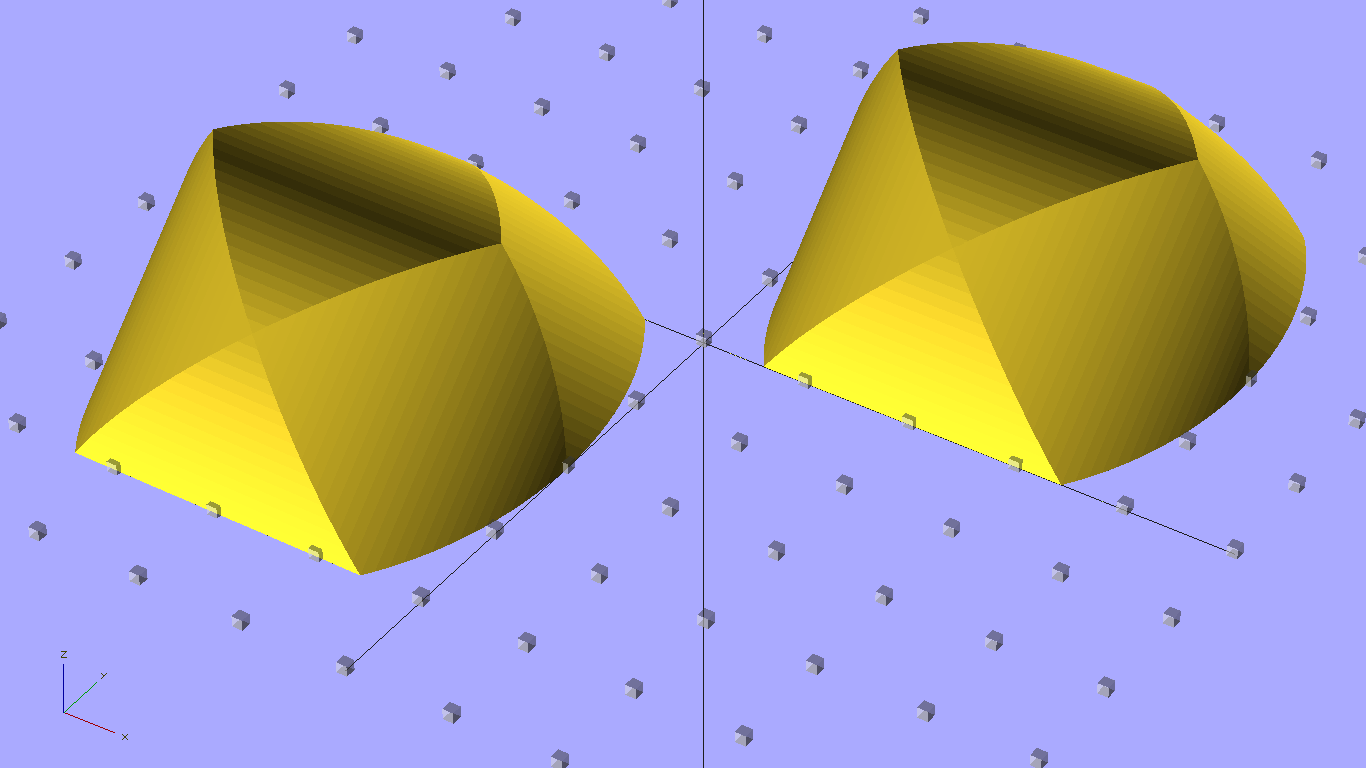
Of course, spheroids aren’t printable without support, but you can chop one in half to reveal the nice, flat interior surfaces, then add holes for alignment pegs. Using 0.50 infill makes for a compact mesh inside the ball:
Cylinder Thing – building
Smooth a few imperfections from the mating surfaces and add four pegs (the other two are busy propping the right-hand half off the countertop). Somewhat to my surprise, the alignment holes came out a perfect push fit for the 2.9 mm actual-OD filament with my more-or-less standard 0.2 mm HoleWindageFinagle Constant. This also uses the 1.005 XY scale factor to adjust for ABS shrinkage, not that that matters in this case:
Cylinder Thing – alignment pegs
Then solvent-bond everything together forever more:
Cylinder Thing – clamped
The seam is almost imperceptible around the equator, perhaps because I didn’t slobber solvent right up to the edge. I did print one without the alignment pegs and demonstrated that you (well, I) can’t glue a spheroid without fixturing the halves; that one goes in my Show-n-Tell heap.
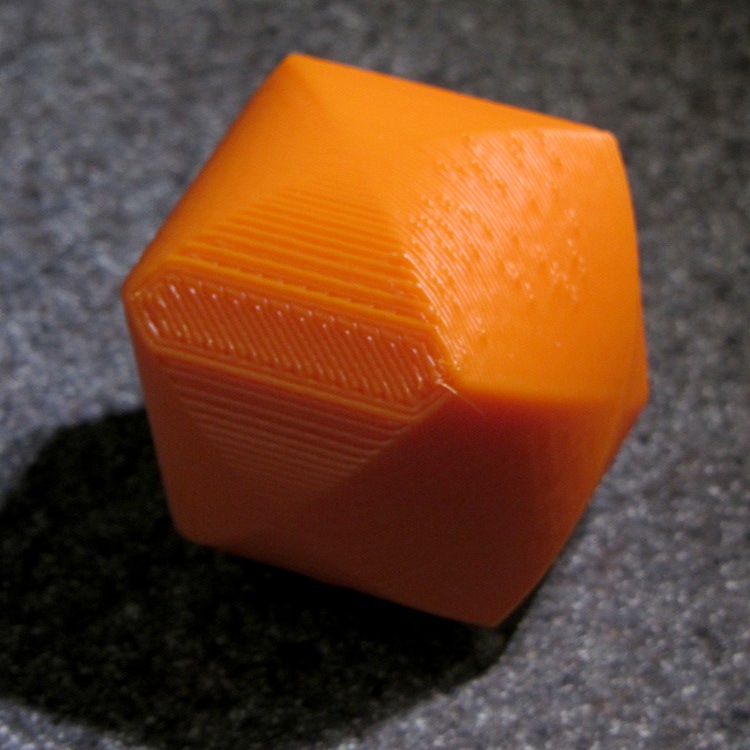
The 0.33 mm Z resolution produces sucky North and South poles; the East, West, Left, and Right poles are just fine, as are the eight Tropical Vertices. After mulling for a bit, I rotated a cylindrical profile upward:
Cylinder Thing Rotated – solid model
The obvious contour lines fit the cylinder much better, although you can see where better Z resolution would pay off:
Cylinder Thing – rotated
This was at 0.33 mm x 0.66 mm, 200 °C, 30 & 100 mm/s, 2 rpm. No delamination problems; I applied a wood chisel to persuade those big flat surfaces to part company with the Kapton tape.
The OpenSCAD source code:
// Three intersecting cylinders
// Ed Nisley KE4ZNU - Oct 2011

Layout = "Build";			// Show Build

//- Extrusion parameters must match reality!
//  Print with +1 shells and 3 solid layers
//  Use infill solidity = 0.5 or more...

ThreadThick = 0.33;
ThreadWidth = 2.0 * ThreadThick;

HoleWindage = 0.2;

Protrusion = 0.1;			// make holes end cleanly

//------ Model dimensions

CylDia = 2*IntegerMultiple(40.0/2,ThreadThick);
CylRad = CylDia/2;

echo(str("Actual diameter: ",CylDia));

Angle = [45,0,0];			// rotate to choose build orientation

$fn=128;

AlignPegDia = 2.90;

//-------

function IntegerMultiple(Size,Unit) = Unit * ceil(Size / Unit);

module PolyCyl(Dia,Height,ForceSides=0) {			// based on nophead's polyholes

  Sides = (ForceSides != 0) ? ForceSides : (ceil(Dia) + 2);

  FixDia = Dia / cos(180/Sides);

  cylinder(r=(FixDia + HoleWindage)/2,h=Height,$fn=Sides);
}

module ShowPegGrid(Space = 10.0,Size = 1.0) {

  Range = floor(50 / Space);

	for (x=[-Range:Range])
	  for (y=[-Range:Range])
		translate([x*Space,y*Space,Size/2])
		  %cube(Size,center=true);

}

//------- Model bits & pieces

module OneCyl() {
  cylinder(r=CylRad,h=CylDia,center=true);
}

module ThreeCyl() {
  intersection() {
	OneCyl();
	rotate([90,0,0]) OneCyl();
	rotate([0,90,0]) OneCyl();
  }
}

module HemiThing() {
  difference() {
	rotate(Angle)
	  ThreeCyl();
	translate([0,0,-CylRad])
		cube(CylDia,center=true);
	for (Index = [0:3])
	  rotate(Index*90)
		translate([CylRad/2,0,-Protrusion])
		  PolyCyl(AlignPegDia,5+Protrusion);
  }
}

//---------

ShowPegGrid();

if (Layout == "Show")
  ThreeCyl();

if (Layout == "Build") {
  translate([CylRad,CylRad,0])
	HemiThing();

  translate([-CylRad,-CylRad,0])
	  HemiThing();
}
These critters look like bumblebees, but they’re squash bees, native to the Americas, working over a squash blossom just inside the garden gate. Much smaller than carpenter bees that drill holes in nearby garden posts, a bit smaller than bumblebees, and good to have around when you’re raising squash!
Squash bees in flower
I noticed the third bee only after looking closely at the picture.
This is a handheld tight macro with the Canon SX230HS using the flash. Surprisingly, the autofocus target picked out the bees and tracked them quite well. A tripod would help, but not all that much.
I’ve carried all my stuff in a belt pack since long before such things were fashionable and, quite some years ago, a friend made me a custom-sized one that’s been in constant use ever since. Of late, one of the zippers got cranky and finally failed completely.
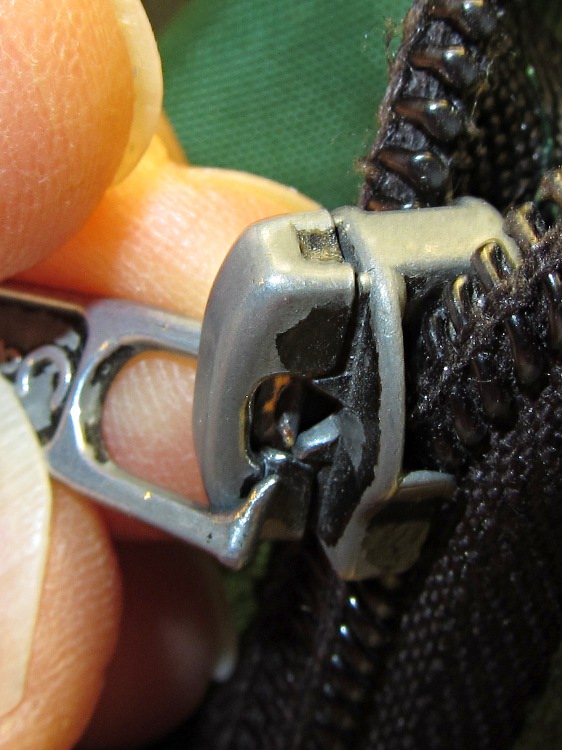
An autopsy showed the middle of the cross bar on the tab had worn completely through, the stubs had bent outward, and the remains no longer engage the zipper tooth lock.
Worn-through zipper tab
I replaced the tab with a short length of chain and a jump ring, but I fear the pack fabric is also reaching end of life.






 The Smell of Molten Projects in the Morning