Ed Nisley's Blog: Shop notes, electronics, firmware, machinery, 3D printing, laser cuttery, and curiosities. Contents: 100% human thinking, 0% AI slop.
Picked up a Harbor Freight thickness gauge to measure Thing-O-Matic filaments and suchlike; it has a plastic piston and anvil, so it’s not well-suited to measure anything other than plastic parts. In fact, it’s all plastic and the various sliding surfaces produced a remarkable amount of friction.
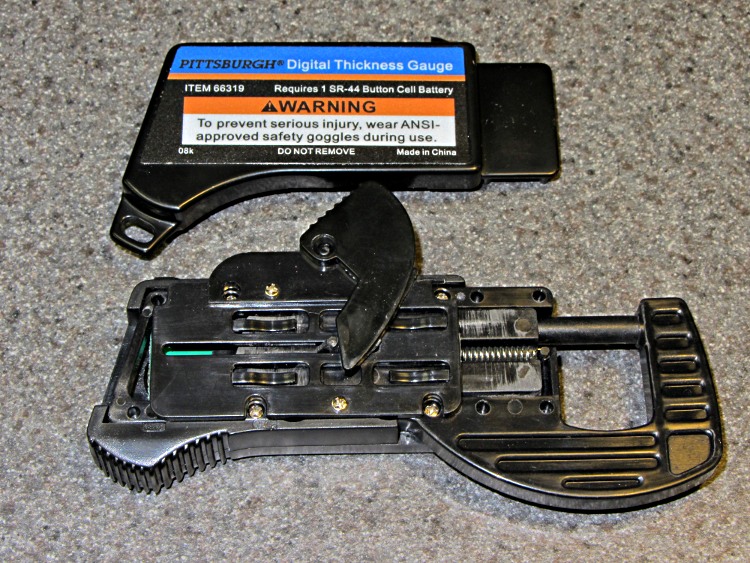
Fortunately, the back cover pops off without too much of a struggle:
Harbor Freight Digital Thickness Gauge – cover removed
Dabs of silicone lube at all the contact points considerably improved its disposition.
The display offers 0.01 mm resolution, but I don’t believe that rightmost digit for an instant. The stated accuracy is ±0.1 mm, which is probably closer to the truth, and it agrees reasonably well with my considerably better quality digital caliper.
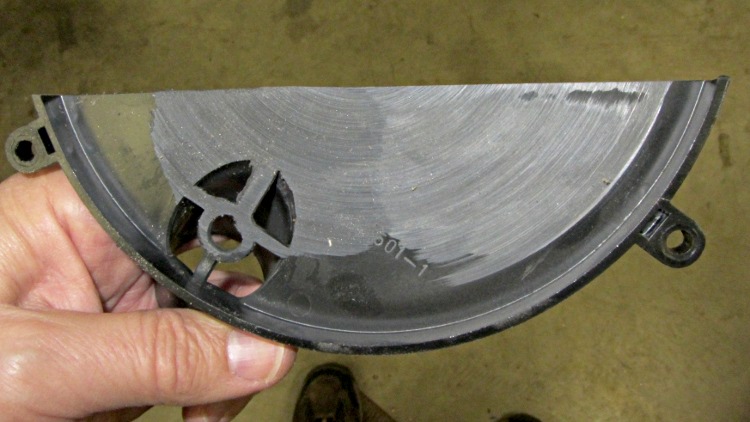
As part of making that PCB, the sanding disk on the side of Mr Belt Sander made a lot more noise than usual; it’s hard to tell, because I wear 30+ dB ear muffs. Turns out that the setscrew had worked loose enough to let the disk walk outward, chewing up the plastic dust collector cover and the aluminum table:
Belt sander disk dust catcher
The setscrew gouged the shaft enough to prevent the disk from sliding off the shaft, which was probably a Good Thing, but that also meant I had to jam a big flat-blade screwdriver inside the guts of the dust guard and twist to pry the disk off:
Belt sander disk shaft
A touch of the file on the shaft, a bit of cleanup inside the disk hole, a dab of Loctite, and it’s all good again.
It always feels good when the parts fit together, even if they don’t actually do anything yet…
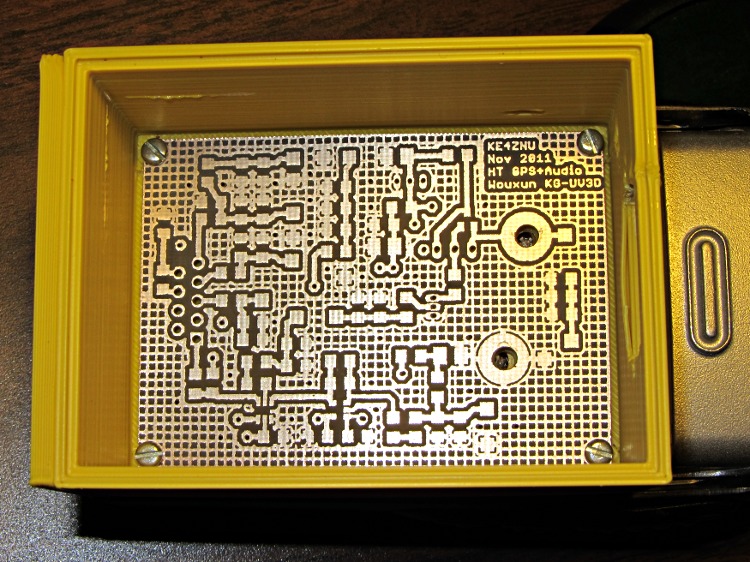
Bare PCB in Wouxun HT battery case
That’s the bare PCB in the first-pass 3D-printed battery case adapter, both of which need quite a bit more work. In particular, the case desperately needs some sort of latch to hold the yet-to-be-built contacts against the HT’s battery terminals.
Amazingly, all the holes lined up spot on, although I think the lower battery contact could move half a millimeter closer to the base of the radio. The battery case contacts are large enough to work as-is and, for what it’s worth, the Wouxun battery cases seem to differ slightly among themselves, too.
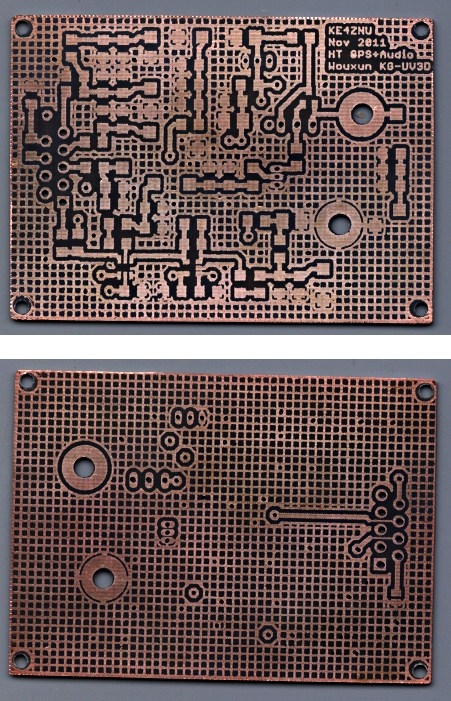
The circuit has provision for pairs of SMD caps on all the inputs, with which I hope to squash RFI from both the VHF and UHF amateur bands by choosing their self-resonant frequencies appropriately.
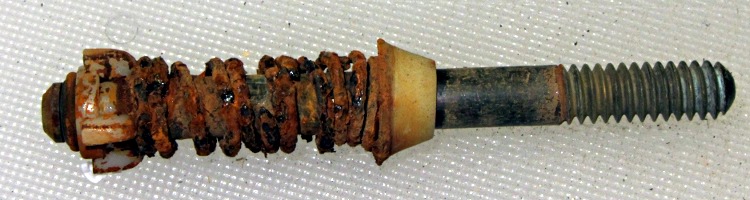
A garden sprayer awaiting repair emerged from the benchtop clutter. It’s an old one, with a metal shell and actual screws, so I could dismantle it to reveal the problem:
Garden sprayer valve – rusted spring
It’s evidently impossible to make a good, cheap, corrosion-resistant spring (pick any two, I suppose):
Garden sprayer valve – wreckage
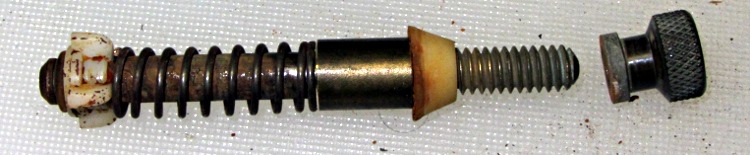
Some rummaging in the Big Box o’ Medium Springs produced a slightly smaller spring that should last for a while; it’s good, free, and rust-able, if a bit too short.
Much to my astonishment, I found a length of 3/8 inch Marine Bronze rod in the stockpile and made a bushing to take up the remainder of the space:
Garden sprayer valve – new spring and bushing
It won’t get a good test until gardening season opens next year, but it seems to seal well enough.
That’s from Richard Feynman, who should know a thing or two about science and experiments.
The full quote, from a book review in Skeptical Inquirer (Sept/Oct 2011, p 57):
If it disagrees with experiment, it is wrong. In that simple statement is the key to science. It doesn’t make any difference how beautiful your guess is, how smart you are, who make the guess, or what his name is. If it disagrees with experiment, it’s wrong. That’s all there is to it.
We’ve all encountered folks with beliefs that simply don’t match up with reality; some of them are us. Many such beliefs are non-falsifiable, sometimes carefully phrased that way, making experiment irrelevant.
This brass dragonfly has graced our garden for some years, but what seemed like a gentle tap during fall cleanup knocked both eyeballs out. The original adhesive looked like urethane, so I cleaned the sockets, applied a layer around the rim, and popped the marbles back in place.
Having missed the fall driveway paving deadline, we will have a gravel section in the middle of the driveway until next spring. All the water from the garage downspouts and the back yard runs down the driveway, which dumps it directly into the gravel patch and the new retaining wall’s foundation. That means the gravel patch, at least, will become a mud hole, which I take to be a Bad Thing.
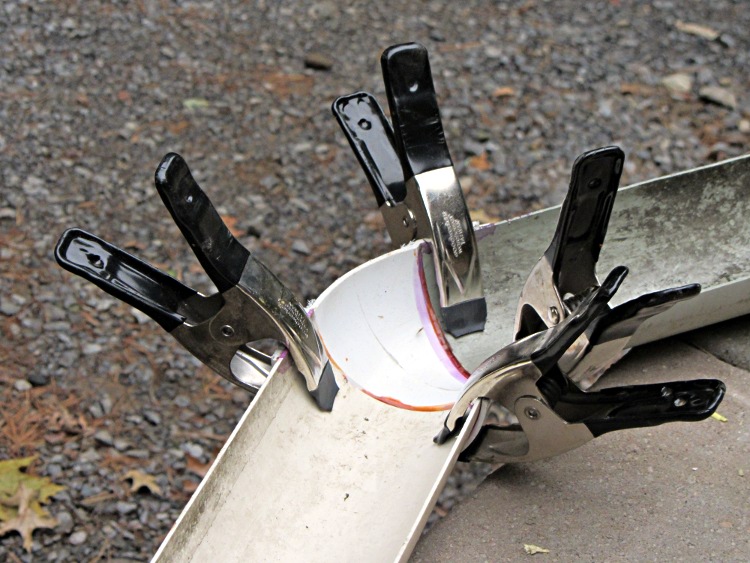
So I bandsawed some 4 inch DWV pipe & fittings in half lengthwise, glued them together as a gutter to capture the runoff and divert it into 80 feet of DWV pipe leading to the bottom end of the wall, then filled the half-pipes with gravel to let us drive right over the whole mess. Unfortunately, the top end of the gravel patch has the driveway ending in broken asphalt, Item 4 gravel, fine gravel, and rubble that make it impossible to snug the pipes up against the asphalt. That means the runoff would pretty much vanish before it reached the gutters.
So I excavated just barely enough gravel to ensure a downhill slope from the remaining asphalt, mixed up a random bag of mortar that’s been kicking around in the garage for a few years, and troweled an apron from the asphalt to the half-pipes. Generally I sign my work, but this kludge need last only a few months and I left it to cure.
The next morning I discovered one of the chipmunks felt the work really needed a signature:




 The Smell of Molten Projects in the Morning