Ed Nisley's Blog: Shop notes, electronics, firmware, machinery, 3D printing, laser cuttery, and curiosities. Contents: 100% human thinking, 0% AI slop.
I set up Xubuntu 11.10 on the Dell 531S driving the Thing-O-Matic, as the Unity UI seems surprisingly like crippleware: every feature that isn’t mandatory is prohibited. However, Xubuntu’s XFCE UI also has a long list of things that should be easy and aren’t, such as enabling remote desktop sharing. Gotta have that so I can fire up the printer and monitor progress from upstairs.
It turns out that the Vino server is installed, but not enabled, so you must start by firing up vino-preferences in a terminal to set some preferences:
This is a local machine behind a firewall, so a moderately secure password with no confirmation will suffice. Your paranoia may vary.
Then drill down through the menu from Settings → Settings Manager → Session and Startup to the Application Autostart tab, then Add the Vino VNC Server to the list: /usr/lib/vino/vino-server. You can start it manually if you have the hots for immediate sharing.
This seems to be impossible in Unity, trivially easy in GNOME, and unduly mysterious in XFCE.
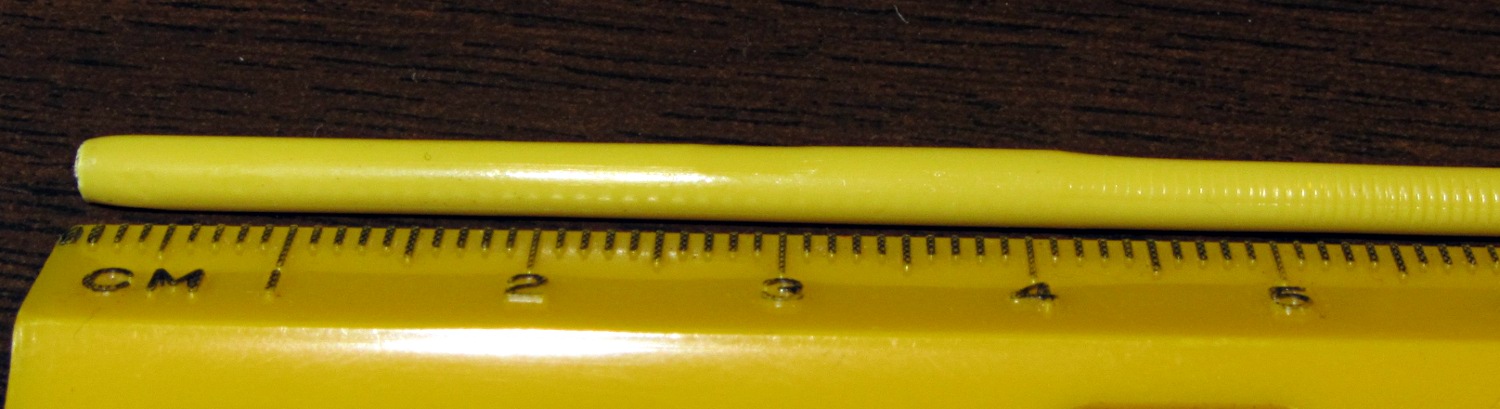
The 0.5 mm nozzle came off the hot end with surprisingly little effort; the high-temperature lube did its job! I dismantled the tensioner, clipped the filament at the top of the drive wheel, and extracted it (with the red PTFE insulation / guide tube) through the bottom of the Thermal Core. Getting the filament out of the tube required the gentle suasion of a pin punch, but eventually I found this:
Filament melt zone – overview
Although you can’t tell from the picture, the filament seems completely melted for about 20 mm, well-softened for another 20 mm, and soft for about 10 mm. Here’s a detail of the transition from well-softened to soft to hard:
Filament melt zone – detail
Notice how the notches from the drive wheel gradually fade out over about 10 mm, whereupon the filament expands to fill the PTFE tube. You can’t see the shallow depression from an air pocket offscreen at about 30 mm, but it suggests the filament isn’t quite molten from 20 mm onward. Given that the distance from the nozzle tip to the top of the Thermal Core is about 40 mm, all this makes sense, particularly when you figure the filament was stationary as the Core cooled off after the last print: the melted-to-melty sections are inside the Core and the softened section is just above the Core.
In round numbers, the Thermal Core supplies enough heat through the PTFE tube to fully melt the filament for about 20 mm above the nozzle when printing at 2 rev/min. The effective drive diameter is 9.6 mm, so 1 rev = 9.6 π = 30 mm and the Core must melt 60 mm/min = 1 mm/s. This is obviously a grossly nonlinear situation, but if you get only 20 mm of molten filament at 1 mm/s, the maximum speed can’t be much more than 4 mm/s or so.
The rest of the Thing-O-Matic’s mechanics set an upper limit for, say, printed octopi at 80 mm/s and 4 rev/min = 2 mm/s, but the extruder will definitely be the limiting factor for speeds over, say, 150 mm/s. Not much risk of that happening here, I’d say.
I’ve settled on Reversal for 125 ms at 25 rev/min, so the retraction distance is:
If you have a landline telephone number, you’ve probably been robo-called by “Rachael” from “Credit Card Services” with an offer to lower your credit card rates. She gives you two options:
Press 1 to speak with a live operator
Press 3 (or, sometimes, 2) to prevent further calls
I presume you’ve discovered that pressing 3 has no effect.
We don’t have a pre-existing business relationship with CCS
They use a robo-dialer
Pressing 3 (or whatever) doesn’t discontinue the calls
Their caller ID is spoofed
Rather than get mad, play along. CCS obviously preys on suckers willing to read off their credit card information to total strangers, so you can retaliate by stringing them along as far as possible, thus increasing their cost-per-sucker. Admittedly, their “agents” are (at best) minimum-wage slaves, which means you’re messing with their income stream, but after the first few months it becomes pretty obvious that the calls will never stop and you may as well roll with the punch.
Suggested topics, all presented in a slow monotone with long pauses:
Making sure they’re not associated with any of your credit cards (they aren’t)
Understanding whether they’re offering a loan to pay off your cards (they lie)
Asking for a callback number in case the call gets dropped (it’ll be a junk number)
They expect a minimum $4k account balance with the usual usurious credit card rates. Getting them to admit any of that requires carefully paced inquiry, because their script requires getting my balance before they devote any more time to me. I haven’t fed them any (totally bogus) numbers yet, but that may be the only way to get beyond the preliminaries.
Topics I’ll investigate in upcoming calls:
Their current interest rate
The repayment schedule
What they hold as collateral
How’s the weather where they are (it’ll be terrible here, for sure)
Thus far, I’ve discovered that any mention of these topics produces an instant disconnect:
Why pressing 3 does not discontinue further calls
Inquiring about their company mailing address
Asking to speak with a supervisor
Whether lying to strangers all day affects their personal relationships
My record so far is 3:05 from picking up the phone, which includes the recorded message and a bit of hold music.
Cleaned the gutters a while ago and the shingle fungus is getting worse: more sites and more stains. I sprized some general-purpose fungicide on the area over the kitchen:
Shingle fungus – east slope
And down the valley between the north and east slopes:
Shingle fungus – north and east slopes
We’ll see what happens by next spring; I hope the larger moss clumps will take the hint.
However, that short length of copper wire seems to be improving things. Here’s the before:
Copper effect on roof discoloration
Compared with the current state, from a different spot:
Shingle fungus – below Cu wire
The intense streaks have vanished, leaving a uniform lighter gray layer, and the upper area near the wire looks, mmm, less awful than the lower areas. I think running copper wire or zinc strips (which I have not found at the big box stores) along the ridge vent will do wonders, although I’m not sure how to anchor either one along the hip joints between the other slopes.
For the last few days, my trust Weller EC1000 soldering iron (well, station) has been misbehaving: shortly after cleaning the tip, it would become covered in charred residue and slag. Today, the LED I’d hacked across the heater terminals inside the base stayed dark, even though the tip was hot, and then became sensitive to the handle position. Obviously there’s a loose wire inside, right?
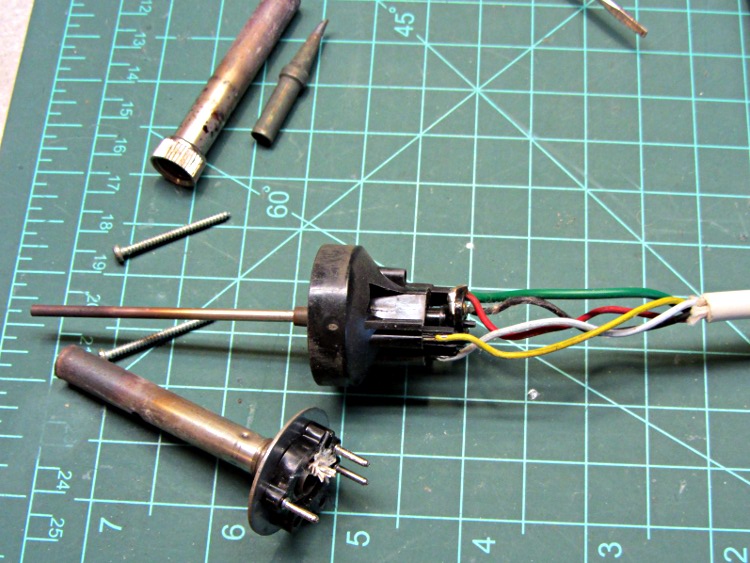
So I took the handle apart by removing the two screws on the front plate:
Weller EC1201A soldering handle innards
The trick to getting the guts out is to push down on the tab inside the handle that locks the cord strain relief block into the handle. After that, everything comes apart with very little force at all.
Contrary to what I thought, the heater is in the tube surrounding the temperature sensor probe. Looking at the connector on the front of the base unit, the key is on the left side and the wires going clockwise from above the key are:
Yellow: heater
White: heater
Black: sensor
Red: sensor
Green: shield
I would have sworn the red & black were the heater, as they have special-looking brass/bronze/copper colored pins & sockets. Wrong again.
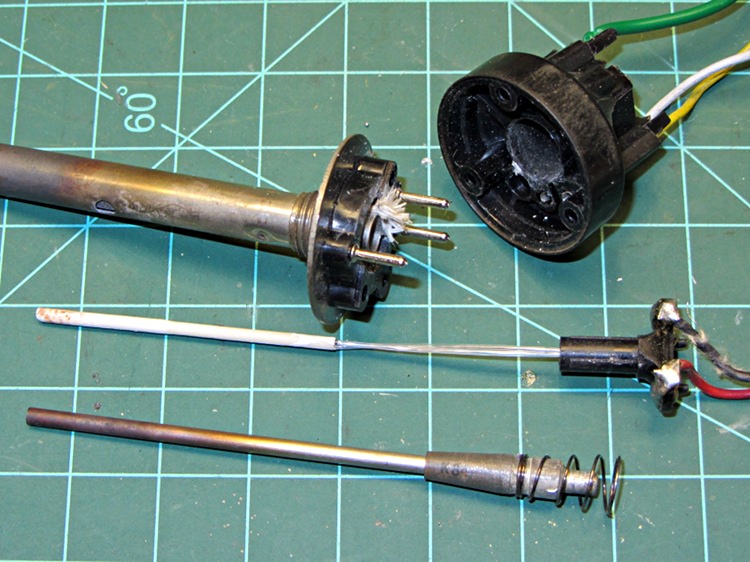
The temperature probe comes apart thusly:
Weller EC1201A temperature probe disassembly
Basically, slide the connector and ceramic-coated sensor out of the back of the black shell, then pull the spring-loaded sheath out the front.
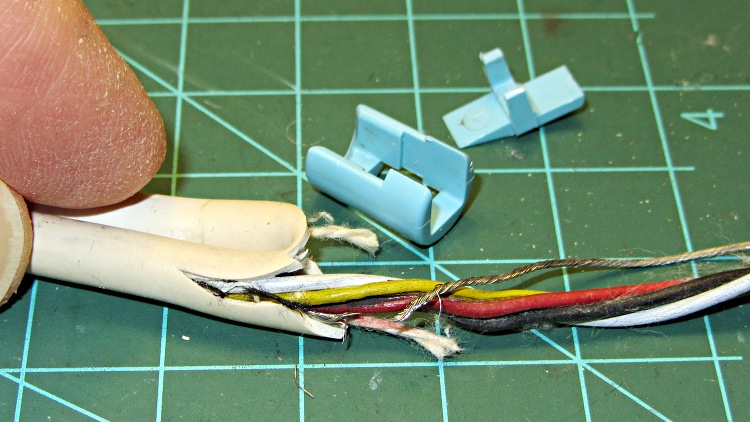
I hoped for a laying-on-of-hands fix, but it was not to be: the tip heats while the LED (which I wired there early in the iron’s life) across the heater power remains off. But the LED blinked on intermittently with slight pressure on the iron’s tip; a bit more poking and prodding isolated an intermittent open-circuit to the ground wire just outboard of the strain relief at the handle:
Soldering iron cable failure
A bit more poking & tugging isolated an intermittent high-resistance short (a few hundred ohms, more or less) to a section of cable half a foot from the base connector at the bottom of the cable’s natural loop when the iron’s in the holder.
Unfortunately, fixing all that didn’t restore the iron to life. It seems that the temperature sensor (a thermocouple?) has failed, allowing the tip to heat well beyond any rational temperature. Now that I’m looking, a cleaned solder layer turns blue with oxidation in a matter of seconds and rosin chars instantly. The temperature control knob has no effect whatsoever.
The date codes inside the box show it’s been with me since late 1982, so on a dollars-per-year basis the thing has been a bargain. A new sensor is $60, a new handle is twice that, and I think it’s time for a new iron… at less than the price of the sensor alone, I think that’s OK.
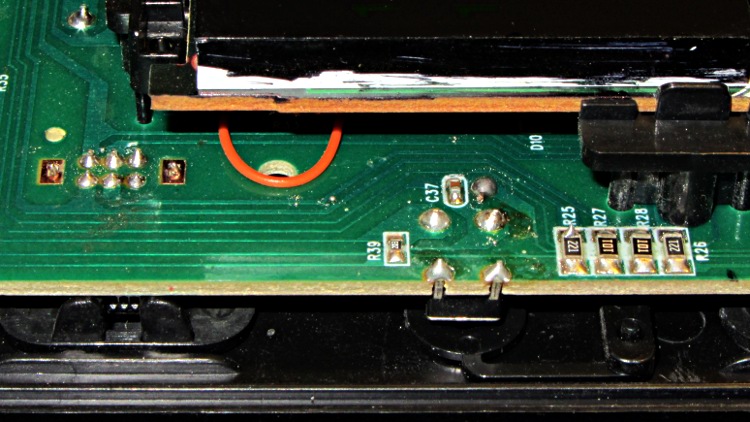
Mary prefers dim digits on the bedroom alarm clock, far below what the usual DIM switch setting provides. I’d slipped a two-stop neutral density filter in front of our old clock’s VFD tube, but the new one has nice green LED digits that ought to have a tweakable current-setting resistor behind the switch. Indeed, a bit of surgery revealed the switch & resistors:
RCA clock – DIM switch and resistors
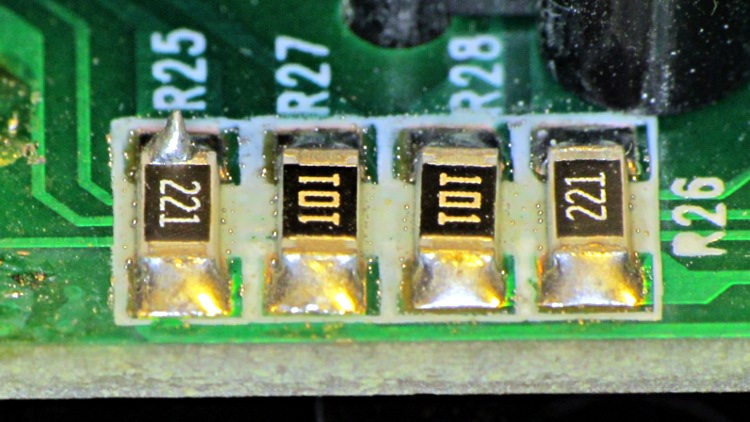
It turns out that the 220 Ω resistors set the DIM current, with the 100 Ω resistors in parallel to set the BRIGHT current. Weirdly, the display operates in two halves: one resistor for the lower and middle segments, the other for the top segments. The resistor numbers give a hint of what the schematic might look like:
RCA clock – LED current-set resistors
The current control isn’t all that good, because the brightness varies with the number of active segments. With 470 Ω resistors (yes, from that assortment) in place, the variation became much more obvious; the LEDs are operating far down on their exponential I-vs-V curve. We defined the result to be Good Enough for the purpose.
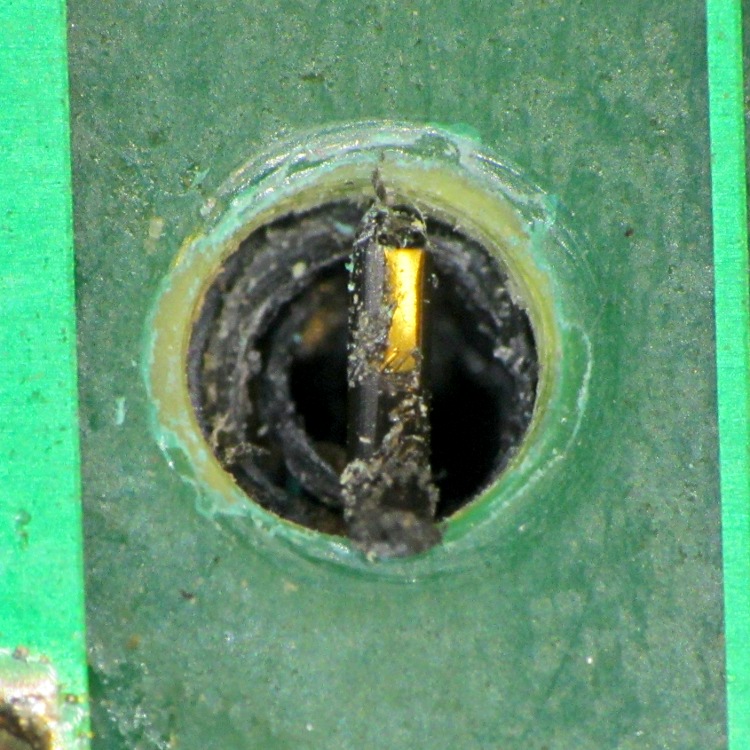
Four short screws hold the circuit board in place, but one of them arrived loosely held in a pre-stripped hole. I cut eight lengths of black Skirt filament, anointed them with solvent adhesive, dropped two apiece into each screw hole, and ran the screws back in place. I likely won’t be back in there, so it should be a lifetime fix:
RCA clock – ABS filament in screw hole
Done!
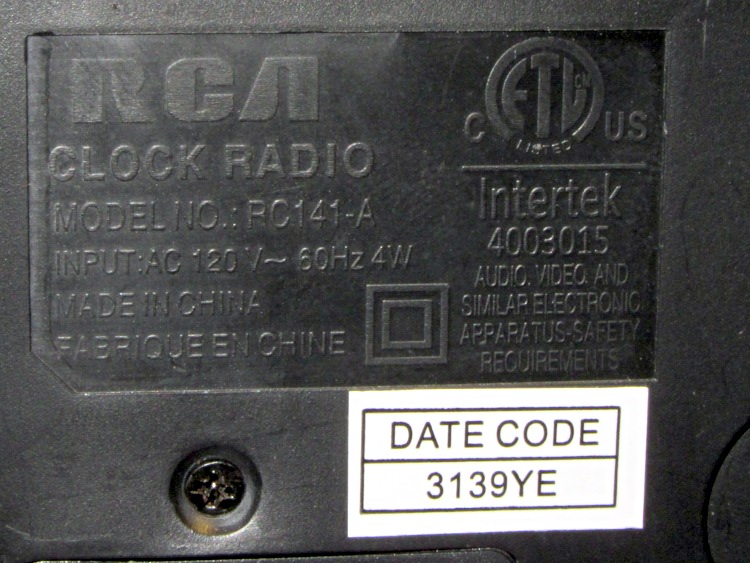
As with all the trade names you remember from back in the Old Days, the present incarnation of “RCA” has nothing whatosever to do with the original Radio Corporation of America:




 The Smell of Molten Projects in the Morning