Ed Nisley's Blog: Shop notes, electronics, firmware, machinery, 3D printing, laser cuttery, and curiosities. Contents: 100% human thinking, 0% AI slop.
For reasons irrelevant to this discussion, I wound up looking at http://widestat.com/softsolder.com, which gave this view of my blog (typos in original, emphasis mine):
Softsolder.com has #12,773,578 traffic rank in world by Alexa. … Out of the 6 unique keywords found on softsolder.com, “chicken ark” was the most dense. … This site has Google PageRank™ 3 of 10.
OK, so it’s not a high-traffic site. I can live with that.
But … chicken ark?
If you search herein for chicken you’ll come up with zero hits (apart from this one) in the posts. Unleashing Google with site:softsolder.com chicken digs up some comments, none of which discuss arks. I have absolutely no idea where Widestat came up with that, which makes me distrust their conclusions even more.
Our Larval Engineer acquired a free bicycle to get around at school: a Rollfast “girl’s bike” dating back to 1972 with 105 miles on the odometer. She completely dismantled it, cleaned everything, reassembled it in reverse order, and added a rear rack & panniers. Having touched every part of the bike, she’s now in a much better position to fix whatever may go wrong in the future.
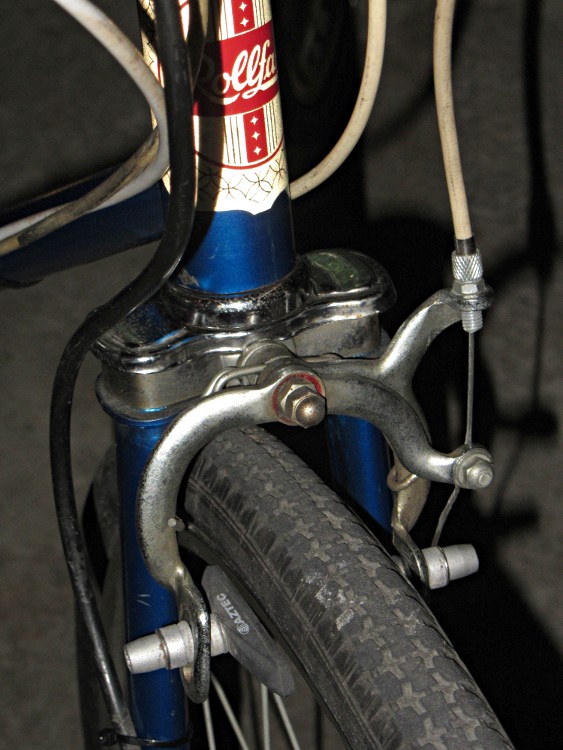
It was an inexpensive bike to start with and we left everything as-is, with the exception of the brake pads. You’re supposed to bend the brake arms to align the pads with the rims, a technique which I didn’t like even back in the day. So we swapped the OEM pads with worn-but-serviceable Aztek pads sporting spherical washers:
They’re way grippier than the old pads, even on those chromed-steel rims. I had a bike with steel rims and old pads; given the slightest hint of water, it didn’t stop for squat. With any luck, the Azteks will at least slow this one down.
Although she wanted to take the Tour Easy, the bike must live outside under the apartment stairs all year and, frankly, that’d kill the recumbent in short order. Forgive me for being a domineering parent; when she has a good place to store a spendy bike, it’s hers for the taking.
We haven’t figured out how to mount the GPS/APRS tracker + radio and antenna. The evidence suggests she prefers to travel incognito from now on…
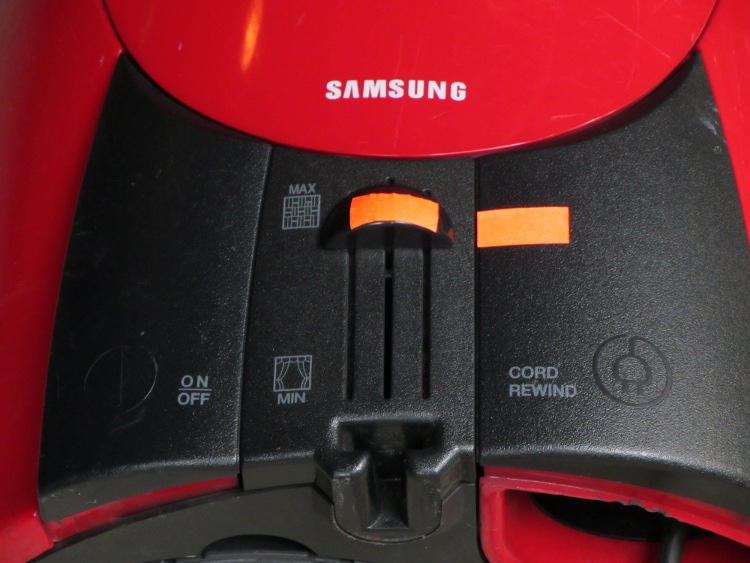
After having discovered, once again, that the vacuum cleaner wasn’t cleaning very well because the suction control was knocked halfway down the scale, I made the normal setting on the damn thing visible:
Samsung vacuum cleaner control labeling
I don’t know why a label in dark-gray-on-black is such a wonderful idea, given that SAMSUNG stands out in pure white-on-red. Designers love subtle touches; I suppose they expect you to just puzzle it out and memorize the right answer.
The embossed / raised black-on-black symbols don’t work for me, either. Did you spot the one to the left of the ON/OFF label? Didn’t think so.
Two turkey hens have formed a creche with seven chicks; if that seems a low number compared with the five in that clutch, we may have just seen the reason.
The turkey flock came foraging across the back yard one evening while we were eating supper on the patio:
Turkey Chicks – foraging
The hens began behaving oddly and the chicks went into periscope mode while looking in all directions at once:
Turkey Chicks – high alert
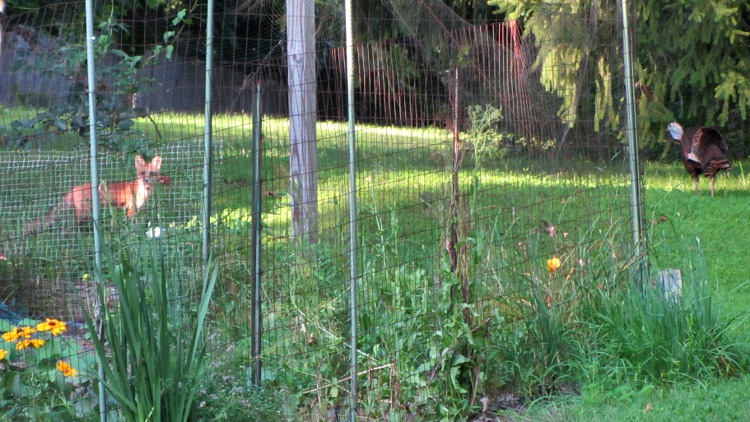
After a moment, we saw this tableau:
Red Fox and Turkey Hen
The red fox entered from the left, then made a great show of ignoring the turkeys while scratching an ear, licking its nuts, and examining the ground as the hens postured and threatened. The fox eventually trotted off to the right, through the grove in the rear, and away.
The flock required a few minutes to stand down from the alert:
Turkey Hen and Chicks – standing down
And then they moved on, searching for yummy things in the grass as usual…
The pictures are crap from the Canon SX230HS, hand-held at long telephoto, and ruthlessly cropped; the high-res originals aren’t much better than these. I’d expect better results in shaded sunlight, but for obvious reasons I couldn’t move any closer or pause to fetch a tripod. The fox tableau seems perfectly focused on the garden netting, which is what you’d expect from contrast-based autofocus; even if using manual focus would help, the bad picture you get is better than the good picture you didn’t.
So I bought a lurid green $8 Tomodachi Santoku knife at K-Mart, which was the first non-stick-coated Santoku-shaped knife I’d seen since that comment. It’s made by Hamilton Forge Ltd, one of those generic names that doesn’t produce any search results worth mentioning and so probably isn’t a real company:
Tomodachi Santoku knife
The knife has a huge steel blade with a solid plastic handle injection-molded around a short tang, which put the balance point maybe 50 mm out into the blade. I didn’t like the feel when I waved it around in the store and really didn’t like how it behaved on the cutting board.
The way I see it, I can fix a too-light handle…
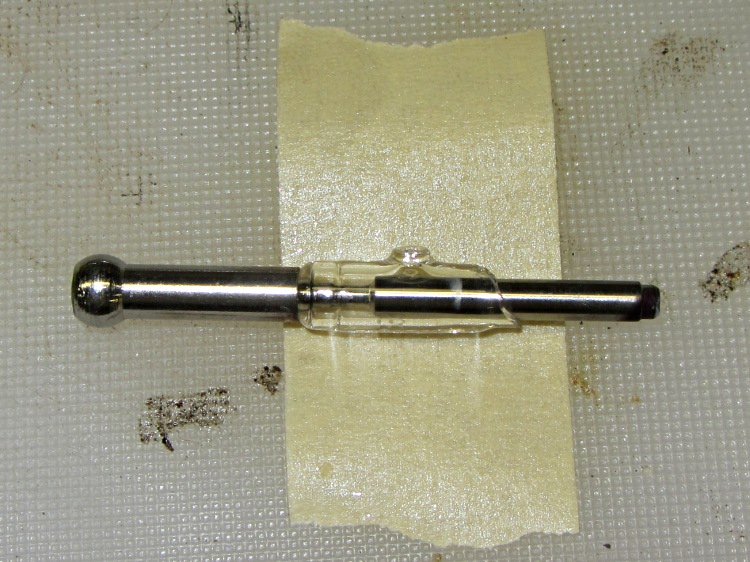
Pursuant to that post, I have a bag of tungsten electrodes, some complete with a glass seal:
Tungsten electrode with glass seal
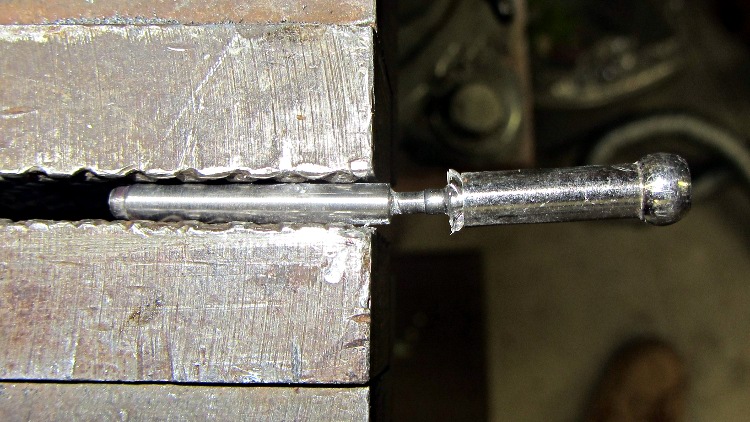
Wrapping some masking tape around the glass, tapping it with a hammer, then sliding the tape-with-fragments into the trash got rid of the glass. The bulbous tip seems to be a stainless steel tube welded around a thin tungsten shaft, so I clamped it in the vise and whacked it with a chisel; tungsten is strong-but-brittle and cracks easily:
Fracturing tungsten electrode
Of course, whacking a tungsten rod didn’t do the chisel the least bit of good, but it was about time to sharpen that thing anyway.
Why use tungsten electrodes instead of, say, ordinary drill rod? Tungsten has about the highest density you can get without going broke, getting poisoned, or dying of radiation exposure. That useful table gives elemental density in g/cm3:
aluminum = 2.7
iron = 7.9
lead = 11.4
gold = 19.32
tungsten = 19.35
osmium = 22.6
Can’t afford gold, not even I would put a lead slug in a kitchen knife, and I had the electrodes, so why not?
Waving a neodymium magnet over the handle convinced me that I could drill a hole slightly more than two inches deep without hitting the tang. I briefly considered drilling half a dozen smaller holes, but that started to look like a lot of work and I don’t have any suitable gun drills.
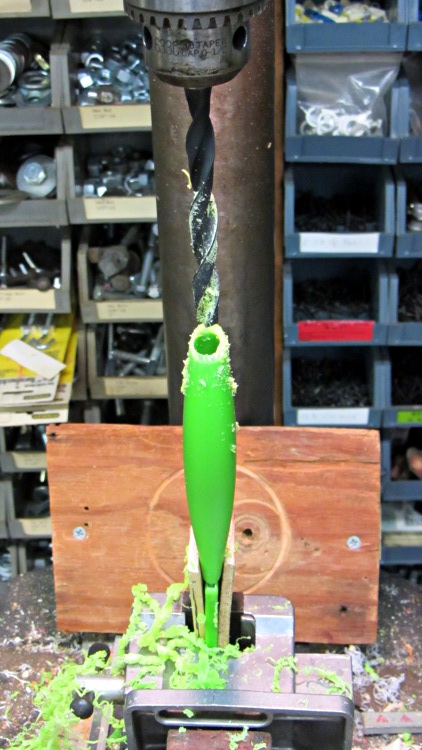
The business end of the electrode measures 1 inch long and 0.1375 inch in diameter. A hexagonal cluster of seven rods fits neatly into a round hole about 3×0.137 = 0.413 inch in diameter: quite conveniently a nice, long Z drill. So I clamped the knife between two strips in the drill press vise and had my way with it:
Drilling knife handle
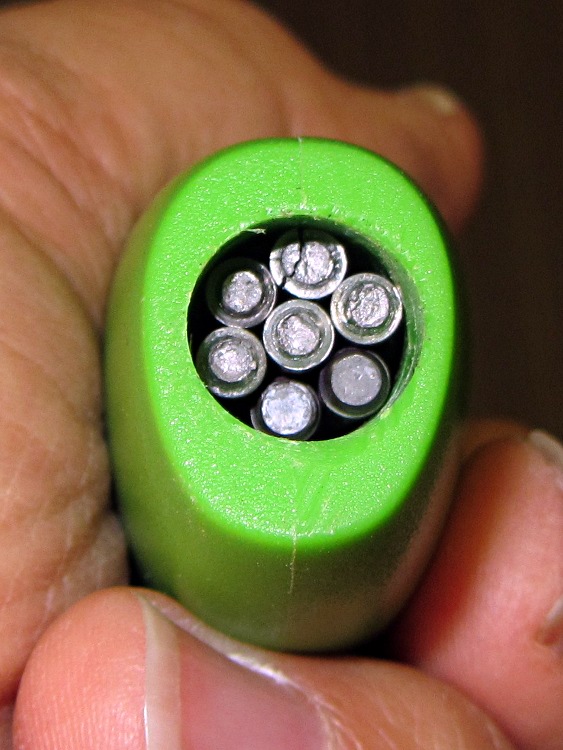
Actually, I spot-drilled with a center drill, then used a long step drill, stopping with the 3/8 inch step just kissing the low side of the handle, to get the hole mostly on center, before running the Z drill down about 2-1/8 inch. The handle walls became so thin that they flexed around the drill to produce an undersized hole, so I reamed it with a hand-turned 7/16 inch drill and the electrodes fit with no room to spare:
Tungsten electrodes in knife handle
Yeah, that’s a crack in the top electrode: tungsten is brittle.
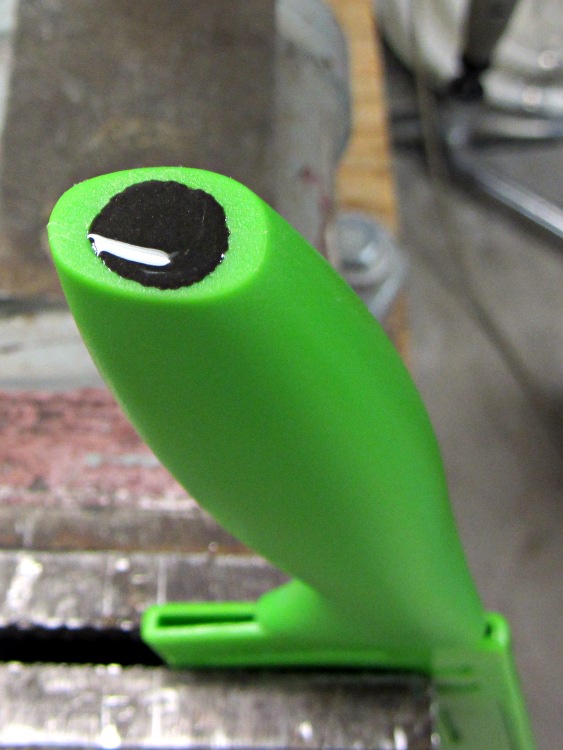
A dollop of epoxy atop the electrodes should seal them in place forever. I clamped the knife (in its color-matched scabbard) with the angled end of the handle water-level, so the epoxy settled in a neat, symmetric blob that looks better in person than it does here:
Epoxy seal over tungsten weights
The epoxy forms a plug over the ends of the electrodes and (probably) doesn’t extend very far down between them, but they’re firmly jammed in a snug hole and (probably) won’t ever rattle around.
Seven electrodes weighed 32 g and, figuring the missing plastic rounds off to slightly over nothing, the handle now has 60 g of additional weight out toward the end, producing a knife weighing 185 g that balances near the narrowest part of the handle. It’s somewhat heavier than I’d like, but I can cope.
The edge came from the factory reasonably sharp; a few passes over the sharpening steel touched it up nicely.
Early results: it cuts cheese perfectly, drifts to the right in melons, cuts wafer-thin slices from a loaf of my High-Traction Bread, and dismantles fruit with some clumsiness. Overall, I like it, although I could do without the bright green color in a big way.
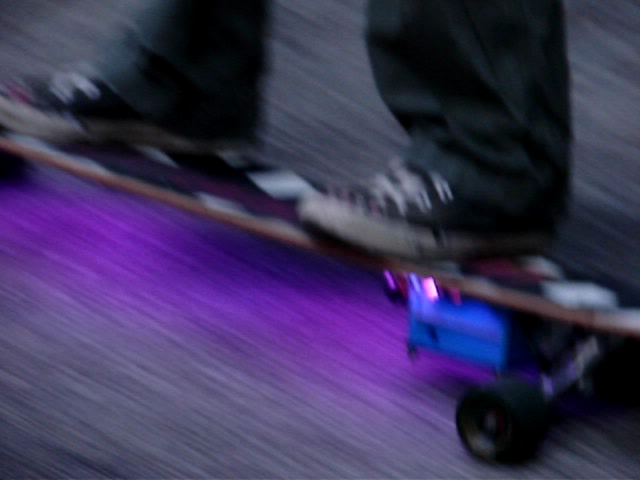
After our Larval Engineer tweaked the code to track the maximum speed for the current run, so that the color always hits pure blue at top speed and red near standstill, we can prove it happened: we have a video! It’s much less awful than the First Light video, but with plenty of cinéma-vérité camera shake, lousy focus, and bloopers:
Longboard In Action
That’s a frame extracted from one of the raw videos files using ffmpegthumbnailer:
for t in `seq 0 10 100` ; do ffmpegthumbnailer -i mov07117.mpg -o Longboard-$t.jpg -t $t% -q 10 -s 640 ; done
This view of the 3D printed case shows the power switch and the Hall effect sensor cable snaking out of the truck just below the near axle:
Longboard RGB LED Electronics – right front view
She filled the case corners that pulled up from the build platform with a thin layer of epoxy, getting a plane surface by curing it atop waxed paper on the shop’s surface plate, to keep the polycarbonate sheet flat. I didn’t have any acorn nuts to top those nylon lock nuts, alas.
The 4-cell Li-ion battery lives in the slice between the white aluminum plates, where it takes about four hours to charge from 3.0 V/cell. The Arduino Pro Mini lives behind the smoked polycarb sheet, where its red LED adds a mysterious touch. Maybe, some day, she’ll show the 1/rev pulse on the standard Arduino LED for debugging.
A view from the other side shows the hole for the charger above the circuit board, with the Hall sensor out of sight below the far axle:
Longboard RGB LED Electronics – left front view
Yes, the cable to the LEDs deserves better care. She learned that you must provide strain relief at cable-to-component junctions, which we achieved by pasting the wires to the board beside the LED strip with double-stick tape. The rest of the LED strip interconnections live atop similar tape strips. There’s nothing much protecting the LEDs or their delicate SMD resistors, butit works!
Actually, one red LED in an RGB package went toes-up and wasn’t revived by resoldering its leads. So we jumpered around the package, subjecting the remaining two red LEDs in that string to a bit more current than they’d prefer, and that’s that.
There’s a whole bunch not to like one could improve in both the mechanics and electronics, butit works! If you’ll grant it alpha prototype status, then I’d say it’s Good Enough; this is her project and she’ll learn a lot from how it works and how it fails, just like we all do.






 The Smell of Molten Projects in the Morning