The Smell of Molten Projects in the Morning

Ed Nisley's Blog: Shop notes, electronics, firmware, machinery, 3D printing, laser cuttery, and curiosities. Contents: 100% human thinking, 0% AI slop.

Author: Ed

  • P-channel MOSFET Power Switch

    This is a simulation showing that a p-channel power MOSFET should work fine as a battery cutoff / switch for the bike taillight (clicky for many more dots):

    P-MOSFET power switch
    P-MOSFET power switch

    The general idea is to have a pushbutton or vibration sensor turn on the power, whereupon the Arduino wakes up and activates an output pin that holds the power on. When it’s time to shut down, the Arduino turns that output pin off, the power goes away, and everybody’s happy.

    The MOSFET must be not only p-channel, but also have a logic-level gate, which is a rare and precious combination among cheap surplus MOSFETs. I’m hoping those FDS6675 MOSFETs work better than their package looks.

    The capacitor and resistor over on the right simulate a reasonable load.

    The voltage-controlled switch in the middle represents the vibration sensor, which is either shorted or open as determined by the voltage source at the bottom. There doesn’t seem to be any other Spice-ish way to do that.

    The Arduino output, simulated by another voltage source drives the NPN transistor, which isolates the output pin from the 7.4 V (up to maybe 8.5 V when fully charged) Li-ion battery. It also isolates it from the switch, which would otherwise yank the output pin to ground if you pushed the button when the power was already on.

    You’d want a few more pullup and pulldown resistors to ensure things stay where they’re put while the lights are out. I’d want to measure an actual vibration sensor; it may require a pulse stretcher to ensure the Arduino has enough time to wake up and smell the electrons.

    The overall concept seems workable.

  • Arduino Pro Mini Pin Coordinates

    Arduino Pro Mini - top
    Arduino Pro Mini – top

    Measured from the Official PCB Layout, with the board origin at the lower-left corner of the PCB, down there by the D9 pin, in mils (0.001 inch):

    • D9 = (50,50)
    • D10 = (650,50)
    • A5 = (535,805)
    • A4 = (535,705)
    • A7 = (535,393)
    • A6 = (535,293)
    • FTDI header = (100,1250) to (600,1250)
    • Reset button = (350,105)
    • D13 LED = (540,100)
    • PWR LED = (350,850)
    • Upper fiducial = (160,1140)
    • Lower fiducial = (490,100)

    Subtract 50 mils from each of those coordinates to put the origin at the middle of the D9 pin, which may be more useful. Doing that in inches produces:

    • D9 = (0.000,0.000)
    • D10 = (0.600,0.000)
    • A5 = (0.485,0.755)
    • A4 = (0.485,0.655)
    • A7 = (0.485,0.343)
    • A6 = (0.485,0.243)
    • FTDI header = (0.050,1.200) to (0.550,1.200)
    • Reset button = (0.300,0.055)
    • D13 LED = (0.490,0.050)
    • PWR LED = (0.300,0.800)
    • Upper fiducial = (0.110,1.090)
    • Lower fiducial = (0.440,0.050)

    Trust, but verify…

    Yes, this is a knockoff PCB from the usual eBay vendor, not from Sparkfun. Contents may settle during shipment. Enlarged to show texture. Your mileage may vary. No warranty, either express or implied, no lie. Do not eat.

  • Semiconductors From eBay: A Tinge Of Doubt Crosses My Mind

    So I picked up a lot of 20 p-channel MOSFETs from the usual eBay supplier in China, which arrived in good order. As is often the case, the SOIC chips are in snippets of tape-and-reel carrier, but this tape looked decidedly odd:

    eBay FDS6675 Tape Cover Contamination
    eBay FDS6675 Tape Cover Contamination

    Peeling back the tape shows that the crud is just on (or perhaps inside) the tape, not on the ICs or inside the carrier pockets:

    img_3456 - eBay FDS6675 Tape Cover Contamination - interior
    img_3456 – eBay FDS6675 Tape Cover Contamination – interior

    Some of those specks are dirt, some seem to be bubbles, other are just, well, I don’t know what they might be. Maybe they were having a bad day in the tape factory?

    One might reasonably conclude the chips aren’t in their original carrier…

    I must gimmick up a quick test to verify that the chips behave like p-channel MOSFETs, instead of, oh, solid plastic; that Fairchild logo looks a bit grotty, doesn’t it?

  • Hall Effect LED Current Control: Measurements and Firmware

    With that hardware in hand, a dab of firmware produces this result:

    Hall Current Sense - 120 mA 25 ms 250 ms
    Hall Current Sense – 120 mA 25 ms 250 ms

    A detailed look at one pulse:

    Hall Current Sense - 120 mA 25 ms 250 ms - detail
    Hall Current Sense – 120 mA 25 ms 250 ms – detail

    The top trace is the total LED current, nominally 120 mA, at 50 mA/div. The ripple (which is a nice triangle waveform at a faster sweep) comes from the 32 kHz PWM pulse train, despite passing through a 1 ms RC filter; the MOSFET runs in the linear region and makes a great amplifier.

    The middle trace is the MOSFET drain voltage at 1 V/div. The on-state voltage runs around 1.6 V, so the LEDs see about 5.9 V at 120 mA, about what you’d expect, with the little bit of PWM ripple accounting for the current sawtooth in the top trace. The off-state voltage is only 3.8 V, because the LEDs soak up the rest; it’s about 1.2 V per LED.

    The bottom trace is the current-sense amp output. The 1 nF cap in the op amp feedback loop rolls it off at 600 Hz, so there’s not much ripple at all in there. That goes directly to the Arduino’s ADC, where it’s further averaged over 10 samples.The LEDs take a couple of milliseconds to get up to full intensity, but it’s much faster than an incandescent filament: this thing blinks rather than flashes.

    The current in each LED string runs from about 15 mA to 25 mA, with all the “old” LEDs at the low end and the “new” LED strings at the high end. Using unsorted LEDs from the same batch will probably be OK, although I’ll measure them just to see what they’re like.

    The LEDs dissipate 700 mW and the MOSFET wastes 192 mW, so the efficiency is around 79%. Not too shabby for a linear regulator and it only gets better as the battery discharges. The toroid winding burns maybe 300 μW, so it’s not in the running; to be fair, a 1 Ω sense resistor would account for only 14 mW, but it would drop 120 mV instead of 3 mV, which is what matters more when the battery voltage drops.

    That’s during the pulse, which should have a duty cycle under 25% or so, which means 175 mW and 48 mW on the average. Obviously, no heatsinks needed: each LED runs at 7 mW average under those conditions.

    The firmware steps the gate voltage by the smallest possible increment, about 20 mV = 5 V / 256. The feedback loop adjusts the gate voltage in single steps to avoid goosing the LEDs with too much current; a binary search wouldn’t work very well at all. I think it’d be a good idea to build a table of transconductance (gate voltage to LED current) by ramping the gate voltage during startup, then fine-tune the coefficients during each pulse.

    The console log tells the tale:

    Hall effect Current Regulator
    Ed Nisley - KE4ZNU - August 2013
    Given Vcc: 5010 mV
    Given VBatt divider ratio: 0.500
    Bandgap reference voltage: 1105 mV
    Battery voltage: 7551 mV
    Nulling Hall sensor offset: 0 PWM
    Final Hall sensor offset: 209 PWM
    Gate voltage: 1947 mV  LED Current: 5 mA
    Gate voltage: 1966 mV  LED Current: 6 mA
    Gate voltage: 1986 mV  LED Current: 6 mA
    Gate voltage: 2005 mV  LED Current: 7 mA
    Gate voltage: 2025 mV  LED Current: 8 mA
    Gate voltage: 2040 mV  LED Current: 8 mA
    Gate voltage: 2064 mV  LED Current: 10 mA
    Gate voltage: 2084 mV  LED Current: 11 mA
    Gate voltage: 2103 mV  LED Current: 13 mA
    Gate voltage: 2123 mV  LED Current: 14 mA
    Gate voltage: 2142 mV  LED Current: 17 mA
    Gate voltage: 2162 mV  LED Current: 19 mA
    Gate voltage: 2177 mV  LED Current: 22 mA
    Gate voltage: 2201 mV  LED Current: 25 mA
    Gate voltage: 2221 mV  LED Current: 29 mA
    Gate voltage: 2240 mV  LED Current: 33 mA
    Gate voltage: 2255 mV  LED Current: 38 mA
    Gate voltage: 2275 mV  LED Current: 44 mA
    Gate voltage: 2294 mV  LED Current: 49 mA
    Gate voltage: 2314 mV  LED Current: 56 mA
    Gate voltage: 2333 mV  LED Current: 63 mA
    Gate voltage: 2353 mV  LED Current: 70 mA
    Gate voltage: 2372 mV  LED Current: 79 mA
    Gate voltage: 2392 mV  LED Current: 89 mA
    Gate voltage: 2412 mV  LED Current: 99 mA
    Gate voltage: 2431 mV  LED Current: 110 mA
    Gate voltage: 2451 mV  LED Current: 122 mA
    Gate voltage: 2431 mV  LED Current: 110 mA
    Gate voltage: 2451 mV  LED Current: 121 mA
    Gate voltage: 2431 mV  LED Current: 110 mA
    Gate voltage: 2451 mV  LED Current: 122 mA
    Gate voltage: 2431 mV  LED Current: 110 mA
    Gate voltage: 2451 mV  LED Current: 121 mA
    

    The current feedback tweaks the gate voltage by one PWM increment on each loop, so the LED current pulses alternate between 110 and 122 mA when the loop finally reaches the setpoint. This doesn’t make any practical difference, as each LED string’s current varies by a few mA, at most, but maybe there should be a deadband of a bit more than ±1/2 PWM increment around the actual current.

    The Arduino source code:

    // LED Curve Tracer
    // Ed Nisley - KE4ANU - August 2013
    
    #include <stdio.h>
    
    //----------
    // Pin assignments
    
    const byte PIN_READ_VBATT = 0;		// AI - battery voltage from divider
    const byte PIN_READ_CURRENT = 1;	// AI - current sense amp
    const byte PIN_READ_VGATE = 2;		// AI - actual gate voltage
    const byte PIN_READ_HALL = 3;		// AI - raw Hall sensor voltage
    
    const byte PIN_SET_BIAS = 11;		// PWM - VCC/2 bias voltage
    const byte PIN_SET_VGATE = 3;		// PWM - MOSFET gate voltage
    
    const byte PIN_HEARTBEAT = 13;		// DO - Arduino LED
    const byte PIN_SYNC = 2;			// DO - scope sync output
    
    //----------
    // Constants
    
    const float MaxLEDCurrent = 0.120;		// maximum LED current
    
    const float Vcc = 5.01; 				// Arduino supply -- must be measured!
    
    const float VBattRatio = 3.03/6.05;		// measured division ratio for battery divider
    
    const float VStep = Vcc/256;			// minimum PWM voltage increment = 5 V / 256
    
    const float IGain = 0.100;				// Hall sense voltage to LED current
    
    const byte PWM_Settle = 10;				// PWM settling time ms
    
    // Timer prescaler = 1:1 for 32 kHz PWM
    #define TCCRxB 0x01
    
    #define MK_UL(fl,sc) ((unsigned long)((fl)*(sc)))
    #define MK_U(fl,sc) ((unsigned int)((fl)*(sc)))
    #define MK_I(fl,sc) ((int)((fl)*(sc)))
    
    //----------
    // Globals
    
    float AVRef1V1;					// 1.1 V bandgap reference - calculated from Vcc
    
    float VBatt;					// battery voltage - calculated from divider
    float VGateSense;				// actual gate voltage - measured after PWM filter
    float ILEDSense;				// LED current from Hall effect sensor
    
    float VGateDrive;				// gate drive voltage
    
    byte PWMHallOffset;				// zero-field Hall effect sensor bias
    
    long unsigned long MillisNow, MillisThen;	// sampled millis() value
    
    //-- Read AI channel
    //      averages several readings to improve noise performance
    //		returns value in volts assuming known VCC ref voltage
    
    #define NUM_T_SAMPLES    10
    
    float ReadAI(byte PinNum) {
    
      word RawAverage;
    
      digitalWrite(PIN_SYNC,HIGH);					// scope sync
    
      RawAverage = (word)analogRead(PinNum);		// prime the averaging pump
    
      for (int i=2; i <= NUM_T_SAMPLES; i++) {
        RawAverage += (word)analogRead(PinNum);
      }
    
      digitalWrite(PIN_SYNC,LOW);
    
      RawAverage /= NUM_T_SAMPLES;
    
      return Vcc * (float)RawAverage / 1024.0;
    
    }
    
    //-- Set PWM output
    
    void SetPWMVoltage(byte PinNum,float PWMVolt) {
    
    byte PWM;
    
      PWM = constrain((byte)(255.0 * PWMVolt / Vcc),0,255);
    
      analogWrite(PinNum,PWM);
      delay(PWM_Settle);
    
    }
    
    //-- compute actual 1.1 V bandgap reference based on known VCC = AVcc (more or less)
    //		adapted from http://code.google.com/p/tinkerit/wiki/SecretVoltmeter
    
    float ReadBandGap(void) {
    
      word ADCBits;
      float VBandGap;
    
      ADMUX = _BV(REFS0) | _BV(MUX3) | _BV(MUX2) | _BV(MUX1);	// select 1.1 V input
      delay(2); // Wait for Vref to settle
    
      ADCSRA |= _BV(ADSC);										// Convert
      while (bit_is_set(ADCSRA,ADSC));
    
      ADCBits = ADCL;
      ADCBits |= ADCH<<8;
    
      VBandGap = Vcc * (float)ADCBits / 1024.0;
      return VBandGap;
    }
    
    //-- Helper routine for printf()
    
    int s_putc(char c, FILE *t) {
      Serial.write(c);
    }
    
    //------------------
    // Set things up
    
    void setup() {
    
    float AVRef1V1;
    
      pinMode(PIN_HEARTBEAT,OUTPUT);
      digitalWrite(PIN_HEARTBEAT,LOW);	// show we arrived
    
      pinMode(PIN_SYNC,OUTPUT);
      digitalWrite(PIN_SYNC,LOW);		// show we arrived
    
      TCCR1B = TCCRxB;					// set frequency for PWM 9 & 10
      TCCR2B = TCCRxB;					// set frequency for PWM 3 & 11
    
      analogWrite(PIN_SET_VGATE,0);		// force gate voltage = 0
    
      Serial.begin(57600);
      fdevopen(&s_putc,0);				// set up serial output for printf()
    
      printf("Hall effect Current Regulator\r\nEd Nisley - KE4ZNU - August 2013\r\n");
    
      printf("Given Vcc: %d mV\r\n",MK_I(Vcc,1000.0));
      printf("Given VBatt divider ratio: 0.%d\r\n",MK_I(VBattRatio,1000.0));
    
      AVRef1V1 = ReadBandGap();			// compute actual bandgap reference voltage
      printf("Bandgap reference voltage: %d mV\r\n",MK_I(AVRef1V1,1000.0));
    
      VBatt = ReadAI(PIN_READ_VBATT) / VBattRatio;
      printf("Battery voltage: %d mV\r\n",MK_I(VBatt,1000.0));
    
      SetPWMVoltage(PIN_SET_VGATE,0.0);		// zero LED current
      PWMHallOffset = 0;
      analogWrite(PIN_SET_BIAS,PWMHallOffset);
      printf("Nulling Hall sensor offset: %d PWM\r\n",PWMHallOffset);
    
      do {
    	ILEDSense = IGain * ReadAI(PIN_READ_CURRENT);
    //	printf("Current Sense: %d mA - ",MK_I(ILEDSense,1000.0));
    	if (ILEDSense > 0.005) {
    		PWMHallOffset += 1;
    		analogWrite(PIN_SET_BIAS,PWMHallOffset);
            delay(PWM_Settle);
    //		printf("Step offset: %d PWM\r\n",PWMHallOffset);
    	}
      } while (ILEDSense > 0.005);
      printf("Final Hall sensor offset: %d PWM\r\n",PWMHallOffset);
    
      VGateDrive = 2.0;					// reasonable starting point
    
      MillisThen = millis();
    }
    
    //------------------
    // Run the test loop
    
    void loop() {
    
    	if ((millis() - MillisThen) > 250) {
    		MillisThen = millis();
    
    		if (ILEDSense < MaxLEDCurrent) {
    			VGateDrive += VStep;
    		}
    		else if (ILEDSense > MaxLEDCurrent) {
    			VGateDrive -= VStep;
    		}
    
    		SetPWMVoltage(PIN_SET_VGATE,VGateDrive);
    
    		VGateSense = ReadAI(PIN_READ_VGATE);
    		printf("Gate voltage: %d mV  ",MK_I(VGateSense,1000.0));
    
    		ILEDSense = IGain * ReadAI(PIN_READ_CURRENT);
    		printf("LED Current: %d mA\r\n",MK_I(ILEDSense,1000.0));
    
    		delay(50 - PWM_Settle - 3);
    		SetPWMVoltage(PIN_SET_VGATE,0.0);
    
    		digitalWrite(PIN_HEARTBEAT,!digitalRead(PIN_HEARTBEAT));
    		digitalWrite(PIN_HEARTBEAT,!digitalRead(PIN_HEARTBEAT));
    	}
    }
    
  • Storm Door Latch: Repair Parts

    The discussion following that post on getting feature coordinates from an existing part reminded me of an old project that I’d written up for Digital Machinist: making repair parts for the half-century old storm doors on our house. Here’s the whole latch, with a replacement drawbar and cam:

    Latch Assembly
    Latch Assembly

    The other side of the drawbar and cam:

    Door Latch Parts
    Door Latch Parts

    An early version of the drawbar that engages the latch strike and gets pulled by cam:

    New and Old latch pulls
    New and Old latch pulls

    Three iterations on a cam; the messed-up one in the center, IIRC, helped track down an EMC2 bug:

    Latch Cams
    Latch Cams

    Now that I look at it again, there’s nowhere near enough meat around that square hole for a 3D printed plastic part… so the notion of printing the complex part of the cam and adding wear bars along those ears just isn’t going to work.

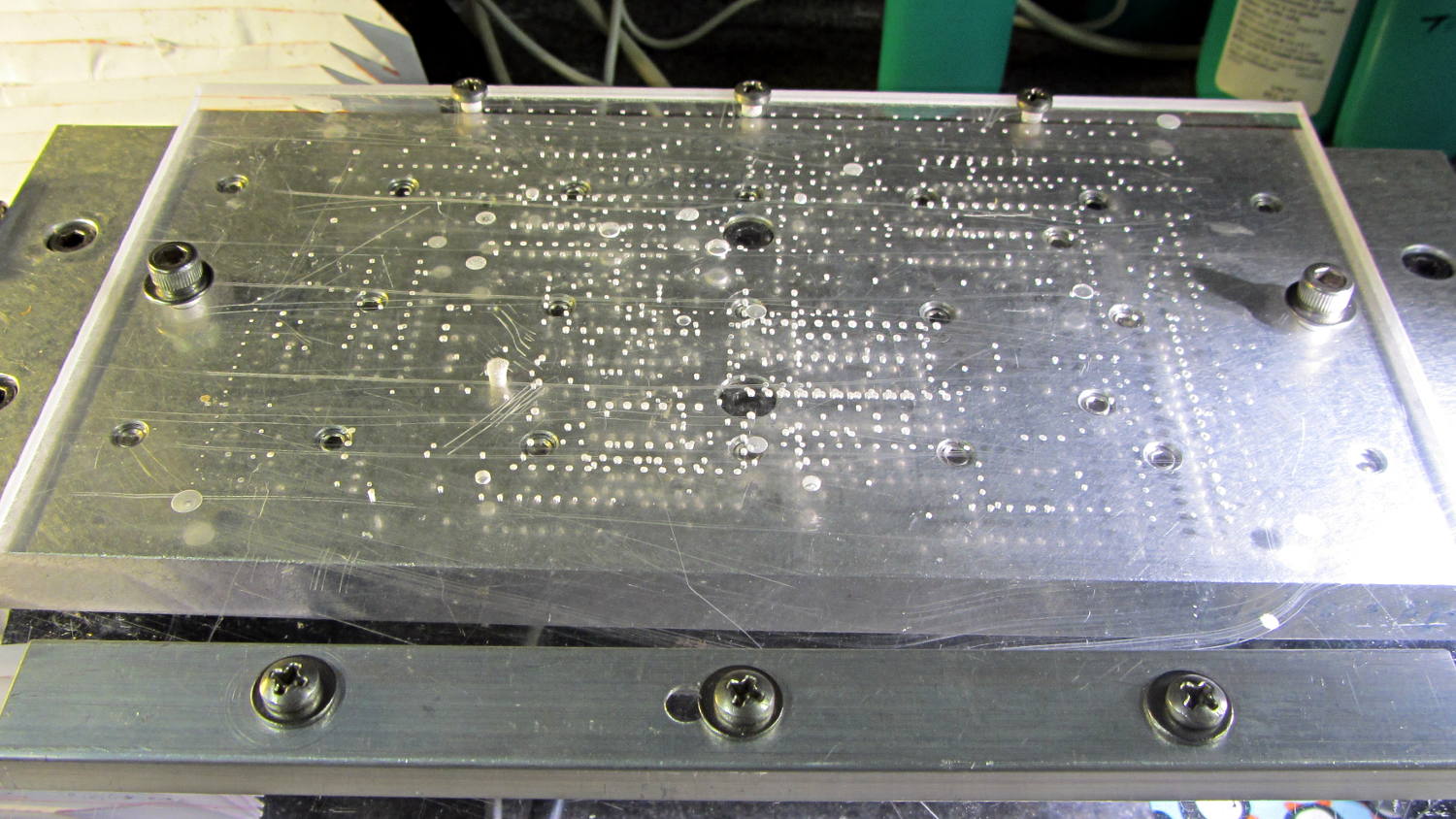
    I made a fixture for the Sherline CNC mill to hold the drawbar for inside milling:

    Latch pull - Inside milling
    Latch pull – Inside milling

    Then a block screwed down in the middle clamps the drawbar in the same place for outside milling:

    Latch pull - Outside milling
    Latch pull – Outside milling

    The square post in the left rear corner holds the cam:

    Latch Cam - First Attempt
    Latch Cam – First Attempt

    Note that I had to file the square hole before milling the cam shape, which meant that if the CNC process screwed up, all that handwork went into the show-n-tell bin… which I’m not going to show you.

    I used an early version of the grid-overlay technique to map out the drawbar coordinates; this was an illustration for the column:

    Latch Pull Dimensions
    Latch Pull Dimensions
  • Humidity Indicator Cards

    A pack of humidity indicator cards arrived from far-off Pennsylvania and work just about like you’d expect.

    The silica gel really does pull the interior of the Basement Safe down below 15%:

    Humidity Indicator card - 10 percent
    Humidity Indicator card – 10 percent

    The dehumidifier struggles mightily to keep the rest of the basement around 50%:

    Humidity Indicator card - 50 percent
    Humidity Indicator card – 50 percent

    They’re not dataloggers, but I can now keep an eye on more locations…

  • Decorative Slug

    This critter trundled across the driveway after a shower wetted the area:

    Orange slug on asphalt
    Orange slug on asphalt

    They do some damage in the garden, but we let them alone elsewhere…