Ed Nisley's Blog: Shop notes, electronics, firmware, machinery, 3D printing, laser cuttery, and curiosities. Contents: 100% human thinking, 0% AI slop.
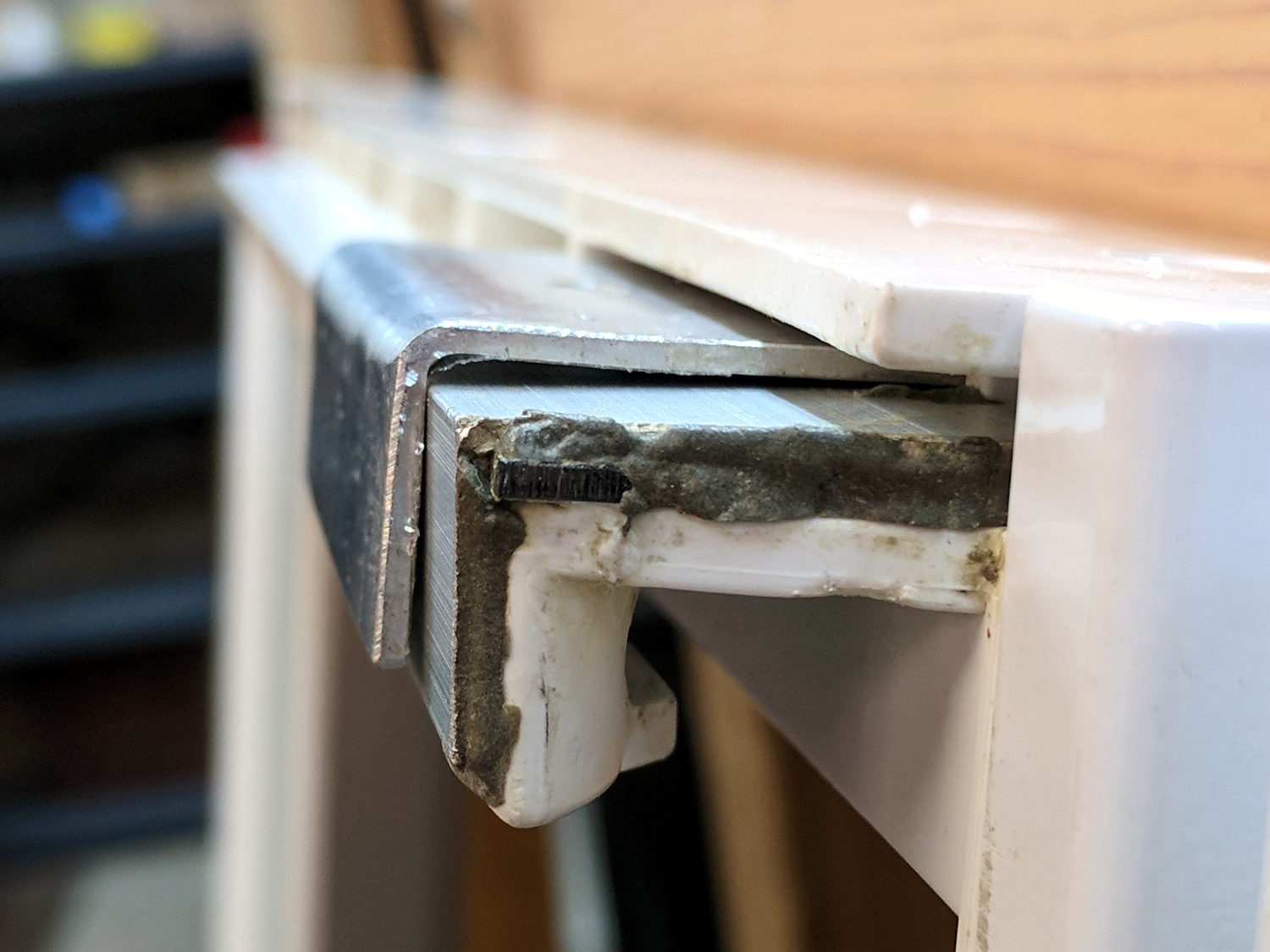
I sawed up a clip-on heatsink originally intended for a 14 pin DIP, bent it a bit, and epoxied it atop the regulator with enough of a blob to contact the copper pour:
RAMPS Mega – regulator heatsink – clamping
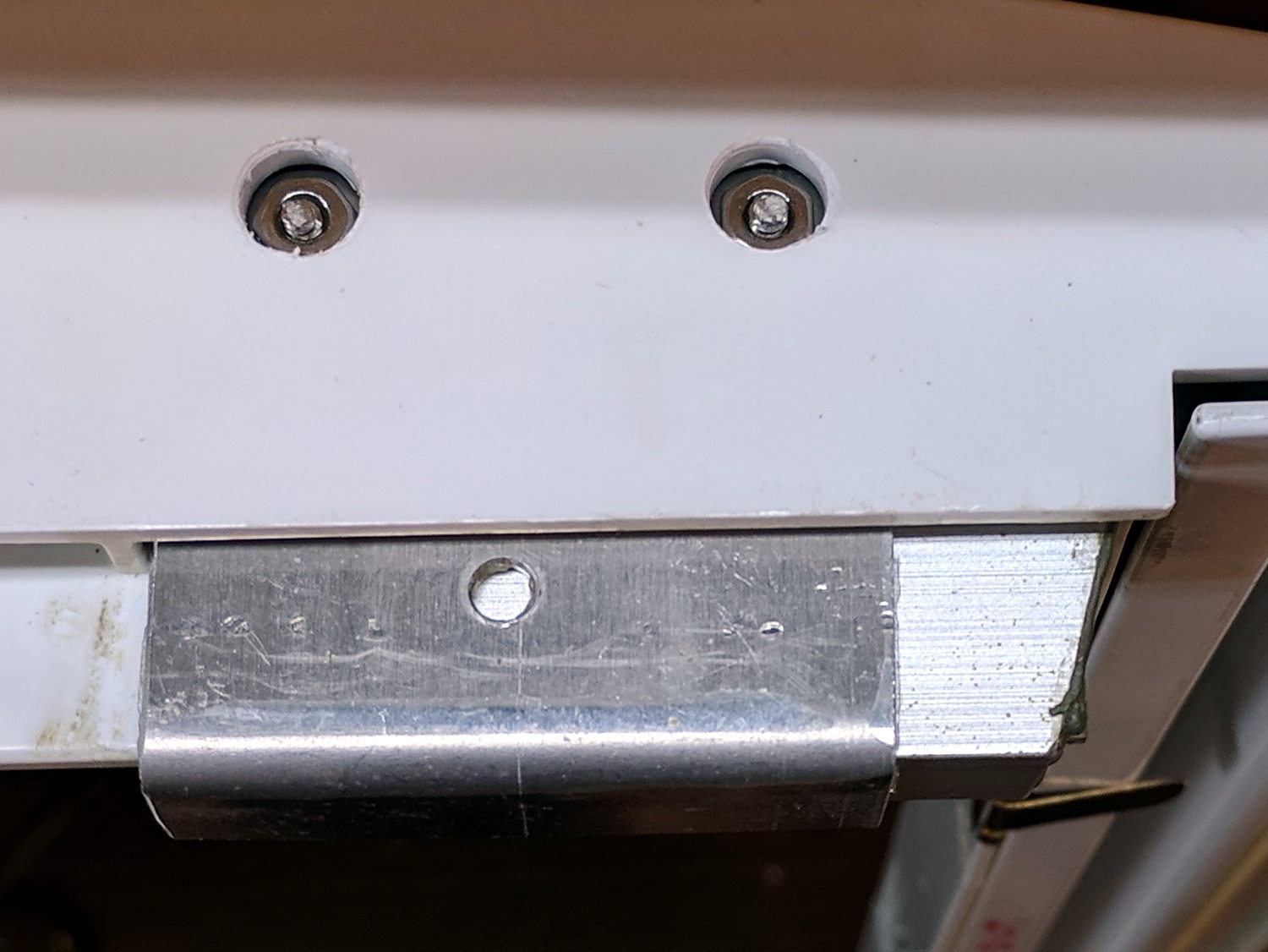
That’s metal-filled JB Weld for good thermal conductivity and electrical insulation:
RAMPS Mega – regulator heatsink
The blob affixing the heatsink to the crystal can was an oopsie, but won’t do any harm. It’s not clear the heatsink will do any good in that confined space, but those regulators lead a rough life and need all the help they can get.
I’d rather see a knockoff than a counterfeit, although by now there’s really no way to tell if it’s a counterfeit knockoff. The Kynix datasheet looks like a direct rip from Allegro.
They now sport cute little heatsinks, which, for all I know, might help a bit:
RAMPS shield – stepper heatsinks
The driver boards are slightly longer than the spacing mandated by the continuous socket strips under the three-in-a-row layout:
RAMPS – stepper driver board fit
Introducing them to Mr Disk Sander (turned by hand) knocked off just enough to make ’em fit.
The replacement NP-BX1 batteries arrived and, as I expected, perform just as badly as the previous pair:
Sony NP-BX1 – Wasabi GHIJK – 2017-09-01 – annotated
The note I sent to Wasabi’s tech support summarizes the details:
The second pair of NP-BX1 batteries are just as bad as the first two. In fact, all four perform worse than the nearly two-year-old Wasabi batteries I’ve been using.
The graph shows the test results from my CBA III analyzer. All batteries were all charged in a Wasabi wall charger.
The top solid red curve shows the as-delivered performance in late 2015 for the battery I labeled “G”, tested at 500 mA. It delivered only 1 Ah, not the claimed 1.6 Ah, even at that relatively low current, but has delivered over one hour of service in the camera.
The top dotted-blue curve shows the as-delivered performance for the NEW battery I labeled “J”, also tested at 500 mA. It delivers only 0.88 Ah, 55% of the claimed 1.6 Ah, at a much lower voltage while discharging.
After two years, OLD battery “G” has more capacity and a higher voltage than the NEW battery “J”!
The lower curves shows the results for the four most recent batteries I labeled H I J K, all tested at 1 A to better match the camera’s actual current; the dotted traces mark the second test of each battery.
The orange traces show battery K has about 0.77 Ah of capacity, less than half of the claimed 1.6 Ah and much worse than the others.
I also re-tested battery old battery G at 1 A, as shown by the dotted red curve labeled “G:2017-09”. It outperforms ALL of the new batteries!
Batteries H and I have date codes BQF22, which I interpret as 2017-06-22: fairly recent stock.
Batteries J and K have date codes BPL28: 2016-12-28. They’ve been sitting around for a while, which may account for the poor performance of battery K.
These Wasabi batteries cost roughly twice (*) as much as they did in late 2015, have /much/ lower capacity, and, to judge from the date codes, they’ve been consistently poor since late last year.
What is going on?
It’s worth noting that Wasabi NP-BX1 batteries are currently $16 for the pair on Amazon and were $9 in late 2015. Allegedly genuine Sony NP-BX1 batteries run $50 MSRP and a suspiciously consistent $37.99 from all the usual big-box sources, including Amazon, where they’re out-of-stock for the next few months. Combining the number of counterfeits in the supply chain with Amazon’s commingled SKU stock bins, I have my doubts about what I’d get by increasing my battery spend by a factor of five.
I think it’s about time to conjure an external 18650 holder / helmet mount for that camera and be done with it.
[(*) Edit: I screwed up the unit of measure: the old invoice had two single batteries. The new order was one pair, so I now pay slightly less for much worse performance. A refund is wending its way through the system.]
The corroded Y valve, minus another failed hose fitting, recently emerged from a heap o’ stuff on the Basement Laboratory Bench. This old photo gives you an idea of what happens to cheap pot metal in a garden:
Corroded Garden Y Valve
I dropped it Y-end-down into a container of white vinegar for a week, after which a few minutes of scrubbing produced a workable result:
Garden hose Y valve – after vinegar soak
The threads on the left side are pretty much gone. The hose fitting protected the threads on the right, but was corroded firmly in place; a penetrating oil soak and concerted muttering removed it.
All of the garden hoses and fittings out in Mary’s Vassar Farms plot have survived well beyond their best-used-by date. Given that we salvaged many hoses from the Farm’s end-of-season midden heaps, they don’t owe us much …
This eight-pointer was one of two browsing in the back-yard grove:
Eight point buck deer in velvet
The other was a mere four-pointer. In a few weeks they’ll get all feisty and browse the grove in shifts.
The notion of a “suburban hunting license”, perhaps with crossbows, may eventually gain traction.
A few days later, Mary awoke to a great clattering caused by a buck fighting free of the slot between the garden’s mesh “deer fence” and the neighbor’s wood fence, flattening the corner post in the process. A similar encounter a few years ago ended poorly.
For the second time in a few months, the kitchen faucet handle stopped moving all the way to the left and the spout stopped dispensing hot water. The last time I did nothing and, after a few days, it resumed normal operation. Having had a while to think it over, this time I removed the handle and saw exactly what I expected:
American Standard Elite 4453 4454 faucet – hot limit stop diagram
The red ring (the “hot limit safety stop”) fits into one of eight click-stop positions; the photo shows it in position 5, with 0 being just to the right of the bottom screw and 7 just below the horizontal notch across the middle.
The dark gray plastic feature inside the ring connects the metal handle (the out-of-focus silver stud aimed at you) to the valve assembly. The two lugs sticking out to its left and right bump into the inward-pointing red lugs as you rotate the handle leftward = clockwise = more hot. With the ring set to the 0 position, the red lugs overlap similar lugs molded into the light gray valve body that limit the rotation in both directions.
Observations:
You must pry the red ring upward to disengage the splines locking it into position
The gray lugs impose a hard stop in the counterclockwise direction = cold
There’s no upward force on the ring for any reason that I can imagine
We don’t pound on the faucet handle, so there’s no shock loading
I have no idea how the red ring could disengage its splines and move counterclockwise by five clicks all by itself.
I reset it to 0, reassembled the faucet with a dot of penetrating oil in the set screw, and it’s all good.
An hour before the festivities started, I lashed together an official NASA-approved pinhole eclipse viewer from available materials:
Eclipse 2017-08-21 – pinhole projector
Although the solar disk showed up fine on the white paper screen, the Pixel’s camera can’t show the notch growing on the left side, even with HDR+ mode in full effect:
Eclipse 2017-08-21 – pinhole projector – interior
As usual for astronomy around here, clouds threatened the outcome:
Eclipse 2017-08-21 – high clouds
Near the maximum, the skies cleared:
Eclipse 2017-08-21 – maximum – lens flare
Although it’s not proof, there’s a definite bite out of the lens flare at about 4 o’clock:
Eclipse 2017-08-21 – maximum – lens flare – detail
The maples south of the driveway produced lower-contrast images better suited to silicon sensors:
Eclipse 2017-08-21 – maximum – shadows
And, although everyone was specifically enjoined not to do this, because UV reflection = blindness, the obligatory solar eclipse selfie:
Eclipse 2017-08-21 – obligatory selfie
I’m sure similar lens flares count as UFOs in someone’s telling of the tale.
We planned to dance naked in the yard, but our neighbor’s lawn crew picked that moment to scalp his grass and we chose discretion over valor …
A silver Honda Accord Civic (NY HLS-3678) passed me on Raymond, just before the Vassar Main Gate roundabout, with about as much clearance as one might expect:
Raymond – Passing 2017-08-30 – 1
I noodled along Raymond at 18 mph and the car pulled ahead at the usual 30 to 40 mph. Just after the College Avenue roundabout, the car pulled off to the right, as if to park, but continued rolling slowly and I gave it plenty of clearance:
Raymond – Passing 2017-08-30 – 2
The car immediately pulled out into the lane, directly in front of the Escalade that’s been following me at a courteous distance since the Main Gate roundabout, and pulled up close behind me, which immediately put me at DEFCON 3. Basically, drivers get exactly one bite at my apple; anyone who deliberately passes me a second time is likely up to no good.
As always, I signal and take the lane going into the Collegeview Avenue roundabout, still at 18-ish mph, whereupon the driver lays on the horn rather heavily. Apparently, he intended to accelerate past me into the roundabout, but I got in the way:
Raymond – Passing 2017-08-30 – 2r
I’m now cranking 20 mph. A block later, the car passes me, rather closely this time:
Raymond – Passing 2017-08-30 – 3
Maybe this is a friendly wave, but the horn thing suggests otherwise and, in any event, it’s hard to tell in real time running:
Raymond – Passing 2017-08-30 – 4
At this point, I presume he’s gesturing me to GTFO the road:
Raymond – Passing 2017-08-30 – 5
And we part company:
Raymond – Passing 2017-08-30 – 6
Raymond Avenue would be a lot more bicycle-friendly without some of the drivers …