The Smell of Molten Projects in the Morning

Ed Nisley's Blog: Shop notes, electronics, firmware, machinery, 3D printing, laser cuttery, and curiosities. Contents: 100% human thinking, 0% AI slop.

Author: Ed

  • Rt 376 at Red Oaks Mill: Semitrailer Squeeze Play

    Rt 376 at Red Oaks Mill: Semitrailer Squeeze Play

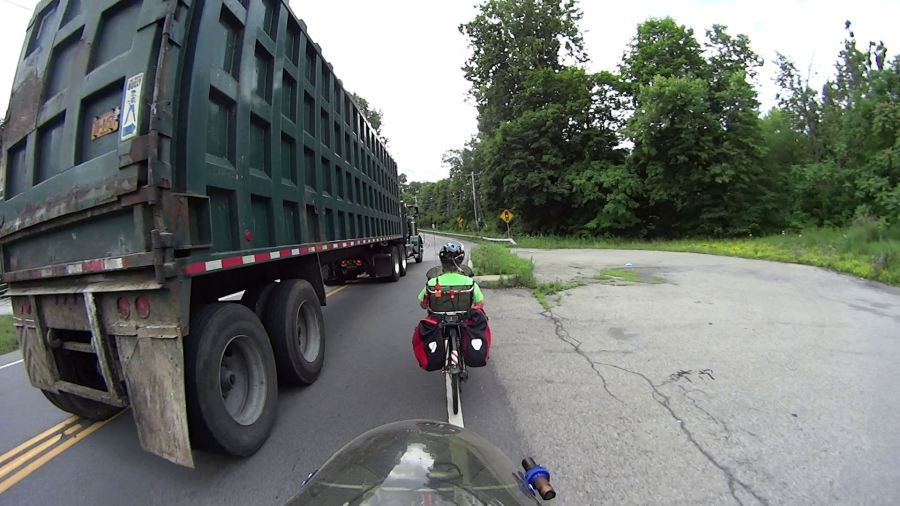
    We’re southbound on NYS Rt 376, approaching the Wappinger Creek bridge at mile marker 1102, avoiding the overgrowth coming through the guide rail:

    Rt 376 SB Marker 1102 - Royal Semi Squeeze - 2020-07-15 - 01
    Rt 376 SB Marker 1102 – Royal Semi Squeeze – 2020-07-15 – 01

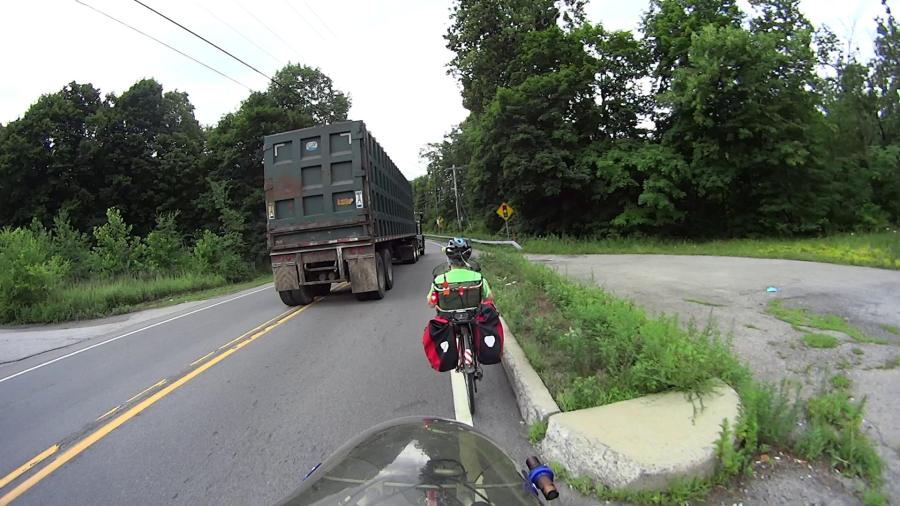
    Avoiding the pothole growing across the right wheel track:

    Rt 376 SB Marker 1102 - Royal Semi Squeeze - 2020-07-15 - 02
    Rt 376 SB Marker 1102 – Royal Semi Squeeze – 2020-07-15 – 02

    Normally, I ride to the left of that pothole, down the middle of the lane, so it’s easier to avoid the next section of overgrowth through the guide rail:

    Rt 376 SB Marker 1102 - Royal Semi Squeeze - 2020-07-15 - 03
    Rt 376 SB Marker 1102 – Royal Semi Squeeze – 2020-07-15 – 03

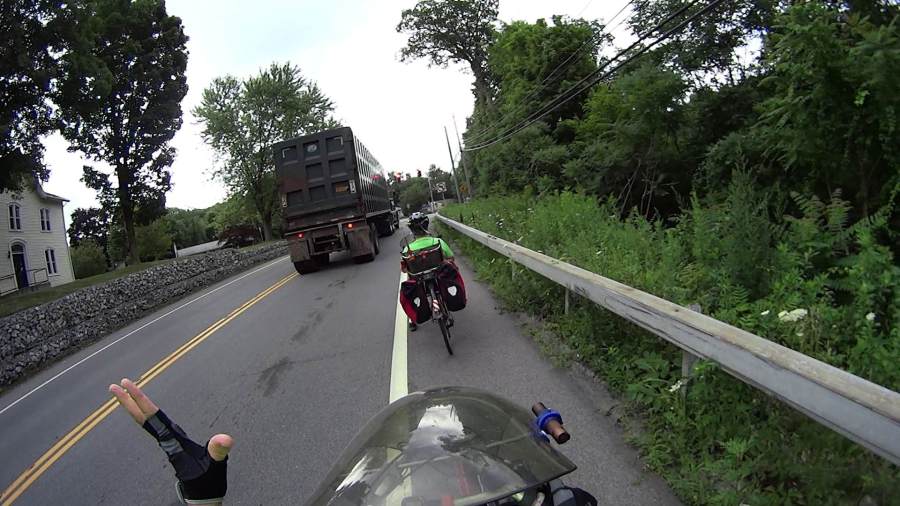
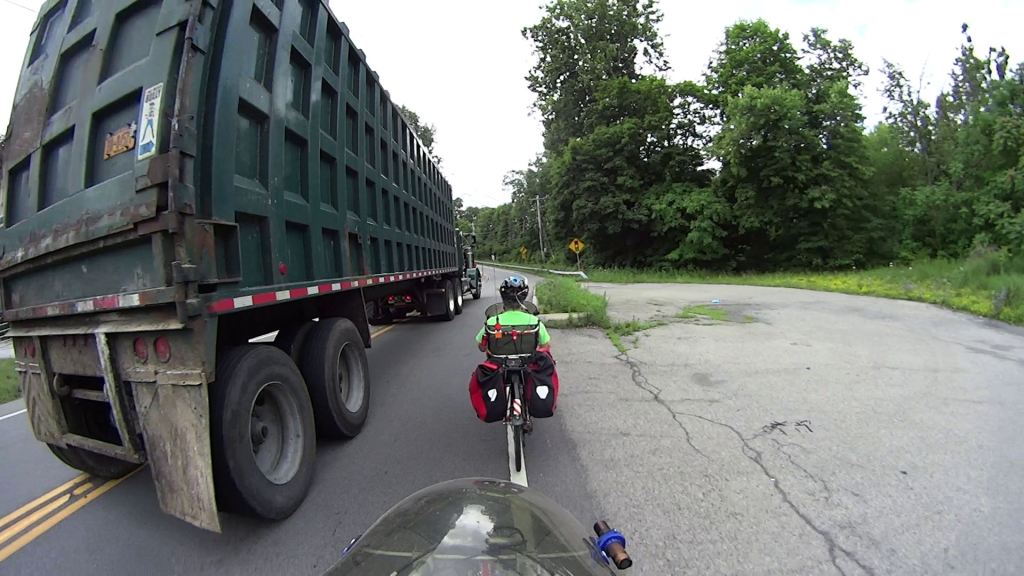
    This time, we’re as far to the right as we can get, because we’re being overtaken by a semitrailer trash hauler:

    Rt 376 SB Marker 1102 - Royal Semi Squeeze - 2020-07-15 - 04
    Rt 376 SB Marker 1102 – Royal Semi Squeeze – 2020-07-15 – 04

    Which is proceeding as far to the left as the driver can possibly squeeze it:

    Rt 376 SB Marker 1102 - Royal Semi Squeeze - 2020-07-15 - 05
    Rt 376 SB Marker 1102 – Royal Semi Squeeze – 2020-07-15 – 05

    Half a lane is more than we sometimes get:

    Rt 376 SB Marker 1102 - Royal Semi Squeeze - 2020-07-15 - 06
    Rt 376 SB Marker 1102 – Royal Semi Squeeze – 2020-07-15 – 06

    Away he goes:

    Rt 376 SB Marker 1102 - Royal Semi Squeeze - 2020-07-15 - 07
    Rt 376 SB Marker 1102 – Royal Semi Squeeze – 2020-07-15 – 07

    We always try to be friendly, because we’re sure to meet again some day:

    Rt 376 SB Marker 1102 - Royal Semi Squeeze - 2020-07-15 - 08
    Rt 376 SB Marker 1102 – Royal Semi Squeeze – 2020-07-15 – 08

    Mary says he waved back, so it’s all good.

    Elapsed time: about twelve seconds.

    For whatever it’s worth, eight years ago, NYS DOT Region 8 South Dutchess Residency did a much better job of clearing the overgrowth along Rt 376:

    Rt 376 SB Marker 1102 - Royal Semi Squeeze - Google StreetView 2012-04
    Rt 376 SB Marker 1102 – Royal Semi Squeeze – Google StreetView 2012-04

    That was then, this is now.

  • Medium Turtle Teleportation: Rail Trail

    Medium Turtle Teleportation: Rail Trail

    Perhaps this is a relative of the tiny turtle I teleported two years ago in the same section of the Dutchess Rail Trail:

    Turtle Teleportation - DCRT near Lagrange Trailhead - 2020-06-19
    Turtle Teleportation – DCRT near Lagrange Trailhead – 2020-06-19

    Such fancy patterns!

    I’m pretty sure box turtles don’t grow fast enough for this to be the same one …

  • Lending a Hand

    Lending a Hand

    This being repotting season, Mary trimmed a pair of leaves from a bay tree and wanted to dry them for cooking, so I offered to lend a hand:

    Bay leaves drying in helping hand fixture
    Bay leaves drying in helping hand fixture

    Two hands, in fact.

    The whole affair now sits on a kitchen windowsill, shriveling by the day, and the leaves should be ready in a month or two. Yum!

  • Copying All! The! Files! (Except Some)

    All our data files spin around on a nearly full 1 TB drive in a “file server”, a grandiosely overqualified and dirt-cheap off-lease Dell Optiplex desktop sitting in the basement. It’s been running headless and unattended for the last half-dozen years and is badly in need of replacement, so I must copy all its files to a newer, even more overqualified, and equally cheap off-lease Optiplex.

    Copying the files from the /mnt/music collection on the existing server to the identically named directory on the new server proceeds thusly:

    sudo mount -o ro fileserver.local:/mnt/music /mnt/nfs
    sudo rsync -ahu --progress --log-file=/tmp/music.log \
     --exclude="/lost+found" \
     --exclude=".Trash*" \
     --exclude=".dtrash*" \
     --delete \
     /mnt/nfs/ /mnt/music

    Mount the existing collection (from the old server) in read-only mode to avoid heartache subsequent to confusion. It could happen.

    The first time through, add a -n option for a dry run, then inspect the log file for surprises.

    The various --exclude options avoid copying trashed-but-not-yet-deleted files from the various trash directories maintained by various file handlers. In the process of sorting this out, I learned the DigiKam photo manager creates a .dtrash directory holding deleted files for each of its Album listings, appearing down near the bottom of the top-level album wherein you’ve quasi-deleted photos via “Move to Trash”.

    The --delete option removes files on the destination (new disk) if they’re not on the source (old disk). I started this migration earlier this year, before the world fell apart, and have moved / consolidated / renamed various directories & files in the interim, so deleting the previous copies from their old locations makes the destination match the source.

    So far, so good …

  • Motor Starting vs. Long Wires

    A recent email conversation may prove relevant to someone else …

    I have a pole barn which has approximately 100′ run of 10 gauge copper supplying power to the building. I … did not care to pay … $12,000 for a new 200′ line from the road … [with] only lights and 2 door openers for demand.

    I … put a 30 gallon air compressor in […]. When I first put it in, it struggled to start @<40 F. They called it a 1.6 running h.p. (whatever that means) motor. Nameplate shows 15/7.5 F.L.A. I switched it to 240v and the problem went away.

    Aren’t I likely to get the same problem as I had before or do 240 volt motors start easier?

    I screwed up when they buried the wire – in retrospect I would have buried 6ga to the barn to lessen the voltage drop.

    After running a few numbers, here’s what I came up with …

    do 240 volt motors start easier?

    The trouble with motors is they draw far more current while starting than they do while running. A factor of ten more is a good rule of thumb.

    So a “1.6 running HP” motor draws 1.2 kW while running at full load:
     – 10 A at 120 V
     –  5 A at 240 V

    The “full load amps” will be higher than that, because the motor isn’t 100% efficient. You can plug the FLA values into the calculation for an even more depressing result.

    During the fraction of a second when it’s starting, however, it will (try to!) draw 100 A or 50 A, depending on which line voltage you’ve wired it for.

    100′ run of 10 gauge copper

    That’s 200 feet of wire out-and-back.

    Look up the resistance per foot in a wire table, finding 10 AWG wire has a (convenient!) resistance of 1 mΩ/ft, so a 200 ft length has 0.2 Ω of resistance:

     – A 10 A load drops 2 V
     – A  5 A load drops 1 V

    Both of which are survivable in normal operation at their respective line voltages.

    However, the motor starting currents will be completely different. A 100 A current will (try to!) drop 20 V, reducing the line voltage to 100 V and stalling the motor. Running the motor from 240 V means the 50 A starting current drops only 10 V and the remaining 230 V can get the motor up to speed.

    Now, 240 V service isn’t a complete solution. The new compressor draws 15 “full load amps”, so it’ll drop 3 V while it’s running and 30 V while starting. It’ll probably start at 210 V, but it may grunt for a bit longer than you like as the speed comes up and the current goes down.

    in retrospect I would have buried 6ga to the barn

    There’s a Pennsylvania Dutch saying: “We grow too soon old and too late smart.” [grin]
  • Monthly Image: Wren Traffic

    Monthly Image: Wren Traffic

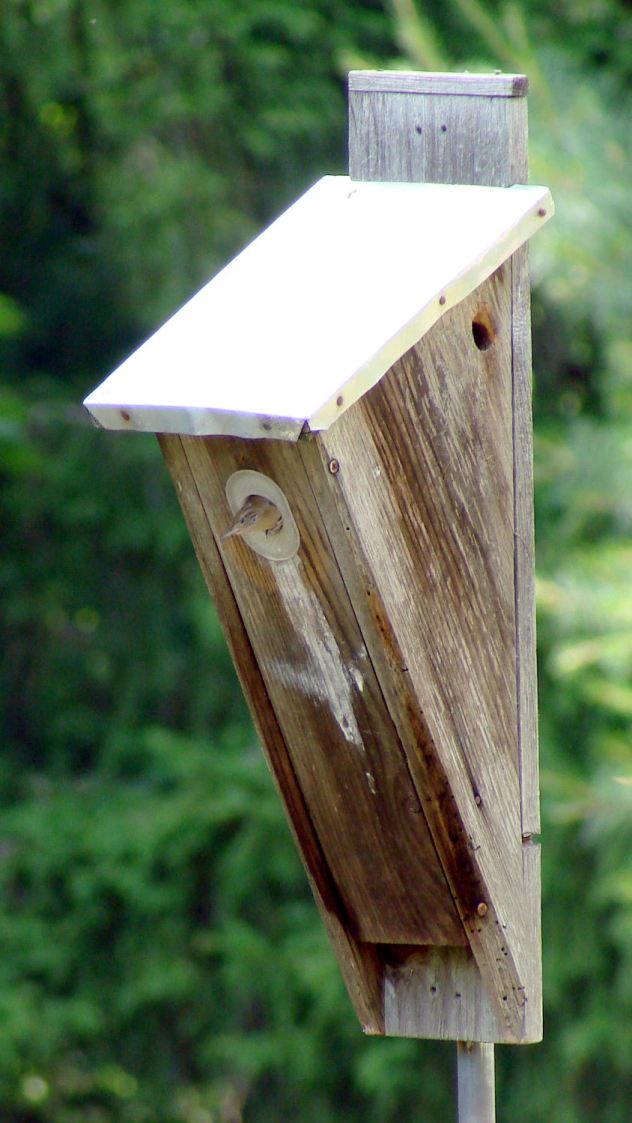
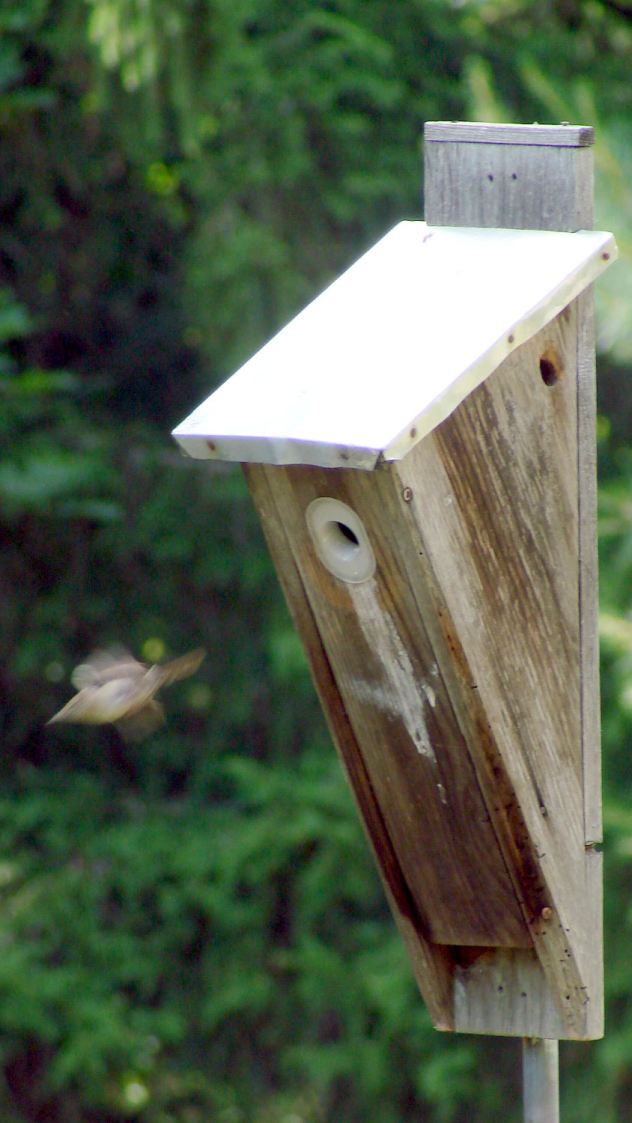
    A pair of wrens, having found the new entrance reducer entirely satisfactory, set up housekeeping in the front bird box and raised their nestlings.

    Somehow, they manage to fly directly into the hole without stopping:

    Wren - front box - entering
    Wren – front box – entering

    Outbound trips require a security check:

    Wren - front box - exit check
    Wren – front box – exit check

    And away!

    Wren - front box - fly away
    Wren – front box – fly away

    After those nestlings fledged, they began building a nest in one of the garden bird boxes a few hundred feet away. In short order, we’ll be awash in wrens!

  • Sharing the Road on NYS Bike Route 9: Squeeze Play

    Sharing the Road on NYS Bike Route 9: Squeeze Play

    I’m southbound on Rt 376, a.k.a. NYS Bike Route 9, riding inches to the right of the fog line on the only sliver of navigable asphalt remaining after NYS DOT applied homeopathic scab patches along this section:

    Rt 376 SB Marker 1110 - Near Miss - oncoming bicyclist and wide trailer - 2020-07-07
    Rt 376 SB Marker 1110 – Near Miss – oncoming bicyclist and wide trailer – 2020-07-07

    On the northbound side, another cyclist rides the sliver of pavement between the fog line and the gravel ridge built up from the deteriorating patches, being overtaken by a huge pickup towing a full-width quad-wheel trailer full of lawn maintenance equipment. The driver has eased about as far toward the yellow line as possible to give the cyclist barely enough clearance:

    Rt 376 SB Marker 1110 - Near Miss - oncoming trailer - 2020-07-07
    Rt 376 SB Marker 1110 – Near Miss – oncoming trailer – 2020-07-07

    I am not “taking the lane”, because I’m towing a trailer of groceries and there’s always overtaking traffic coming around the blind curve behind me:

    Rt 376 SB Marker 1110 - Near Miss - horn - 2020-07-07
    Rt 376 SB Marker 1110 – Near Miss – horn – 2020-07-07

    You can’t hear the car’s horn, but it’s right in my ear.

    The white patches beside and behind the trailer are the fog line paint on the original asphalt surface showing through the disintegrating scab patch. Cyclists cannot ride safely on broken pavement with half-inch discontinuities, which is why I’m to the right of the fog line, mostly off the edge of the patch. If I “took the lane” as expected by NYS DOT, I would be riding about two feet into the lane, in line with the car’s right headlight, to avoid the wheel-grabbing longitudinal fissures showing through the scab patch.

    Elapsed time: 10 seconds.

    Just another day of bicycling on NYS Bike Route 9, one of the roads NYS DOT makes “safe and functional for all users.”