Ed Nisley's Blog: Shop notes, electronics, firmware, machinery, 3D printing, laser cuttery, and curiosities. Contents: 100% human thinking, 0% AI slop.
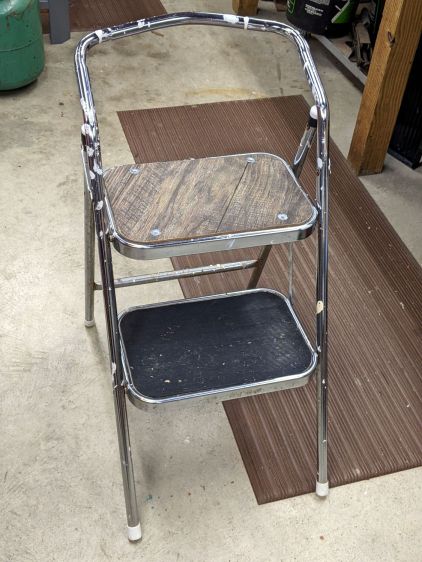
The top step of a folding step stool we’ve been (ab)using forever finally wore out, mostly because it was covered in vinyl and intended as a seat. We always used it as a step, despite knowing you should never stand on the top rung of a ladder: “Do not stand on or above this level”.
I tossed the ripped vinyl and warped particle board, cut a random chunk of wood-textured paneling (which Came With The House™) to fit, match-drilled four holes, and it looks OK:
Folding step stool – reseated
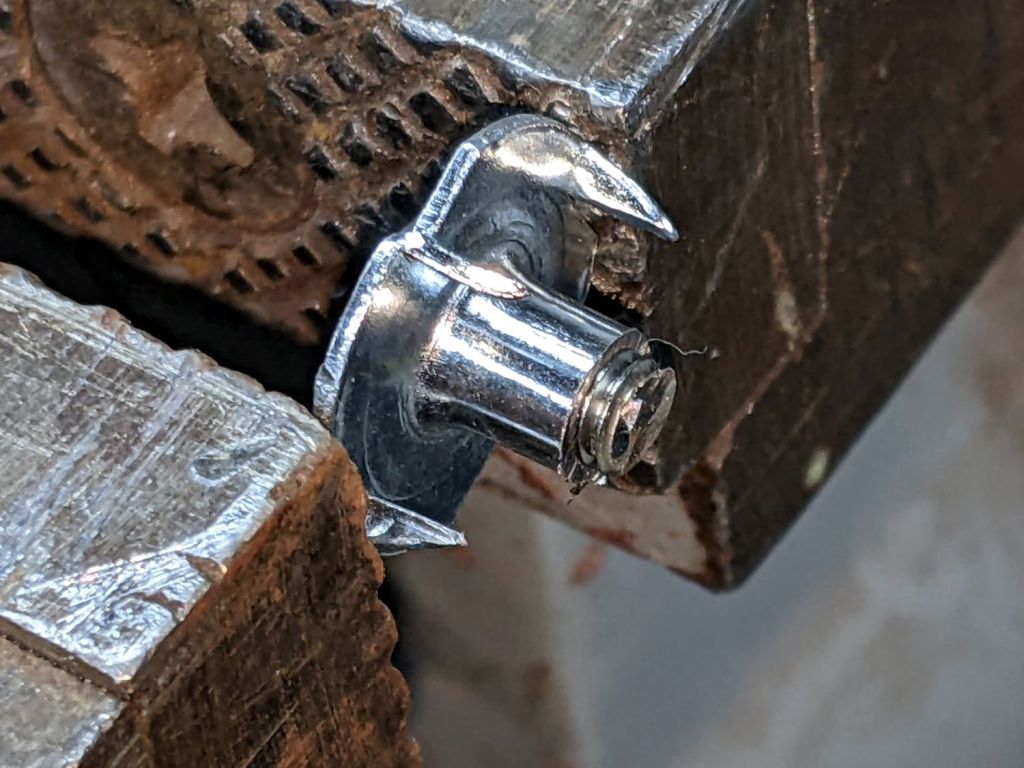
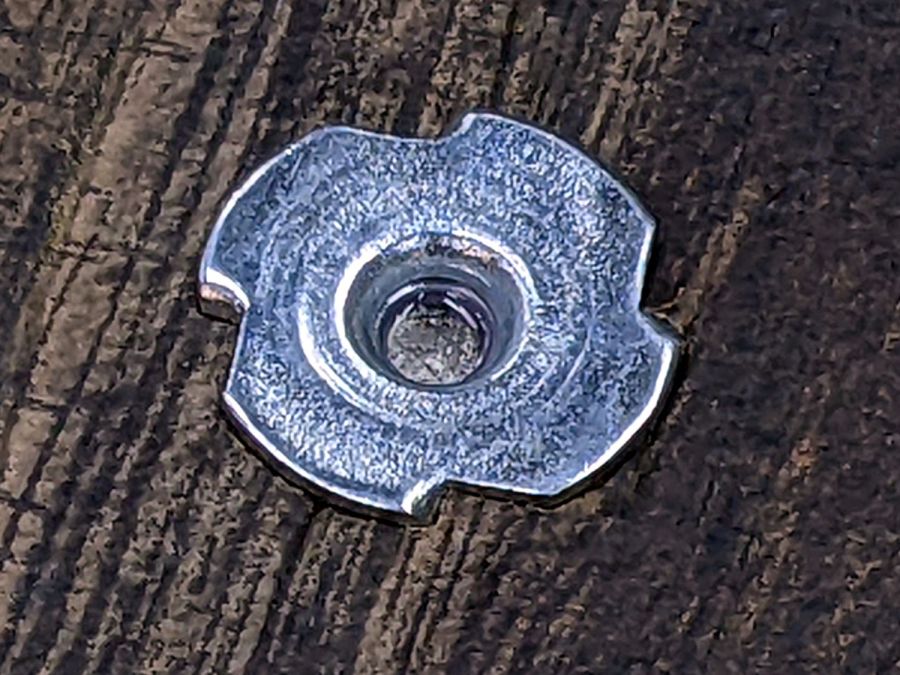
The original seat / step / whatever used press-fit studs with a flat flange covered by the vinyl, but I just slammed 10-32 tee nuts into the paneling:
Folding step stool – tee nut installed
That’s a ring of low-strength threadlock around the inside of the nut; I do not expect the screws to come out ever again.
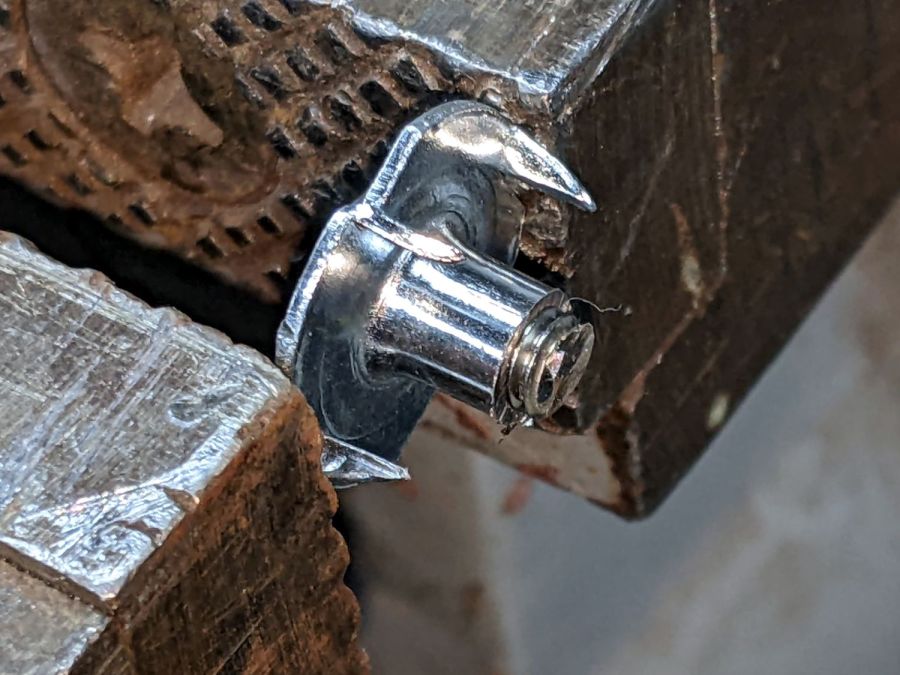
I cut the screws to length with a Dremel cutoff wheel using a slightly shortened tee nut as a fixture:
Folding step stool – screw shortening fixture
Not visible: the vacuum hose clamped to the vise sucking up all the abrasive + metal dust.
Good for an hour of Quality Shop Time™ on a cold winter morning!
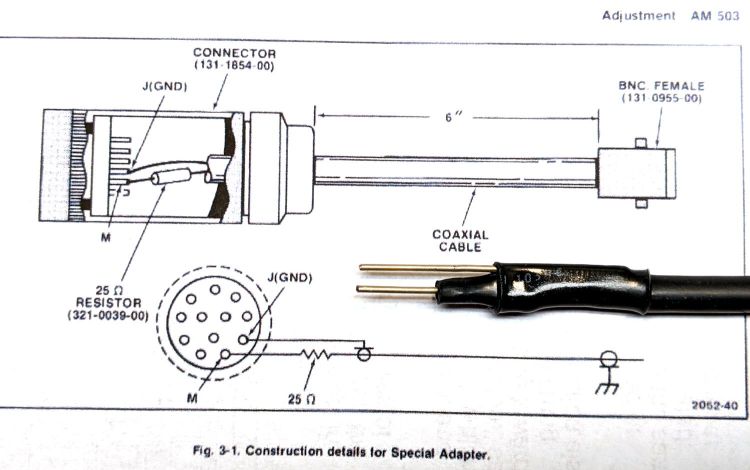
The Tektronix AM503 manual specifies a Special Adapter to inject a signal directly into the input connector in place of the A6302 Hall probe:
Tektronix AM503 Special Adapter
The intricate Amphenol plug might still be available at some phenomenal cost, but I’m willing to just jam a pair of wires into the AM593 connector and be done with it.
I combined a pigtail BNC sporting a male connector, two 51 Ω resistors in parallel, two snippets of 18 AWG wire (an exact match for the 40 mil connector pins!) with the ends filed smooth, and some heatshrink tubing to make a roughly equivalent adapter:
Tek AM503 – Crude Special Adapter
Because the pigtail didn’t quite reach the function generator, I joined it to a longer cable with a BNC bullet, whereupon a slight tug ripped the guts out of the bullet:
BNC Bullet – failed
A closer look:
BNC Bullet – parts
The center hole comes into play with their equally craptastic BNC tee connectors.
Comparing this bullet with others from the same eBay lot shows the outer shell didn’t get quite enough crimp around the metal ring. Because it’s not an electrical connection, I eased some epoxy onto the internal shoulder where that ring seats, then slid the guts back in place.
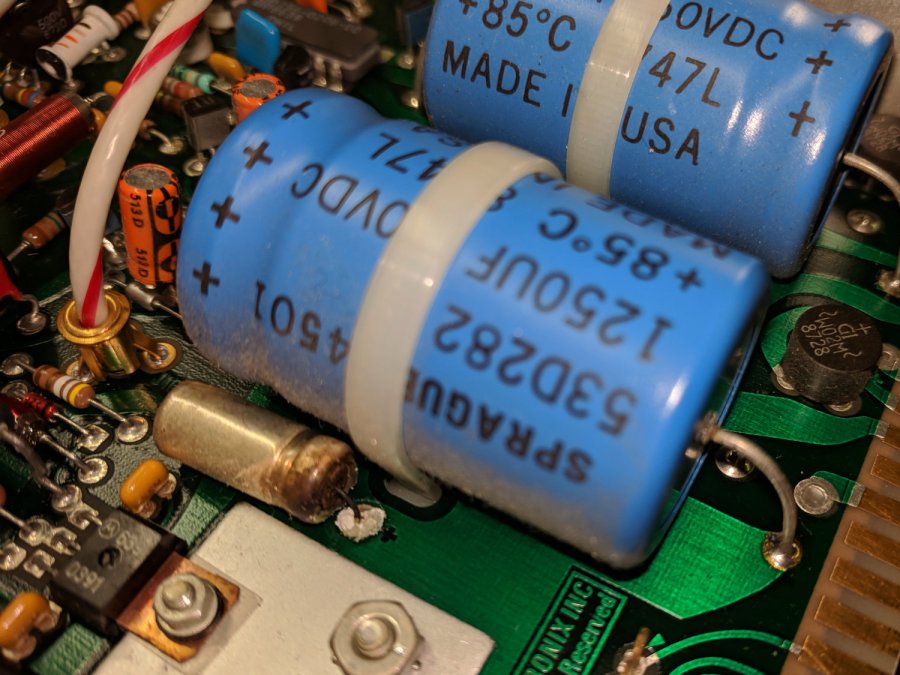
So, despite it not showing any leakage or damage, I replaced C155:
Tek AM503 B075593 – C155
Which had stopped being a capacitor some time ago:
Tek AM503 B075593 – C155 measurement
I also replaced C165 with a newer capacitor.
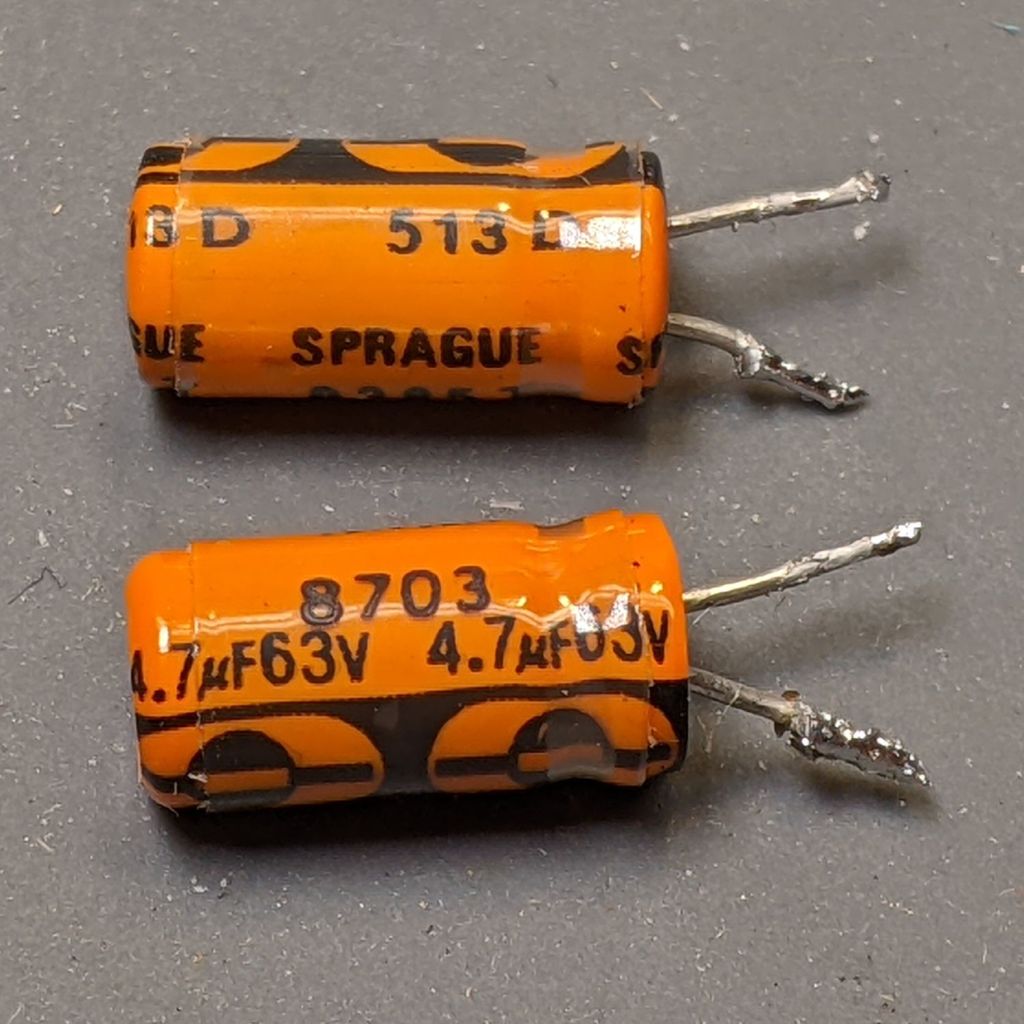
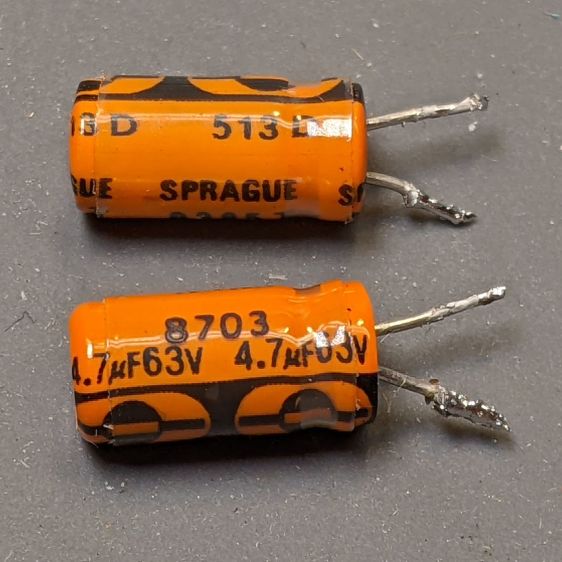
Again, having the hood up, I pulled C452 and C462 from the ±19.3 V supplies:
Tek AM503 B075593 – C452 C462
Despite the 1987 date code, they seemed to be in fine shape, but I replaced them anyway. The new caps have a 50 V rating, not the original 63 V: only a factor of two headroom.
The four new capacitors in their new home:
Tek AM503 B075593 – replaced caps
The power supply voltages looked clean before and look clean now.
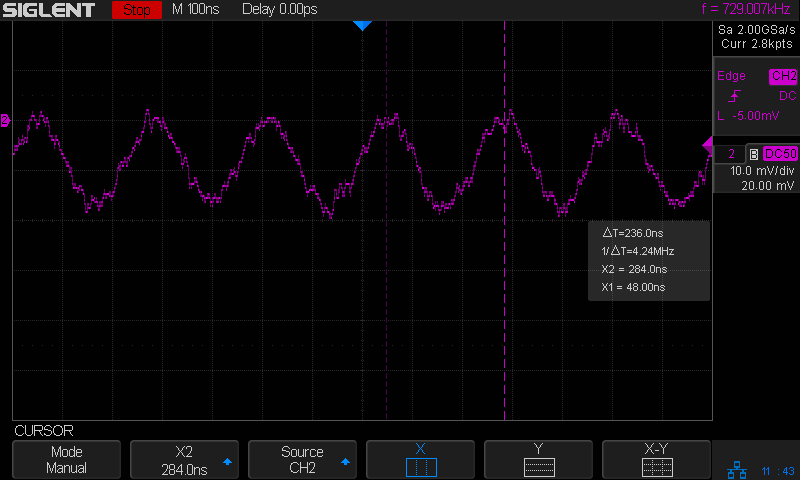
The AM503 still has the mysterious 4 MHz oscillation, so the capacitors weren’t the problem. Even though the amp is still sick, I feel better.
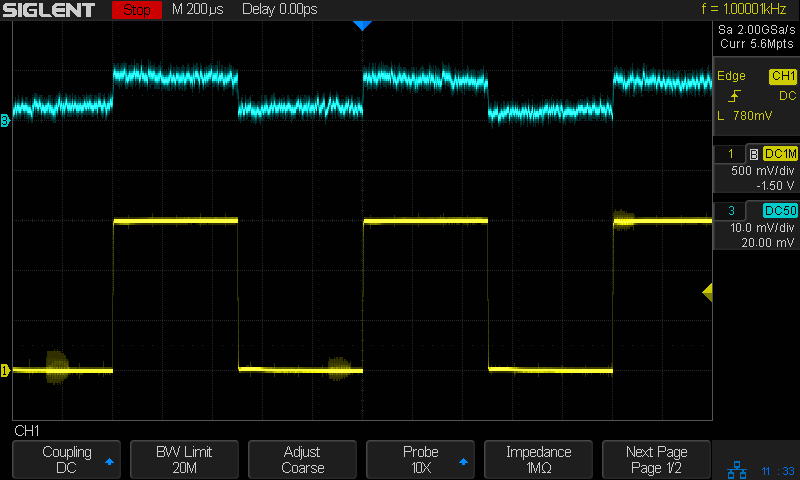
The test signal (yellow) comes from the scope’s calibrator output into a 2320 Ω resistor, so the AM503 calibration is about right: 0.6 mA ≅ 1.5 V/2320 Ω.
Just to maintain historical accuracy in the two AM503 amps in the TM502 mainframe on the Electronics Workbench, I transplanted the good (not noisy) OEM Tek Q230 (from SN B075593) into the previously noisy-and-offset-prone AM503, which now works fine. I now have a pair of works-pretty-good AM503 amps, one not-so-good AM503 in the to-be-fixed lookaside buffer, plus a defunct Q230 dual JFET.
That third amp (B075593, now with the NOS 2N5911) has a nasty noise problem:
Tek AM503 B075593 – SDS2304 cal – 1 mA-div
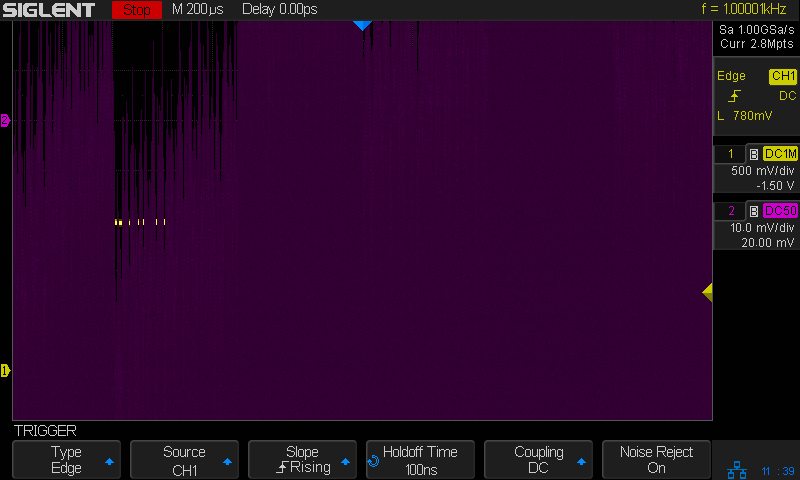
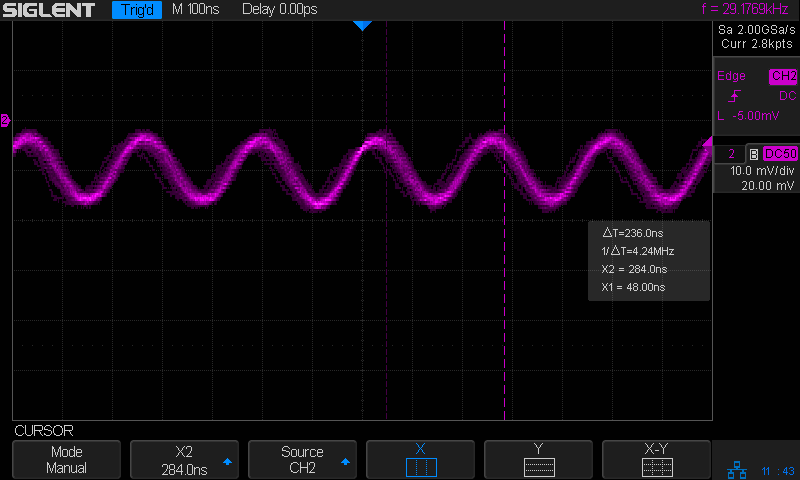
The barely visible yellow trace is the same calibrator signal as before, but the output is a howling 4.2 MHz (!) sine wave. The oscillation amplitude responds to the AM503 front panel gain control, making it possible to see what’s going on:
Tek AM503 B075593 – 4 MHz oscillation
Flipping the front panel switch to limit the AM503 bandwidth to 5 MHz shaves off the fur:
Tek AM503 B075593 – 4 MHz osc – 5 MHz BW
Disconnecting the probe or unplugging P220 kills the oscillation, as does setting the front panel switch to CAL/DC LEVEL, which means it’s an internal feedback problem.
It’s trivially easy to construct an amplifier circuit that becomes an oscillator at the slightest provocation, but this puppy had been working dependably for somebody else during the three decades (!) before I bought it and continued for a few years after that, so the overall circuit topology is known-good.
Shooting this one will require more pondering, as the obvious first step of replacing the power supply’s electrolytic caps had no effect.
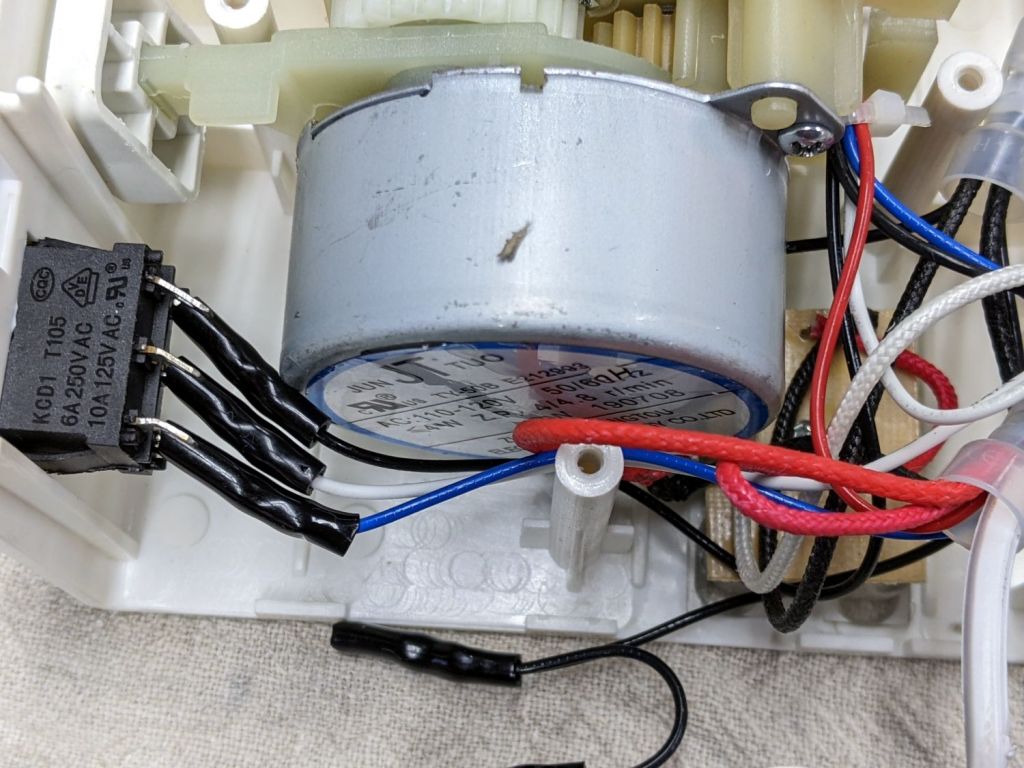
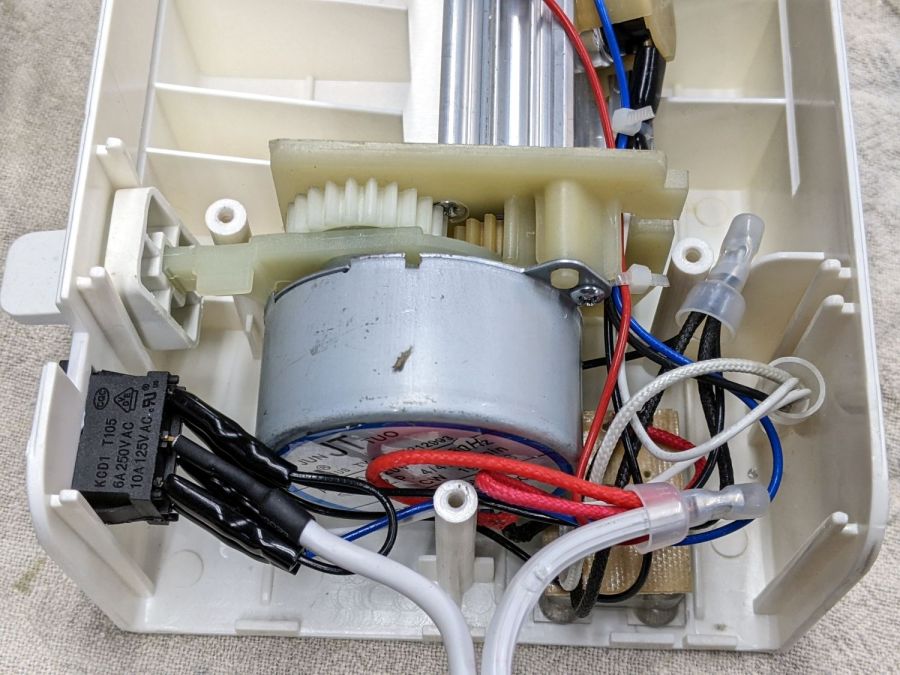
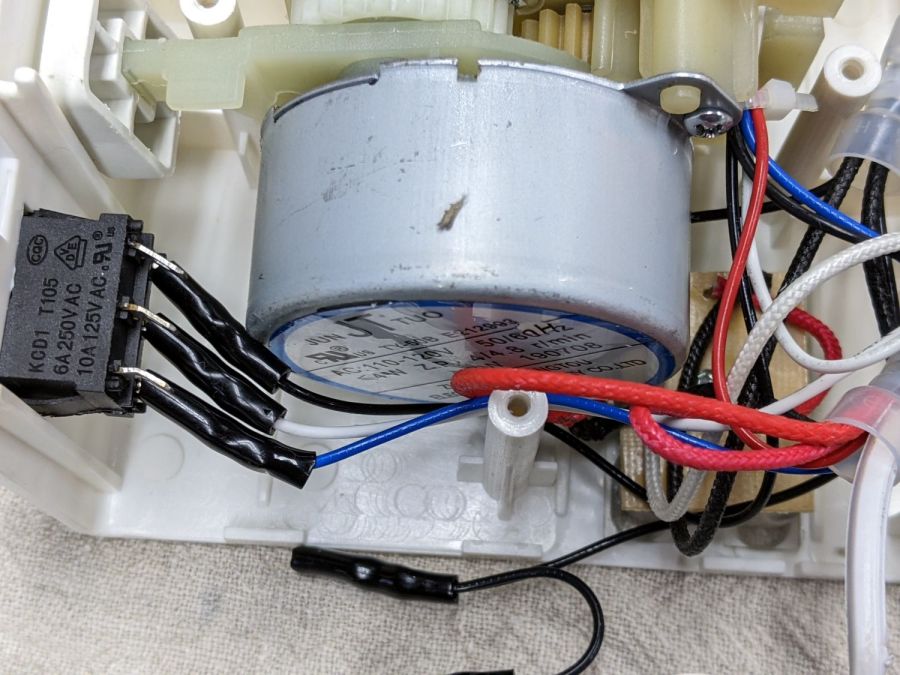
Someone with a jammed Amazon laminator inadvertently dislodged the switch wiring, so I took a few more pictures to help. Note: I see absolutely no reason to assume any two laminators will have the same wire colors, but the overall functions should be the same.
The top set of three switch terminals control the overall power to the laminator:
Amazon Laminator – switch wiring
The center terminal comes from the unmarked (no ridges) wire in the line cord. The two outer terminals are connected together with a short jumper from the terminal nearest the motor, with a longer black wire to the wire nut binding other black wires.
The bottom set of terminals select the temperature:
Amazon Laminator – switch bottom contacts
The white wire on the center terminal goes to the wire nut holding the other white wires and a black wire (!) going to the middle of the three thermostats on the extrusion. The black and blue wires on the outer switch terminals go to the thermostats on the aluminum extrusion to the heater.
Verily, it is written: There’s nothing like a good new problem to take one’s mind off all one’s old problems.









 The Smell of Molten Projects in the Morning