After going through the ritual required to install the 0.8 mm nozzle and preload the filament, the hot end looks like this before installing the silicone sock:
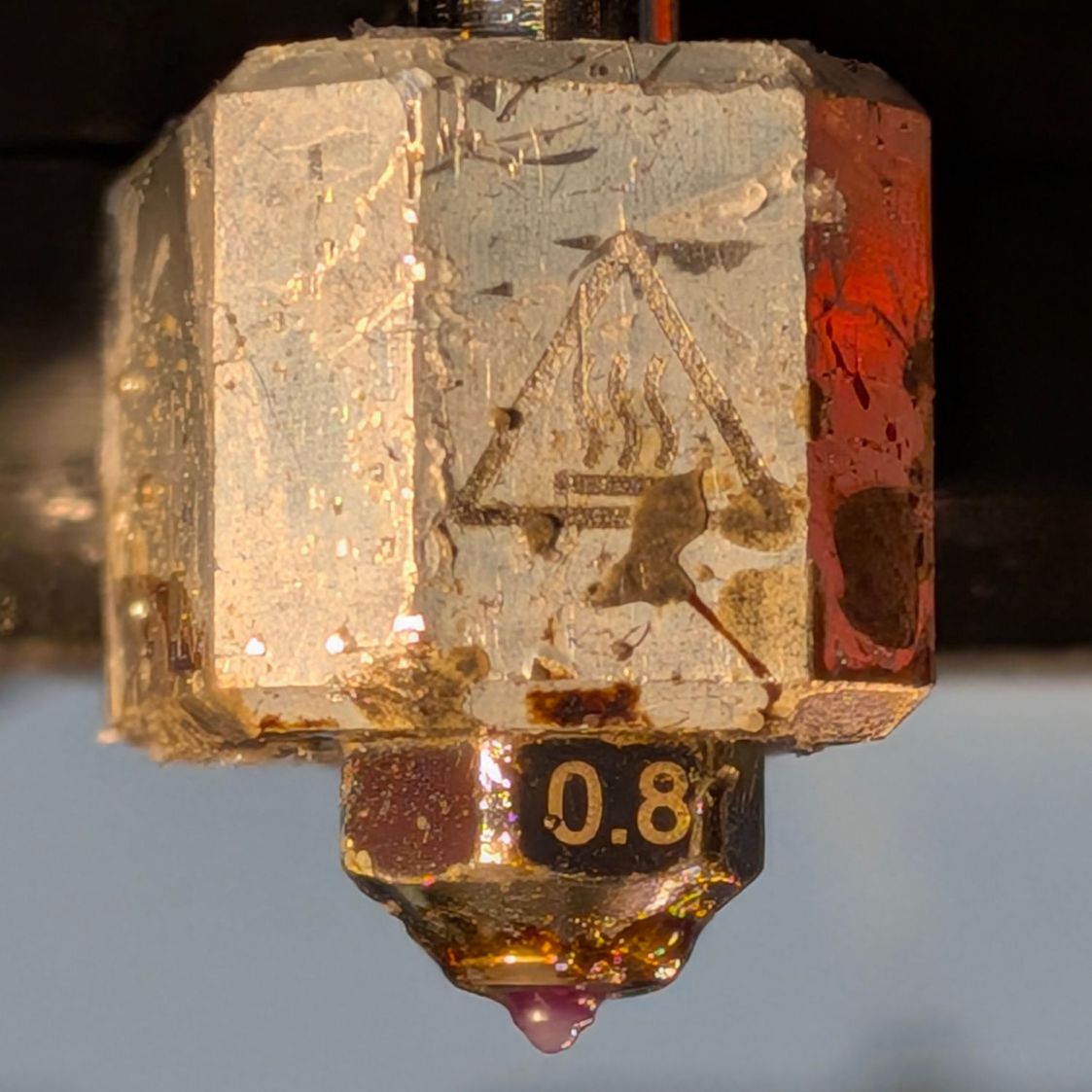
The aluminum block doesn’t look nearly as awful as these pictures suggest; those plastic smears serve as reminders of a few previous printing mishaps.
The nozzle is a 0.8 mm Durozzle with a ruby tip suitable for abrasive filaments like PETG-CF, although this is gooey squishy “natural” TPU:
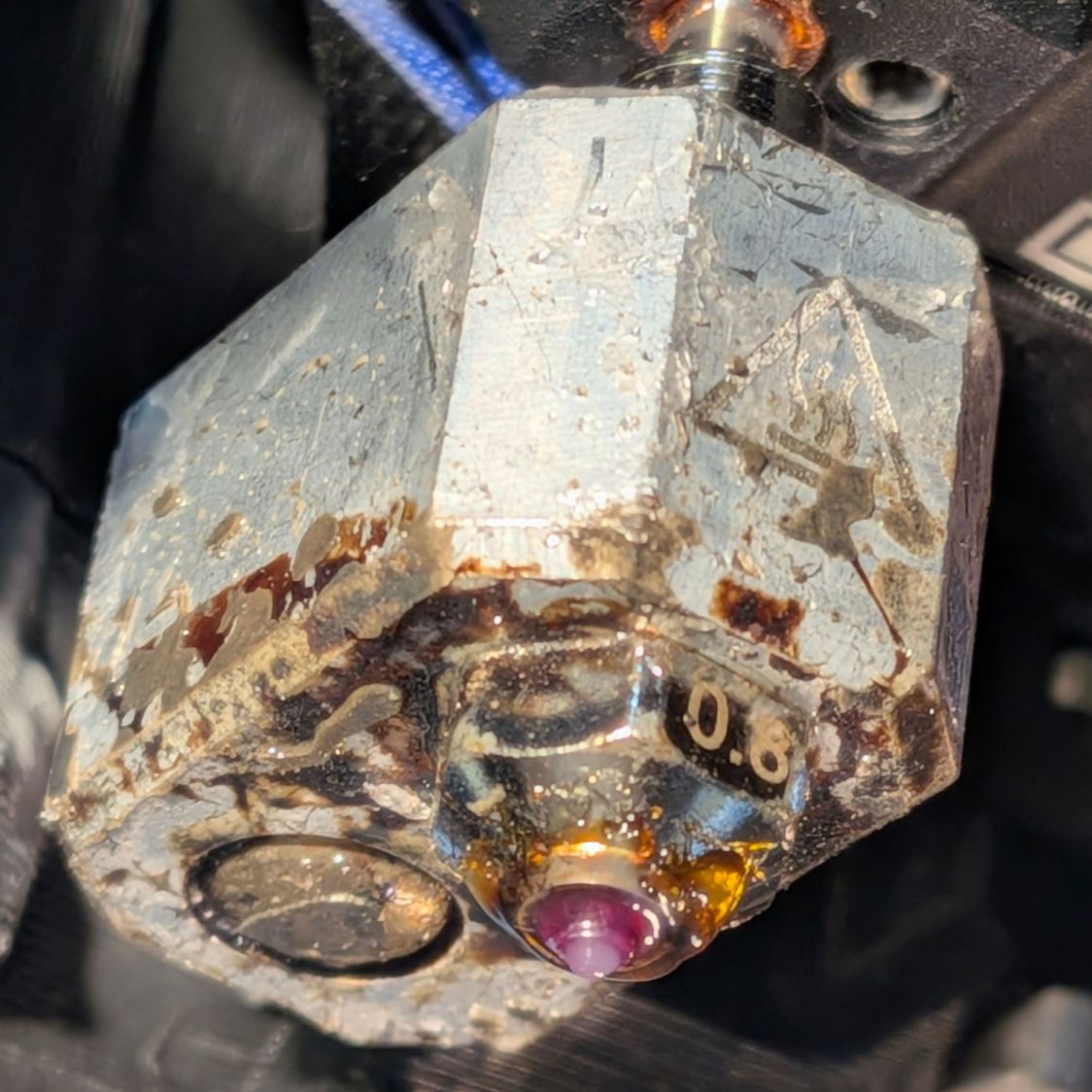
The first patio table foot test piece in TPU had terrible adhesion to the Textured Sheet, which I eventually tracked down to an excessively thick first layer. Given that the MK4 homes the axes and performs mesh bed leveling probes over the build area, this was difficult to believe, particularly because it had never been a problem with the Prusa 0.4 mm ObXidian hardened steel nozzle.
More poking around showed some of the plastic drool left on the outside of the nozzle from the previous print session (as shown in the two pictures above) could remain hardened or at least “not squishy” despite the nozzle being heated before homing and mesh probing. Because probing depends on having the nozzle touch the platform, anything between the nozzle and the steel sheet will raise the Z=0 position and cause all the layers to be too high.
As far as I can tell, ruby has a thermal coefficient around 40 W/m·K, roughly the same as steel. Both are considerably lower than the 200-ish W/m·K for the aluminum block surrounding the nozzle tube, suggesting most of whatever temperature gradient there may be occurs between the heater and the nozzle, not in the nozzle.
While puzzling that out, I noticed the nozzle heated to only 160 °C prior to homing and probing, which seemed low for a filament calling for 230 to 250 °C during printing. Ordinary PETG heated to 170 °C, so something was different.
More puzzling showed the Start G-Code section of the printer’s Custom G-Code sets the home / probe temperature, herein reformatted for readability:
M140 S[first_layer_bed_temperature] ; set bed temp

M104 T0 S{((filament_notes[0]=~/.*MBL160.*/) ? 160 :
(filament_notes[0]=~/.*HT_MBL10.*/) ? (first_layer_temperature[0] - 10) :
(filament_type[0] == "PC" or filament_type[0] == "PA") ? (first_layer_temperature[0] - 25) :
(filament_type[0] == "FLEX") ? 210 :
(filament_type[0]=~/.*PET.*/) ? 175 :
170)} ; set extruder temp for bed leveling

M109 T0 R{((filament_notes[0]=~/.*MBL160.*/) ? 160 :
(filament_notes[0]=~/.*HT_MBL10.*/) ? (first_layer_temperature[0] - 10) :
(filament_type[0] == "PC" or filament_type[0] == "PA") ? (first_layer_temperature[0] - 25) :
(filament_type[0] == "FLEX") ? 210 :
(filament_type[0]=~/.*PET.*/) ? 175 :
170)} ; wait for temp
The bursts of line noise after the M104 Set Extruder Temperature and M109 Set Extruder Temperature and Wait commands consist of nested ternary operators sifting placeholder variables defined in other parts of the slicer configuration.
I had set up the eSun TPU 95A filament parameters based on Prusa’s TPU definition. I eventually discovered that definition includes the text MBL160 in its Notes section, which satisfies the regex in the first ternary operator:
(filament_notes[0]=~/.*MBL160.*/) ? 160 : … snippage …
Which then emitted the M104 T0 S160 and M109 R160 commands into the G-Code to set the temperature.
After considerably more flailing around while figuring this out, I changed the filament Notes to read:
HT_MBL10 -- force higher probe temperature for Durozzle ruby nozzle
mbl160 -- disabled by lowercase
Which then falls through to the regex in the second ternary operator:
(filament_notes[0]=~/.*HT_MBL10.*/) ? (first_layer_temperature[0] - 10) :
Which sets the temperature to 10 °C below the first layer temperature, which I had set to 230 °C, so the probing now occurs at 220 °C.
I am not making this up.
Although that may be a bit too hot, the drool on the nozzle softens nicely and smashes flat during probing, thus solving the immediate problem and, without further ado, produced good round and square TPU feet.


Comments
2 responses to “Prusa MK4: Mesh Bed Leveling Temperature vs. 0.8 mm Ruby Durozzle”
amazing. fantastic follow through. I suspect there a market opportunity here for a gcode debugger that is not a previewer like all my search results show. Anyway, thank you for this post (i’ve only printed 2 things on my core one so far but am trying to absorb as much as I can, and was lead to rss follow you by previous polydryer posts that are still pinned tabs in my browser before i go and decide how many things to cut away)
IMO, the basic problem comes down to forcing a myriad complex operations into the printer controller, with the G-Code “language” being a completely inadequate interface between the slicer and the firmware.
While the G-Code will be syntactically correct (because there’s not much to G-Code syntax), its semantics can be bewildering (because every printer’s firmware is different). The slicer must decompose the solid model into slices, convert each one into tool paths, then generate the G-Code describing them, while simultaneously considering all the printer / filament / design configuration parameters.
It Would Be Nice If printer firmware evolved with a scripting language, but …