Soldering a 32.768 kHz quartz tuning fork resonator into the test fixture:

The HP 8591 tracking generator doesn’t go below 100 kHz, so I used the FG085 DDS function generator as a source. I trust the 8591’s calibration more than the FG805’s, but right now I’m more interested in the differences between successive frequencies and the DDS can step in 1 Hz increments.
The output appears on the 8591, with a big hump comes from the analyzer’s 30 Hz IF filter response sweeping across what’s essentially a single-frequency input. The hump is not the crystal’s response spectrum!
With the jumper installed to short the 33 pF cap, the output peaks at 32.764:
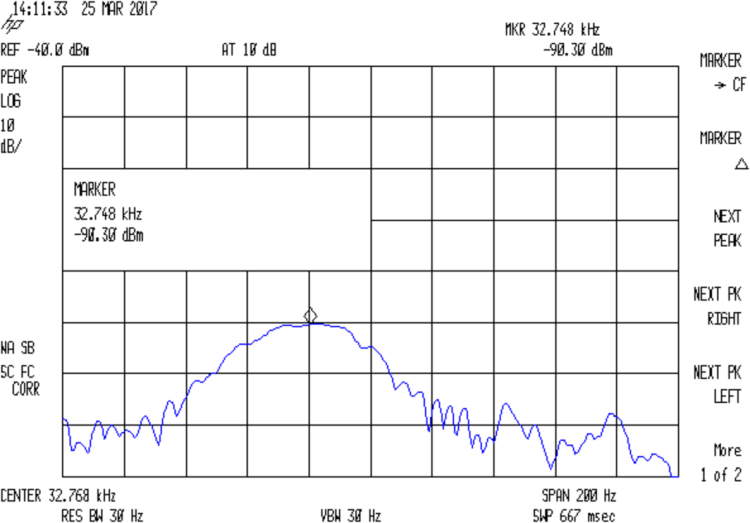

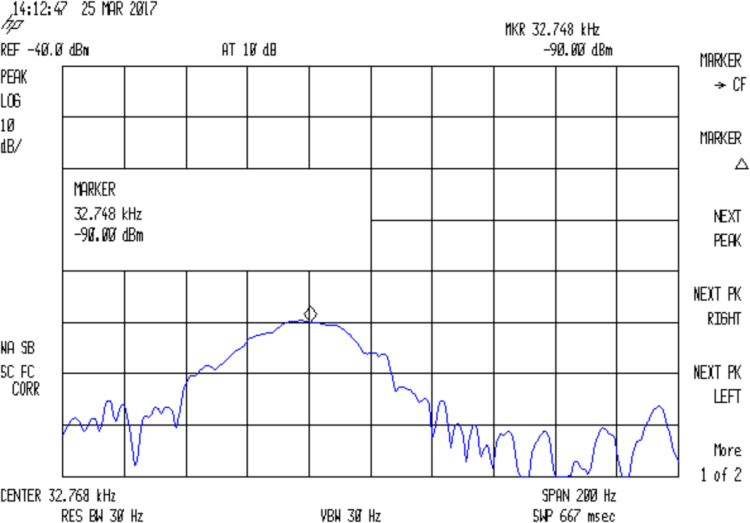

Removing the jumper to put the cap in the circuit, the response peaks at 32.765 kHz:

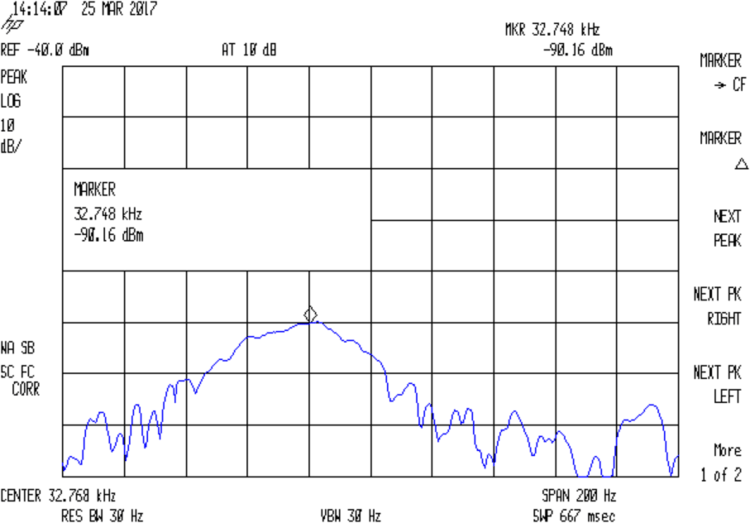

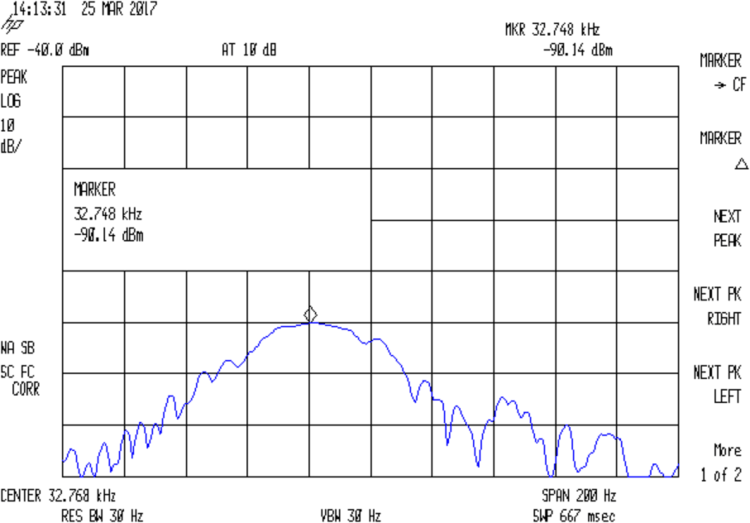
The marker delta shows the difference between the two peaks, ignoring their 1 Hz difference:
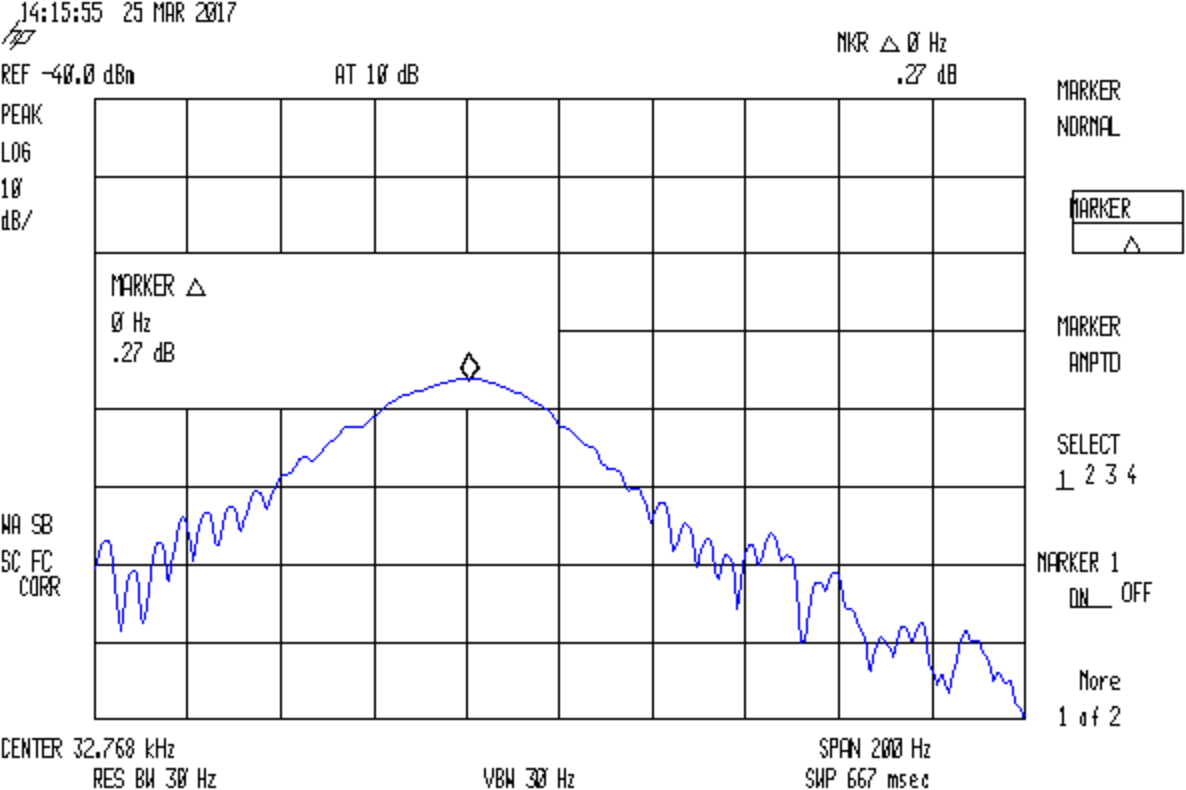
So I’d say the cap really does change the resonator series resonance by just about exactly 1 Hz.
With the jumper installed to remove the cap from the circuit, setting the reference marker at the 32.764 kHz peak, and measuring the relative response at 32.765 kHz :

So the response peak is much much narrower than 1 Hz: being off-peak by 1 Hz knocks 13-ish dB from the response.
What’s painfully obvious: my instrumentation is totally inadequate for crystal measurements at these frequencies!
 The Smell of Molten Projects in the Morning
Comments
5 responses to “Quartz Resonator Test Fixture: 32 kHz Quartz Tuning Fork”
[…] proto board has two oscillator circuits behind the crystal test fixture, with the 32 kHz resonator hanging from the header pins on the lashup toward the […]
[…] general idea is to build a specialized sine-wave source as part of a test fixture to measure quartz crystal / tuning fork resonators in the 10 kHz to 100 kHz band. AD9850 / AD9851 […]
[…] are 13-ish spots apart, which corresponds to 1.3 H, which is roughly the 1 Hz I measured with the HP8591 spectrum analyzer, The baseline is down 8 dBV, not quite as much as the analyzer’s 13 dB at 1 Hz offset from […]
[…] series-resonant peaks look about 1 Hz wide at the -3 dBV points, more or less agreeing with what I found with the HP 8591 spectrum analyzer. The series cap is a bit smaller, producing a slightly larger frequency change in the series […]
[…] I provided in my April 2017 Circuit Cellar column. Here’s the schematic, with values for a 32 kHz tuning fork resonator and the original […]