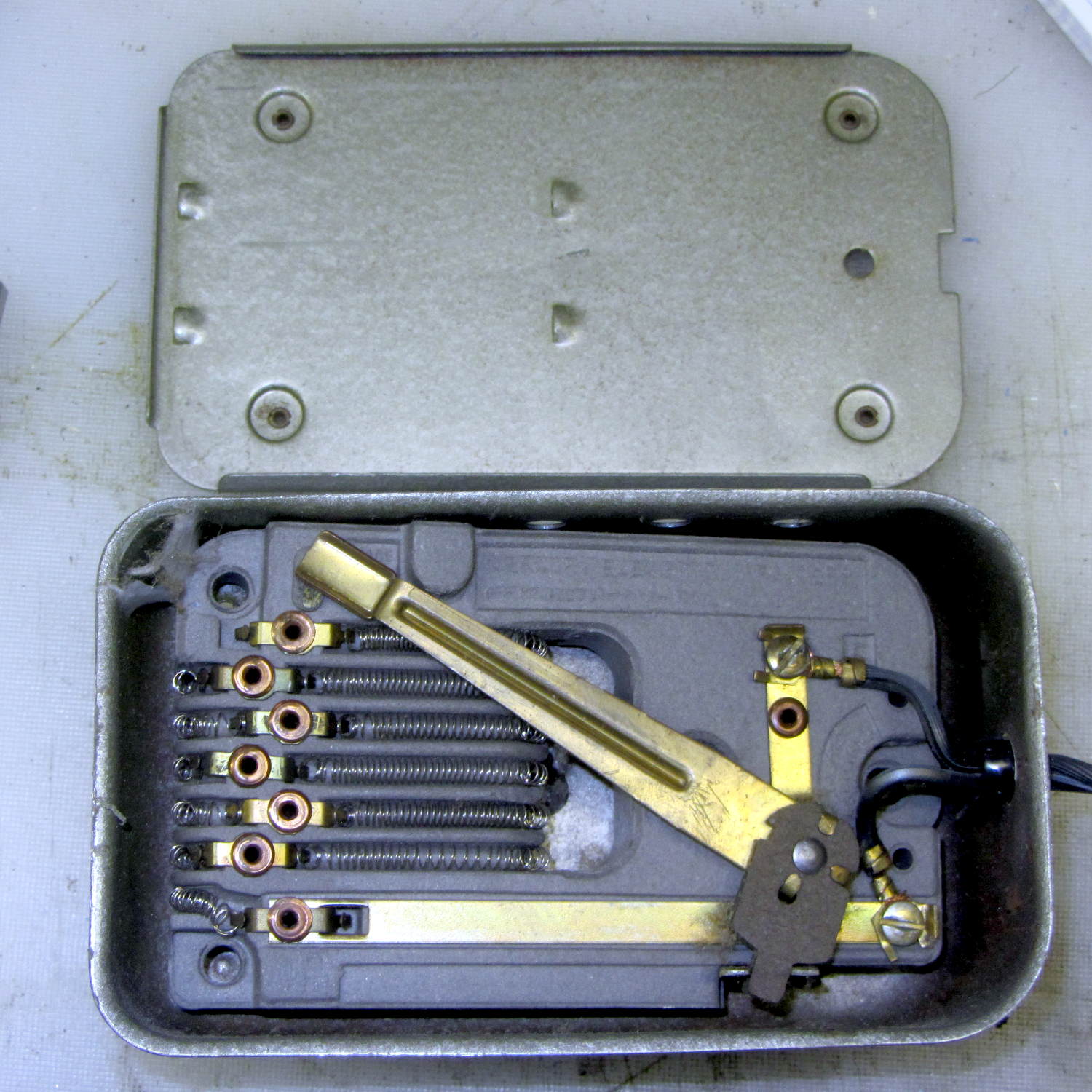
Based on the paperwork tucked into the sewing table, the most recent Kenmore Model 158 sewing machine in our stable dates to 1972, a bit earlier than the others, and has a metal-cased foot pedal with a wire-wound resistor:
The cord insulation stiffened up over the decades and I wanted to replace it, but the contacts in the sewing machine connector were spot-welded to the conductors with no room for teeny screws:

I blew out the fuzz, put it back together, and it works pretty well, modulo the usual low torque at slow speeds issue.
The discrete resistor taps produce a somewhat stepped response, but early reports suggest it’s not enough to be annoying; it’s much more stable than the carbon disks in the more recent pedals.
 The Smell of Molten Projects in the Morning
Comments
3 responses to “Kenmore Model 158: Older Foot Pedal Resistor”
For what it’s worth, around Y2K, I had a failure in my then-45 year old sewing machine’s foot pedal. One of the insulators cracked and allowed the ‘hot’ metal to touch the case. At that time, Not sure which part of the pedal died; it wasn’t repairable, but generic resistor foot pedals were readily available.
Yeeps!
The machine has a two-wire cord, of course, and I think the case is (supposed to be) isolated from both. Perhaps that’s why they went to a Bakelite (or whatever) case: no exposed metal.
She’s happy with the (much-repaired) pedals, but I should see about safety-grounding that case!
Thanks for the data point…
[…] Via The Smell of Molten Projects in the Morning. […]