Ed Nisley's Blog: Shop notes, electronics, firmware, machinery, 3D printing, laser cuttery, and curiosities. Contents: 100% human thinking, 0% AI slop.
Tag: Thing-O-Matic
Using and tweaking a Makerbot Thing-O-Matic 3D printer
After adding F feed speed parameters to all the G0 commands in my start.gcode (to work around that bug), I decided to use the new-with-firmware-2.8 feature that stores the home offsets in the Thing-O-Matic’s EEPROM. That turned out to be, one might say, a thinly documented feature, so this may be a useful summary…
The Official Way to set the EEPROM, which you can find in ReplicatorG/scripts/calibration/Thing-O-Matic calibration.gcode, goes a little something like this:
Manually position the nozzle dead center on the build plate, just touching the surface
Use G92 to set all axes to 0.0
Home the axes to the switches
Use M131 X Y Z A B to store the current values in EEPROM
Having already found good values for those offsets as part of the aluminum build plate adventure, I jammed them into EEPROM using RepG’s Machine→Motherboard Onboard Preferences. The values I’m using are:
X = -53.0
Y = -59.0
Z = 116.0
For some unknown reason that has nothing to do with floating point representation (I mean sheesh even the 32-bit version of IEEE 754 floating point has at least 10 decimal digits of precsion), RepG modifies only the negative values sufficiently to be bothersome:
X = -52.964
Y = -58.976
Having stored the offsets, I wondered how to fetch them. That is also, of course, completely undocumented, but I eventually traced down the answer in (deep breath)
That’s not true for all the start.gcode files you might find, though, and there are many such in far more obvious places.
So, OK, I fetch the EEPROM coordinates using M132 after doing both the coarse home (they’ll be pretty close) and the fine home (they’ll be dead on, modulo the changes), then wipe the nozzle and poke the Z-minimum height switch (which is why I really really care about random changes in the stored values) to find the actual height above the aluminum build surface.
At exactly this position it would be nice to set only the Z height to the actual switch thickness, but G92 sets all un-mentioned axes to zero, so you can’t set just one axis. I have no idea how M131 and M132 behaves in that regard; none of this stuff is documented anywhere that I can find and this stopped being funny a while ago.
So, knowing the XYZ coordinates of the switch, I reset the XYZAB axes using G92.
The current working start.gcode that I devoutly hope will continue to work for a while:
(---- start.gcode begins ----)
(MakerBot Thing-O-Matic with aluminum HBP and Z-min platform switch)
(Tweaked for TOM 286 - Ruttmeister MK5 stepper extruder mod)
(Ed Nisley - KE4ZNU - July 2011)
(Hack to work around bad G0 speed)
(- set initial conditions)
G21		(set units to mm)
G90		(set positioning to absolute)
(- begin heating)
M104 S210 T0	(extruder head)
M109 S110 T0	(HBP)
(- coarse home axes)
G162 Z F1000	(home Z to get nozzle out of danger zone)
G161 Y F4000	(retract Y to get X out of front opening)
G161 X F4000	(now safe to home X)
M132 X Y Z A B	(fetch home offsets from EEPROM)
(- fine home axes)
G0 X-51 Y-55 Z114 F400	(back off switches)
G161 Y F200
G161 X F200
G162 Z F200
M132 X Y Z A B	(fetch home offsets from EEPROM)
(- manual nozzle wipe)
G0 F6000 X0 Y0 Z10	(pause at center to build confidence)
G4 P500
G0 X40 Y-57.0 Z10	(move to front, avoid wiper blade)
G0 X56				(to wipe station)
G0 Z6.0				(down to wipe level)
M6 T0				(wait for temperature settling)
G1 Y-45	F1000		(slowly wipe nozzle)
(-----------------------------------------------)
(- Make sure the XY position matches the G92    )
(- home Z downward to platform switch)
G0 F6000 X56.4 Y7.6 Z3		(get over build platform switch)
G161 Z0 F50					(home downward very slowly)
G92 X56.4 Y7.6 Z1.60		(set Z height)
G0 F6000 Z6.0				(back off switch to wipe level)
(-----------------------------------------------)
(- start extruder and re-wipe)
G0 X56 Y-45     (set up for wipe from rear)
G1 Y-57.0 F1000 (wipe to front)
M108 R2.0		(set stepper extruder speed)
M101			(Extruder on, forward)
G4 P4000  	    (take up slack, get pressure)
M103			(Extruder off)
G4 P4000  	    (Wait for filament to stop oozing)
G1 Y-45	F1000	(slowly wipe nozzle again)
G0 F6000 X0		(get away from wiper blade)
(- build some pressure)
M108 R2.0		(set stepper extruder speed)
M101			(start extruder)
G4 P100			(run for a bit)
(---- start.gcode ends ----)
For what it’s worth, I put that file in the sf_40_alterations directory, blew away the previous versions in all the profiles, and replaced them with symlinks to that single file. When the next change comes along, I can modify one file and all the profiles will pick up the change at once.
I upgraded to ReplicatorG 25 and the Thing-O-Matic promptly got weird: the initialization code slowed to a crawl. The motors ran fine, the motion was properly coordinated, but the thing moved at a minute fraction of its normal 100 mm/s.
This was most obvious on the first move to the center of the stage after homing the axes. If you peer into the source code, that instruction looks like this:
G0 X0 Y0 Z10 (pause at center to build confidence)
The comment tells you exactly why I put that move in there when I first started tinkering with start.gcode: I long ago discovered that automation doesn’t always do what you want, so having a simple verification at the first opportunity sometimes pays off big.
Anyhow.
A bit of rummaging showed that RepG 25 has changed the semantics of G0, which is supposed to be a fast move to the programmed coordinates. Now G0 moves at the feed rate set by the most recent G1 and also accepts an F parameter, which it shouldn’t. I suspect somebody refactored the code and didn’t notice that G0 isn’t supposed to work exactly like G1.
The base of that case makes a good protector to keep an Arduino board out of the conductive clutter on a typical electronics bench. I stopped the printer shortly after it finished the bosses atop the mounting posts:
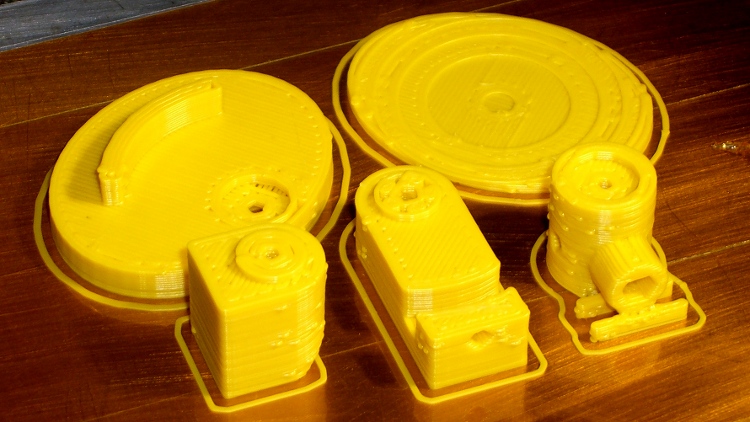
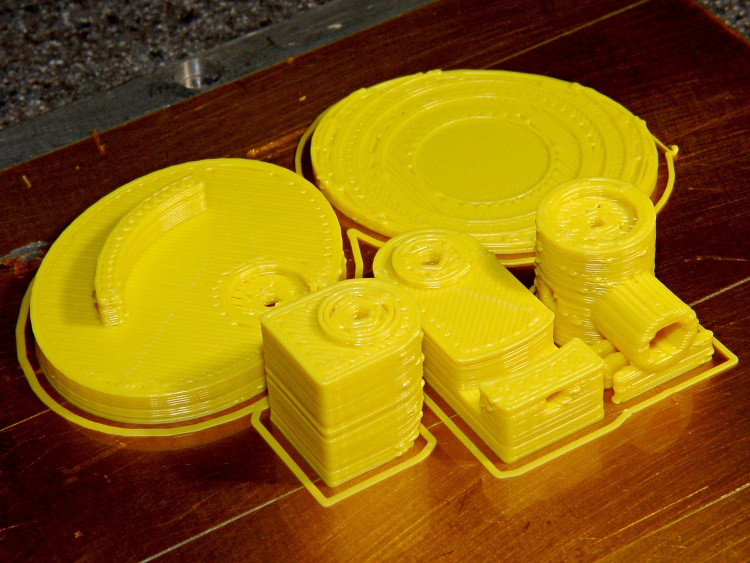
Printing went smoothly after two preliminary passes to work out the sizes and alignments; this is the second pass, which you can tell because the mirror shoulder has three supports instead of the two shown in the solid model:
Mirror mount parts on build plate
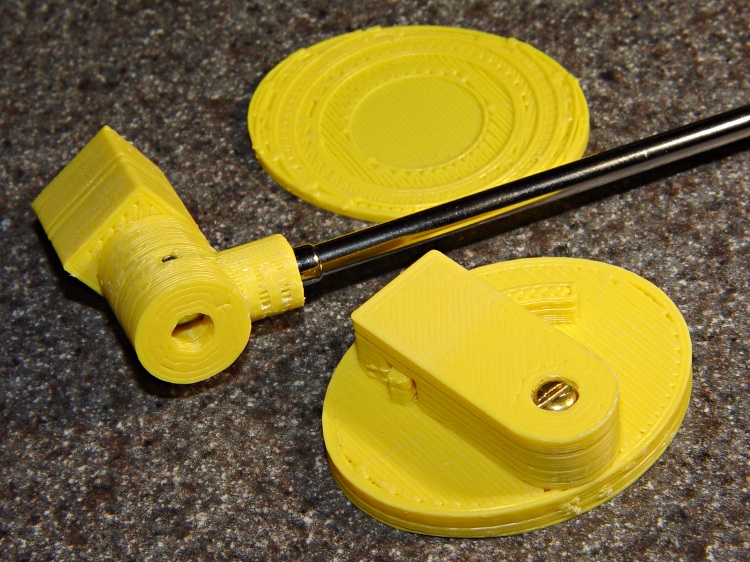
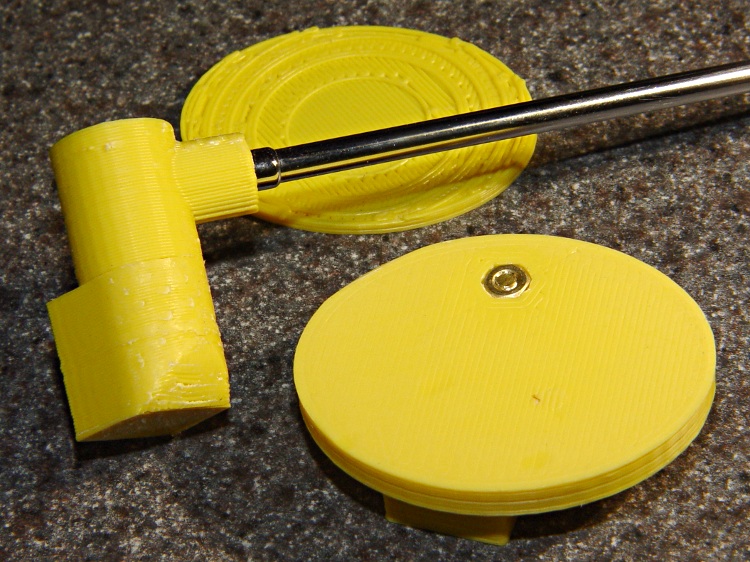
One view of the parts, with the mirror shaft in place:
Mirror mount partial assembly – top
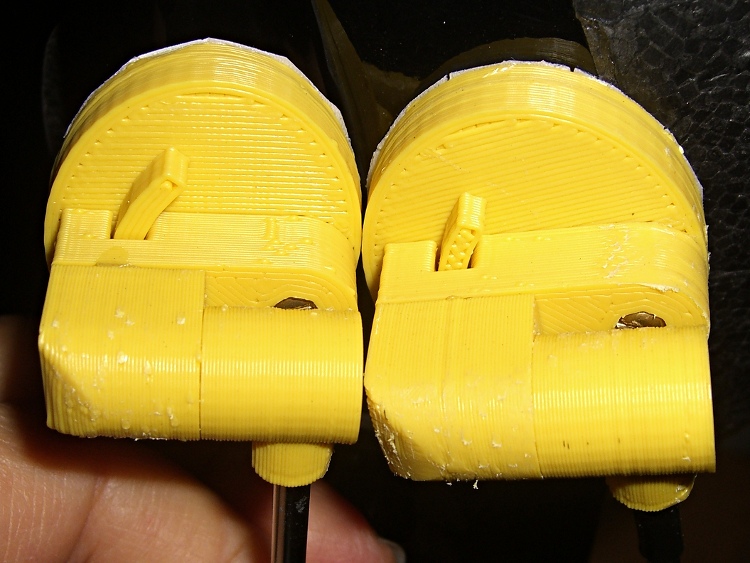
Another view, showing the bottom of the Elevation Plate with the recessed nut:
Mirror mount parts partial assembly – bottom
Assembling the two glue joints required an overnight clamping:
Mirror mount – glued and clamped
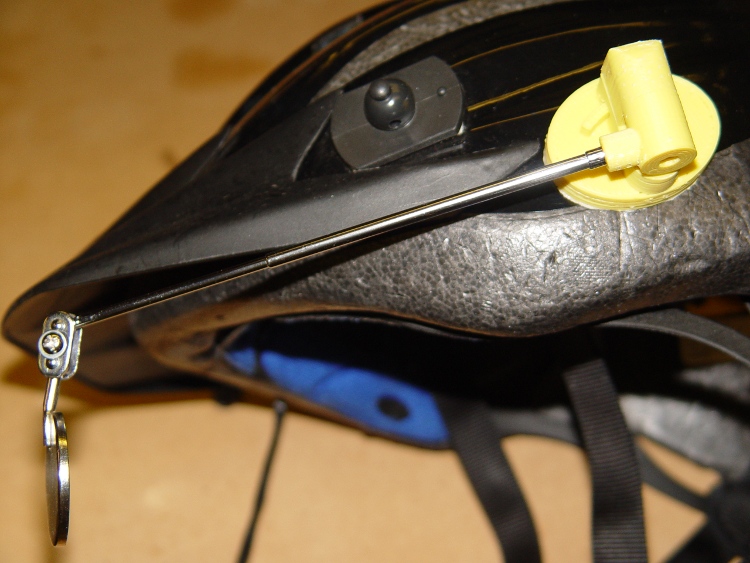
Then a layer of double-stick foam tape affixes it firmly to the helmet:
Mirror mount – on helmet
It’s a bit too big and way ugly, but works pretty much as expected.
Two lengths of heatshrink tubing now lock the mirror shaft sections in place; they tended to rotate slightly under normal vibration.
The OpenSCAD code and model have a few modifications from this object. The next one won’t have the third section of mirror shaft, which makes the shoulder and Az Mount smaller, and the Az Mount is 1 mm closer to the El Body. That shaves a few millimeters off the whole thing.
The mirror clamp out there on the end is much too large and has too many fiddly parts. I think a little printed doodad would work, but that’s in the nature of fine tuning.
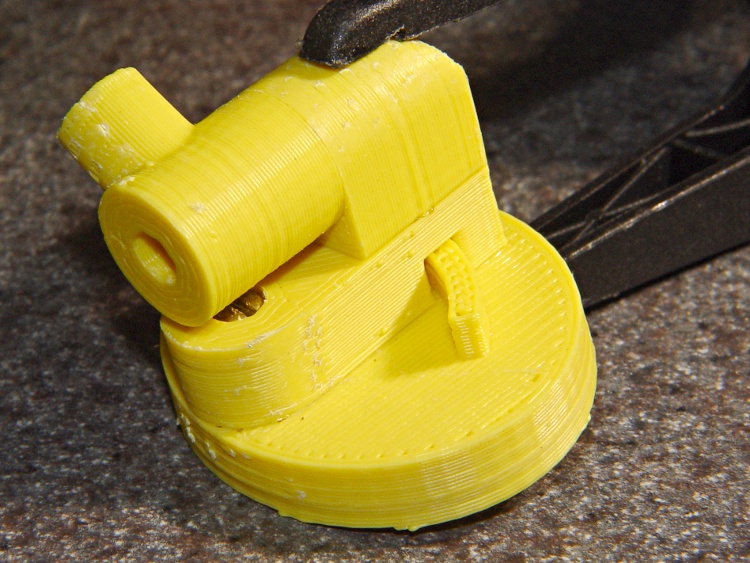
After a bit of OpenSCAD twiddling, those doodles turned into a printable model. This view shows what it looks like all neatly assembled:
The tiny hole on the top of the Elevation Body accepts a 2-56 setscrew that grabs the arc protruding from the Elevation Plate and locks the up-and-down setting. The Azimuth Mount pivots on the 3-48 screw holding it to the Elevation Mount.
Both of those pivots must be loose enough to move when you bump the mirror and tight enough to stay put in normal use. It’s a delicate balance and I’m not convinced this will work for the long term, but it’s a brassboard.
The 2-56 stud on the end of the mirror shaft screws into a socket in the rear side of the Az Mount. Another 2-56 setscrew in the Az Mount (facing the El Body), grabs the side of the shaft and prevents it from rotating.
The mirror shaft shoulder on the Az Mount (front center) sticks out in mid air and requires a little bit of support.
The El Mount (left rear) builds surprisingly well with its curved top surface downward. If it’s rotated 90 degrees with the curve facing to the left, Skeinforge grumps about not being able to do something or another and generates totally bogus G-Code.
The Helmet Plate has a 3 mm deep depression that more-or-less corresponds to the helmet’s surface. It’s gouged out by a huge sphere sitting on the plate, with a radius calculated from the measured helmet curvature.
The OpenSCAD source code has two useful parameters near the top:
Layout selects the overall appearance: Fit, Show, or Build
Examine selects a single part for inspection & tweakage
You’ll need the MCAD and Visibone libraries to make this work. It’s the original code, without the tweaks to the grid mentioned in the comments there:
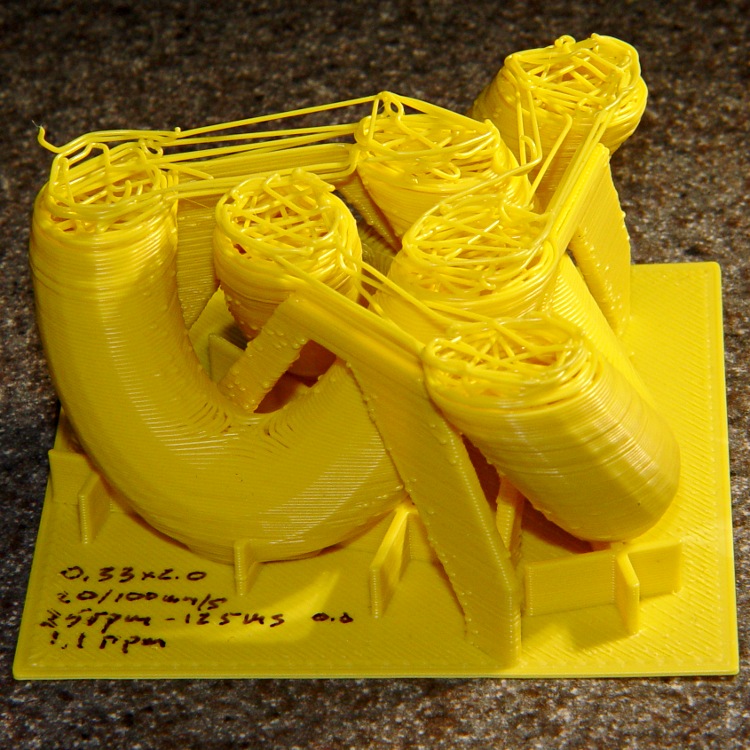
As the scrawled notation says: printed at 50 mm/s with 100 mm/s moves. The only cleanup: remove the scaffolding and slice off the Reversal zittage.
If the truth be known, that was actually the third knot. The first suffered a spectacular failure: one corner of the filament spool snagged on the wall behind the printer and jammed the filament:
Large Knot – failed
The filament drive pulled all the slack out of the bundle, broke off three of the six internal guide posts (admittedly, they’re just hot-melt glued in place), and dragged a nasty kink halfway down the feeder tube. Obviously the stepper was shedding steps during that whole process, but it came rather close to doing the Ouroboros thing.
While that went down, I was puttering around in the far reaches of the Basement Laboratory, attempting to clean up a bit of the clutter, and checking in on the printer every now and again. Seemed like a good idea at the time, is all I can say.
Perhaps the Lords of Cosmic Jest simply decided this was an appropriate object to mess with. The vertices of the hexagonal filament spool stick out perhaps 10 mm from the printer’s backside and every one has cleared the wall on countless previous rotations. I moved the entire affair a bit further from the wall and maybe it’ll be all good from now on.



 The Smell of Molten Projects in the Morning