The Smell of Molten Projects in the Morning

Ed Nisley's Blog: Shop notes, electronics, firmware, machinery, 3D printing, laser cuttery, and curiosities. Contents: 100% human thinking, 0% AI slop.

Tag: Repairs

If it used to work, it can work again

  • Sears Kenmore HE3 Washer Teardown: Tub Damage Assessment

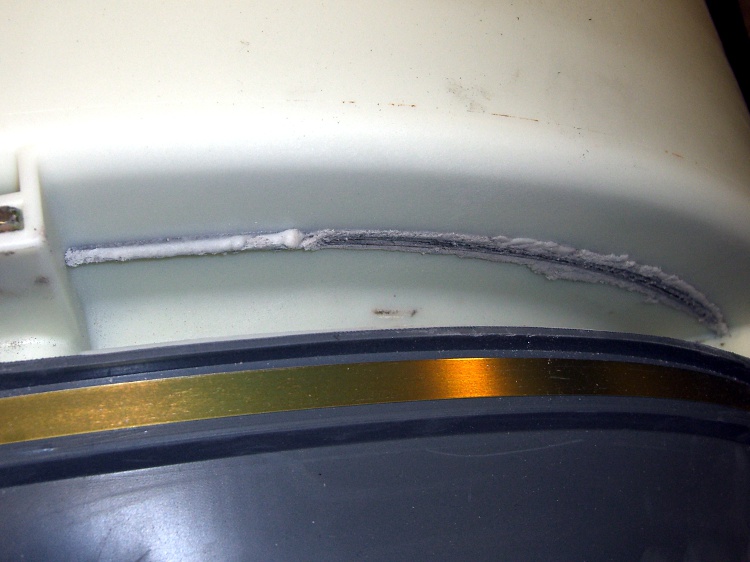
    After removing the concrete weights from the tub, I saw where the piddle of water was coming from: the stainless steel drum (formally: Basket) had been chewing on the plastic Tub for quite some time. That’s most likely the strange new sound Mary heard, but it’s impossible to see the affected area without gutting the entire washer.

    The top left section, below the detergent dispenser.

    Outer Tub Damage - Top Left
    Outer Tub Damage – Top Left

    The top right section.

    Outer Tub Damage - Top Right
    Outer Tub Damage – Top Right

    I assumed the damage was limited to the top section, because the drum would pivot downward under load. That turned out to be incorrect, as I realized when I looked behind the lower concrete weight: the Tub was scored through all the way around.

    Here’s a view of the interior, taken after I removed the Tub from the washer and pried off all the clamps that secure the Front Tub to the Rear Tub.

    Outer Tub Damage - Inside View
    Outer Tub Damage – Inside View

    And a closeup…

    Outer Tub Damage - Inside Detail
    Outer Tub Damage – Inside Detail

    The drum has a ridge around the front circumference where the round perforated shell joins the convoluted front piece that necks down into the opening behind the door. That ridge contacts the plastic Tub and, even though it’s smooth, generates enough friction to burn through the Tub.

    Now, this is the point where the repairman turns to you and says that, although he (it’s always a he) can replace the drum and Tub, the total cost will be more than a whole new washer.

    Sticker price for the parts, direct from Sears, looks like this:

    • Stainless Steel Basket: $364
    • Front Tub: $150

    Onto that, reports from various forums indicate that you will have incurred some labor charges:

    • Labor: $120+ to this point
    • Parts Service Fee: $50 (I don’t know what that is, either)

    A new HE3 washer is $850, more or less.

    Ah, you ask, isn’t there a Lifetime Limited Warranty on the Stainless Steel Drum? Why, yes, there is, and that’s a story all in itself …

  • Sears Kenmore HE3 Washer Teardown: Tub Grounding Connection

    Tub Grounding Connection
    Tub Grounding Connection

    Before you pull the tub out of the washer, you must disconnect the ground wire from the bearing behind the pulley. This isn’t impossible… it just looks that way.

    There’s a notch molded into the pulley that provides access to the ring terminal. IIRC, it’s a Torx T15 screw and there’s just barely enough clearance for a magnetic tip holder in there.

    For some unknown reason, the tapped hole on our washer was filled with steel filings that clogged the threads. I ran the screw in until it stopped, backed it out, cleaned off the filings, and repeated until it came out mostly clean.

    The picture is after a few cleaning passes; the screw came out covered with filings the first time!

    Magnetized Screw
    Magnetized Screw

    The magnetization comes from the holder I used for the Torx bit, but it certainly was handy.

  • Sears Kenmore HE3 Washer Teardown: Shock Absorbers

    HE3 Washer Shock Absorber
    HE3 Washer Shock Absorber

    The instructions you’ll find elsewhere tell you to just twist the head of the shock absorber a quarter-turn to release it. That’ll probably work, although I think you’ll break the two locking clips that hold the head in place, after which you’re depending on friction to prevent the whole affair from shaking loose.

    The head is the small bump visible inside the white bracket on the tub. The locking clips are the tabs inside the square shape just under the bracket. It’s obvious when you see it, if you know what you’re looking for.

    The trick is to use a small screwdriver to pry the locking clips downward while twisting the head. This is impossibly awkward, but you can get one started, lever the other one out, and then both will suddenly slide free as the head turns.

    If you’ve removed the three concrete tub weights, the tub will rise up as you release each shock absorber. Mind your fingers!

  • Sears Kenmore HE3 Washer Teardown: Control Panel

    In order to get the drum out, you must remove the Control Panel and Top Front Brace

    Start by unplugging the ribbon cable from the side of the Machine Control Microcomputer. Note the cute little latch holding the connector plug in place. Things will not go well with you if you break that latch off; the plug will vibrate loose.

    Control Panel plug at Machine Control unit
    Control Panel plug at Machine Control unit

    Unthread the ribbon cable from the clips all the way around the rear and right side of the washer body.

    The Control Panel has three mechanical attachments:

    Remove the screw behind detergent drawer on far left. Put the drawer in a tray so it doesn’t drool all over the place.

    Control Panel - left screw
    Control Panel – left screw

    Unsnap latch inside the washer body on far right. By now you’ve removed the top, so just reach inside and shove the tab over a bit to the right to release the latch.

    Control Panel - right-side latch
    Control Panel – right-side latch

    Unsnap latch in the middle. This one baffled me, but all you must do is push upward with a screwdriver (or maybe a dowel) inside the notch on the bottom of the Control Panel Cover directly above the middle of the door opening.

    Control Panel - center latch
    Control Panel – center latch

    Then feed the ribbon cable through the opening.

    Now you can get to the screws that hold the Front Panel in place. Don’t remove those until you disconnect the Bellow that seals the Tub to the Panel and unhook the Door Lock assembly.

  • Sears Kenmore HE3 Washer Teardown: Toe Panel

    It turns out you can get access to the extractor pump from the front of the washer, without having to take the back off and reach all the way through. If any of the problems we’ve ever had with the washer could have been fixed just by reaching into the pump, that’d be nice to know.

    Remove three Torx T-20 screws at the very bottom of the lower front panel, known as the Toe Panel, and it drops right out.

    If you have something jammed in the pump, you can put a tray underneath, unscrew the obvious plug, and bloosh water all over the place. I don’t know how you’d know you had something in jammed in the pump, but that’s how you get to it.

    Pump access from Toe Panel
    Pump access from Toe Panel

    In our case, the junk was spread all through the washer

  • Sears Kenmore HE3 Washer Drum: The Rot

    Corroded Aluminum Spider - Overview
    Corroded Aluminum Spider – Overview

    Our Kenmore HE3 washer emitted a dramatic KLONK that had all hands racing for the Cancel button. After a bit of to-ing and fro-ing, some Web searching, and a few hours of teardown, I determined that the washer had failed in the usual HE3 way: the cast aluminum spider connecting the back of the lah-dee-dah stainless steel drum to the shaft had corroded and fractured.

    Now, class, let’s review our chemistry. What do we call a pair of dissimilar metals in an ionic solution?

    Very good. Can you spell “battery”?

    Bonus points: what happens to the battery electrodes as the current flows?

    Excellent! I’m sure you can spell “corrosion”, too.

    The stuff that looks (and feels!) like cheese is aluminum corrosion filling every nook & cranny in the back of the spider. The fact that the drum spins at 900 rpm tells you it’s rather tenacious gunk, but evidently we’ve been washing our clothes in corrosion products for several years.

    If you have a Sears or Whirlpool HE washer, so are you.

    Mary noticed the washer made a strange noise during the spin parts of the cycle, starting a few weeks ago, but it wasn’t anything you’d tear down the washer to diagnose. I’ll have more to say about that in a bit.

    The KLONK happened when a third fracture finally disconnected the drum from the shaft and it started whacking against the outer tub. All that’s holding the shaft in place is the remaining thickness of the spider casting and the interlocking fracture pattern; I can move the shaft, but not easily.

    Here are closeups of the three sections near the hub between the arms. Anything that looks like a crack really is one…

    Corroded Spider - Fracture 1
    Corroded Spider – Fracture 1

    The next section has a nice crack running along the circumference, too…

    Corroded Spider - Fracture 2
    Corroded Spider – Fracture 2

    And the third section…

    Corroded Spider - Fracture 3
    Corroded Spider – Fracture 3

    I hauled it to the driveway and hosed off the corrosion. There isn’t supposed to be that little hole where the sun shines through…

    Corroded Spider - After Rinsing
    Corroded Spider – After Rinsing

    The washer is six years old and cost $1100 new.

    Needless to say, We Are Not Amused.

    More on this as I sort things out. Search for HE3 and you’ll find more than you want to know (at least after I’ve gotten it posted).

  • Aztek Brake Pad Inserts: Glazing Thereof

    Went on a ride around the block and after about 4 miles discovered I had no rear brakes. Well, the brakes were there and doing the right mechanical things, but without much friction.

    Did an expedient repair by squeezing strips of paper between the pads and the rim, then rolling the wheel. Came out black and graphite-looking, not oily, but didn’t improve the braking.

    Rolled the bike into the shop after the ride; 23 miles without a rear brake gets my immediate attention. Wiped a lot of black graphite-looking schmutz off the rim using denatured alcohol, filed the well-glazed pads to a nice finish, and reinstalled.

    These are Aztek pad inserts, which I’m trying out to see how they work. So far, not much; they seem less grippy than the ordinary Aztek pads (on the front and previously on the back) and certainly much more prone to glazing.

    Memo to Self: 7792 on the odometer.