The Smell of Molten Projects in the Morning

Ed Nisley's Blog: Shop notes, electronics, firmware, machinery, 3D printing, laser cuttery, and curiosities. Contents: 100% human thinking, 0% AI slop.

Tag: Repairs

If it used to work, it can work again

  • Opening a USB Stick

    After I failed to fix that old USB memory, my friend suggested a brain transplant: swap the Flash chip from the dead stick into a new one. That has a low chance of success because the innards will be different for every manufacturer and, even for USB sticks of the same vintage, nothing remains the same from lot to lot.

    Anyhow, I removed the fancy end caps from the donor stick, which looks to be swag from a medical conference:

    Case caps removed
    Case caps removed

    The key step is to crack the case open without damaging anything inside. This technique works wonderfully well:

    Cracking the case
    Cracking the case

    Grab diagonally opposing corners in a bench vise and slowly increase the clamping force until the case snaps apart. Poke a screwdriver in the gap, remove the case from the vise, and pry the thing open.

    As it turned out, the innards were completely different: different Flash controllers and different Flash memory chips. So it goes.

    Not surprisingly, you can find the data sheets / manuals / configuration utilities for the Flash controller chips by searching for the obvious keywords. Machine translation is your friend…

  • Salvaged Heatsink Reconstruction

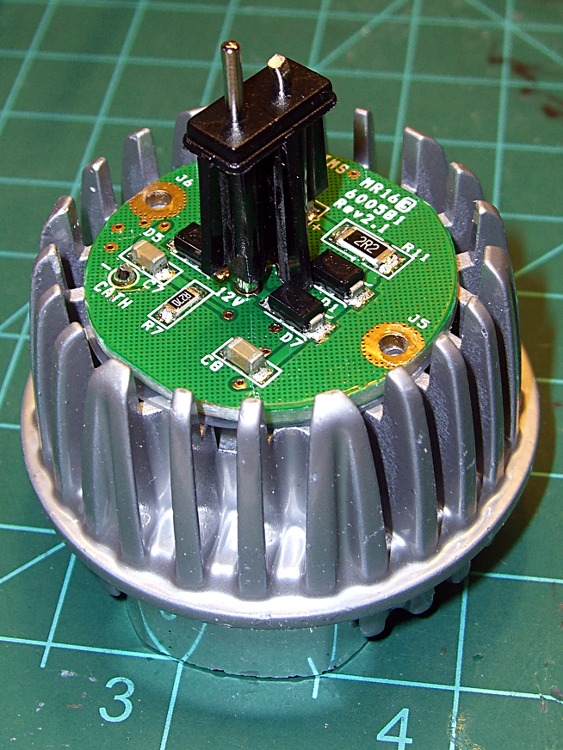
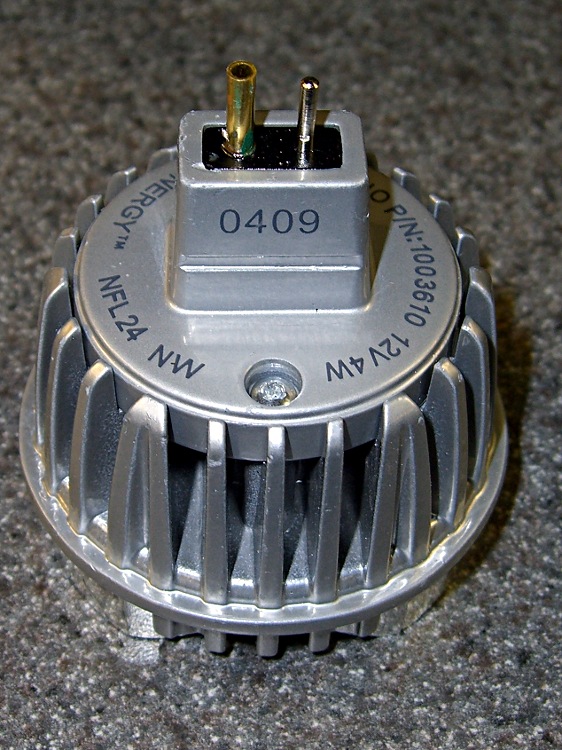
    Heatsink mounting flanges
    Heatsink mounting flanges

    I decided to replace the sawed-off flanges on that salvaged heatsink to make all three use the same mounting arrangement, whatever that might turn out to be.

    Nothing particularly fancy about it: two random chunks of aluminum sheet and two thinner strips, sanded to roughen their surfaces, and epoxied into place.

    The repaired heatsink is marginally taller than its siblings, but not so anybody will ever notice, and it’s no more off-kilter than they are, either.

    A quartet of 5/16-inch lathe bits provided the right spacing to hold the heatsink over its new flanges while the epoxy filled in all the gaps and irregularities. I probably should have paid a bit more attention to squaring things up, but it’s good enough for what it’ll need to do.

    Heatsink up on blocks
    Heatsink up on blocks


  • Cold Solder Joint

    Found this inside a friend’s dead USB memory stick:

    Cold solder joint in USB memory
    Cold solder joint in USB memory

    The leads come from a teeny 12 MHz crystal. The solder blob on the other side looked just fine, but you simply can’t tell by looking.

    As it turned out, the stick was dead for some other reason: the Flash memory controller chip got hot when the stick was drawing power. Resoldering all the joints had no effect, which wasn’t surprising.

    I suspect a killer static discharge or some such calamity.

  • Tour Easy: New Rear Brake

    While I had the bike up on the stand to replace the seat strut screws, I installed a new rear brake. The old brake hadn’t been braking well for a while, which I attributed to different brake pads, but nothing seemed to help.

    New rear brake
    New rear brake

    I had to drive the old brakes off the mounting studs with a drift punch; the studs were pretty well rusted after a decade of continuous use under the hostile conditions that pass for normal around here.  Shined them up, applied a generous layer of Never-Seez, and bolted the new brakes in place.

    Turns out that the rear brakes on a Tour Easy are backwards from their orientation on an upright bike: the studs point spinward, so the cable exits on the right side of the frame. Doesn’t make any difference, as that’s how the front brake studs work, but if you’re thinking of buying some fancy brake with odd mounting requirements, you probably shouldn’t.

    The installation specs require “more than 39 mm” of cable between the clamp bolt and the bracket on the other arm. The Tour Easy frame tubes are closer together than that, allowing a bare 25 mm of cable.

    Rear brake cable and boot
    Rear brake cable and boot

    I trimmed the boot to fit, but the real problem is that the arms aren’t at quite the right angle with respect to the braking surface on the rim and provide a bit less leverage than you’d like; the pad alignment is also trickier. I tried adding spacers to the brake pads, but the mounting studs aren’t quite long enough for that.

    The first road test indicates the new brakes work much better than the old ones…

  • Another Fractured Seat Strut Screw

    Having replaced both screws back in March, I wasn’t expecting this:

    Fractured screw surfaces
    Fractured screw surfaces

    Of course, it broke at the first pedal stroke while pushing off across an intersection, which is why I never try to ace out oncoming cars.

    This was, mercifully, on the left side of the bike, so I could replace it without removing the rear wheel. Being that sort of bear, I now carry spare screws and we were back on the road in about ten minutes.

    A closer look at the head end of the screw shows some interesting details:

    Fractured screw - head
    Fractured screw – head

    The tail end has matching cracks:

    Fractured screw - tail
    Fractured screw – tail

    Notice how the cracks are all oriented in the same direction. The screw fractured at the edge of the brazed-on frame fitting, so I suspect the seat stay clamp must be moving just enough to flex the screw across that plane.

    I mooched a pair of hardened socket head cap screws from Eks, ground down the head of the right-side screw for better chain clearance around the sprockets, buttered ’em up with Never-Seez, and we’ll see how long Real Steel lasts.

    Right-side screw with ground-down head
    Right-side screw with ground-down head

    I really should conjure up a clamp that mounts to the frame tubing, rather than depend on that puny brazed-on fitting, shouldn’t I?

    It appears that new Tour Easy ‘bents come with more brazed-on fittings and a more secure seat stay mounting bracket. A photo was there when I looked.

  • Oil Filter: Oops

    So I swapped in the snow tires and did the fall oil change a few days ago. Everything went smoothly, although the oil filter, as usual, blooshed oil over the front of the engine and, despite my padding the area with rags, onto the exhaust plumbing.

    Digression: I don’t understand why the Toyota engineers felt they had to tuck the oil filter below the exhaust header, behind the front downpipe, and over the flexible coupling to the forward cat converter, with the mounting tube pointed upward. It might have something to do with their rotating the entire engine rearward to get a lower hoodline. It seems to me that angling the filter so it can’t drain and must dump its contents atop the exhaust system isn’t Good Design; I’ve been muttering about it for the last decade.

    Anyway, the new filter screwed on easily, its seal ring (seemed to) seat against the block, and one final turn snugged it up just fine. The last fraction of that turn felt gritty, as though part the shell kissed the block, but I attributed that to the fact I was using a different filter style.

    I added the usual 5 quarts of oil, wiped up the spills, cleaned off the exhaust pipes, declared victory, called it a day, and put away the tools. Later that evening, I checked for leaks, found nothing, and we drove to a meeting about 12 miles away. As you might expect, the van smelled strongly of hot oil: you cannot wipe all the oil off those pipes.

    Oil trails on driveway
    Oil trails on driveway

    The next morning, Mary drove to an all-day class about 15 miles away and, about noon, I rolled out my bike to go grocery shopping… only to discover what you see in the picture (minus the sawdust patch) on the driveway.

    This is what we call in the trade A Very Bad Sign.

    There are three oil tracks:

    • Right-front track = outbound to evening trip
    • Rightmost heavy track = return
    • Leftmost track = outbound to morning trip

    Now, the fact that there’s no huge oil slick means the drain plug is in place and properly sealed. The oil evidently leaks out only under pressure, so the filter isn’t sealed against the block. This can be due to a number of causes, the most common of which is leaving the rubber ring from the old filter stuck to the block. I checked the old filter, which was still in the trash: the seal was still in place, so that wasn’t contributing to the problem.

    Regardless, the car was bleeding to death. I called Mary and she reported a dry dipstick.

    So I loaded a 5-quart jug of oil into the right pannier, dumped all the tools that might possibly come in handy into the left pannier, topped both off with many rags, stopped at an auto parts store along the way for a new filter, and rode those 15 miles at a pretty good clip. When I got to the parking lot, it was easy to find the van: simply follow its trail. The van sat atop a disturbingly large slick, evidently caused by oil draining off every local minimum inside the engine compartment and under the forward half of the chassis.

    The filter was still firmly screwed in place, but when I got it off and compared it with the new filter, they were different: the offending filter was slightly larger in diameter and the threaded hole was noticeable larger. Although it threaded on, the threads weren’t properly engaged, the larger diameter shell did hit the engine block, and it most certainly wasn’t sealed properly.

    I installed the new filter, poured in 3 quarts to the get the oil level midway into the dipstick’s OK range, wiped off some of the oil that coated essentially every part of the engine compartment, and we drove home trailing a cloud of hot oil fumes.

    As it turned out, the old filter was the same brand as the one that didn’t seal, but with different numbers and a different prefix: the correct filter is a 3614, the wrong one was 3593. Of course, the boxes and illustrations are identical, with slightly different contents. I’m sure they’re adjacent on the shelf and migrate into each other’s slot. It’s worth noting that the filter I bought while on the way to fix the problem was a different brand sporting a part number totally unrelated to 3614.

    The butt end of the van was covered with oil, as though the droplets blew out under the chassis and got sucked up against the rear surface; the window was a mess. I sprayed on stout detergent and wiped it clean, but I think we must treat the poor thing to an all-over car wash with the special undercarriage scrub option.

    No harm done, as nearly as I can tell, although it’s an exceedingly good thing we weren’t driving off to the grandparents!

  • Clearing the Shower Drain

    Clearing a clog
    Clearing a clog

    My shop assistant bears most of the hair in the household, so it seemed entirely appropriate that she clear the clog from the shower drain. She says she’s going to take a picture of the hairball and show her friends what her parents make her do…

    I pointed out that plumbers are ecstatic when they get a call for this sort of problem and will charge maybe 150 bucks to make the clog Go Away. When she’s writing the check, she can make whatever choice she wants.

    For now, this is how it gets done; the snake hangs on the garage wall.