Ed Nisley's Blog: Shop notes, electronics, firmware, machinery, 3D printing, laser cuttery, and curiosities. Contents: 100% human thinking, 0% AI slop.
The hose on our aging Samsung Quiet Jet (used to be a Quiet Storm, but I suspect they lost a trademark fight) vacuum cleaner has been a constant nuisance. Most recently, the end toward the handle began splitting:
Splitting vacuum hose
The fix consisted of a tight duct tape wrap, which has absolutely nothing to recommend it other than expediency.
When the same thing happened on the other end, I sealed it up and added a length of husky heatshrink tubing.
Strain relief on vacuum hose
The flared end isn’t particularly decorative, but it serves to reduce the strain on the hose. Alas, there’s no practical way to do the same thing on the handle end.
The replacement cost for the hose roughly equals a new vacuum, so when we run out of bags, this one gets harvested for the shop’s Parts Heap.
You can rub and you can rub, but you can’t shine shit.
Eks tells me that was one of his grandmother’s favorite sayings.
He introduced me to the concept of a “used-car polish”: high shine over deep scratches. Sometimes, that’s exactly what the job requires.
There’s also the notion of making a silk purse from a sow’s ear (attributed variously to Jonathan Swift and Anon), which someone actually did: render the ear down to a gel, extrude thread, loom cloth, and sew up a purse. Yes, it can be done, but there’s a practical limit in there somewhere.
Contrary to what you might think, this has nothing to do with a certain Thing-O-Matic. A bit of laparoscopic surgery on our front yard just revealed that our septic leach field has filled with gunk; it’s 56 years old and hadn’t been pumped for two decades before we bought the place. The next week or two should be interesting: I can do the diagnosis, but I can’t handle this repair.
The X10 RF Remote Control in the kitchen stopped working, which could mean only one thing: a set of dead AAA cells.
A negative terminal in the battery compartment showed the expected corrosion:
X10 Remote battery terminals
The corrosion evidently pushed the cell away from the terminal just enough to starve the remote.
The cells, on the other paw, looked just fine:
Battery negative terminals
They’d been in there a year, sported a date code that’s still a few years in the future, and had a 1.3 V loaded output. Looks like that little bit of corrosion gave me enough of a heads-up to get the cells out before they rotted.
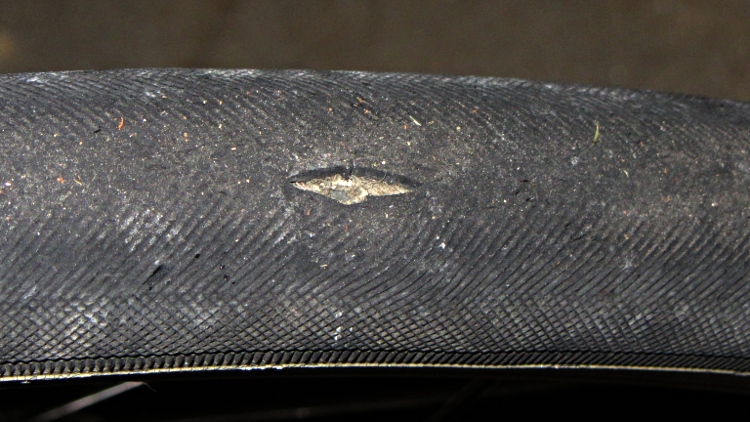
Just fixed a flat on my bike which, like that one, came from the tire liner chewing through the tube. The holes are above the raised 28″ molded into the tube, at the upper-left corner of the tire liner impression.
Schwalbe tube with tire liner abrasion
In this case, the tire liner (which, judging from the color, was a Slime) was too short by maybe 50 mm. This view inside the tire shows a 10 mm gap where the ends didn’t overlap as they should:
Schwalbe Maration tire with liner abrasion
I don’t trim the rear-tire liners, but comparing a handful in the drawer shows that the as-sold lengths differ by a few tens of millimeters. The Marathons are husky tires, but the tread OD isn’t all that much different from stock tires: that’s the definition of a 700-series tire.
That we’re getting repeated flats from tire liners intended to eliminate flats is, mmmm, disturbing. Looking at the condition of the tire treads, however, shows we’re not getting an order of magnitude more flats from road debris, so it’s a net win. I doubt we could get through a month of riding without a flat; I replace tires when the carcasses accumulate enough gashes that the tire liners begin extruding through the tread.
Also, remember that these samples come from three bikes that travel upwards of 2000 miles a year (each!), not just one bike ridden along a nice rail trail on weekends…
I picked up a pair of 12 V 4 W 3-LED floodlights (datasheet, newer datasheet, and catalog) with 34 degree and 24 degree beams from All Electronics, with the intent of making some task lighting fixtures for the shop. Somebody decommissioned the lamps by snipping off a pin, so they’re not immediately useful.
The back pulls off with a bit of difficulty, after removing the two obvious screws and holding the connector body in place while pulling. I didn’t try to remove the circuit board, which would require unsoldering the clearly marked Anode and Cathode LED wires that enter from the bottom of the board.
LED Floodlight – interior
I plan to build these lamps right into the fixtures, so soldering a wire directly onto the pin makes sense; I expect they’ll outlast my usage and a socket won’t add any value. As an intermediate step, I soldered a short brass tube onto the pin stump:
LED Floodlight – repaired pin
In new condition, these retail somewhere beyond $60, so cutting 6 mm from one pin shaved about fifty bucks off the price. I suspect they were extracted from somebody’s shiny new, recently abandoned, and probably foreclosed, office complex and were ruined to prevent resale-as-new. The fact that the reflectors got a bit scuffed up along the way wouldn’t help their value any, either.
They draw 330-odd mA from a 12 V supply, run from AC or DC (either polarity), and seem to have a constant-current driver inside. I wouldn’t buy ’em new, but for eight bucks a pop they’re a pretty good deal.
This didn’t work out, but it came close. Eventually I’ll figure out what material can replace the boot, at which point I’ll need to remember these steps…
That LED flashlight + laser pointer has a rubber boot over the push-on / push-off switch stem that makes it sorta-kinda waterproof. Although I wouldn’t trust it in more than a sprinkle, it’s my pocket flashlight and tends not to get soaked very often.
Anyhow, the rubber boot wore through:
Broken switch boot
Taking it apart, now that I know how, was easy enough:
Switch button parts
Note that the mushroom part goes on the outside, which means the stem will vanish if the boot rips apart.
I planned to mold a boot from acrylic caulk, so I wrapped narrow strips of electrical tape to match the stem to the mushroom head, then wrapped a bit around that to make the final boot fit loosely:
Wrapped switch stem
A thin layer of oil served as mold release, over which I smoothed a blob of caulk. This looks awful, but the majority of the blob at the bottom will get trimmed off:
Switch stem covered with acrylic caulk
Unfortunately, the cured caulk turned out to be remarkably fragile. Each individual blob felt tough, but it’s really not designed to form thin membranes; I got about what I expected.
Pourable silicone rubber seems like the right hammer for the job: make an outer mold to surround this thing (or a 3D printed replica) and pour it on. I must get some of that, one of these days.
So I put the flashlight back together with the mushroom on the inside to keep the stem in place… and I generally avoid getting more than knee-deep in liquids, so not having a good seal won’t matter too much.
A friend mutters that every time something goes wrong with her house, which (to be fair) isn’t all that often.
However, if you’ve got the itch to fix things, a house will certainly keep you scratching: nearly everything we own has a part or patch from the Basement Laboratory Repair Division!
She has similar sayings about cars, cats, bicycles …