Ed Nisley's Blog: Shop notes, electronics, firmware, machinery, 3D printing, laser cuttery, and curiosities. Contents: 100% human thinking, 0% AI slop.
Cleaned the gutters a while ago and the shingle fungus is getting worse: more sites and more stains. I sprized some general-purpose fungicide on the area over the kitchen:
Shingle fungus – east slope
And down the valley between the north and east slopes:
Shingle fungus – north and east slopes
We’ll see what happens by next spring; I hope the larger moss clumps will take the hint.
However, that short length of copper wire seems to be improving things. Here’s the before:
Copper effect on roof discoloration
Compared with the current state, from a different spot:
Shingle fungus – below Cu wire
The intense streaks have vanished, leaving a uniform lighter gray layer, and the upper area near the wire looks, mmm, less awful than the lower areas. I think running copper wire or zinc strips (which I have not found at the big box stores) along the ridge vent will do wonders, although I’m not sure how to anchor either one along the hip joints between the other slopes.
For the last few days, my trust Weller EC1000 soldering iron (well, station) has been misbehaving: shortly after cleaning the tip, it would become covered in charred residue and slag. Today, the LED I’d hacked across the heater terminals inside the base stayed dark, even though the tip was hot, and then became sensitive to the handle position. Obviously there’s a loose wire inside, right?
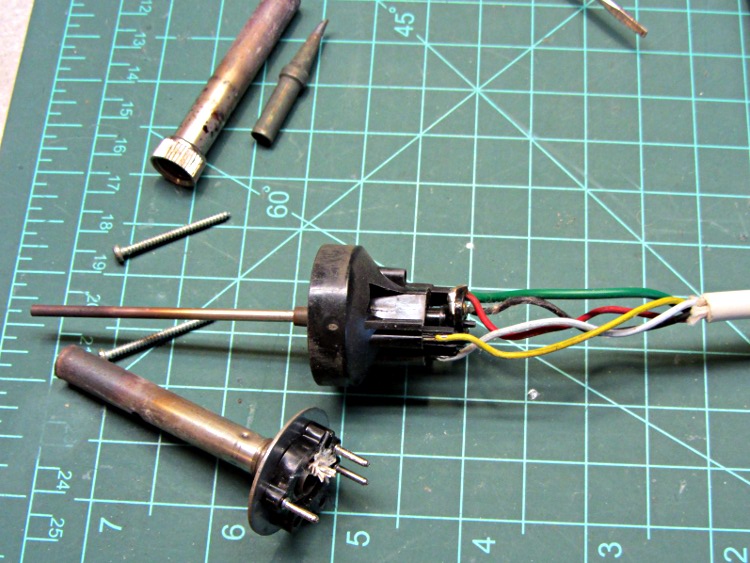
So I took the handle apart by removing the two screws on the front plate:
Weller EC1201A soldering handle innards
The trick to getting the guts out is to push down on the tab inside the handle that locks the cord strain relief block into the handle. After that, everything comes apart with very little force at all.
Contrary to what I thought, the heater is in the tube surrounding the temperature sensor probe. Looking at the connector on the front of the base unit, the key is on the left side and the wires going clockwise from above the key are:
Yellow: heater
White: heater
Black: sensor
Red: sensor
Green: shield
I would have sworn the red & black were the heater, as they have special-looking brass/bronze/copper colored pins & sockets. Wrong again.
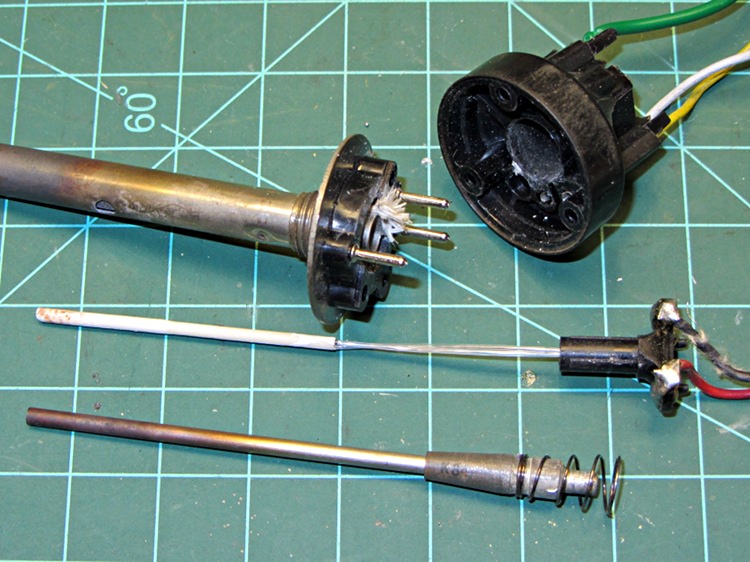
The temperature probe comes apart thusly:
Weller EC1201A temperature probe disassembly
Basically, slide the connector and ceramic-coated sensor out of the back of the black shell, then pull the spring-loaded sheath out the front.
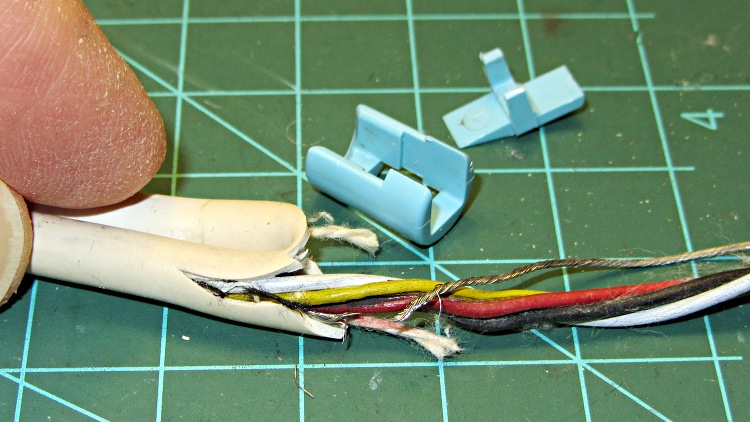
I hoped for a laying-on-of-hands fix, but it was not to be: the tip heats while the LED (which I wired there early in the iron’s life) across the heater power remains off. But the LED blinked on intermittently with slight pressure on the iron’s tip; a bit more poking and prodding isolated an intermittent open-circuit to the ground wire just outboard of the strain relief at the handle:
Soldering iron cable failure
A bit more poking & tugging isolated an intermittent high-resistance short (a few hundred ohms, more or less) to a section of cable half a foot from the base connector at the bottom of the cable’s natural loop when the iron’s in the holder.
Unfortunately, fixing all that didn’t restore the iron to life. It seems that the temperature sensor (a thermocouple?) has failed, allowing the tip to heat well beyond any rational temperature. Now that I’m looking, a cleaned solder layer turns blue with oxidation in a matter of seconds and rosin chars instantly. The temperature control knob has no effect whatsoever.
The date codes inside the box show it’s been with me since late 1982, so on a dollars-per-year basis the thing has been a bargain. A new sensor is $60, a new handle is twice that, and I think it’s time for a new iron… at less than the price of the sensor alone, I think that’s OK.
This pitiful excuse for a hinge actually lasted far longer than I expected:
Brita pitcher lid hinge pins
Also much to my surprise, the plastic solvent-bonded to itself, although I doubt either of those pins will survive another four years.
The yellow discoloration seems to be most prominent on the inside of the lid, which suggests the water is nastier than they’d have you believe. The disinfection additive has switched from chlorine to chloramine and back to chlorine over the last few years, which may have something to do with it.
Measuring some low-value resistances with one of my DVMs produced weird results: dead shorts around 10 Ω.
Differential diagnosis:
Test lead tips clean
Wires firmly mounted in probes
Banana plugs OK
Short banana jumper across jacks reads 10+ Ω
Took the meter apart and what do we see? An ABC ceramic fuse in good old PCB clips:
DVM fuse holder
Spinning the fuse dropped the resistance by a few ohms. Adding a minute drop of DeoxIT to each end, rotating the fuse to scrub it in, and wiping off the excess put the total resistance back around 0.2 Ω where it should be.
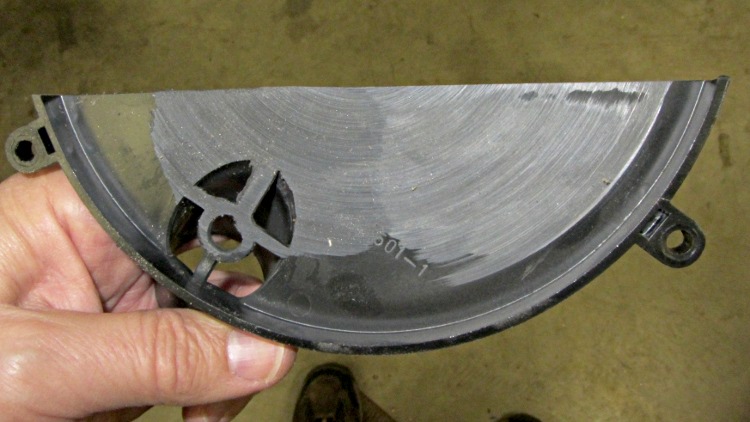
As part of making that PCB, the sanding disk on the side of Mr Belt Sander made a lot more noise than usual; it’s hard to tell, because I wear 30+ dB ear muffs. Turns out that the setscrew had worked loose enough to let the disk walk outward, chewing up the plastic dust collector cover and the aluminum table:
Belt sander disk dust catcher
The setscrew gouged the shaft enough to prevent the disk from sliding off the shaft, which was probably a Good Thing, but that also meant I had to jam a big flat-blade screwdriver inside the guts of the dust guard and twist to pry the disk off:
Belt sander disk shaft
A touch of the file on the shaft, a bit of cleanup inside the disk hole, a dab of Loctite, and it’s all good again.
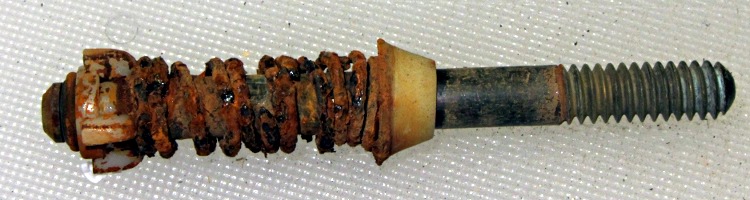
A garden sprayer awaiting repair emerged from the benchtop clutter. It’s an old one, with a metal shell and actual screws, so I could dismantle it to reveal the problem:
Garden sprayer valve – rusted spring
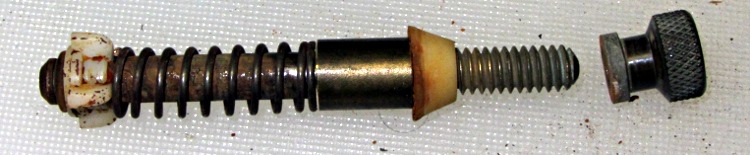
It’s evidently impossible to make a good, cheap, corrosion-resistant spring (pick any two, I suppose):
Garden sprayer valve – wreckage
Some rummaging in the Big Box o’ Medium Springs produced a slightly smaller spring that should last for a while; it’s good, free, and rust-able, if a bit too short.
Much to my astonishment, I found a length of 3/8 inch Marine Bronze rod in the stockpile and made a bushing to take up the remainder of the space:
Garden sprayer valve – new spring and bushing
It won’t get a good test until gardening season opens next year, but it seems to seal well enough.
This brass dragonfly has graced our garden for some years, but what seemed like a gentle tap during fall cleanup knocked both eyeballs out. The original adhesive looked like urethane, so I cleaned the sockets, applied a layer around the rim, and popped the marbles back in place.