Ed Nisley's Blog: Shop notes, electronics, firmware, machinery, 3D printing, laser cuttery, and curiosities. Contents: 100% human thinking, 0% AI slop.
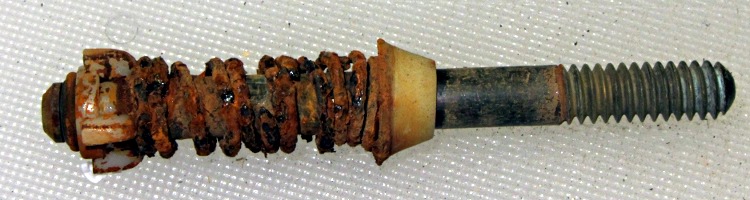
A garden sprayer awaiting repair emerged from the benchtop clutter. It’s an old one, with a metal shell and actual screws, so I could dismantle it to reveal the problem:
Garden sprayer valve – rusted spring
It’s evidently impossible to make a good, cheap, corrosion-resistant spring (pick any two, I suppose):
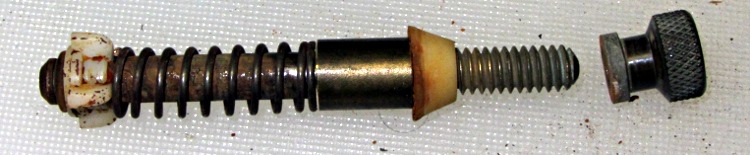
Garden sprayer valve – wreckage
Some rummaging in the Big Box o’ Medium Springs produced a slightly smaller spring that should last for a while; it’s good, free, and rust-able, if a bit too short.
Much to my astonishment, I found a length of 3/8 inch Marine Bronze rod in the stockpile and made a bushing to take up the remainder of the space:
Garden sprayer valve – new spring and bushing
It won’t get a good test until gardening season opens next year, but it seems to seal well enough.
This brass dragonfly has graced our garden for some years, but what seemed like a gentle tap during fall cleanup knocked both eyeballs out. The original adhesive looked like urethane, so I cleaned the sockets, applied a layer around the rim, and popped the marbles back in place.
Having missed the fall driveway paving deadline, we will have a gravel section in the middle of the driveway until next spring. All the water from the garage downspouts and the back yard runs down the driveway, which dumps it directly into the gravel patch and the new retaining wall’s foundation. That means the gravel patch, at least, will become a mud hole, which I take to be a Bad Thing.
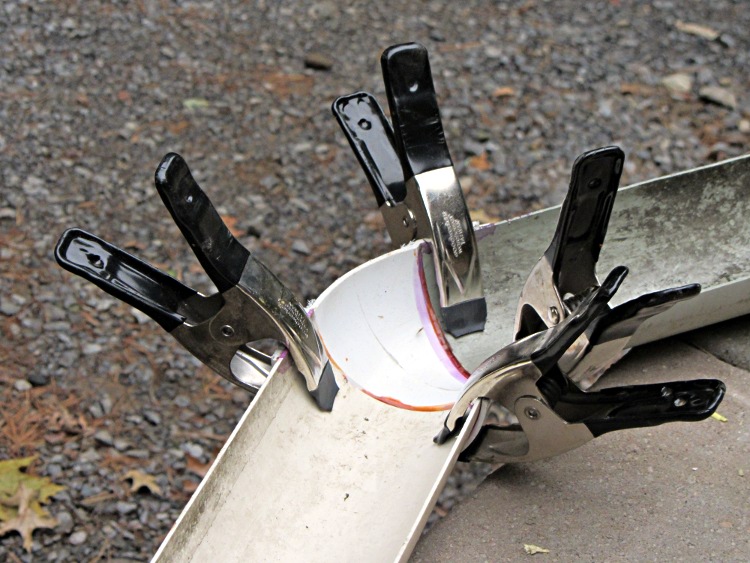
So I bandsawed some 4 inch DWV pipe & fittings in half lengthwise, glued them together as a gutter to capture the runoff and divert it into 80 feet of DWV pipe leading to the bottom end of the wall, then filled the half-pipes with gravel to let us drive right over the whole mess. Unfortunately, the top end of the gravel patch has the driveway ending in broken asphalt, Item 4 gravel, fine gravel, and rubble that make it impossible to snug the pipes up against the asphalt. That means the runoff would pretty much vanish before it reached the gutters.
So I excavated just barely enough gravel to ensure a downhill slope from the remaining asphalt, mixed up a random bag of mortar that’s been kicking around in the garage for a few years, and troweled an apron from the asphalt to the half-pipes. Generally I sign my work, but this kludge need last only a few months and I left it to cure.
The next morning I discovered one of the chipmunks felt the work really needed a signature:
The Moen sink faucet in our black bathroom (so named because of its black tile, white trim, and gray floor) began piddling a few days ago, which seemed odd: Moen says it has a good-for-your-lifetime ceramic valve. So I took it apart, extracting an impressive vector of internal parts in the process.
The “notch” that indicates the hot-cold alignment isn’t particularly obvious, but evidently forward corresponds to the usual hot-on-the-left plumbing:
Moen valve cartridge alignment notch
The retainer clip holding that white stop sleeve in place requires a bit of tweaking from a small pointy probe, but after you expose the hole in that notch the clip comes out easily enough:
Moen faucet retainer clip
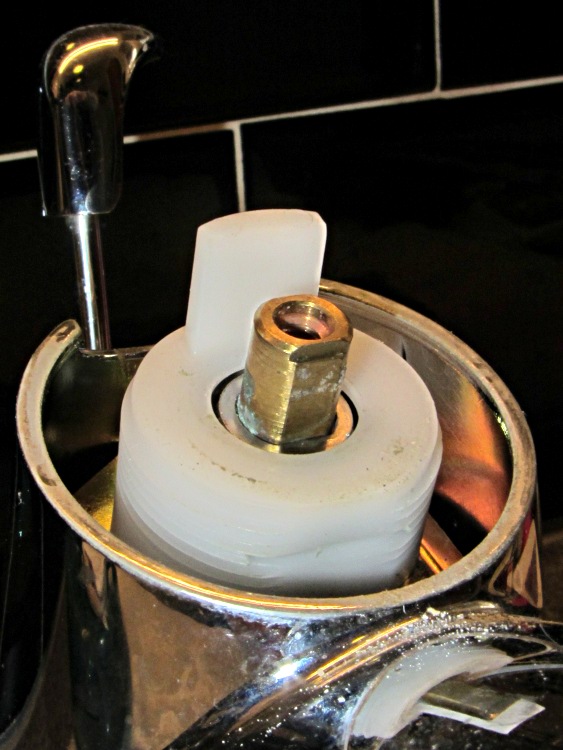
With all the frippery out of the way, then “Using pliers, pull the cartridge out of the body by the stem”, which simply did not work for me. No matter what, the cartridge body didn’t budge:
Moen faucet cartridge top
There’s nothing about turning / unscrewing the transparent (looks black here) shell around the stem, so I didn’t try.
Putting enough of the parts back together to keep the cartridge from blowing out in my face (even if I can’t remove it, it’ll certainly blow out on its own), the faucet valve worked fine. You’re supposed to turn the gray pivot retainer 1/4 turn beyond hand tight, which compresses a wavy washer under the retainer. The retainer had been quite loose when I dismantled the faucet, which suggests that either it hadn’t been tightened at the factory or had worked itself loose. That would tend to hold the handle up just a bit, perhaps enough to prevent the valve from completely closing.
After snugging that retainer down tight and reassembling everything, the faucet worked perfectly: happy dance!
I removed the nozzle aerator and found a surprising amount of grit for something that’s downstream of the whole-house water filter and softener:
I just updated EMC2 on the Sherline CNC mill from 2.4.6 to 2.4.7 (which mis-identifies itself as 2.4.6 on the splash screen) and the Axis UI failed to start. A bit of digging shows that the name of Button 1 (the left button in the right-hand quad, clearly labeled 1) has inexplicably changed from btn-trigger to btn-joystick.
Logitech Gamepad Pendant
Most likely the change has nothing to do with EMC2, because (I think) those names bubble up from the HID driver that actually talks to the hardware and that stuff has also been updated; this is all on Ubuntu 10.04 LTS. But in any event, the name is now different.
That requires a tweak to the Eagle schematics, which will regenerate Logitech_Gamepad.hal, but you can just edit the latter file and change btn-trigger to btn-joystick.
As nearly as I can tell, changing the pin name in the Logitech library component, saving the library, then updating the library in the schematic doesn’t do squat. Evidently, Eagle keeps track of which components you’ve used and won’t update them unless you do some manual gymnatistics, which makes a certain amount of sense.
That means one must:
Delete both “gates” of the old component (INPUT.0.BUTTONS first, then INPUT.0)
Make sure you’re on Page 2 where the basic gate will go
Add the revised LOGITECH_DUAL_ACTION_GAMEPAD to get the INPUT.1 “gate”
Rename it to INPUT.0
Use Move to jiggle it around a bit to ensure its pins get hitched up to the existing nets
Switch to Page 1 where the button nets lie in wait
Type invoke input.0 into the Eagle command line
Pick -BUTTONS from the list to select that “gate”
Position that gate appropriately
Use Move to jiggle the gate
Save everything
Run the Eagle2Hal ULP to get a new HAL output file
Put that file where it’ll do the most good
There, now, wasn’t that obvious?
The modified Logitech_Gamepad.hal file:
# HAL config file automatically generated by Eagle-CAD ULP:
# [/mnt/bulkdata/Project Files/eagle/ulp/hal-write-2.4.ulp]
# (C) Martin Schoeneck.de 2008
# Mods Ed Nisley 2010
# Path        [/mnt/bulkdata/Project Files/eagle/projects/EMC2 HAL Configuration/]
# ProjectName [Logitech Gamepad - 2.4.7]
# File name   [/mnt/bulkdata/Project Files/eagle/projects/EMC2 HAL Configuration/Logitech Gamepad - 2.4.7.hal]
# Created     [10:40:31 11-Nov-2011]

####################################################
# Load realtime and userspace modules
loadrt constant		count=16
loadrt and2		count=17
loadrt flipflop		count=4
loadrt mux2		count=5
loadrt mux4		count=1
loadrt not		count=8
loadrt or2		count=10
loadrt scale		count=7
loadrt timedelay		count=1
loadrt toggle		count=1
loadrt wcomp		count=6

####################################################
# Hook functions into threads
addf toggle.0		servo-thread
addf wcomp.1		servo-thread
addf wcomp.2		servo-thread
addf wcomp.3		servo-thread
addf and2.0		servo-thread
addf and2.4		servo-thread
addf and2.3		servo-thread
addf and2.2		servo-thread
addf and2.1		servo-thread
addf constant.6		servo-thread
addf constant.5		servo-thread
addf constant.4		servo-thread
addf constant.3		servo-thread
addf constant.2		servo-thread
addf constant.1		servo-thread
addf constant.0		servo-thread
addf constant.7		servo-thread
addf constant.8		servo-thread
addf scale.1		servo-thread
addf scale.2		servo-thread
addf scale.3		servo-thread
addf mux4.0		servo-thread
addf mux2.0		servo-thread
addf scale.4		servo-thread
addf scale.0		servo-thread
addf wcomp.5		servo-thread
addf wcomp.4		servo-thread
addf wcomp.0		servo-thread
addf flipflop.1		servo-thread
addf flipflop.0		servo-thread
addf and2.5		servo-thread
addf and2.6		servo-thread
addf and2.7		servo-thread
addf and2.8		servo-thread
addf flipflop.2		servo-thread
addf flipflop.3		servo-thread
addf or2.4		servo-thread
addf or2.8		servo-thread
addf or2.7		servo-thread
addf or2.6		servo-thread
addf or2.5		servo-thread
addf or2.3		servo-thread
addf or2.2		servo-thread
addf or2.1		servo-thread
addf or2.0		servo-thread
addf not.1		servo-thread
addf not.2		servo-thread
addf not.3		servo-thread
addf not.4		servo-thread
addf not.5		servo-thread
addf not.6		servo-thread
addf not.7		servo-thread
addf not.0		servo-thread
addf constant.9		servo-thread
addf mux2.1		servo-thread
addf mux2.2		servo-thread
addf mux2.3		servo-thread
addf mux2.4		servo-thread
addf constant.10		servo-thread
addf constant.11		servo-thread
addf scale.5		servo-thread
addf scale.6		servo-thread
addf constant.12		servo-thread
addf constant.13		servo-thread
addf timedelay.0		servo-thread
addf constant.14		servo-thread
addf constant.15		servo-thread
addf and2.16		servo-thread
addf and2.15		servo-thread
addf and2.14		servo-thread
addf and2.13		servo-thread
addf and2.12		servo-thread
addf and2.11		servo-thread
addf and2.10		servo-thread
addf and2.9		servo-thread
addf or2.9		servo-thread

####################################################
# Set parameters

####################################################
# Set constants
setp constant.0.value	+0.02
setp constant.1.value	-0.02
setp constant.2.value	60
setp constant.3.value	1.00
setp constant.4.value	0.10
setp constant.5.value	0.50
setp constant.6.value	0.10
setp constant.7.value	+0.5
setp constant.8.value	-0.5
setp constant.9.value	0.0
setp constant.10.value	[TRAJ]MAX_LINEAR_VELOCITY
setp constant.11.value	[TRAJ]MAX_ANGULAR_VELOCITY
setp constant.12.value	-1.0
setp constant.13.value	0.1
setp constant.14.value	0.020
setp constant.15.value	0.000

####################################################
# Connect Modules with nets
net a-button-minus or2.2.in0 input.0.btn-joystick and2.15.in0
net a-button-plus or2.2.in1 input.0.btn-thumb2 and2.16.in0
net a-buttons-active or2.2.out or2.3.in0 or2.4.in1
net a-disable not.7.out and2.5.in1
net a-enable or2.4.in0 flipflop.3.out not.7.in mux2.4.sel
net a-jog wcomp.2.in input.0.abs-z-position mux2.4.in1
net a-knob-active not.2.out and2.7.in1
net a-knob-inactive wcomp.2.out not.2.in and2.6.in1
net a-select and2.8.in0 and2.7.out
net a-set flipflop.3.set and2.8.out
net angular_motion or2.4.out mux2.0.sel
net any-buttons-active mux4.0.sel0 or2.8.out
net az-buttons-active or2.3.out or2.8.in1 or2.9.in0
net az-reset flipflop.2.reset and2.6.out flipflop.3.reset
net button-crawl scale.4.out mux4.0.in3
net button-fast scale.2.out mux4.0.in1 scale.4.in
net jog-crawl toggle.0.out mux4.0.sel1
net jog-speed halui.jog-speed mux4.0.out
net knob-crawl mux4.0.in2 scale.3.out
net knob-fast mux4.0.in0 scale.1.out scale.3.in
net n_1 constant.10.out mux2.0.in0
net n_2 and2.0.in0 input.0.btn-top2
net n_3 and2.0.in1 input.0.btn-base
net n_4 and2.0.out halui.abort
net n_5 halui.mode.manual input.0.btn-base3
net n_6 wcomp.0.max wcomp.1.max wcomp.2.max wcomp.3.max constant.0.out
net n_7 halui.program.resume input.0.btn-base4
net n_8 wcomp.0.min wcomp.1.min wcomp.2.min wcomp.3.min constant.1.out
net n_9 mux2.0.in1 constant.11.out
net n_10 constant.12.out scale.5.gain scale.6.gain
net n_11 or2.0.in0 input.0.btn-base5
net n_12 or2.0.in1 input.0.btn-base6
net n_13 constant.9.out mux2.1.in0 mux2.2.in0 mux2.3.in0 mux2.4.in0
net n_14 mux2.1.out halui.jog.0.analog
net n_15 toggle.0.in or2.0.out
net n_16 constant.2.out scale.0.gain
net n_17 constant.5.out scale.1.gain
net n_18 constant.3.out scale.2.gain
net n_19 constant.4.out scale.3.gain
net n_20 scale.4.gain constant.6.out
net n_21 halui.jog.1.analog mux2.2.out
net n_22 mux2.2.in1 scale.5.out
net n_23 scale.6.out mux2.3.in1
net n_24 constant.13.out halui.jog-deadband
net n_25 wcomp.4.max constant.7.out wcomp.5.max
net n_26 constant.8.out wcomp.4.min wcomp.5.min
net n_27 mux2.3.out halui.jog.2.analog
net n_28 halui.jog.3.analog mux2.4.out
net n_29 timedelay.0.out and2.9.in1 and2.10.in1 and2.12.in1 and2.11.in1 and2.13.in1 and2.14.in1 and2.16.in1 and2.15.in1
net n_30 and2.9.out halui.jog.0.minus
net n_31 or2.9.out timedelay.0.in
net n_32 constant.14.out timedelay.0.on-delay
net n_33 constant.15.out timedelay.0.off-delay
net n_34 and2.10.out halui.jog.0.plus
net n_35 and2.11.out halui.jog.1.minus
net n_36 halui.jog.1.plus and2.12.out
net n_37 and2.13.out halui.jog.2.minus
net n_38 and2.14.out halui.jog.2.plus
net n_39 and2.15.out halui.jog.3.minus
net n_40 and2.16.out halui.jog.3.plus
net vel-per-minute scale.0.out scale.1.in scale.2.in
net vel-per-second mux2.0.out scale.0.in
net x-buttons-active or2.7.in0 or2.5.out
net x-disable not.4.out and2.4.in1
net x-enable not.4.in flipflop.0.out mux2.1.sel
net x-hat-jog wcomp.4.in input.0.abs-hat0x-position
net x-hat-minus wcomp.4.under or2.5.in1 and2.9.in0
net x-hat-plus or2.5.in0 wcomp.4.over and2.10.in0
net x-jog wcomp.0.in input.0.abs-x-position mux2.1.in1
net x-knob-active not.0.out and2.1.in0
net x-knob-inactive wcomp.0.out not.0.in and2.2.in0 and2.3.in0
net x-set and2.1.out flipflop.0.set
net xy-buttons-active or2.7.out or2.8.in0 or2.9.in1
net xy-reset flipflop.0.reset and2.2.out flipflop.1.reset
net y-buttons-active or2.6.out or2.7.in1
net y-disable not.5.out and2.1.in1
net y-enable flipflop.1.out not.5.in mux2.2.sel
net y-hat-jog wcomp.5.in input.0.abs-hat0y-position
net y-hat-minus wcomp.5.under or2.6.in1 and2.12.in0
net y-hat-plus or2.6.in0 wcomp.5.over and2.11.in0
net y-jog wcomp.1.in input.0.abs-y-position scale.5.in
net y-knob-active not.1.out and2.3.in1
net y-knob-inactive not.1.in wcomp.1.out and2.2.in1
net y-select and2.4.in0 and2.3.out
net y-set flipflop.1.set and2.4.out
net z-button-minus or2.1.in0 input.0.btn-thumb and2.13.in0
net z-button-plus or2.1.in1 input.0.btn-top and2.14.in0
net z-buttons-active or2.1.out or2.3.in1
net z-disable not.6.out and2.8.in1
net z-enable not.6.in flipflop.2.out mux2.3.sel
net z-jog wcomp.3.in input.0.abs-rz-position scale.6.in
net z-knob-active not.3.out and2.5.in0
net z-knob-inactive not.3.in wcomp.3.out and2.7.in0 and2.6.in0
net z-set and2.5.out flipflop.2.set
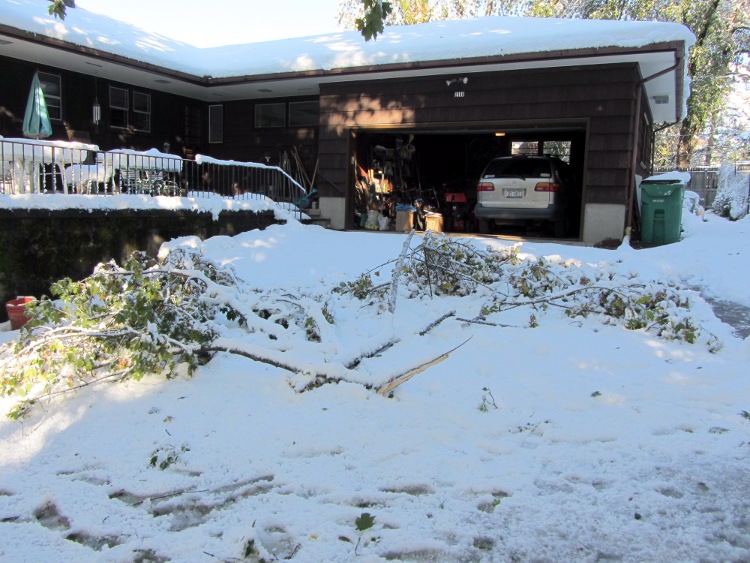
Our yard accumulated about 14 inches of heavy wet snow that made a mess of the maple trees. Before I could get the snowblower out of the garage, I had to cut up a stack of branches:
Branches at garage
Yes, there really is that much of a slope leading up to the garage; clearing the driveway immediately after every snowstorm is not optional.
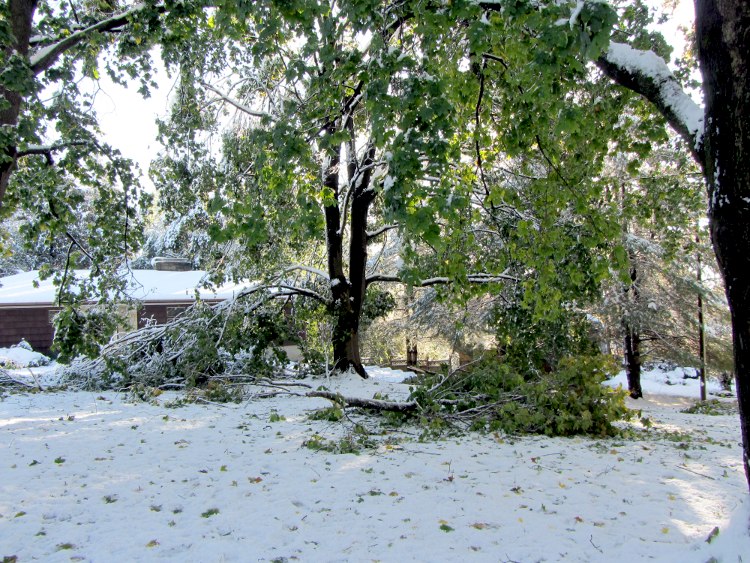
Many of the branches in the back yard broke off and simply leaned against the ones still arched over the driveway:
Branches in back yard
The front yard was a mess:
Branches in front yard
In addition to all that, we had branches down beside the house, in the garden, around the beehive, and, in general, everywhere. Obviously, we have too many maples, but they’re what the previous owners planted (or at least didn’t uproot while that was possible).
The generator bridged 25 hours without power to save the refrigerator & freezer contents and keep the house between 55-60 °F. We survived five days with no phone (shrug) or Internet (eeek!); the cell phone was, as usual, useless because the house sits on a local maximum in a shallow valley below line-of-sight from all the surrounding towers.
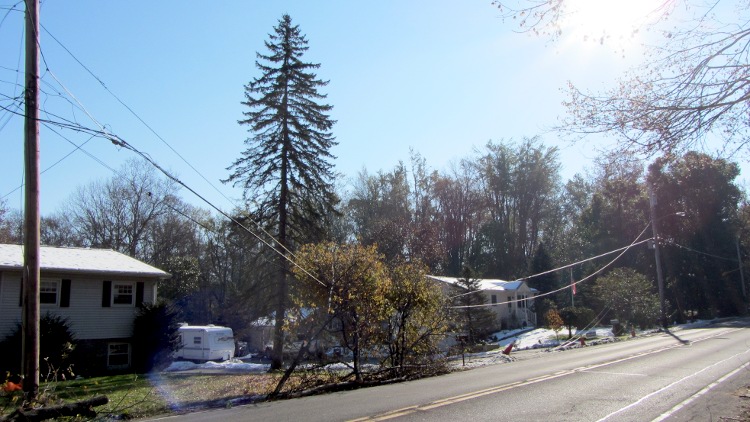
The last break in the phone & Internet cables occurred just north of us:
Branches on wires
Those branches came from a tree across the road that put down roots on a slab of rock that just didn’t provide enough griptivity:
Tree down on Rt 376
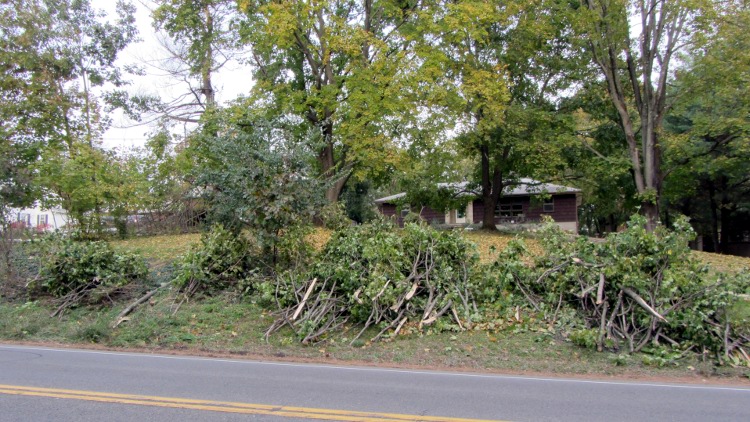
After three days of diligent bow-saw work and mule-mode dragging, we cleared the yards. The back yard clutter went over the cliff toward our bottomlands adjoining the Wappingers Creek and the front yard timber now sits ready for what we hope will be the town’s pickup:
Branches ready for pickup
Our experience was a nuisance, rather than a disaster, unlike that of many folks in the area.
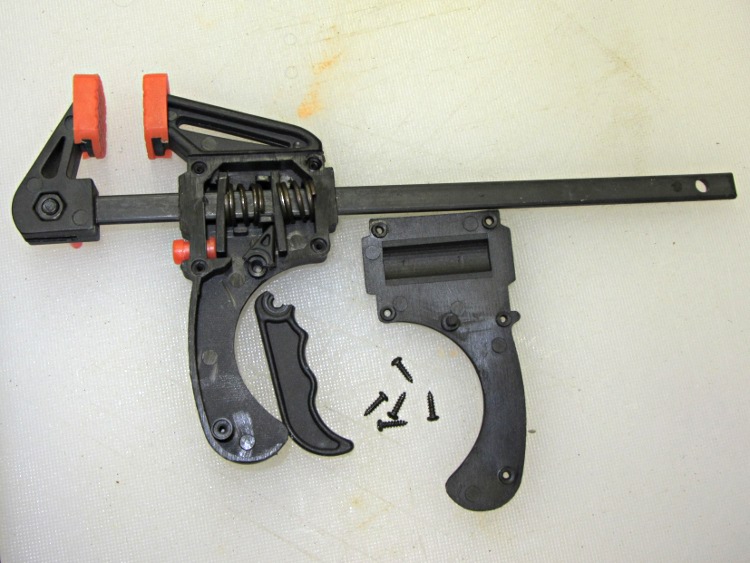
The squeeze handle that tightens the bar clamp cracked exactly where you’d expect: directly across the pivot hole where the miracle engineering plastic thins down to a precarious ridge. The end of the handle is still inside the clamp:
Bar clamp with broken handle
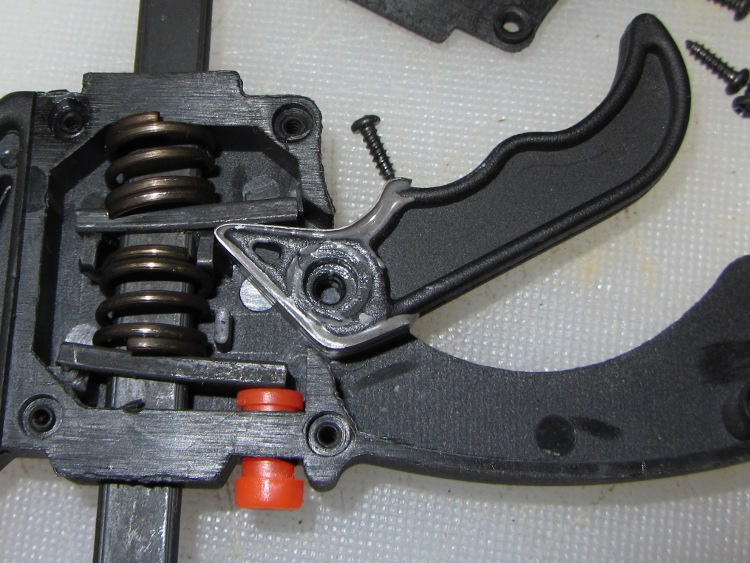
Nothing bonds that plastic, so, in the nature of a quick fix, I cut a steel strap to wrap around the perimeter of the broken section and epoxied the whole mess together:
Reinforced bar clamp handle
That lasted for exactly 2.5 squeezes and then pulled apart; the epoxy doesn’t really have anything to grab.
ABS isn’t a good substitute for engineering plastic, so this will require a bit of CNC work on the Sherline. I’ll probably carve the first one from polycarbonate, just because I have a sheet of the right thickness, but it really cries out for aluminum, doesn’t it?
Why CNC? Well, I’m going to make a handful of handles and get proactive on the other clamps.
My other bar clamps have much heavier sections in that area, so perhaps the folks supplying Harbor Freight could take a hint? Yeah, but the clamp was cheap, which always conflicts with good. On the other paw, I’ve seen exactly this same clamp priced at not cheap elsewhere.