Ed Nisley's Blog: Shop notes, electronics, firmware, machinery, 3D printing, laser cuttery, and curiosities. Contents: 100% human thinking, 0% AI slop.
One of the oven drawer supports in our Sears Kenmore gas range cracked and I finally got around to replacing it:
Cracked oven drawer slide and replacement
I originally thought the drawer slid on the large, blocky, well-supported lump. Nope, that delicate little tab must support half the weight of the drawer; the lump might support the drawer in another oven. Perhaps we shouldn’t store the Lesser and Least Cast Iron Pans in that drawer, but that’s where they fit best. The Greater Cast Iron Pan lives atop the stove, because it get used so often there’s no point in putting it away.
One could, of course, Fire the Thing-O-Matic! to print brightly colored plastic bits (after the usual tedious 3D modeling & trial fitting), but replacement parts cost a buck each from RepairPartsDirect. I bought three, so as to have a complete backup set, and most of the $9 total went to postage & handling.
So here’s the Rest of the Story, reconstructed from my notes…
Having already torn the thing apart and discovered that the repair would include both the drum+spider assembly (not available separately, which may actually make sense given high-speed spin balancing) and the front half of the plastic tub, I priced them at RepairClinic and Sears Parts Direct. In round numbers, this adventure would cost $300-400 just for the parts, a bit less than half the cost of the washer.
As I recall, the Sears price for the drum was roughly twice that for RepairClinic, while the tub was about the same. I suspect Sears deliberately inflates the drum price to make sure nobody actually buys the thing and to pad out the tech’s time to replace it.
The warranty in the front of the Owner’s Manual seemed promising:
Sears Kenmore HE3 Washer Warranty
So I called the Sears Parts & Warranty line, walked the menu tree, explained the situation, asked for a new drum, and was told that they must dispatch a tech to diagnose the problem. Despite the warranty, there would be a labor fee and an additional fee to process the parts order. There was no way to determine those fees before dispatching the tech.
I pointed out that I’d already dismantled the washer, knew exactly what the problem was, and just needed the replacement drum as described in the warranty. I was put on hold to “process my request”, eventually being transferred to a “tech specialist department for further assistance”.
The “tech specialist” was willing to spend as much time as required to convince me that the Lifetime Warranty had expired, based on a deliberate misreading of the terms. As far as they were concerned, the sentence “After the first year, you will be charged for labor” meant that the warranty had expired on a five-year-old washer and that the drum was no longer covered. They would not, under any circumstances, send me the drum. Yes, I asked for a supervisor and, no, I doubt that she really was one; handing the call to the next cubicle is standard call-center subterfuge to placate irate customers.
I eventually decided that this was not a language-barrier issue, but a carefully planned & executed part of their standard script: letting their Indian-subcontinent call center take the heat works wonderfully well for the purpose of getting rid of warranty claims.
So I looked up the phone number of the “interim CEO/President” (I assume he’s long gone by now) at Sears Holding Corporation and gave him a call. Of course, I didn’t expect to actually reach the CEO, but I figured I’d shake the dice a bit to see if a better combination came up.
It turns out that they expect this sort of behavior and immediately connected me to their “Executive Customer Service” department, which was described as “the highest they can go”. So I told my tale, asked her to ship me a drum, and was told that wasn’t possible. What she could do, as a “one time offer”, was to “waive the labor fee” when they dispatched the tech.
I asked if there were any other fees. She refused to answer that question. I asked if there was a charge to order the parts. She refused to answer that question. It being a Friday, I asked when the tech could arrive; she said that they would attempt to schedule it for Monday, but Tuesday was more likely. I asked if he’d arrive with the drum. She said the tech would assess the problem and order the necessary parts, requiring a second appointment later in the week.
I told her that it was obvious Sears had no intention of honoring their warranty. She repeated that this was a one-time offer. We did not part on good terms.
So I ordered the drum & tub from RepairClinic, two huge boxes arrived on Tuesday, I installed everything, buttoned up the machinery, and the washer has worked fine ever since.
Every time I looked at that big drum, I got mad all over again. I never mustered the enthusiasm to take the spider off the back for a post-mortem, which is why there’s no Part 2 after that post. Eventually I hauled the carcasses to the town’s disposal site and bid them good riddance.
Obviously, Sears won: they got rid of me without spending a dime on the warranty. It cost them maybe two hours of phone time, but I doubt the pleasant voice in the “Executive Customer Service” department makes much more than minimum wage and Indian-subcontinent personnel are basically free compared to that.
I’m doing a bunch of appliance repair right now and wonder just how much we’d be spending if we had to go through the Official Channels for repairs. I’m definitely earning my keep… and having much more fun than being jerked around by that corporate structure.
Well, that fix didn’t take long to fail; they sure don’t make ’em like they used to:
OEM Replacement fan in freezer
The “new” fan’s bearing failure sounded more like an owl than a dog, but it was certainly not what we wanted to hear in the middle of the night. A replacement fan costs on the order of $60, which seems like an absurdly high number for what’s basically a clock motor, a plastic fan blade, and some stamped steel.
After mulling the situation for a bit, I concluded that the refrigerator has reached that age where stuffing more money into it doesn’t make much sense: the compressor will drop dead in fairly short order. It’s time for a gonzo fix that also slightly reduces the clutter in the Basement Laboratory Warehouse: stick a PC case fan and wall wart into the freezer, ignore their temperature ratings, and see what happens.
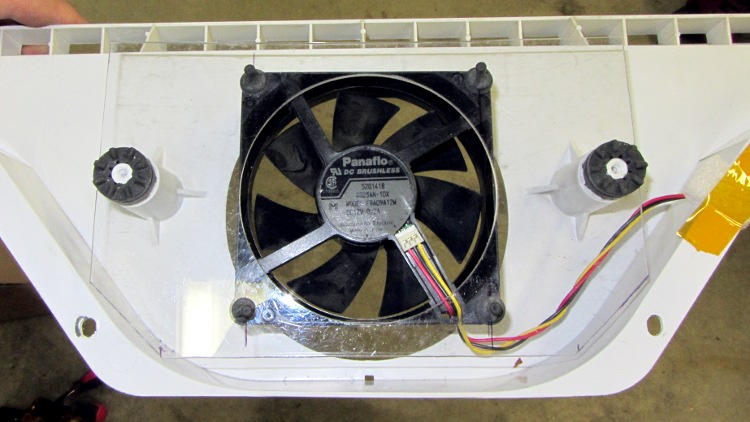
A polycarbonate sheet, a band saw, some step drills, a big hole saw, and an hour of Quality Shop Time produced a perfectly serviceable space transformer to mate the fan to the airflow director:
PC case fan in air flow director
The plate surrounds the squishy foam washers from the OEM motor mount, with the fan on its own rubbery posts: there won’t be any vibration transmitted to the plastic air flow director! The obligatory Kapton tape on the right holds a closed-cell foam wrap around the wires to prevent rattling; I’d done much the same when I tore the thing apart after the first OEM fan failure.
The air flow is toward you out of the screen: the fan draws air from the refrigerator compartment through the evaporator coils, then directly into a square duct that leads back to the refrigerator. Whatever doesn’t make it into the duct flows into the freezer compartment through the row of vents at the top of the picture.
I assume some serious modeling went into choosing the OEM fan blade configuration and spacing so as to optimize the distribution. I hope just moving some air in roughly the right direction will suffice; I have no way to measure any interesting numbers, so this is entirely cut-and-try.
The PC case fan expects 12 VDC, which comes from a standard wall wart conspicuously labeled “For Indoor Use Only”. Well, this is certainly indoor, even if it’s not quite what they expected. The wart plugs into a cobbled-together extension cord receptacle with male 1/4 inch quick-disconnect tabs that match the female QD connectors on the OEM wiring harness that originally plugged into the fan:
PC case fan with adapted wall wart
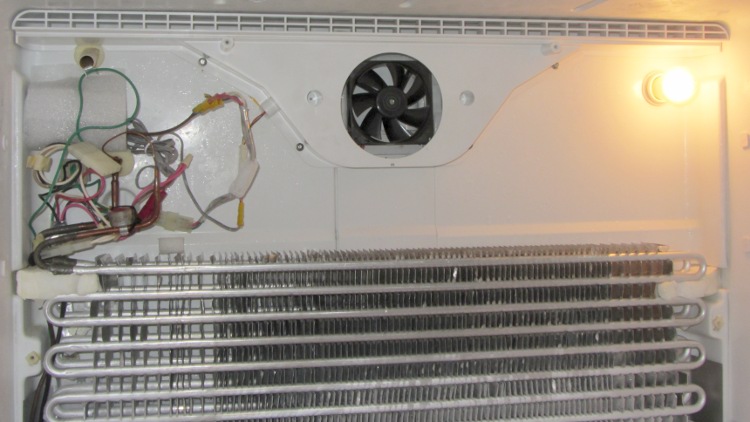
All that fits into the space behind the rear panel, with the wart wrapped in a sheet of closed-cell foam to prevent rattling and provide a bit of protection:
PC case fan installed in freezer
The rear panel covers the mess, exposing only the row of vent holes along the top. The air flow is upward through the evaporator coil and fins, through the fan, and back to the two compartments.
One question remains: will the fan continue to start below 0 °F (-20 °C)?
Given the ball bearings in the fan, it ought to remain quiet, but I’ve thought that before. Now, however, I have a generous supply of case fans and wall warts that plug into the mechanical and power adapters, so I can replace fans for a long time.
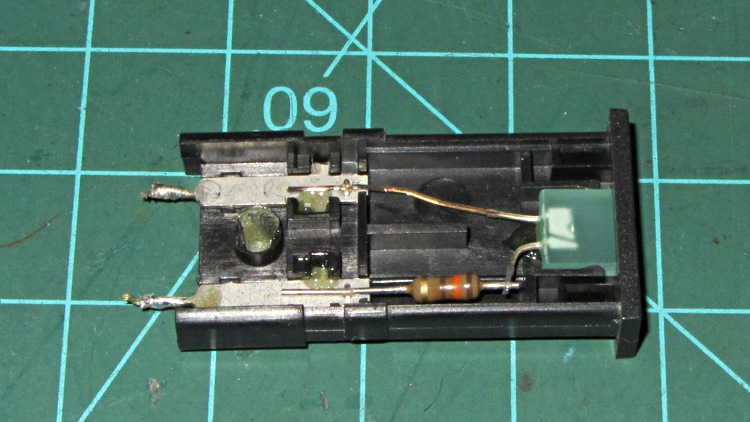
This panel-mount LED indicator glued to the Z-axis stage of my Thing-O-Matic had been dutifully showing a bright green glow when the extruder heater was active:
Failed LED panel indicator
Of late, it began flickering erratically whenever the heater turned on. It used to flicker when the PID loop (hacked to be a bang-bang controller) drove the extruder temperature past the switching threshold, but this was worse.
It’s rated for 5 VDC, 25 mA and has an internal resistor to make that happen. Channeling the true spirit of DIY 3D printer electronics, I deliberately connected it directly across the 12 V extruder power and let it burn at 80 mA. The poor thing was surprisingly bright for an ancient green LED ( the 8124 date code stamped on the side I pried off for the picture says it’s three decades old) and, even under that abuse, it lasted for a year: not to be sniffed at.
I’d expect the LED to fail open when a bond wire burned through, but you just never can tell. It worked fine on the bench, which is typical of all intermittent failures.
So I popped an identical indicator off the stack, conservatively added a 270 Ω series resistor to drop the excess voltage, and it’s all good again.
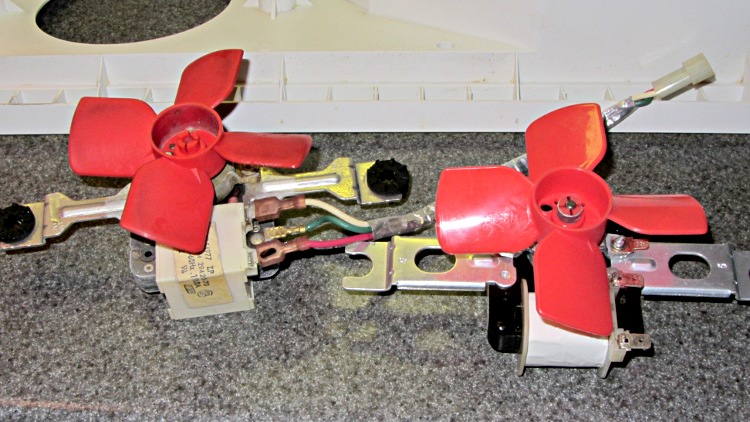
Back in 2006, our ancient (19-ish years old) Whirlpool refrigerator started making weird howling noises suggested someone broke into the house and stuffed a dog inside the freezer. Turned out to be the fan behind the rear panel of the freezer compartment that moves air across the cooling coils and down into the refrigerator compartment; evidently the sintered bronze bearings wore just enough to let the shaft oscillate side-to-side while rotating.
I ordered a replacement, but then decided to try an old fix: put a dollop of STP in the bearings. That added enough damping to kill the resonance and let the old fan turn freely. It worked so well that I put the new fan on the shelf in case it came in handy later on.
Years passed… and then, as if by magic, the freezer dog reappeared.
Mary moved the contents to the downstairs chest freezer (she’s much more organized than I and wanted to find things again), I pulled the old fan out, installed the “new” fan, buttoned up the freezer, and it ran fine.
Whirlpool refrigerator fans
Until about two in the morning, when the freezer dog began howling again…
As nearly as I can tell, the new fan’s bearings arrived just slightly oversize; I doubt they’re pre-worn.
So I applied the STP fix to the new fan:
Remove the compression fitting from the fan blade hub
Remove the fan blades from the shaft
Remove the screws & nuts holding the frame together
Remove motor shaft from bearings
Put a drop of STP into the rear bearing
Slather a ring of STP around the front bearing
Deliberately misalign the self-aligning bearings to redistribute the slack
Reassemble in reverse order
It’s been running silently for a day, which suggests it’ll be good for quite a while…
Having suffered flat tires due to the tire liner chafing the tube, I’ve been running the Tour Easy without a rear tire liner since last year. Worked fine, up until the steering went mushy on a recent ride:
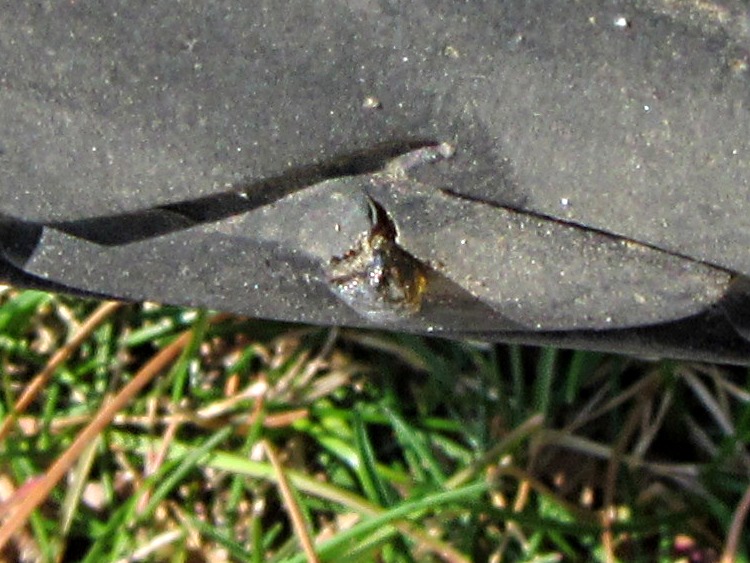
Brown glass chip – in tire
Ever notice how a rear flat means you can’t steer and a front flat means you can’t pedal? Works that way on our recumbents, too. Weird.
The chip probably came from a beer bottle tossed out a car window, those being the canonical source of brown glass on the road. That razor edge punched right through the Kevlar belt in the Schwalbe Marathon tire and just barely penetrated the tube:
Brown glass chip – detail
Fortunately, I discovered all that in a nice grassy area, patched the tube, fired a pair of CO2 capsules into the thing, and rode another 20 miles around the block on a lovely day. Unfortunately, I managed to pinch the tube while installing it, producing a very slow leak that flatted the tire by the next morning.
While repairing that flat in the comfort & convenience of the Basement Laboratory Repair Wing, I installed a tire liner with two strips of silicone tape over the ends to see if that reduces the abrasion:
Silicone tape on tire liner
Silicone tape doesn’t adhere to anything other than itself, so I added two duct tape snippets to hold them in position while I buttoned up the tire. And, yes, I left the transparent plastic cover tape in place, in the hope that it can’t do any harm.
Perhaps the inevitable slow leak will produce a flat in the garage, not on the road…
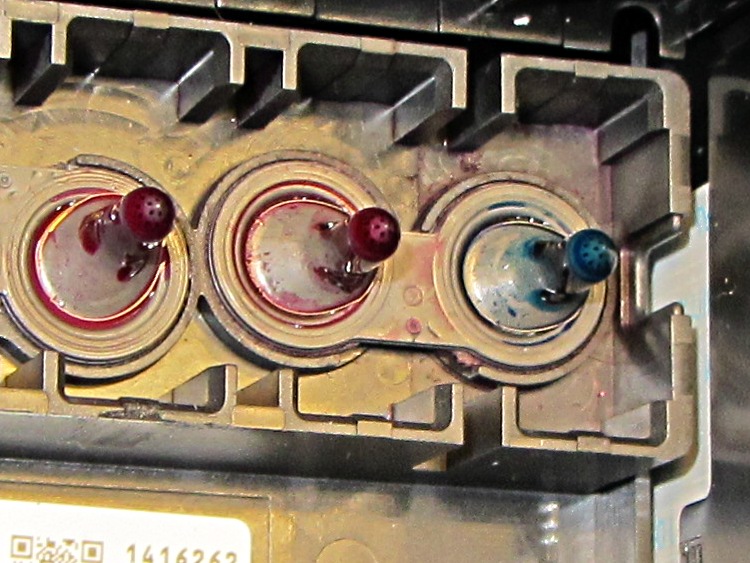
… look like they ought to fit some sort of tubing and, indeed, a bit of rummaging produced a hank of suitable thick-walled plastic stuff. Heating one end until it went clear and floppy, then jamming it over a syringe’s Luer fitting produced a workable flushing tool:
Syringe with tubing to fit R380
I folded a tissue, laid it over the sponges and wipers at the printhead park position, then pushed the ink tank carrier over the tissue to absorb the spray. Squirting three syringes full of 10% ethanol through the head cleaned out a few of the blocked jets, but didn’t produce a complete fix.
Next up: homebrew window cleaner, diluted about 1:3 to knock back the ammonia concentration.






 The Smell of Molten Projects in the Morning