The Smell of Molten Projects in the Morning

Ed Nisley's Blog: Shop notes, electronics, firmware, machinery, 3D printing, laser cuttery, and curiosities. Contents: 100% human thinking, 0% AI slop.

Tag: Laser Cutter

  • OMTech 60 W Laser: Hatch Latch Phasing

    OMTech 60 W Laser: Hatch Latch Phasing

    The OMTech laser cutter has six access hatches, each with one or two latches. These are not locks, although you do need a triangular “key” to turn the latch plug:

    OMTech laser - latch - cylinder point up
    OMTech laser – latch – cylinder point up

    Being that type of guy, I want all the latches to have the same plug orientation when they’re closed, so that I can hold the key one way, poke it into any latch without thinking too hard, and have it fit onto the plug:

    OMTech laser - latch key - latched position
    OMTech laser – latch key – latched position

    A quarter-turn clockwise (remember clocks with hands?) then releases the latch:

    OMTech laser - latch key - unlatched position
    OMTech laser – latch key – unlatched position

    Inside the hatch, the closed position corresponds to a tongue capturing a flange around the cabinet opening (not shown):

    OMTech laser - latch - latched position
    OMTech laser – latch – latched position

    After the quarter-turn, the tongue releases the flange:

    OMTech laser - latch - unlatched position
    OMTech laser – latch – unlatched position

    So, we’re not talking high security here.

    As delivered, the plugs had more-or-less random orientations when they were closed and some required a counterclockwise quarter-turn to release.

    It turns out the latches aren’t a complete unit that simply drops into a hole in the hatch:

    OMTech laser - latch parts
    OMTech laser – latch parts

    I sympathize with whoever must assemble ten handfuls of parts into ten latches on a production line and I also understand why orienting the plug wasn’t on that person’s to-do / QC checklist. I further understand why two cylinders lacked the big toothed washer under the nut; it’s not essential to the function and nobody will ever miss it.

    The plug has a triangle on one end (for the key) and a square on the other (for the tongue), with one triangle point aligned to a side of the square:

    OMTech laser - latch plug
    OMTech laser – latch plug

    To my way of thinking, that point must be upward, as shown in the first picture, when the latch is secured.

    The cylinder can fit into the square(-ish) hatch hole in four possible ways, but its symmetry allows only two unique orientations. It must look like this in order to put that point upward when the plug is maximally counterclockwise (my finger is pointing upward):

    OMTech laser - latch cylinder
    OMTech laser – latch cylinder

    So I devoted a pleasant half-hour to reducing the latch entropy.

    The screw attaching the tongue to the plug also controls the friction of that spring against the plug as you (well, I) turn it. All the screws now sport a dab of Loctite to ensure the tension remains mostly constant (at least for a while), as do the two large nuts lacking corresponding toothed washers.

    The “key” has no marking to indicate its “point-up” orientation, so I stuck a snippet of label on one side, with a jaunty red highlight marking the point. Something better will surely occur to me, but it’s no longer in the critical path.

  • OMTech 60 W Laser: Ventilation

    OMTech 60 W Laser: Ventilation

    The best place for the OMTech laser cutter seems to be snuggled at base of the chimney, venting into the long-disused fireplace through the steel plate adapting a long-gone wood stove to the opening:

    Duct fan installed
    Duct fan installed

    The short run of flexible tubing allows some give-and-take at the cutter’s vent outlet. The elbow on the duct fan’s output terminates in a blast gate to cut off the draft blowing up (or down!) the flue with the fan off.

    The cutter arrived with a huge high-speed axial blower screwed to its output baffle:

    OMTech 60W laser - OEM vent fan
    OMTech 60W laser – OEM vent fan

    The noise from that fan had to be heard to be believed.

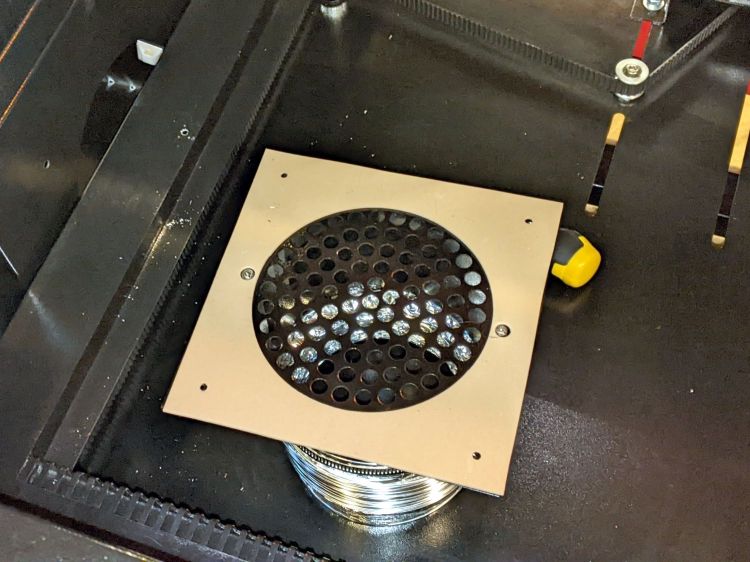
    The cylindrical exhaust duct attached directly to the motor with four screws, only two of which matched holes in the baffle plate:

    OMTech 60W laser - modified vent
    OMTech 60W laser – modified vent

    A trial fit revealed the assembly rattled something awful: those two screws let the duct vibrate against the baffle. Match-drilling two more holes into the baffle let me mount the duct with three screws and, in combination with the foam gasket, it is now solid and quiet.

    A quick check shows the duct fan draws 10 to 11 m/s through the baffle at full throttle, roughly 400 CFM. That’s pretty close to the flow measured through a long pipe and, with only 6 ft³ of stink inside the laser’s cabinet, ought to exhaust the fumes just fine.

  • OMTech Laser Cutter: Arrival

    OMTech Laser Cutter: Arrival

    Lacking a loading dock, I built a level unloading platform in the driveway:

    OMTech 60W Laser Cutter - unloading platform
    OMTech 60W Laser Cutter – unloading platform

    The OMTech 60 W laser cutter arrived inside a generous supply of plywood obviously intended for practice cutting and engraving:

    OMTech 60W Laser Cutter - crate
    OMTech 60W Laser Cutter – crate

    Knowing the crate wouldn’t fit through our “36 inch” basement door, we stripped the cutter down to the crate’s steel-framed baseplate:

    OMTech 60W Laser Cutter - uncrated
    OMTech 60W Laser Cutter – uncrated

    I raised the cutter (using the foot-pad screws) enough to slide 3/4 inch planks under the casters so we could roll it over the lip of the crate base.

    The specs say it’s 34 inches wide, but, not at all to our surprise, that’s just the cabinet. The hinges on the access hatches and the lid handle make it just over 35 inches wide, which we slowly and carefully verified would not fit through the 34 inch door opening:

    OMTech 60W Laser Cutter - slow fit check
    OMTech 60W Laser Cutter – slow fit check

    Raising the lid to get the handle out of the way, then pushing gently inward on the sides, eased it through without damage to either the cabinet or the door frame:

    OMTech 60W Laser Cutter - door fit
    OMTech 60W Laser Cutter – door fit

    Standing on the plank let me raise the outer end enough to roll it forward and lower the casters onto the planks inside the door.

    It vents through a long-disused flue straight up the chimney:

    Duct fan installed
    Duct fan installed

    The supplied aquarium pump circulates five gallons of distilled water to cool the laser tube. My simple test patterns so far haven’t dumped much heat into the water:

    Dot Mode - 15 pct power - 1 2 3 ms on - 0.25 mm spacing
    Dot Mode – 15 pct power – 1 2 3 ms on – 0.25 mm spacing

    The doily on the left shows 9% power cuts right through paper. Dot Mode fires the laser every 0.25 mm (in this case) for a specified number of milliseconds to reduce the total energy; 3 ms produces dark dots, 1 ms is a pale brown, and 2 ms looks pretty good.

    More tinkering is in order …

  • Vintage Acrylic

    Vintage Acrylic

    Concerted rummaging in the Basement Warehouse produced some rather old acrylic sheets:

    Acrylic Stockpile
    Acrylic Stockpile

    Washing with detergent and denatured alcohol cleaned off a lot of grunge, but the yellow tint says it’s been around for a while. In fact, It Came With The House™ when we bought it three decades ago.

    One sheet was a status board in an automobile machine shop:

    Vintage Acrylic Sheet
    Vintage Acrylic Sheet

    So, yeah, that might be 70-year-old acrylic.

  • Dual Thermocouple Meter Backlight Override

    Dual Thermocouple Meter Backlight Override

    A cheap dual thermocouple meter, utterly devoid of branding, arrived:

    It seems suitable for a semi-permanent laser cooling water monitor, particularly because it can perform arithmetic to show the difference between the inlet and outlet temperatures. The minuscule clock face at the center top of the display shows it’s in auto-power-off mode, which can be defeated by a Vulcan Nerve Pinch while turning it on.

    Having a large backlit display was a selling (well, buying) point and the instructions have this to say about its operation:

    Dual Thermocouple meter - backlight instructions
    Dual Thermocouple meter – backlight instructions

    The instructions say nothing about defeating the backlight timeout. The description is technically correct, because the two seconds before it goes dark is “within 30 seconds”, but I’d rather have a nicely lit display that’s on all the time.

    Five screws hold the back cover in place, with no nasty prying required to pull it apart, and the build quality is about what you’d expect for a cheap meter. The circuitry fits on a single PCB and perhaps the thermistor over on the right serves as the cold junction compensation:

    Doodling the backlight circuit layout suggests it’s pretty simple, even without filling in the component values:

    I replaced the transistor base resistor with a somewhat larger 4.7 kΩ SMD part and added a flying wire to jam the transistor on all the time:

    The IC is a serial EEPROM with its VCC and ground pins in the usual places, so, when the power to the EEPROM goes on, the backlight turns on and stays on.

    The meter draws a bit over 8 mA with the backlight running, which means the trio of AAA cells won’t last all that long. When things settle down, I’ll conjure a simpleminded power supply running from a convenient voltage inside the laser cabinet.

  • Duct Fan: Pipe Flow Test

    Duct Fan: Pipe Flow Test

    A crude test setup to measure the duct fan’s air flow against resistance from plausible lengths of 6 inch duct and fittings:

    Duct fan test setup
    Duct fan test setup

    The orange stripe (upper left corner) marks the blast gate mounted on the steel plate closing off the fireplace: when the stripe is visible, the gate is open. It’s hot-melt glued into a plywood square reducing the 8 inch hole in the plate.

    I won’t be using five feet of steel duct, but [handwaving] it’s what I have on hand and should produce results similar to a shorter length of flexible duct [/handwaving].

    A useful conversion factor from the anemometer’s air flow in meter/sec to the corresponding volume flow in ft³/min (colloquially CFM), based on a 6 inch diameter opening with uniform airflow:

    38.6 ft³·s/m·min =  0.196 ft² × 3.28 ft/m × 60 s/min

    The air flow up the chimney depends strongly on basement temperature, outdoor temperature, and wind speed. On a midwinter’s calm-but-freezing evening it ran around 1.5 m/s → 57 CFM and the next day I measured 0.7 m/s → 27 CFM with wind gusts pooting old-fireplace smell into my face.

    A picture being worth a kiloword:

    Vent fan CFM
    Vent fan CFM

    The upper line is the duct fan mounted as in the picture and the lower line is the bare fan as measured on the bench.

    One might reasonably conclude something has gone horribly wrong, as the ductwork seems to contribute negative resistance and increased airflow. I think it’s a combination of the natural flow up the chimney, combined with a bit of flow straightening through the pipe directing air into the fan’s blades and measuring the (mostly uniform) inlet stream instead of the (somewhat segmented) outlet stream.

    Anyhow, the controller has eight speeds with surprisingly linear output. I doubt the upper line’s slope of 50 CFM/click means anything, but the consistency of both suggests a 4:1 flow range, from which I can pick the lowest speed that provides enough fume extraction.

    The basement has enough air leaking in (and out) that opening the exterior door had no discernible effect on the flow through the fan and up the chimney. At top speed the fan will produce two air changes per hour, chilling the basement something awful in the winter and introducing too much warm+moist air in the summer. This may call for a separate duct for outdoor makeup air, but that’s a problem for another season.

  • AC Infinity Fan Air Flow

    AC Infinity Fan Air Flow

    Being that type of guy, I had to measure the airflow through the inline duct fan intended for the soon-to-arrive laser cutter:

    CloudlIne Duct Fan - overview
    CloudlIne Duct Fan – overview

    The fan is on the inlet side:

    CloudlIne Duct Fan - inlet
    CloudlIne Duct Fan – inlet

    The outlet side consists of flow straightening blades around the backside of the motor mount:

    CloudlIne Duct Fan - outlet stator
    CloudlIne Duct Fan – outlet stator

    The duct ports on each end are (nominal) 6 inch, with the larger central body about 7 inch ID around the blank-faced 5 inch OD motor mount.

    I measured the air speed (in m/s) at the rim of the outlet port and at the center, with the rim speed about twice the center speed. The anemometer is an inch in diameter, so I assumed the annular flow was about 1.5 inch thick.

    Subtracting the dead zone in the middle from the total area of the fan body gives the area of the annulus carrying most of the moving air:

    Dia inchArea in^2Area ft^2
    Pipe6280.20
    Center370.05
    Annulus210.15

    Remember, the central dead zone isn’t quite dead: it has an air speed maybe half of the annulus.

    More spreadsheet action finds the flow for each of the fan speed settings:

    SpeedOuter m/sOuter ft/mUniform CFMAnnulus CFMInner ft/minInner CFMTotal CFMRated
    11.8354705217796144
    22.957111284286149888
    33.874814711037418129132
    44.996518914248224166176
    56.0118223217459129203220
    66.9135926720067933233264
    77.8153630222676838264308
    89.3183136027091645315351

    The Uniform CFM column assumes a uniform air flow through the whole pipe, which is obviously incorrect. The Total CFM equal to the sum of the Annulus and the Inner zone, which comes out pretty close to the Rated values in the last column, taken from a comment by the seller.

    Hard to believe I did the figuring before finding the “right” answers.

    This is, admittedly, in free air without ducts or elbows, so the results will be lower when everything gets hooked up.