The Smell of Molten Projects in the Morning

Ed Nisley's Blog: Shop notes, electronics, firmware, machinery, 3D printing, laser cuttery, and curiosities. Contents: 100% human thinking, 0% AI slop.

Tag: Improvements

Making the world a better place, one piece at a time

  • SJCam M50 Trail Camera: Battery Wire FAIL

    SJCam M50 Trail Camera: Battery Wire FAIL

    My SJCam M50 Trail Camera has had its share of problems, including water making it past the seals to corrode some connections:

    M50 Trail Cam - contact corrosion
    M50 Trail Cam – contact corrosion

    I thought cleaning that mess up would solve an intermittent power problem, but the camera continued to fail immediately after being deployed and finally refused to work at all.

    The camera case has eight (!) AA cells in one half connected to the electronics in the other half by a pair of wires that pass through the hinge between the halves:

    M50 Trail Cam - pivot wire route
    M50 Trail Cam – pivot wire route

    The steel rod is the hinge pivot, with the battery half wearing brown and the electronics half in lighter plastic. As you’ll see in a bit, the rod is fixed in the electronics half and the battery half pivots around it.

    The two short case sections on the right contain the two wires carrying the 6 V battery power. Some gentle manipulation suggested the fault lay inside those hinge sections, which meant I had to figure out how to get them apart.

    The other end of the steel rod has a knurled section jammed firmly into the electronics half, but I managed to carve away just enough plastic to expose just enough of the knurl to get just enough of a grip (yes, with a pair of genuine Vise-Grip 10WR Locking Pliers, accept no substitutes) to yoink the rod out:

    M50 Trail Cam - extracted pivot
    M50 Trail Cam – extracted pivot

    With the hinge released, the problem became immediately obvious:

    M50 Trail Cam - failed hinge wires
    M50 Trail Cam – failed hinge wires

    Yes, those are wire strands poking out of the hole in the left hinge section.

    A tedious needle-nose tweezer session extracted the remains of the wires from the hinge and cleaned out the adhesive:

    M50 Trail Cam - extracted OEM PVC wires
    M50 Trail Cam – extracted OEM PVC wires

    Although those two hinge sections are hollow with plenty of room for the wire, it seems the assembler squirted adhesive into both sections to glue the wires in place. As a result, every time I opened the case to charge the batteries, maybe two millimeters of wire twisted 180° degrees. The wonder is that it lasted as long as it did.

    I snaked a pair of 20 AWG silicone-insulated wires through the hinge sections:

    M50 Trail Cam - silicone rewiring
    M50 Trail Cam – silicone rewiring

    The OEM wires had PVC insulation, which is a terrible choice for wires that will undergo lots of flexing, but that’s what SJCam used.

    Two untidy blobs of acrylic caulk do at least as good a job of sealing the case openings as the black gunk visible in the earlier pictures:

    M50 Trail Cam - new caulk
    M50 Trail Cam – new caulk

    I left all of the wire in the hinge un-stuck, hoping the twist will distribute itself over maybe 5 mm of wire and last longer.

    In anticipation of future repairs, however, I left enough of the knurled end of the hinge rod exposed to get an easy grip:

    M50 Trail Cam - restaked pivot
    M50 Trail Cam – restaked pivot

    Solder the new wires to the old pads, assemble in reverse order, and it works as well as it ever did:

    The alert reader will note I did not reset the camera clock after charging the batteries, a process requiring the janky SJCam app.

    The two finches on the right have been constructing a nest in the wreath hanging at our front door. They tolerate our presence, although they’d be happier if delivery folks dropped packages elsewhere.

  • Packing Tape Dispenser Annoyance: Fixed!

    Packing Tape Dispenser Annoyance: Fixed!

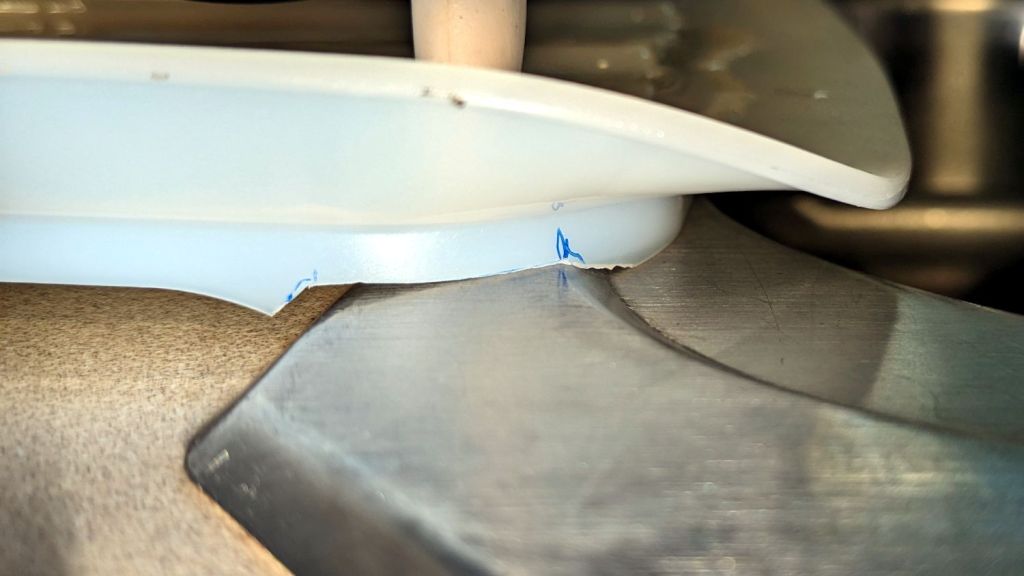
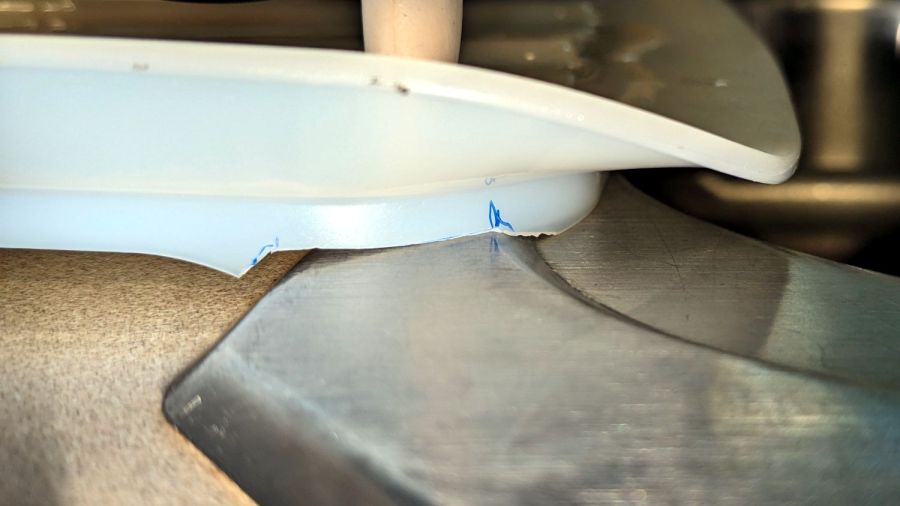
    So I bought a packing tape dispenser (“gun”) for the 4 inch wide clear tape over the box labels, only to find the frame projected beyond the rubber roller on one side:

    Packing tape dispenser - projecting edge
    Packing tape dispenser – projecting edge

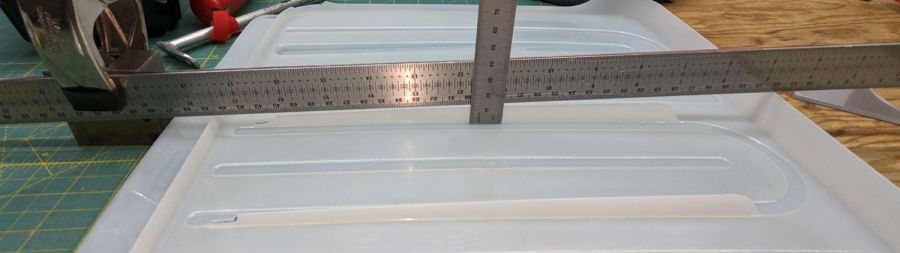
    That steel flange prevented the roller from making firm contact with the box and pressing the tape into place. I’d never seen such a thing on any of the other tape guns I’d used, including a similar one (for 2 inch tape) on loan from the good folks at archive.org:

    Packing tape dispensers
    Packing tape dispensers

    Well, even with the shop in disarray, I can fix that:

    Packing tape dispenser - filed edge
    Packing tape dispenser – filed edge

    Filing that bump down definitely improved my disposition over the next few hundred boxes …

  • Skil Cordless Driver Re-batterying

    Skil Cordless Driver Re-batterying

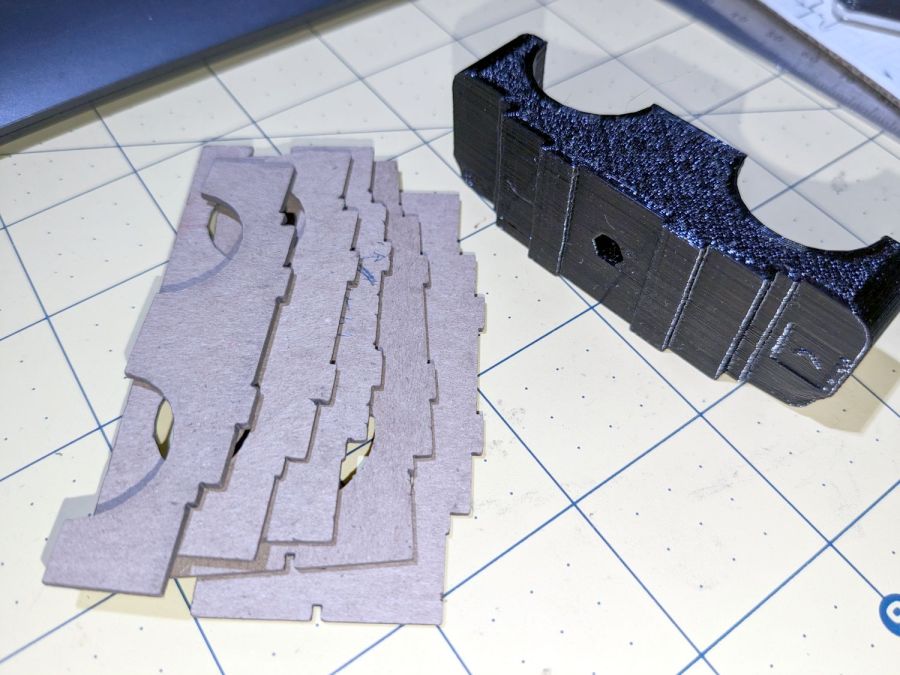
    In anticipation of upcoming disassembly & reassembly tasks, I finally replaced the long-dead NiCd battery in an old Skil cordless driver with an 18650 lithium cell from the Basement Warehouse Wing:

    Skil Cordless Driver - 18650 cell overview
    Skil Cordless Driver – 18650 cell overview

    A USB charge controller sits in a slot carved into the plastic formerly supporting the NiCd battery’s charging jack:

    Skil Cordless Driver - USB charger detail
    Skil Cordless Driver – USB charger detail

    Hot-melt glue holds everything in place.

    The motor draws about 2 A under full load, which is a bit more than the charge controller wants to supply. I simply wired the motor (through its reversing switch) directly to the 18650 cell terminals, which is certainly not good practice, but seems reasonable given the intended use case.

    A red LED shows the charger stuffing energy into the cell:

    Skil Cordless Driver - charge indicator
    Skil Cordless Driver – charge indicator

    You can see the blob of glue holding one of the acrylic cylinders left over from the gelatin capsule filler; only 99 more to go! I had to turn it down by about a millimeter, an operation best left to your imagination.

    After an hour, a green glow shows the cell is fully charged:

    Skil Cordless Driver - full charge
    Skil Cordless Driver – full charge

    The original label proudly touted the NiCd battery’s 2.4 V, so I figured truth in packaging required a new label:

    Skil Cordless Driver - new label cutting
    Skil Cordless Driver – new label cutting

    The process:

    • Scan the original labels
    • Blow out the contrast to make binary masks
    • Trace into vectors with LightBurn, simplify & clean up
    • Add targets for Print-and-Cut
    • Save as SVG, import into GIMP, lay out text, print
    • Cut the outlines

    The labels have laminating film on the top and craft adhesive on the bottom, both of which cut neatly and look pretty good:

    Skil Cordless Driver - lithium in action
    Skil Cordless Driver – lithium in action

    The alert reader will note the 4+ V from a fully charged lithium cell exceeds the 2.4+ V from fully charged NiCd cells, which accounts for the very bright incandescent headlamps. I figure 4 is roughly equal to 2.4, for large values of 2.4: the driver ticks along at 170 RPM instead 140 RPM.

    I measured the torque using a double-ended hex bit in a torque screwdriver, with the torque setting cranked up until the driver just barely clicked it over.

    I took the liberty of filing the raised “2.4 V” off the hinge covers and adding tidy retroreflective disks:

    Skil Cordless Driver - hinge cover
    Skil Cordless Driver – hinge cover

    I briefly considered adding “3.7 V” (because “4.2 V MAX” wouldn’t fit) in laser-cut PSA vinyl, but it was getting late.

    Now I can screw things up in style …

  • Hiatus

    Hiatus

    The sellers have accepted our offer on their house, so over the course of the next couple of months we’ll be moving, then selling this place. Having begun dismantling and packing the contents of the Basement Shop, Laboratory, and Warehouse, my blog-worthy activities will grind to a temporary halt.

    Should you or anyone you know be interested in moving to the trendy Hudson Valley region, we have a conveniently located property with a shop-ready basement:

    2108-2110 New Hackensack Rd - Streetview 2023-08
    2108-2110 New Hackensack Rd – Streetview 2023-08

    Maybe we can make a deal …

  • CD / DVD Coasters: Foam vs. Cork Backing

    CD / DVD Coasters: Foam vs. Cork Backing

    Up to this point, I’d been making coasters with a layer of cork on the bottom, held in place with wood glue (for MDF or plywood tops) or an adhesive sheet (for acrylic or glass). Doing that with a CD produced the bottom coaster:

    Laser cut CDs - Foam vs MDF-cork backing - detail
    Laser cut CDs – Foam vs MDF-cork backing – detail

    Although the Mariner’s Compass pattern looks like it extends over the edge, you’re looking through the transparent polycarbonate at the deep pits burned nearly through the entire disc at the corners of the triangles where the laser head slows.

    Although the MDF layer makes the coaster exceedingly stiff, it also makes it entirely too thick and much too fiddly to assemble.

    The top coaster is a Guilloche-patterned CD stuck to an EVA foam disk with an adhesive sheet. A small foam disk fills the hub hole and, not incidentally, covers the adhesive that would otherwise be exposed:

    Laser cut CDs - Foam coaster backing
    Laser cut CDs – Foam coaster backing

    It’s stiffer than I expected and works well unless the mug / glass / cup has a wet bottom. Alas, the small channels cut into the CD’s surface fill up with the liquid sealing the coaster to the mug, so it sticks firmly and follows the mug upward off the table.

    But they’re kinda pretty, inexpensive, and easy to assemble, which counts for something.

  • Guilloche Generator: Now With Layers & Colors

    Guilloche Generator: Now With Layers & Colors

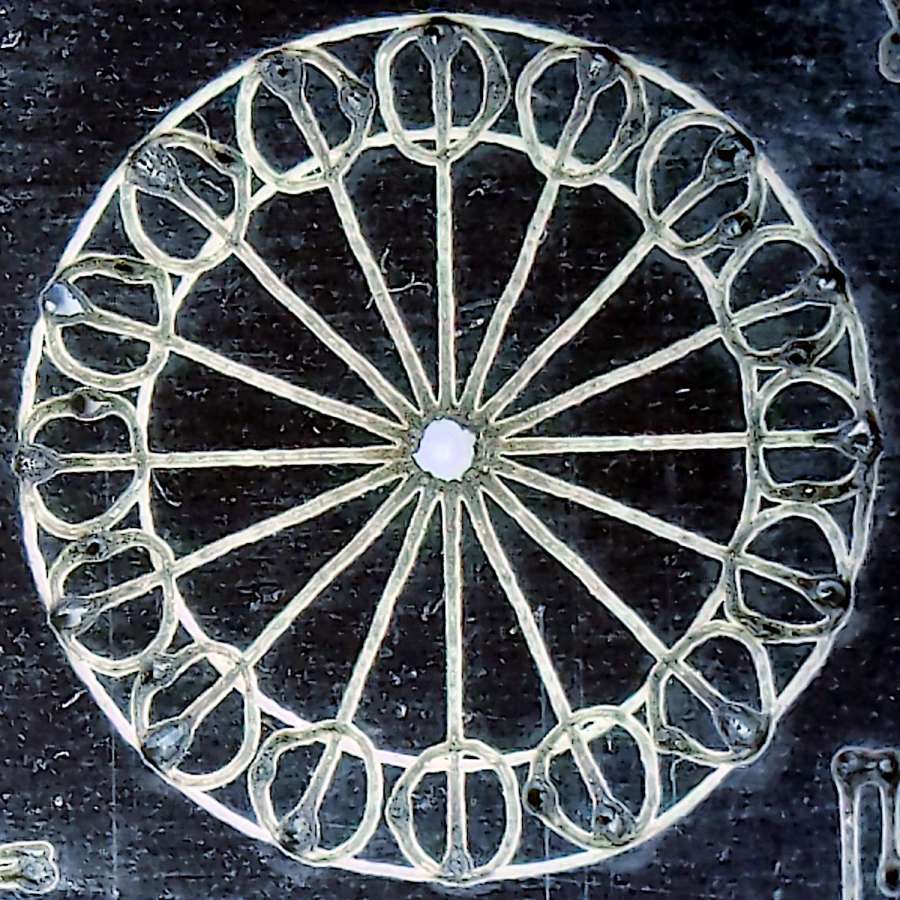
    Tweaking the GCMC Guilloche generator to define colors for the SVG layers produces a pattern ready for LightBurn:

    Guilloche - SVG layer colors
    Guilloche – SVG layer colors

    The blue layer runs at 300 mm/s at 10% PWM to carve trenches all over the CD / DVD surface, which should render it unreadable:

    Laser cut CDs - Guilloche patterns
    Laser cut CDs – Guilloche patterns

    The laser runs much faster than a drag knife or a diamond engraving tool!

    The reddish layer uses Dot mode to draw the legend around the hub:

    Laser-engraved CD - legend detail
    Laser-engraved CD – legend detail

    The characters are 1.5 mm top-to-bottom, with dots just under 0.2 mm diameter on 0.2 mm centers.

    Stipulated: there’s no real point to annotating a CD that you’re wrecking, but the code was already there, so why not?

    So the overall workflow involves generating an SVG image, importing it into LightBurn with those layers set up with the appropriate cut parameters, using the Three-Point Circle Center Finder tool to align the pattern with the CD, then Fire The Laser. Alignment stops on the laser platform eliminate the need to realign every pattern, so it boils down to running the generator script enough times, importing a batch of patterns, then snapping each one into place and cutting it.

    They’re kinda pretty, in the usual techie way:

    Laser cut CDs - Guilloche patterns
    Laser cut CDs – Guilloche patterns

    I have a lot of scrap discs, some ideas of optimizing the process, and a general notion what to do with the prettier results.

    The GCMC source code and Bash driver script as a GitHub Gist:

  • Laser Cutter: Low Power Vectors vs. CD-Rs

    Laser Cutter: Low Power Vectors vs. CD-Rs

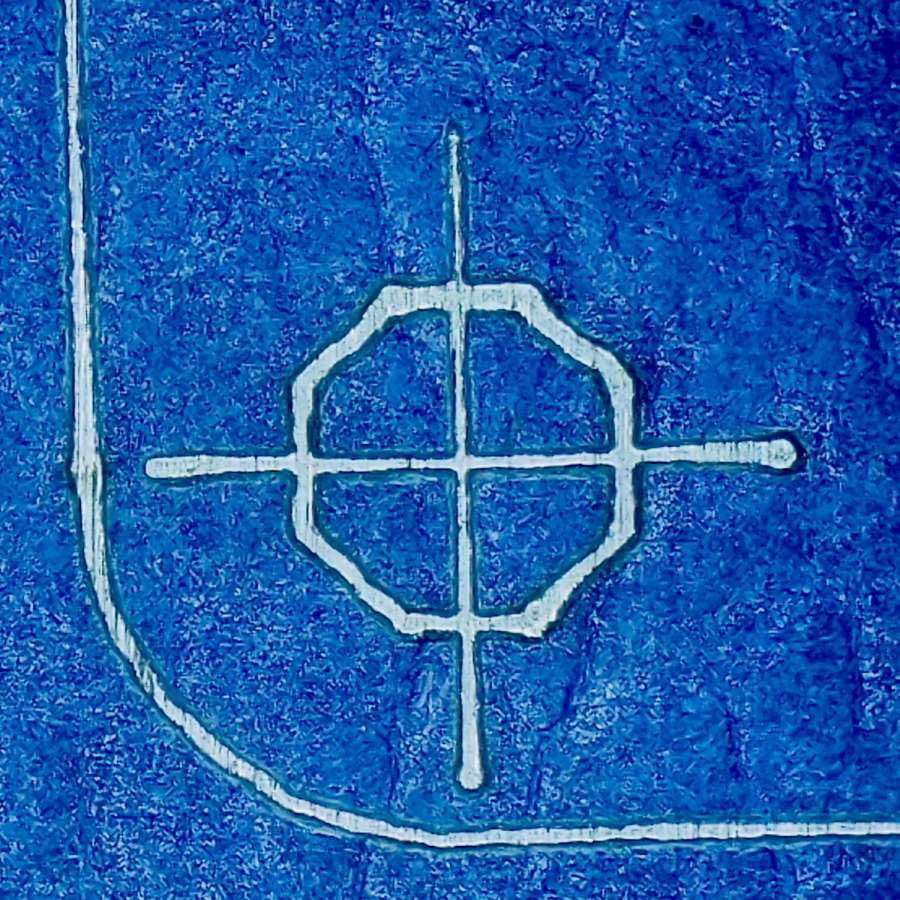
    Wrecking scrap discs led to experimenting with the low-power behavior of my nominal 60 W CO₂ laser. I used the same inset version of the Mariner’s Compass quilting pattern as before:

    Mariners Compass - stacked insets - LB layout
    Mariners Compass – stacked insets – LB layout

    The KT332N controller is set to a 7% minimum power, as the tube simply doesn’t fire below that level. The power levels shown below are the minimum and maximum for the layer.

    The cuts are on CD-R discs with the same general appearance, although I can’t say whether they all came from the same manufacturing lot. All of the cuts are on the clear side of the disc, with the data side flat against the platform. Unless otherwise noted, the pictures are from the clear side, looking down into the trenches carved into the surface, and you can see reflections of the cuts in the aluminized data layer.

    Power 7 to 10%:

    CD-R vector cut - clear side - 7-10pct
    CD-R vector cut – clear side – 7-10pct

    Because the controller uses the minimum power at lower speeds, the laser fails to fire near the corners of the pattern.

    Power 8 to 10%:

    CD-R vector cut - clear side - 8-10pct
    CD-R vector cut – clear side – 8-10pct

    The patterns generally begin in their upper-right corner where the laser has little enough power to prevent melting. However, the tube now continues firing as the laser slows for two other corners and melts a gouge into the surface.

    Power 7.5 to 10%:

    CD-R vector cut - clear side - 7.5-10pct
    CD-R vector cut – clear side – 7.5-10pct

    The gouges are less prominent, but not by much.

    Power 7.1 to 10%:

    CD-R vector cut - clear side - 7.1-10pct
    CD-R vector cut – clear side – 7.1-10pct

    Reducing the minimum power to just over the 7% absolute minimum reduces the size of (most of) the blobs, but also causes gaps in some of the lines and at the corners.

    Power 7.1 to 7.5%:

    CD-R vector cut - clear side - 7.1-7.5pct start
    CD-R vector cut – clear side – 7.1-7.5pct start

    Reducing the maximum power causes the tube to not fire at all for some vectors; it doesn’t fire at all with the maximum power set to 7.1%.

    However, the firing is very sensitive to the tube temperature, as that picture is for the first pattern around the disc rim with the cooling water temperature at 20.5 °C.

    The last pattern (which is just to the right of the first) looks much better with the coolant at 20.7 °C:

    CD-R vector cut - clear side - 7.1-7.5pct end
    CD-R vector cut – clear side – 7.1-7.5pct end

    It’s still not complete, but you can see the tube power has increased enough to melt blobs into the surface similar to those at higher maximum powers.

    Power 7.5 to 8%:

    CD-R vector cut - clear side - 7.5-8pct
    CD-R vector cut – clear side – 7.5-8pct

    Although the tube now fires continuously throughout the pattern, you can see thinner sections in the longer vectors over on the left.

    All of the pictures above are using assist air at 12 l/min, so there’s a stiff breeze blowing the smoke away from the laser beam. Turning the assist air off reduces the flow to 2 l/min and produces a much larger cloud of fumes over the surface that seems to deposit more crud around the vectors:

    CD-R vector cut - 2l-min assist air
    CD-R vector cut – 2l-min assist air

    The small MDF stops jammed in the honeycomb platform let me put all the CD-Rs at the same spot and reuse the same pattern with slight power variations and no realignment. It’s not perfect, but it’s pretty good.

    Power 7.5 to 8%, 2 l/min assist air:

    CD-R vector cut - clear side - 7.5-8pct low air
    CD-R vector cut – clear side – 7.5-8pct low air

    Notice the smudges to the left of center.

    Cleaning the surface with a soft cloth and a vigorous circular motion improves the result:

    CD-R vector cut - clear side - 7.5-8pct low air cleaned
    CD-R vector cut – clear side – 7.5-8pct low air cleaned

    If you’re being fussy about cleanliness, you might avoid scratching the otherwise pristine surface.

    I also burned the data side of a disc to wreck the lacquer and aluminized layer, rather than just the clear polycarbonate.

    Power 7.5 to 8% on data side, as seen from the data side:

    CD-R vector cut - data side - 7.5-8pct data side
    CD-R vector cut – data side – 7.5-8pct data side

    The same pattern on the same disc, seen from the clear side:

    CD-R vector cut - data side - 7.5-8pct clear side
    CD-R vector cut – data side – 7.5-8pct clear side

    Burning through the lacquer and aluminum produces a narrower trench and slightly smaller blobs at the junctions.

    Running near the tube’s minimum power produces unpredictable results, because the tube temperature matters. Variations of a few tenths of a degree can prevent the tube from firing, either intermittently or completely, so keeping the minimum layer power well above the minimum tube power is a Good Idea™ unless you can afford considerable scrap.

    It’s a slow way to wreck discs, but a nice way to produce suncatching coasters:

    Mariners Compass Coaster - CD data side finished
    Mariners Compass Coaster – CD data side finished