The Smell of Molten Projects in the Morning

Ed Nisley's Blog: Shop notes, electronics, firmware, machinery, 3D printing, laser cuttery, and curiosities. Contents: 100% human thinking, 0% AI slop.

Tag: Art-ish

They might be Art

  • Holly Coaster: Improved Mirror Setup

    Holly Coaster: Improved Mirror Setup

    Other than demonstrating that it’s possible to laser-engrave a 3 mm deep pocket in a ¼ inch thick piece of scrap paneling, the process didn’t have much to recommend it:

    Holly Coaster - mirror flaws
    Holly Coaster – mirror flaws

    So I re-did the layout to put the 3 mm mirror in 3 mm thick plywood:

    Holly Coaster - overview
    Holly Coaster – overview

    The coaster has a self-adhesive cork pad on the bottom, which required an intermediate adhesive layer holding the aluminized Mylar reflector on the bottom of the mirror to brighten the colored areas.

    The LightBurn layout shows all the pieces:

    Holly Mirror Coaster - LB layout
    Holly Mirror Coaster – LB layout

    The plywood cuts with the good side down, although “good” is certainly a judgement call with B/BB grade plywood. I cover the good side with blue painter’s tape to reduce scorch marks. In a real application, you’d do some sanding and finishing, probably before cutting; in this case, I want to see what happens to bare wood in coaster duty.

    Engrave and cut the mirror with the backing upward:

    Holly Coaster - removing mirror layer
    Holly Coaster – removing mirror layer

    The tracer rounds may be burning aluminum.

    I colored the engraved areas with fat-tip permanent markers, despite knowing the alcohol will crack the acrylic. In real life, you’d use spray paint, probably with laser-cut tape masks.

    The adhesive layer extends 2 mm beyond the mirror perimeter to stick onto the bottom face of the plywood:

    Holly Coaster - adhesive placement
    Holly Coaster – adhesive placement

    Peeling off the paper reveals the adhesive tape stuck to the back side of the mirror:

    Holly Coaster - adhesive exposed
    Holly Coaster – adhesive exposed

    Apply the similarly embiggened aluminized Mylar to the adhesive:

    Holly Coaster - mylar placed
    Holly Coaster – mylar placed

    Cutting the holly shape directly from the original foot-square adhesive sheet lets me tuck smaller shapes into the remaining uncut areas. In a production environment, however, joining the Mylar and adhesive (perhaps using pre-cut squares), then cutting them as one sheet would definitely simplify the process.

    Then peel-n-stick a cork disk (thus explaining why the plywood is exactly 4 inch OD) on the bottom:

    Holly Coaster - edge view
    Holly Coaster – edge view

    I’ve been aligning the cork by feel, which explains the half-millimeter overhang along the right side. Inexplicably, I have yet to justify an alignment fixture.

    The LightBurn SVG layout as a GitHub Gist:

    Loading
    Sorry, something went wrong. Reload?
    Sorry, we cannot display this file.
    Sorry, this file is invalid so it cannot be displayed.
  • Frosted Snowflakes

    Frosted Snowflakes

    After the first two snowflake coasters, it finally penetrated my thick skill that putting a 1 mm hole in the flake cut from the center of the plywood would convert it into a decorative window hanging:

    Snowflake Hanger - plywood
    Snowflake Hanger – plywood

    Admittedly, I may be using the word “decorative” in a manner you had not previously encountered, but work with me on this.

    Cutting a similar flake from transparent acrylic looks better:

    Snowflake Hanger - blue acrylic
    Snowflake Hanger – blue acrylic

    Transparent acrylic turned out to be, well, too transparent, so I set up a LightBurn layout to “engrave” a light frosting on the flake before cutting it out:

    Snowflake Hangers - engraving in situ
    Snowflake Hangers – engraving in situ

    That worked for all subsequent flakes, but I had to do something about the first few flakes. After realizing that the time to engrave an object depends only on its width, I set up a rectangle with the proper parameters, snugged two forlorn flakes next to each other, and fired the laser:

    Snowflake Hangers - retroactive engraving
    Snowflake Hangers – retroactive engraving

    I thought using cardboard was a Good Idea™ for a stable backing, but lightly vaporizing the top layer produced an unbelievable amount of filth:

    Snowflake Hangers - frosted
    Snowflake Hangers – frosted

    I had to scrub those poor flakes with dish detergent and a toothbrush to get them even close to their former pristine state; the blue one may never recover.

    Anyhow, frosted flakes look good if you don’t look closely:

    Snowflake Hangers - frosted
    Snowflake Hangers – frosted

    The grid pattern comes from the window screen in direct sunlight; the vertical bars are DIY BirdSavers.

    The LightBurn layout produces 120 mm coasters to fit my 20 ounce mugs:

    Snowflake Coaster 120 mm - LB Layout
    Snowflake Coaster 120 mm – LB Layout

    You get two hanging flakes: one plain plywood and one frosted acrylic!

    The LightBurn SVG layout as a GitHub Gist:

    Loading
    Sorry, something went wrong. Reload?
    Sorry, we cannot display this file.
    Sorry, this file is invalid so it cannot be displayed.
  • Snowflake Coasters: Kerf Compensation

    Snowflake Coasters: Kerf Compensation

    A flurry of snowflake coasters:

    Snowflake Coaster - assortment
    Snowflake Coaster – assortment

    The two on the left are the original snowflakes with interchanged innards and, perforce, no kerf compensation.

    The upper-left coaster has a wood flake surrounded by acrylic, which makes a sharp clack when you set a glass down on it. The wood surrounds emit a much more pleasing clunk.

    The next two have 0.1 mm compensation applied to their acrylic snowflakes, which produces snug fit (original on the left, compensated on the right):

    Snowflake Coasters - kerf corr 0.0 vs 0.1 mm
    Snowflake Coasters – kerf corr 0.0 vs 0.1 mm

    Applying 0.2 mm compensation makes the flakes impossible to push in, so the true compensation is somewhere just over 0.1 mm. I think you could optimize for a specific wood and acrylic combination, but, as with 3D printing, any change requires something different.

    The little arrowhead shapes tend to get lost, so collecting them on a strip of tape while you’re hunting in the chip tray helps:

    Snowflake Coasters - plywood cutouts
    Snowflake Coasters – plywood cutouts

    The dark flake on the right got a coat of walnut stain, as did the two darker coasters in the first picture. It looks better in person than in the photo, although Mary still thinks the lighter wood sets off the white acrylic just fine.

    The two large (120 mm OD) coasters fit my 20 ounce mugs, with the Nanook Memorial Coaster in the lower right.

  • Seasonal Snowflake Coasters

    Seasonal Snowflake Coasters

    The rattlecan chipboard coasters having passed their Best Used By dates, I figured a more durable seasonal version was in order:

    Snowflake Coasters - overview
    Snowflake Coasters – overview

    I laid out the design with the intent of cutting an acrylic snowflake with a bit of compensation to fit snugly into a plywood background:

    Snowflake Coaster - LB layout
    Snowflake Coaster – LB layout

    At the last moment I realized I could just cut two of the patterns on the left, swap the snowflakes, and get two coasters with very little scrap:

    Snowflake Coasters - detail
    Snowflake Coasters – detail

    Mary thinks the gap between the snowflake and the background looks OK. I’m not convinced, but studying the results suggests applying enough kerf compensation to close the largest gaps would results in the rest of the flake not fitting into its socket. Plus, of course, you’d have more scrap.

    Embiggening the small dagger-shaped pieces around the center would be an improvement. Perhaps cutting those as a separate operation after arranging them in a corner would work.

    Protip: Align the grain in those daggers with the rest of the plywood, because It Will Be Very Obvious if you don’t.

    Applying a nice wood stain / finish to the plywood, perhaps before cutting it out, would certainly improve the result.

    Invisible on the bottom: self-adhesive cork disks eliminating the need to glue the pieces to something else. I had thought of a blank plywood or MDF disk, but came to my senses just in time.

    The original SVG fell with a blizzard from one of the many SVG snowflake generators out there. Because LightBurn uses only the stroke centerlines of SVG images and ignores the stroke width, it required some tweakage before becoming a coaster.

    After saving an SVG flake from the blizzard, fire up Inkscape:

    • Import the SVG file
    • Center it in whatever page you’re using
    • Ungroup the flake from the frame (if it has one)
    • Delete the frame to leave only the flake
    • Select the flake
    • Invoke Path → Stroke to Path
    • Save as an SVG image under a new file name

    Then fire up LightBurn:

    • Import the tweaked SVG file
    • Assign a layer with line (rather than fill) parameters
    • Ungroup to separate the flake’s strokes
    • Weld the strokes together to remove the overlaps
    • Wrap a coaster outline around it
    • Resize the flake as needed
    • Set layer parameters as needed
    • Duplicate the flake
    • Embiggen as needed
    • Unleash the laser!

    The LightBurn SVG layout as a GitHub Gist:

    Loading
    Sorry, something went wrong. Reload?
    Sorry, we cannot display this file.
    Sorry, this file is invalid so it cannot be displayed.
  • Seasonal Holly Coasters

    Seasonal Holly Coasters

    Starting with a random SVG holly image from the InterTubes:

    Holly Coaster - assortment
    Holly Coaster – assortment

    The rattlecan chipboard versions came out pretty well, because I’ve already explored much of the error space. The two-tone berries and leaves received Sharpie contrast touchup. They’re all in constant use on the kitchen table!

    The wood veneer version over on the right looks surprisingly good (in person, anyway) for being a complete faceplant. The narrow sections suffered severe burning and fell apart where the grain runs perpendicular to the cut. The highlight spots for the berries fell through the honeycomb table and vanished in the chaff. Sanding the whole mess flat scuffed off most of the smudges, although I couldn’t bring myself to slather it with polyurethane.

    The bright holly on the left is mirror-back acrylic pressed into a 3 mm deep (!) recess engraved in more scrap paneling:

    Holly Coaster - mirror
    Holly Coaster – mirror

    I hand-painted the colors by scribbling Sharpie onto areas where the mirror backing was engraved away. A sheet of aluminized Mylar below the acrylic reflects some light back through the colors to make them slightly brighter.

    As I recently learned, applying alcohol to laser-cut acrylic produces almost instantaneous stress-cracking, which accounts for the decorative crackle finish around the perimeter:

    Holly Coaster - mirror flaws
    Holly Coaster – mirror flaws

    The surface flaw beyond the berry over on the right apparently came from an acrylic fume explosion in the honeycomb below it, strong enough to torch the protective plastic film. Given that I was starting with a scrap mirror fragment, I didn’t perch it up on spikes, which is pretty much required to prevent such events.

    The wood coasters have mmmmm excellent upside potential, but it’s obvious I have not yet mastered my craft.

    The LightBurn SVG layout as a GitHub Gist:

    Loading
    Sorry, something went wrong. Reload?
    Sorry, we cannot display this file.
    Sorry, this file is invalid so it cannot be displayed.
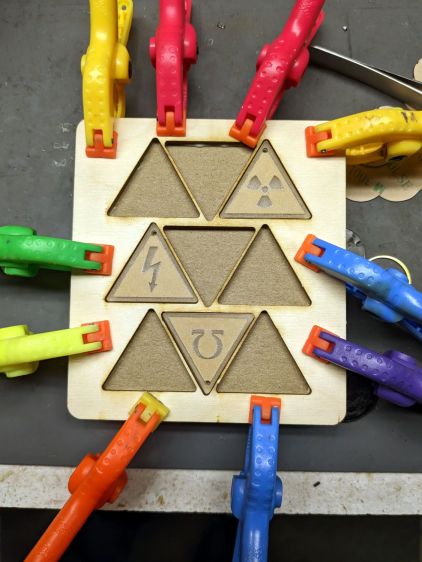
  • Marquetry: Veneer Test Piece

    Marquetry: Veneer Test Piece

    I haven’t given Mary a diamond in forever, so:

    Marquetry test piece
    Marquetry test piece

    Straight up: this was mostly for fun, as can be determined by the hideous juxtaposition of the diamond amid a hexagon with the grain running the wrong way.

    The diamond pattern was the least awful result of searching the Intertubes for diamond svg.

    I didn’t expect it to work on the first try, but apart from having to calibrate the engraving depth in the scrap of plywood paneling, things went swimmingly:

    Marquetry plywood engraving depth tests
    Marquetry plywood engraving depth tests

    I now have settings to excavate 0.2, 0.5, and 1.0 mm into that particular paneling. The veneer sheets were just over 0.5 mm thick and stuck out just enough to sand them flush.

    The ideal kerf compensation turned out to be none at all, which I found after compensating the frame 0.1 mm outward on all sides, then having it not fit in the hole nor around the inner triangles.

    A layer of yellow Elmer’s Wood Glue holds everything in place.

    A few licks of 120 grit sandpaper, wipe it down with polyurethane finish, let it cure overnight, and it’s presentation-ready.

    Got a chuckle, which is as much as I expected.

  • High Impact Art: Coaster 5

    High Impact Art: Coaster 5

    This came out all glittery:

    Smashed Glass Coaster 5 - top view
    Smashed Glass Coaster 5 – top view

    Epoxy tinted with transparent black dye does a pretty good job of not obliterating the cracks between the cuboids. In person, the cracks seem less conspicuous around the borders of the glass pieces, but they’re visible enough for this ahem use case.

    Under the proper lighting, a few bubbles appear along and above the black layer:

    Smashed Glass Coaster 5 - oblique view
    Smashed Glass Coaster 5 – oblique view

    The new thing this time around were three pins holding the layers in alignment while the epoxy cured:

    Smashed Glass Coaster 5 - alignment pin
    Smashed Glass Coaster 5 – alignment pin

    The conical end comes from grabbing an 8 mm snippet of 3/64 inch steel rod in a pin vise and twirling it against Mr Bench Grinder for a few seconds.

    The pins pretty much dropped into 1.1 mm holes created while cutting the sheets. The tiny circles mark the laser path around the pin holes:

    Coaster 5 - layers
    Coaster 5 – layers

    The “holes” in the top sheet (upper middle) are in the Tool 2 layer so they’re not cut, because it was easier to match-drill holes halfway into the top sheet with the drill press than to figure out how to convince the laser to not punch all the way through. Engraving (along the lines of the earring borders) might work, but I’m not sure how well a high-aspect-ratio hole will engrave.
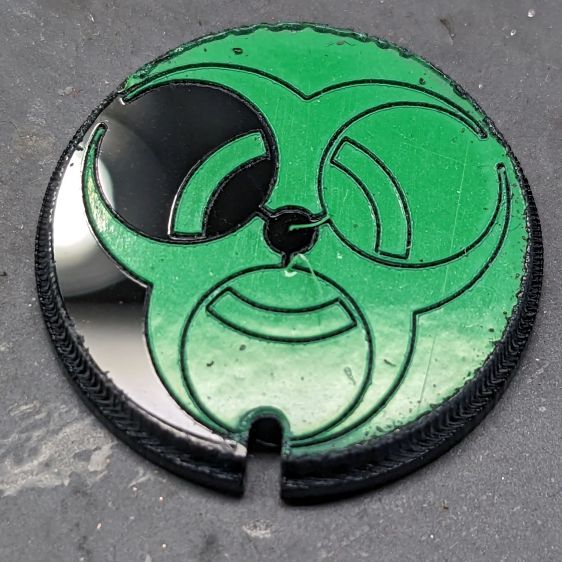
    The mirror sheet is reversed left-to-right in order to cut it from the back of the reflective layer. I’m not certain this is necessary, because acrylic is basically opaque to 10.6 µm IR light and any doubly attenuated reflected light will diverge strongly from the focus point at the top surface, but it’s the recommended procedure and easy enough to do.

    The cork cuts with its adhesive layer up and blue tape on the bottom to prevent soot from accumulating in all the surface crevices.

    The alignment pins worked surprisingly well:

    Smashed Glass Coaster 5 - edge alignment A
    Smashed Glass Coaster 5 – edge alignment A

    The top sheet sticks out 0.3 mm on one side:

    Smashed Glass Coaster 5 - edge alignment B
    Smashed Glass Coaster 5 – edge alignment B

    Oddly, there’s no place where the top sheet is indented by any noticeable amount, so there may be slight size differences depending on all the colors and ages in that stack of plastic sheets.

    I’ll cure the next one top-side down, giving the bubbles an opportunity to rise toward the mirror layer and maybe become less conspicuous:

    Smashed Glass Coaster 5 - curing
    Smashed Glass Coaster 5 – curing

    The tricky part: finding and arranging glass chunks within a 100 mm circle!

    Avoiding narrow gaps and acute angles in the perimeter, as the notch on the left side, should simplify draining the epoxy.