The Smell of Molten Projects in the Morning

Ed Nisley's Blog: Shop notes, electronics, firmware, machinery, 3D printing, laser cuttery, and curiosities. Contents: 100% human thinking, 0% AI slop.

Category: Science

If you measure something often enough, it becomes science

  • Money For Nothing: Gfk MRI TV Survey

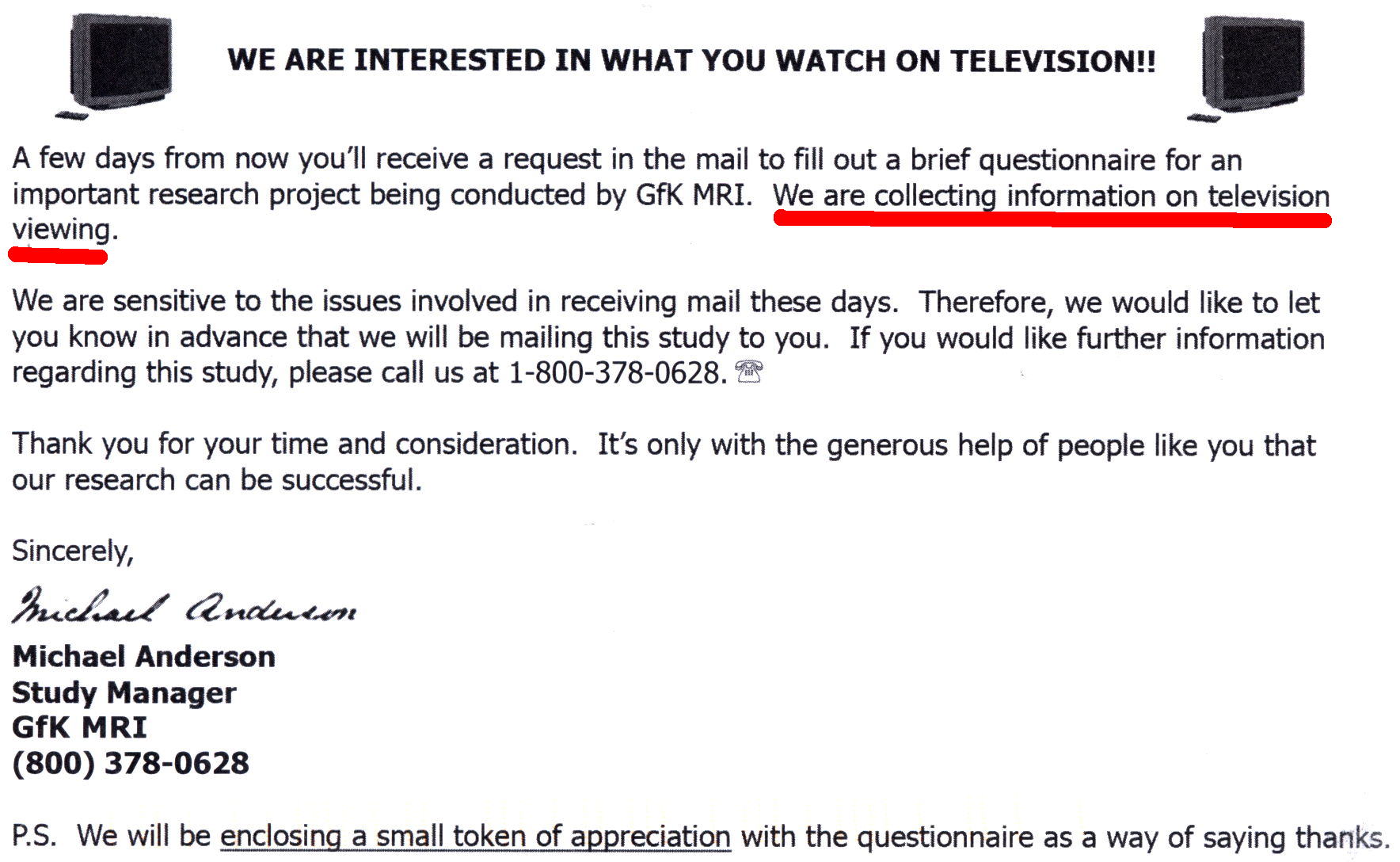
    This arrived a week ago:

    GfK MRI postcard
    GfK MRI postcard

    You cannot imagine my excitement when the actual survey arrived, complete with a crisp $5 bill:

    GfK MRI Survey
    GfK MRI Survey

    These folks are cheapskates; Nielsen paid better, although I haven’t gotten anything further from them.

    It didn’t take long to fill out; my fat Sharpie slashed through the NO columns at a pretty good clip. I did attach a note saying we didn’t have a TV and regarded all TV programs as crap, just in case they didn’t get the message.

    Now they know.

    FWIW, I did not fill out the form that would enter us in a drawing for one of five $500 prizes, because that would let them associate my name with my response without fattening my wallet. The survey itself probably encodes my identity, even though it didn’t have any obvious bar codes or other ID; they could simply print the questions in a unique order in each survey.

  • Cast Iron Pan Seasoning: Low-woo Results

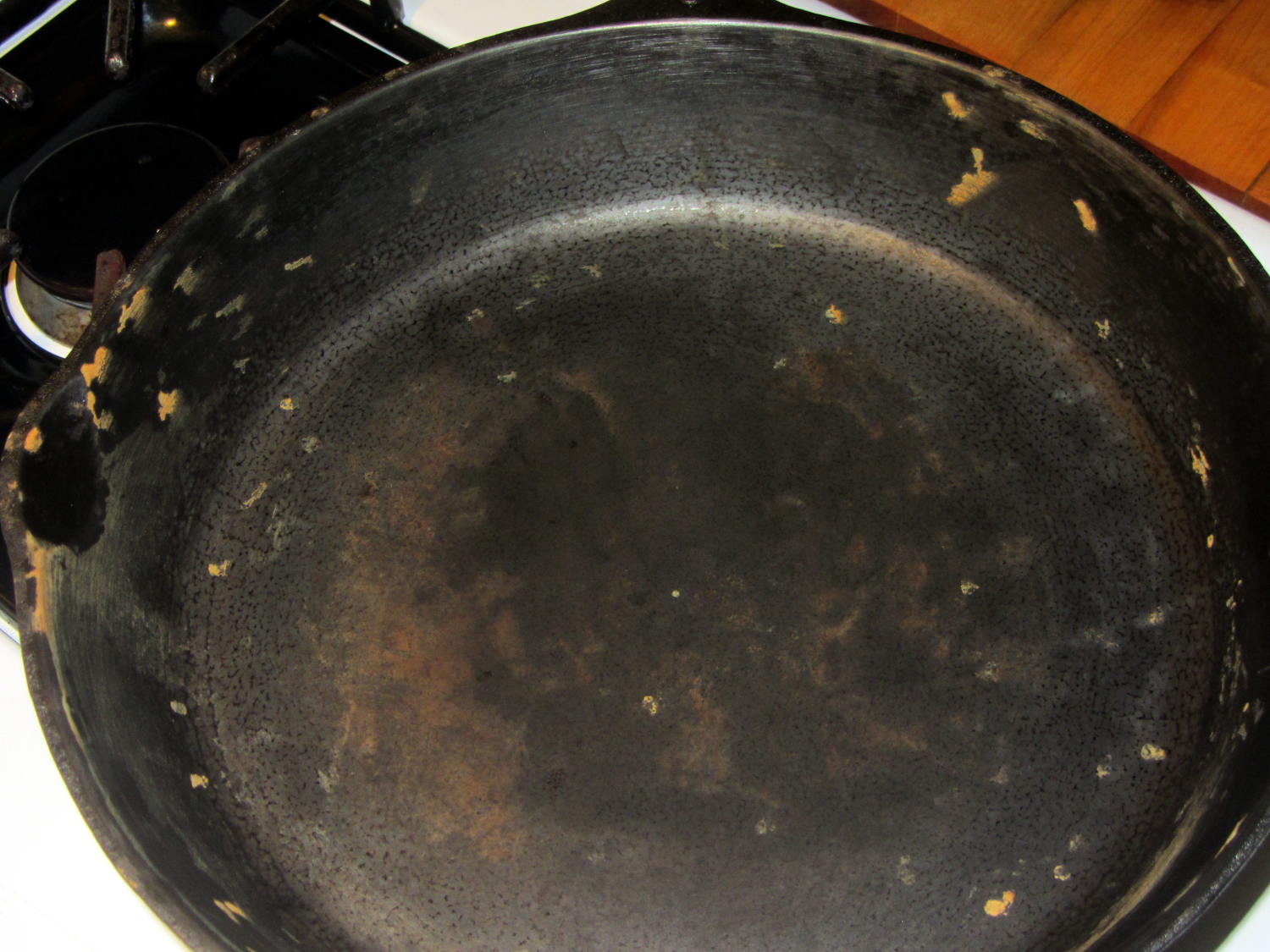
    The original cast-iron seasoning recipe, after half a dozen iterations of flax seed oil & high-temperature baking, produced disappointing results:

    Wagner cast iron skillet - washed - top
    Wagner cast iron skillet – washed – top

    The key point of seasoning seems to require heating the oil enough to polymerize its molecular thingies, with (IMO) pretty nearly everything else boiling down to woo.

    Since that rusting incident, I’ve done this after every use:

    • Wipe the pan clean with the same hot soapy water I use for everything else
    • Remove crud with the same Scotchbrite / sponge pad I use for everything else
    • Rinse and wipe dry with the sponge side of the pad
    • Set stove timer for 3 minutes
    • Put pan on simmer burner, set to high flame
    • Continue cleanup until timer sounds
    • Set stove timer for 3 minutes
    • Wipe half a dozen drops of flax seed oil around pan with cotton cloth scrap
    • Continue cleanup until timer sounds
    • Turn off simmer burner
    • Wipe pan with that oily cotton scrap

    The pan reaches about 300 °F after 3 minutes. The “opening the pores” thing is woo, but a completely dry pan doesn’t spit back and that’s a major plus.

    The pan tops out at a bit over 400 °F after a total of 6 minutes. There’s no smoke, no excitement, just a hot pan on the back burner.

    Given that I’m washing the pan anyway, the whole “seasoning” operation adds maybe two minutes to the process. By now, it’s entirely automatic.

    Nota Bene: Set the timer before turning on the burner and before adding the oil, because you will become distracted and will not remember the pan quietly heating on the back burner. You have been warned.

    After two months of doing that about once a day:

    Wagner Cast Iron Skillet - Low Woo Seasoning
    Wagner Cast Iron Skillet – Low Woo Seasoning

    Granted, it looks about the same as the previous results, but this uniform dull black coating repels water, doesn’t rust, loves oil, wipes clean without scouring, and the daily omelet doesn’t stick hardly at all. Obviously, the key difference is that I’ve polymerized a gazillion coats of oil, rather than half a dozen.

    Although I have no idea whether I’m exposing us to lethal free radicals created by the polymerization process, I doubt anybody else knows anything on that subject with regard to their own seasoning technique, so we’re pretty much even. As with most such worries, It Doesn’t Matter.

    Next, I’ll just wipe the pan and let it dry in the rack. That coating should eventually wear off, at least in the high-traffic areas; let’s see how little maintenance it requires.


  • Discrete LED Aging After Two Decades

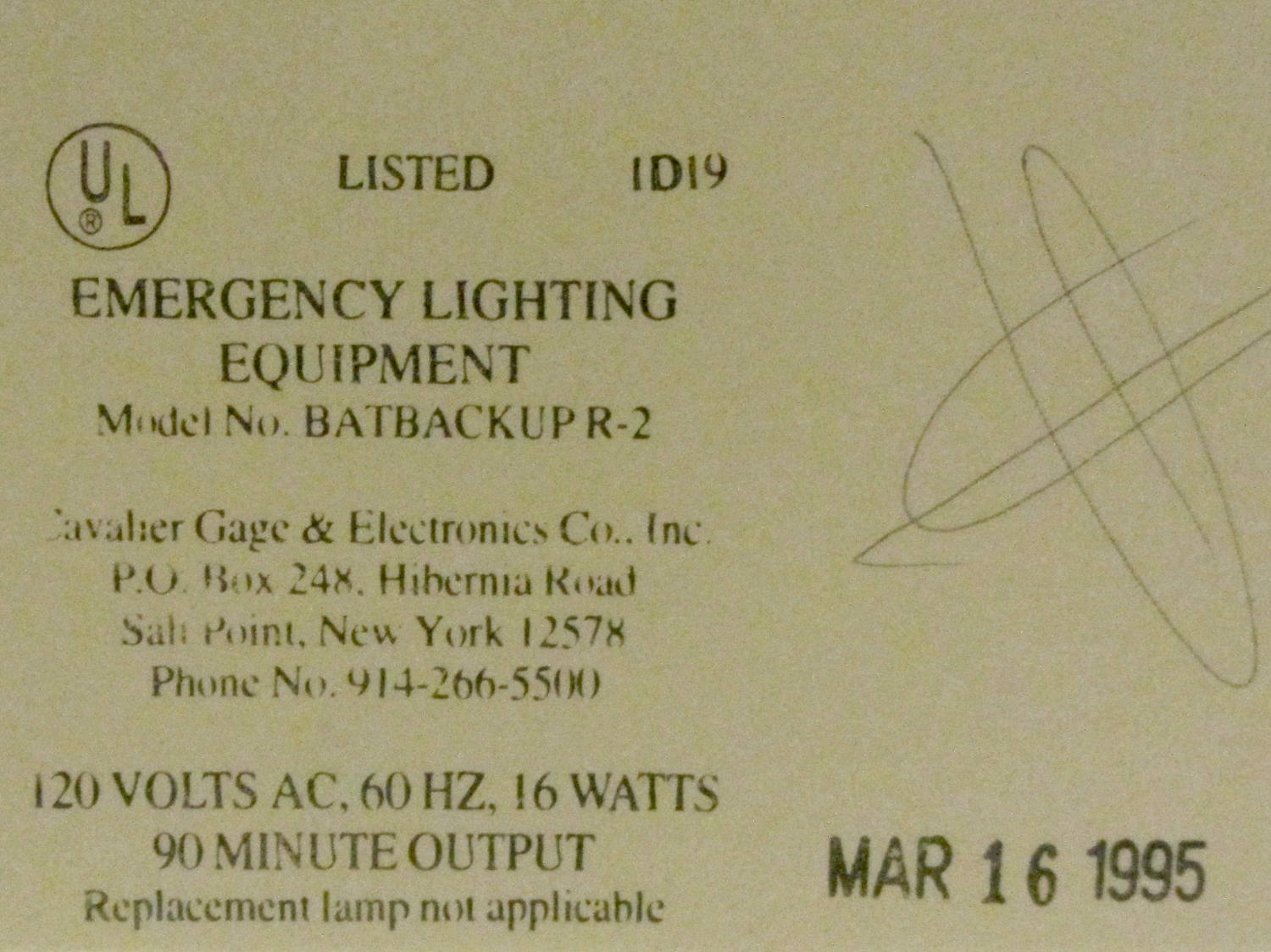
    While at another Vassar concert, I noticed a manufacturing date stamp on one of the LED exit signs in Skinner Hall:

    Exit Sign - Manufacturing date
    Exit Sign – Manufacturing date

    I like the “Replacement lamp not applicable” line. I wonder how recently they’ve tested the battery for the projected 90 minutes of backup time…

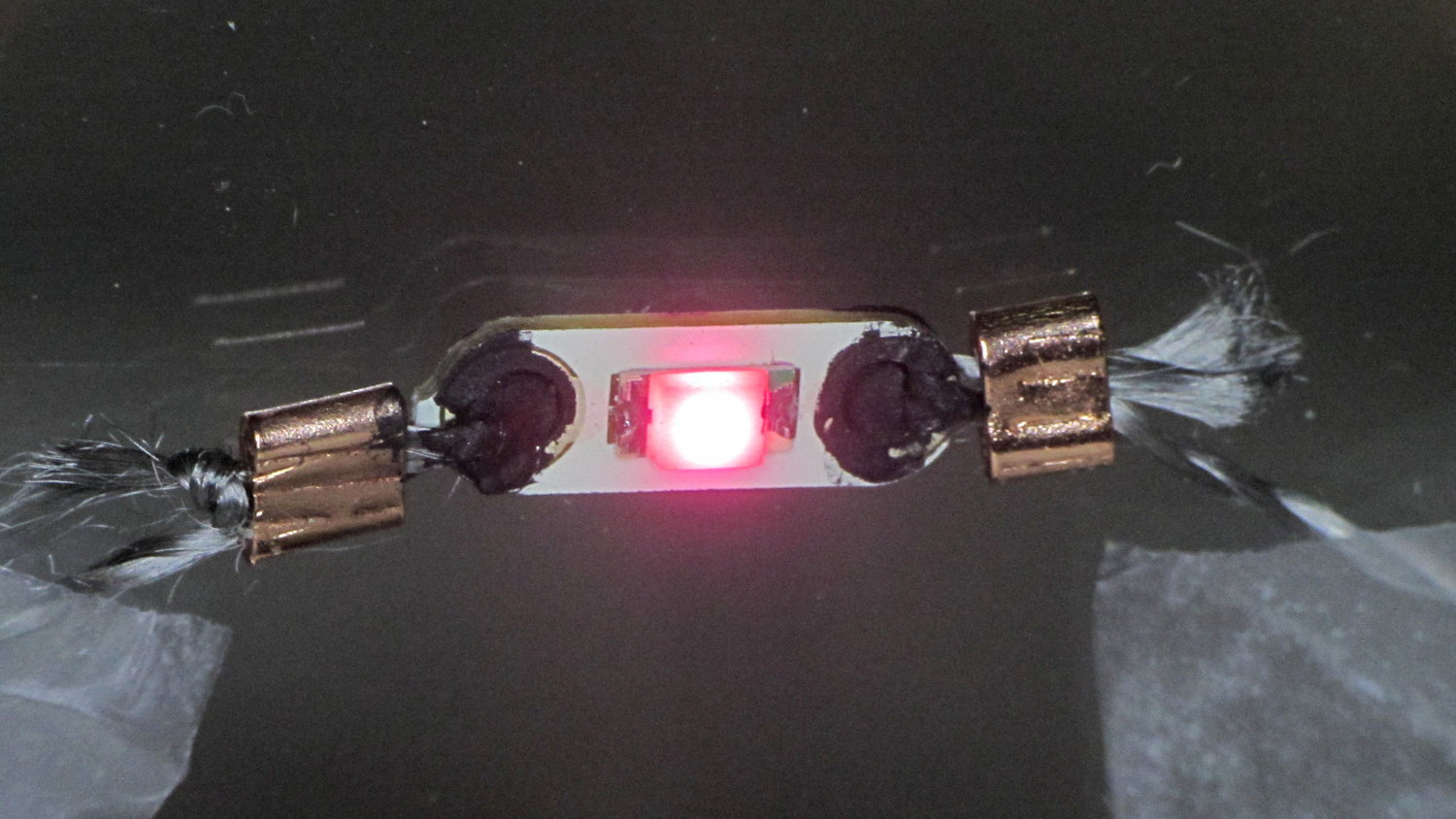
    These old LEDs show the expected brightness variations:

    Exit Sign - LED aging
    Exit Sign – LED aging

    So, now you know what your discrete LEDs will look like after two decades of continuous use. That’s if anybody (else) still uses discrete LEDs, of course.

  • Kitchen Spatula Search

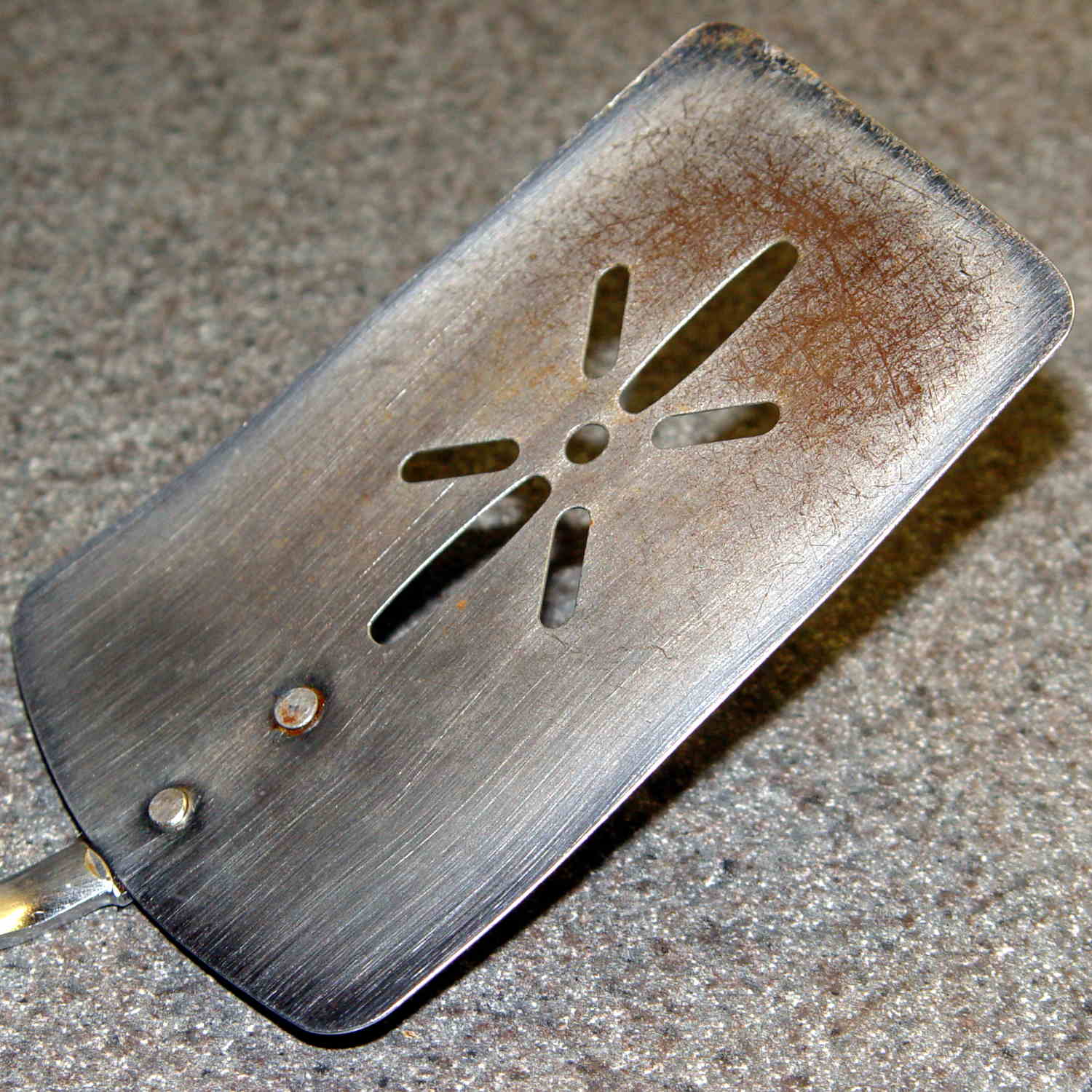
    A long long time ago, we bought a kitchen spatula that’s served us well ever since:

    Spatula Search - original
    Spatula Search – original

    To give you an idea of how old that poor thing is, the back of the handle bears a Japan stamp. I’ve re-set the rivets several times, the blade has rusted as badly as you think, and we recently, very reluctantly, decided it has passed its best-used-by date.

    The 3 x 4.5 inch blade is 19 mil = 0.45 mm plated carbon steel, stiff enough to remain flat and springy enough to bend a little, with a 9 inch = 230 mm steel handle ending in a plastic overmold.

    These days, it’s essential to the cutting, flipping, and serving of the morning’s omelet-like substance, made of eggs, bacon, veggies, green leafy things, plus this-and-that, in the cast-iron pan. Mary chops the disk into quarters with the reasonably sharp edge, maneuvers the reasonably bendy blade under each quarter, flips them over, tops with bacon & cheese, pauses for consolidation & melting, then pops them onto plates. Yum!

    Omelet in cast-iron pan
    Omelet in cast-iron pan

    So we set out to buy a replacement.

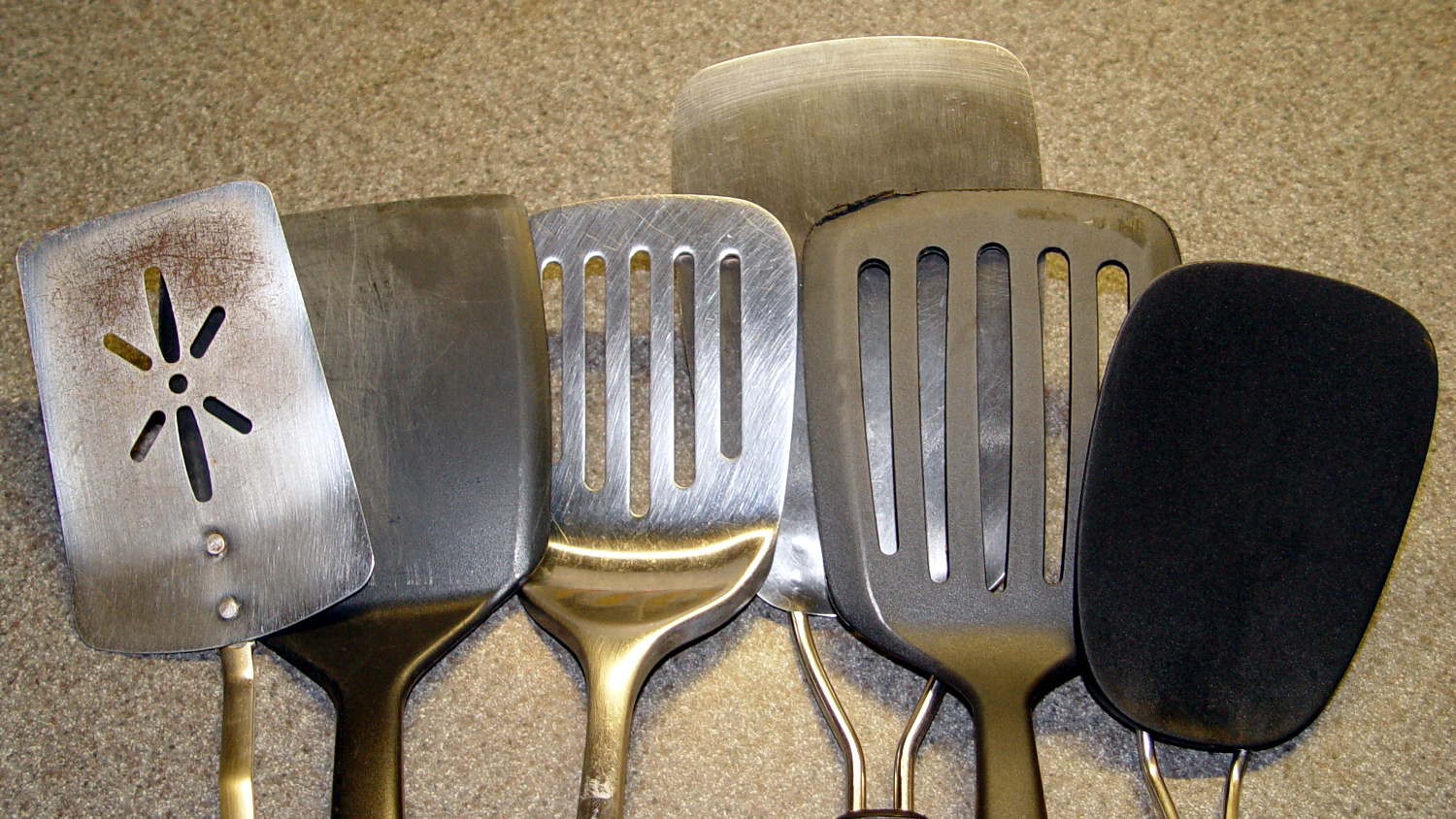
    Here’s what we’ve tried and rejected so far:

    Spatula Search - overview
    Spatula Search – overview

    I’ve used this one for many years to flip pancakes on a succession of non-stick griddles, a service at which it excels. The edge isn’t sharp enough to cut the green-and-leafy and the completely inflexible blade cannot be maneuvered under the omelet quarters:

    Spatula Search - heavy solid plastic
    Spatula Search – heavy solid plastic

    This one gets deployed for burgers and their ilk, also in the cast-iron pan. The blade, although sharp enough, is completely rigid:

    Spatula Search - heavy slotted metal
    Spatula Search – heavy slotted metal

    On the other paw, a slightly concave 7 mil = 0.18 mm spring steel blade is much too thin and, well, springy. Although very sharp, you cannot apply enough cutting force without suddenly bending the blade and, if the omelet quarter isn’t positioned exactly right, the blade will bend underneath it and dump breakfast on the stovetop. The alert reader will notice a missing weld between the blade and the bottom wire handle:

    Spatula Search - thin spring steel
    Spatula Search – thin spring steel

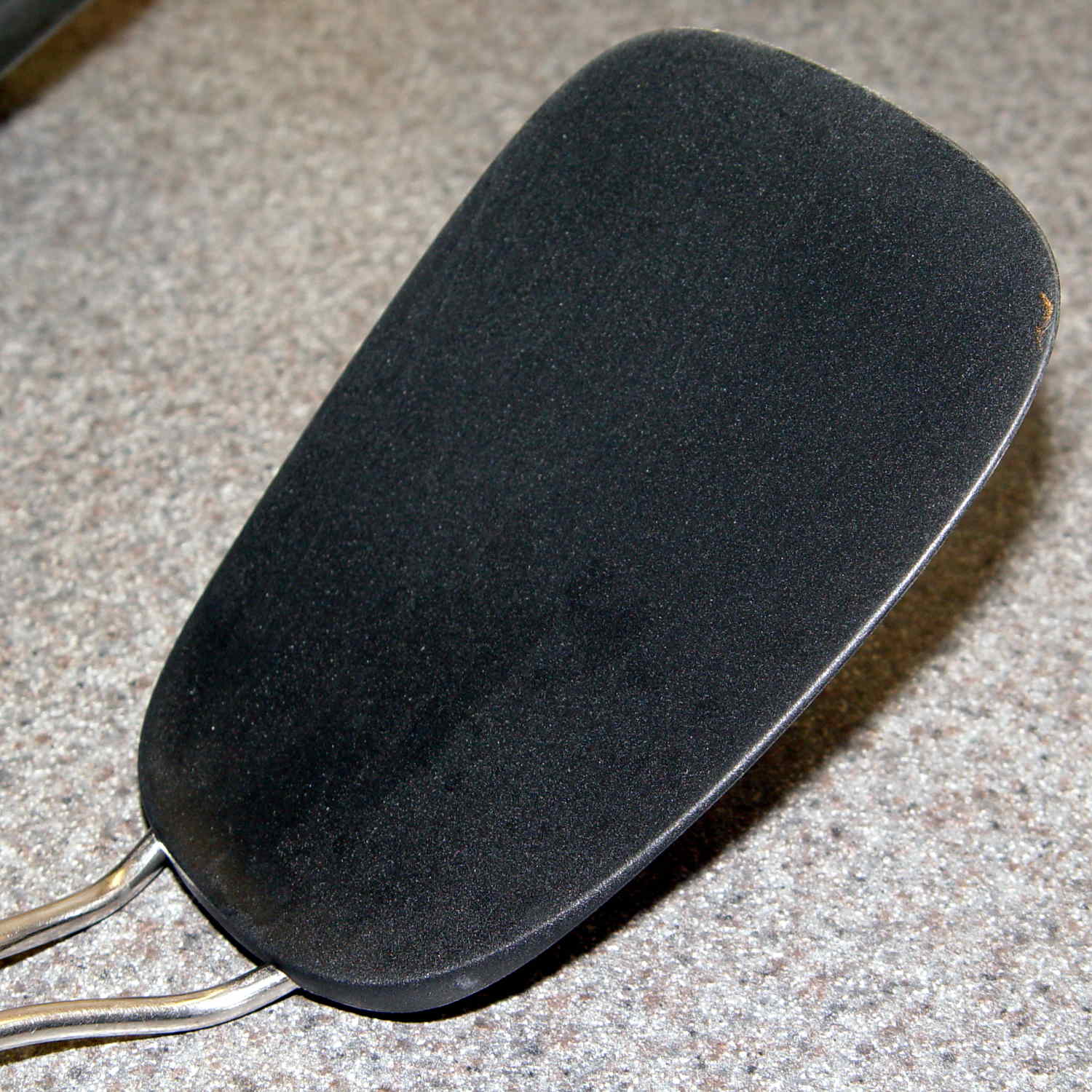
    This very thin plastic blade has similar problems with poor cut-ability and excessive flexibility:

    Spatula Search - thin springy plastic
    Spatula Search – thin springy plastic

    This one looked really promising and worked almost perfectly. Regrettably, its nylon blade bears a 400 °F rating and the bottom of the omelet reaches nearly 450 °F. You can see what happens to the reasonably sharp edge as it scrapes across the pan:

    Spatula Search - heavy slotted nylon
    Spatula Search – heavy slotted nylon

    The omelet cooks at the temperature it cooks at, which part of the specifications is not subject to further discussion.

    So, we’re stumped. Having trawled the usual online and big-box stores, we’ve been unable to find a replacement. Simple steel blades aren’t available. Trendy silicone-bonded stainless steel blades combine the worst of all worlds: won’t cut and won’t flip. Pretty nearly anything you don’t see above seems obviously unsuitable for our simple needs: too big, too small, or too melty.

    We’ll consider all recommendations and suggestions! Thanks …

  • Monthly Science: CR2032 Lithium Cell Life

    One of the Hobo dataloggers asked for a new battery during its most recent data dump. The old battery dates back to January 2015:

    Maxell CR2032 lithium cell - 22 month life
    Maxell CR2032 lithium cell – 22 month life

    That was when a batch of Energizer cells failed in quick succession: it wasn’t the datalogger’s fault. I’ve been handling the cells a bit more carefully, too, although that certainly doesn’t account for the much longer life.

    With batteries, particularly from eBay, you definitely can’t tell what you’re going to get or how long it’ll last; that’s true of many things in life.

  • Mother In Law’s Tongue Plant: Flower Season

    Both of us began sniffling and sneezing in early October, long after the outdoor flowers faded away, and finally remembered to check the Mother In Law’s Tongue:

    Mother In Law Plant - flowering
    Mother In Law Plant – flowering

    It’s that time of the year again: we’re both wildly allergic to a houseplant with weird flowers. Even after cutting the stalk off and deporting it outdoors, we’re still sniffly.

    The blossoms produce so much nectar that the droplets near the base of each flower eventually fall off, making a mess on the floor if the stalk tilts over far enough.

    We kept it when we helped Mom move out of the Ancestral House, long ago, and it’s still going strong.

  • Satellite Dish Mounting Angle in Norway

    A friend asked why Norwegians point their satellite dishes at the ground. After maneuvering Google Streetview around Vadsø for a while, I found a dish in profile:

    TV satellite dish - Vadso Norway
    TV satellite dish – Vadso Norway

    Turns out geostationary orbit is way low, as seen from the top of the world. A bit of doodling shows it’s only 11° above the horizon at 70° N:

    TV Satellite Dish - Horizon Angle at 70° N
    TV Satellite Dish – Horizon Angle at 70° N

    TV satellite antennas have an offset-fed reflector, with the receiver in the lump at the end of the spine sticking out from the bottom of the dish, so as to not obstruct the signal entering the dish. Even though the plane of the reflector points downward, the signal reflected to the receiver comes in from above.

    Ain’t science trigonometry grand?