The Smell of Molten Projects in the Morning

Ed Nisley's Blog: Shop notes, electronics, firmware, machinery, 3D printing, laser cuttery, and curiosities. Contents: 100% human thinking, 0% AI slop.

Category: Science

If you measure something often enough, it becomes science

  • Funnel Web Spiders

    Funnel Web Spiders

    This critter took up residence in our kitchen window:

    Funnel web spider in window
    Funnel web spider in window

    She’s between the outer storm window and the inner sash, having secured her funnel web to both panes across the entire width of the window. We’d opened the storm window to clear an air conditioner vent and spiders know a good location when they see it.

    We know she’s female, because a (smaller) male appeared and conducted negotiations for the better part of an afternoon. After she accepted his offer of a small, somewhat battered, moth, the two hooked up for the rest of the day; we feared for his life, but he hung around until the next afternoon, then departed.

    She normally stays tucked inside the channel running along the edge of the window frame, with only the tips of those two front legs visible, and retreats at the slightest vibration, so we’ll leave her in peace until we must close the storm window.

  • Cicada Time

    Cicada Time

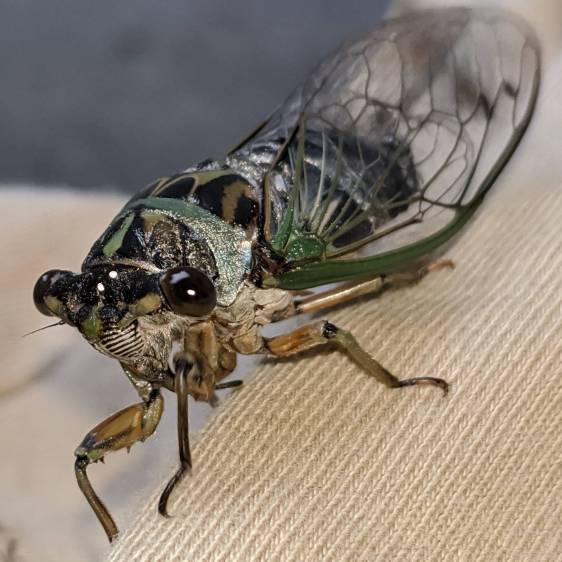
    Even though cicadas are completely harmless, Mary was quite startled to discover one crawling up the back of her garden pants:

    Cicada - left front
    Cicada – left front

    It seems the cicada mistook her for a tree.

    They’re handsome creatures:

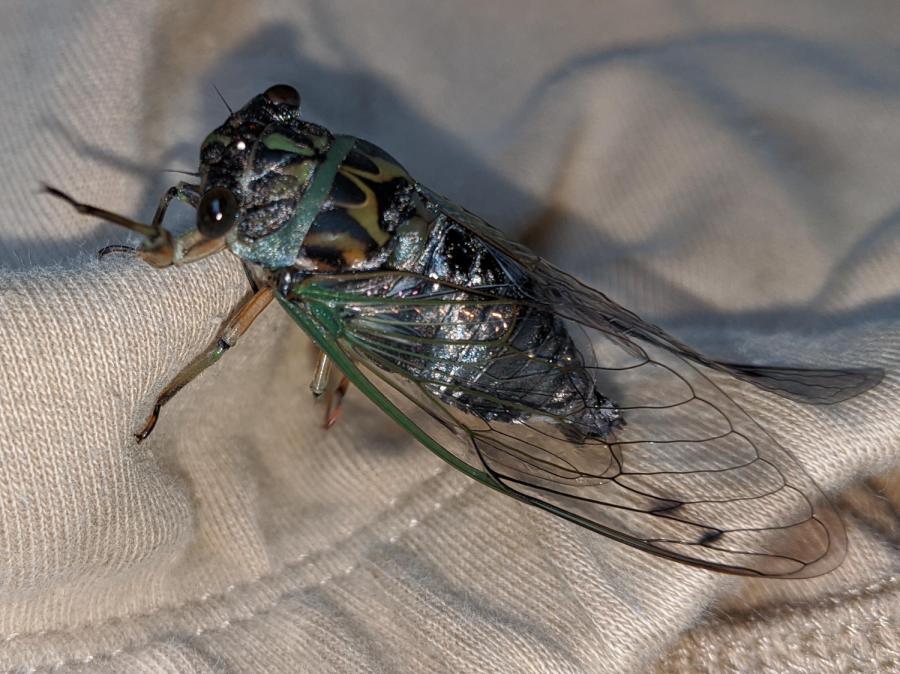
    Cicada - left dorsal
    Cicada – left dorsal

    They’re very conspicuous on fabric:

    Cicada - right dorsal
    Cicada – right dorsal

    I teleported it to a maple tree, where it was better camouflaged:

    Cicada - on tree - right
    Cicada – on tree – right

    When last seen, it was headed upward at a pretty good pace. We wished it well on its adventures …

  • Striped Hairstreak Caterpillar

    Striped Hairstreak Caterpillar

    Mary found this gadget gnawing holes in a bean:

    Striped Hairstreak Butterfly - caterpillar
    Striped Hairstreak Butterfly – caterpillar

    The lump on the right is frass, not a mini-me tagging along behind.

    We had no clue what it might be when it grew up, but Google Lens suggested a Striped Hairstreak Butterfly caterpillar and, later that day (and for the first time ever!), we saw an adult Hairstreak fluttering on a goldenrod in the corner of the garden.

    As with all caterpillars, you’d never imagine the adult butterfly. It seems they move their hind wings to make predators aim at the south end of a northbound butterfly …

  • Discrete LM3909 vs. DSO150 Scope

    Discrete LM3909 vs. DSO150 Scope

    Although I’m a big fan of multi-channel scopes and Hall-effect current probes, a dirt-cheap single-trace oscilloscope can get you quite a ways to the goal:

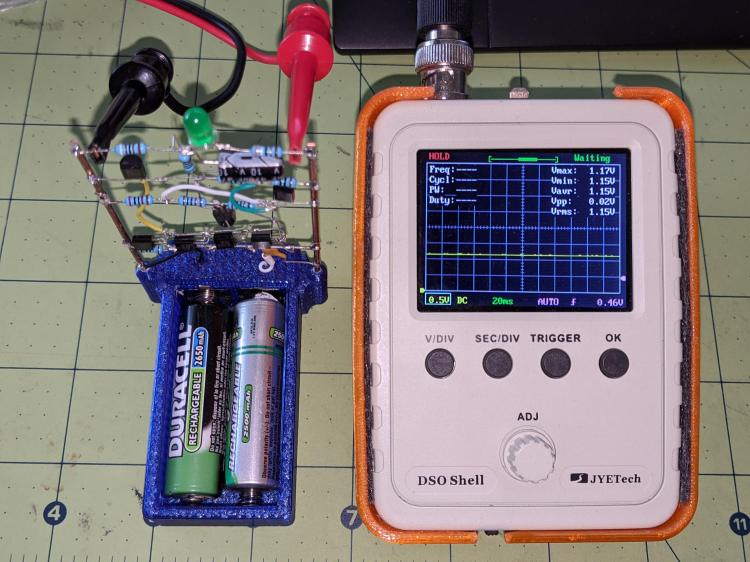
    LM3909 - DSO150 test setup
    LM3909 – DSO150 test setup

    That’s a genuine JYETech DSO150 powered by an 18650 lithium cell and a boost converter set to 9 V. Make sure you get a genuine DSO150 from an authorized seller, rather than one of the myriad knockoffs; it doesn’t cost much more and tends to reward the right folks.

    Anyhow, battery power means you can connect it directly across components to measure what would otherwise be a differential voltage:

    LM3909 - Darl Q1 3x Q2 - 1.5 V - R1 V - DSO150
    LM3909 – Darl Q1 3x Q2 – 1.5 V – R1 V – DSO150

    That’s the voltage across R1, the 39 Ω LED ballast resistor in the discrete LM3909 circuit running from a 1.5 V supply. Divide the 314 mV peak by 39 Ω to get 8 mA of LED current.

    The voltage across C1, the timing and boost capacitor, looks like this:

    LM3909 - Darl Q1 3x Q2 - 1.5 V - C1 V - DSO150
    LM3909 – Darl Q1 3x Q2 – 1.5 V – C1 V – DSO150

    So the cap adds half a volt to the supply in order to put 2.0 V across the LED, which accounts for the relatively low current; the green LED has a forward drop of about 2.2 V at 20 mA and 1.9 V at µA-level current.

    For completeness, the voltage across the LED:

    LM3909 - Darl Q1 3x Q2 - 1.5 V - Green LED V - DSO150
    LM3909 – Darl Q1 3x Q2 – 1.5 V – Green LED V – DSO150

    So, yup, the LED really does see 2.0 V. I love it when the numbers work out.

    Crank the supply to 3 V and see this across R1:

    LM3909 - Darl Q1 3x Q2 - 3.2 V - R1 V - DSO150
    LM3909 – Darl Q1 3x Q2 – 3.2 V – R1 V – DSO150

    The LED current is now 1.23 V / 39 Ω = 33 mA.

    The capacitor just barely enters reverse charge:

    LM3909 - Darl Q1 3x Q2 - 3.2 V - C1 V - DSO150
    LM3909 – Darl Q1 3x Q2 – 3.2 V – C1 V – DSO150

    Pop quiz: what voltage to you expect to see across the LED?

    I’ll leave further investigation to your imagination, but for low-frequency analog work, you can do worse than a DSO150.

  • Monthly Science: Inchworms

    Monthly Science: Inchworms

    A Rudbeckia Black-eyed-susan coneflower from the garden carried a passenger to our patio table:

    Inchworm - linear
    Inchworm – linear

    Even linearized, the inchworm was barely 20 mm long; it’s the thought that counts.

    The stamens mature in concentric rings, each stamen topped by a pollen grain. Apparently, those grains are just about the most wonderful food ever, as the inchworm made its way around the ring eating each grain in succession:

    Inchworm - feeding
    Inchworm – feeding

    Of course, what goes in must come out:

    Inchworm - excreting
    Inchworm – excreting

    I had to brush off the table before washing it; the pellets are dry, but smear when you get them wet.

    Another flower in the vase held a 10 mm inchworm with plenty of upside potential:

    Inchworm - junior edition
    Inchworm – junior edition

    After nearly a week, the flowers were done and the inchworms had moved on. We wish them well, although we likely won’t recognize them in the future.

  • LTSpice Diode Models Sorted By Forward Voltage

    LTSpice includes a bunch of LEDs I’ll never own, so finding a tabulation of their forward voltages helped match them against various LEDs on hand. The table was sorted by the forward voltage at the diode’s rated average current, which wasn’t helpful for my simple needs, so I re-sorted it on the Vf @ If = 20 mA column over on the right:

    Part #       Mfg             Is         N      Iavg Vf@Iavg  Vd@If
    QTLP690C     Fairchild    1.00E-22    1.500    0.16   1.90    1.82
    PT-121-B     Luminous     4.35E-07    8.370   20.00   3.84    2.34
    LUW-W5AP     OSRAM        6.57E-08    7.267    2.00   3.26    2.39
    LXHL-BW02    Lumileds     4.50E-20    2.600    0.40   2.95    2.75
    W5AP-LZMZ-5K Lumileds     3.50E-17    3.120    2.00   3.13    2.76
    LXK2-PW14    Lumileds     3.50E-17    3.120    1.60   3.11    2.76
    AOT-2015     AOT          5.96E-10    6.222    0.18   3.16    2.80
    NSSW008CT-P  Nichia       2.30E-16    3.430    0.04   2.92    2.86
    NSSWS108T    Nichia       1.13E-18    3.020    0.04   2.99    2.94
    NSPW500BS    Nichia       2.70E-10    6.790    0.03   3.27    3.20
    NSCW100      Nichia       1.69E-08    9.626    0.03   3.60    3.50

    The currents come from plugging the various constants into the Schockley Diode Equation and turning the crank.

    One could, of course, measure the constants for the diodes on hand to generate a proper Spice model, but that seems like a lot of work for what’s basically a blinking LED.

  • Cheap LED Assortment: Forward Voltage

    Cheap LED Assortment: Forward Voltage

    Starting with a box of cheap LEDs from halfway around the planet:

    LED kit - case
    LED kit – case

    Measuring the forward voltages didn’t take much effort:

    5mm 3mm LED kit - Vf tests
    5mm 3mm LED kit – Vf tests

    The top array fed the LEDs from a bench power supply through a 470 Ω resistor, with the voltage adjusted to make the current come out right. The bottom array came from the Siglent SDM3045 multimeter’s diode test function, which goes up to 4 V while applying about 400 µA to the diode (the 20 µA header is wrong).

    These numbers come into play when blinking an LED from a battery, because a battery voltage much below the Vf value won’t produce much light. It’s a happy coincidence that a single lithium cell can light a white or blue LED …

    For comparison, the forward voltages from another batch of LEDs:

    ROYGBUIW - LED Color vs Vf
    ROYGBUIW – LED Color vs Vf

    Those all look a bit higher at 20 mA, but everything about the measurements is different, so who knows?