The Smell of Molten Projects in the Morning

Ed Nisley's Blog: Shop notes, electronics, firmware, machinery, 3D printing, laser cuttery, and curiosities. Contents: 100% human thinking, 0% AI slop.

Category: Science

If you measure something often enough, it becomes science

  • AC Infinity Fan Air Flow

    AC Infinity Fan Air Flow

    Being that type of guy, I had to measure the airflow through the inline duct fan intended for the soon-to-arrive laser cutter:

    CloudlIne Duct Fan - overview
    CloudlIne Duct Fan – overview

    The fan is on the inlet side:

    CloudlIne Duct Fan - inlet
    CloudlIne Duct Fan – inlet

    The outlet side consists of flow straightening blades around the backside of the motor mount:

    CloudlIne Duct Fan - outlet stator
    CloudlIne Duct Fan – outlet stator

    The duct ports on each end are (nominal) 6 inch, with the larger central body about 7 inch ID around the blank-faced 5 inch OD motor mount.

    I measured the air speed (in m/s) at the rim of the outlet port and at the center, with the rim speed about twice the center speed. The anemometer is an inch in diameter, so I assumed the annular flow was about 1.5 inch thick.

    Subtracting the dead zone in the middle from the total area of the fan body gives the area of the annulus carrying most of the moving air:

    Dia inchArea in^2Area ft^2
    Pipe6280.20
    Center370.05
    Annulus210.15

    Remember, the central dead zone isn’t quite dead: it has an air speed maybe half of the annulus.

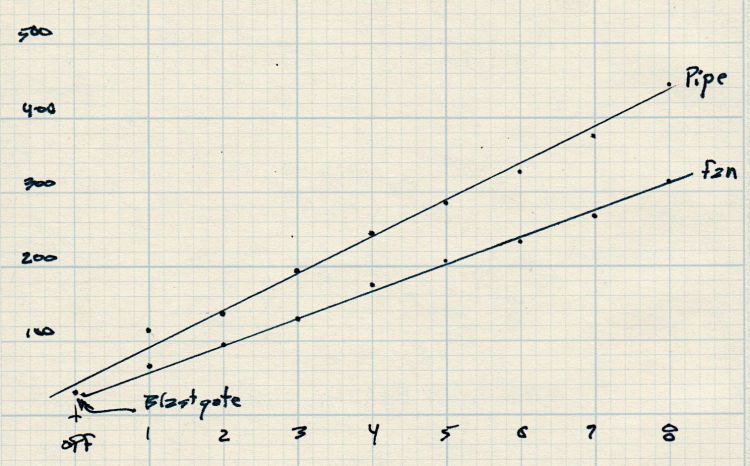
    More spreadsheet action finds the flow for each of the fan speed settings:

    SpeedOuter m/sOuter ft/mUniform CFMAnnulus CFMInner ft/minInner CFMTotal CFMRated
    11.8354705217796144
    22.957111284286149888
    33.874814711037418129132
    44.996518914248224166176
    56.0118223217459129203220
    66.9135926720067933233264
    77.8153630222676838264308
    89.3183136027091645315351

    The Uniform CFM column assumes a uniform air flow through the whole pipe, which is obviously incorrect. The Total CFM equal to the sum of the Annulus and the Inner zone, which comes out pretty close to the Rated values in the last column, taken from a comment by the seller.

    Hard to believe I did the figuring before finding the “right” answers.

    This is, admittedly, in free air without ducts or elbows, so the results will be lower when everything gets hooked up.

  • Wireless Numeric Keypad vs. AmazonBasics AAA Alkaline: Another Data Point

    Wireless Numeric Keypad vs. AmazonBasics AAA Alkaline: Another Data Point

    Looks like a trend to me:

    Wireless keypad - 6 year battery
    Wireless keypad – 6 year battery

    Of course, past performance does not guarantee future results, because Amazon surely has gone through more white-label suppliers in the last half-dozen years than I can count.

  • Halogen Blinky Test

    Halogen Blinky Test

    Dropping the ordinary flashlight bulb into the drawer where it belonged revealed what I think is a halogen flashlight bulb, so I rebuilt the blinky test setup:

    Halogen flashlight bulb test setup
    Halogen flashlight bulb test setup

    This time I used a BUZ71A MOSFET (13 A, 100 mΩ RDS) driven with a 10 V gate pulse to make sure it acted like a switch instead of a current sink.

    The first attempt looked … odd:

    Halogen 3V - no cap - 4ms 1A-div
    Halogen 3V – no cap – 4ms 1A-div

    The gate pulse is yellow, the drain voltage is magenta, the bulb current is cyan at 1 A/div, and the timebase ticks along at 2 ms/div.

    Moving the magenta trace to the supply voltage on the other side of the bulb produces even more weirdness:

    Halogen 3V - no cap - Vsupply - 4ms 1A-div
    Halogen 3V – no cap – Vsupply – 4ms 1A-div

    Apparently, slugging a 3 A bench supply with a 3 A pulse lasting only 4 ms causes distress of the output tract.

    Kludging a hulking 22 mF (yes, 22000 µF) cap across the power supply provides enough local storage to make things work properly:

    Halogen 3V - 22000µF - Vsupply - 4ms 1A-div
    Halogen 3V – 22000µF – Vsupply – 4ms 1A-div

    With the cap in place, the drain terminal looks less unruly:

    Halogen 3V - 4ms 1A-div
    Halogen 3V – 4ms 1A-div

    The drain voltage starts at about 600 mV with the 3 A pulse, a bit more than you’d expect from the alleged 100 mΩ drain-source resistance, but those numbers are generally aspirational and the test setup leaves a lot to be desired.

    A 10 ms pulse produces a distinct flash, rather than a dull orange blip (timebase now at 10 ms/div):

    Halogen 3V - 22000µF - 10ms 1A-div
    Halogen 3V – 22000µF – 10ms 1A-div

    A 30 ms pulse reaches full brightness as the filament settles at normal operating temperature:

    Halogen 3V - 22000µF - 30ms 1A-div
    Halogen 3V – 22000µF – 30ms 1A-div

    A 20 ms flash might suffice for decorative purposes, in which case each pulse requires 90 mW·s = 3 V × 1.5 A × 20 ms of energy. Running it all day requires 7.8 kW·s = 2.2 W·h, so it’s even less appealing than that old skool tungsten bulb.

    Which is, of course, why LED flashlight bulbs are a thing.

  • Incandescent Blinky Test

    Incandescent Blinky Test

    A flashlight bulb emerged from the clutter, which prompted me to ask if it might make an interesting blinky. Spoiler: probably not.

    The bulb had “2.4 V 0.7 A” stamped on its shell, so the test setup looked like this:

    Flashlight bulb test setup
    Flashlight bulb test setup

    A list seems helpful:

    • Solder wires to bulb in lieu of a socket
    • Bench supply at 2.4 V
    • Grossly abused 2N3904 NPN transistor as a switch
    • Function generator pulsing the base
    • Scope voltage probes on base (yellow) and collector (magenta)
    • Tek current probe on bench supply lead (cyan, 500 mA/div)

    The function generator has a 50 Ω output, so depend on it to limit the base current just like it was a resistor. The output voltage is symmetric around 0 V, so apply an offset of half the peak-to-peak signal to get a positive-going pulse:

    Flashlight bulb test - function gen setup
    Flashlight bulb test – function gen setup

    A 150 ms pulse gives the bulb just barely enough energy to light as a little orange blip, with the collector voltage dropping as the filament heats up and its resistance increases:

    Tungsten 2.4V 700mA - 150ms
    Tungsten 2.4V 700mA – 150ms

    Given 350 ms to heat up, the bulb produces a nice white-hot flash:

    Tungsten 2.4V 700mA - 350ms
    Tungsten 2.4V 700mA – 350ms

    The poor transistor acts as a 600 mA constant current sink, which isn’t surprising given its 300 mA absolute maximum current rating.

    Homework: figure the base drive and current gain

    Protip: don’t do that to a cherished transistor

    The bulb resistance starts out at 0.5 Ω and rises to 2.5 Ω when the filament glows white-hot at the end of the pulse.

    Something like 250 ms produces a noticeable blink, requiring 360 mW·s = 2.4 V × 600 mA × 250 ms from the power supply. Blinking once every ten seconds all day means 8640 pulses for a total energy of 864 mW·hr; call it 1 W·hr.

    A pair of (fresh) AA alkaline cells provide 7.5 W·hr for maybe a week of blinkiness.

    A not-dead-yet 18650 lithium cell might offer 15 W·hr, but running the bulb from 3.7-ish V, rather than 3-ish V, increases the energy per pulse by 20% and decreases the run time correspondingly.

    Surely not worth the effort …

  • Incandescent Bulb Lifetime: Also Better Than Average

    Incandescent Bulb Lifetime: Also Better Than Average

    This bulb spent the last seven-plus years of its life lighting the front bathroom:

    Dead incandescent bulb - 7 years
    Dead incandescent bulb – 7 years

    The green corrosion around the tip seems strange, given that we don’t use the tub or shower in that bathroom, and I’m pretty sure it wasn’t the cause of the failure.

    My stock of incandescent bulbs will eventually run out; I must figure out how to light the deaders in an attractive manner.

  • Lyme Disease, Now With Bonus Babesiosis

    Lyme Disease, Now With Bonus Babesiosis

    Two weeks of doxycycline should kill off all the Borrelia bacteria responsible for Lyme disease, but a blood test shows the antibodies:

    Lyme test - 2021-11-10
    Lyme test – 2021-11-10

    Those antibodies will gradually disappear during the next few months and, unfortunately, a past Lyme infection does not prevent future infections.

    The tick also injected Babesia parasites which do not respond to antibiotic treatment:

    Babesia test - 2021-11-10
    Babesia test – 2021-11-10

    The “titer” refers to the dilution required to produce a negative test result, with the 1:64 reference titer representing six successive 50% dilutions. My blood required ten 50% dilutions to produce a negative result for the IgG antibodies and (presumably) six 50% dilutions from a 20% base for the IgM antibodies.

    As I understand the situation, IgM antibodies appear promptly upon infection and IgG antibodies follow along later, so my reaction to the Babesia infestation was ramping up after two weeks.

    In the Bad Old Days™, quinine was the go-to treatment for parasitic infections, but it has a host of horrific side effects at the dosage required for traction against actual diseases; tonic water ain’t gonna get you where you need to go.

    The new hotness is atovaquone, arriving as 100 ml of a yellow liquid with the consistency of latex paint, (allegedly) the taste of “tutti fruitti“, and a price (modulo your drug plan) making inkjet printer ink look downright affordable. You might expect to get a 5 ml measuring spoon along the the bottle, but suffice it to say it’s an exceedingly good thing I’m well stocked for printer cartridge refilling.

    All of the diseases and drugs list “fatigue” / “drowsiness” / “malaise” as symptoms / side effects and I’m here to tell you knocking off a couple of hours in the recliner during the day does nothing at all to disturb another nine hours in the sack overnight.

    A few weeks of low productivity in the Basement Shop™ will definitely count as a successful outcome.

    Protip: We need permethrin spray. Lots permethrin spray.

  • CFL Lifetime: Better Than Average

    CFL Lifetime: Better Than Average

    Although compact fluorescent lamps have fallen out of favor, I’m burning through a box of the things donated by a friend who upgraded to LEDs and figured I could put them to good use. In general, complex electronic doodads (like CFL or even LED lamps) used in hostile situations (like an ordinary downlight fixture) seem to fail too quickly to justify the power savings; searching for “cfl fail” will produce some evidence from around here.

    One of the downlights in the Basement Office just killed this specimen:

    Dead CFL - detail
    Dead CFL – detail

    Much to my surprise, however, it survived for more than five years:

    Dead CFL - over 5 years
    Dead CFL – over 5 years

    The previous CFL bulb in that fixture lasted only two years, so their average lifetime is entirely too short.

    A taller bulb does a better job of lighting up that corner, although it started with enough power-on hours to suggest it won’t survive for another five years:

    Dead CFL - replacement
    Dead CFL – replacement

    The ghostly humps above the overexposed glare are the long CFL tubes reflected inside the Pixel’s camera optics.

    I didn’t see much point in nailing a ceiling to too-low floor joists.