Ed Nisley's Blog: Shop notes, electronics, firmware, machinery, 3D printing, laser cuttery, and curiosities. Contents: 100% human thinking, 0% AI slop.
Category: Science
If you measure something often enough, it becomes science
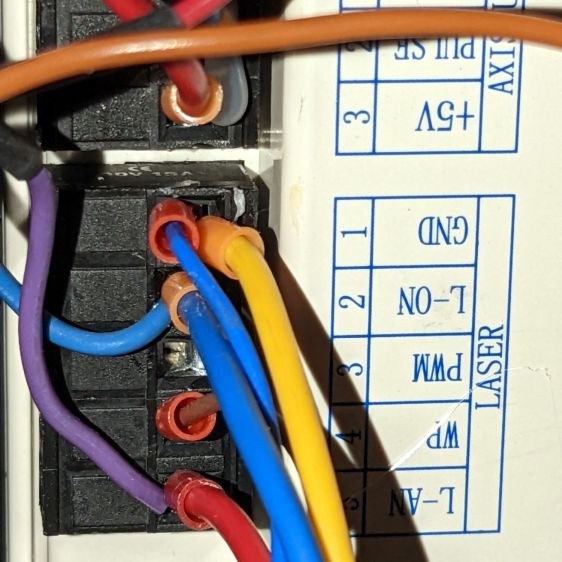
Return the laser power supply’s IN terminal (and the purple wire to the oscilloscope) to the Ruida KT332N controller’s PWM output:
Ruida KT332 – PWM laser control wiring
Engraving the pattern in grayscale mode at 254 dpi produces 0.1 mm pixels and makes each bar 1 mm wide:
LightBurn – bandwidth test pattern setup
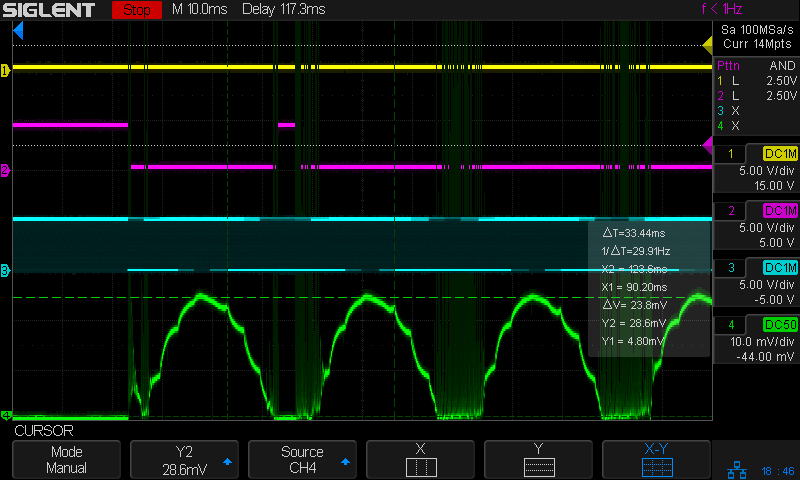
Engraving at 50 mm/s = 50 Hz lets the laser current once again hit full scale:
Tube Current – PWM bandwidth – 10 sine – 50mm-s – 10ma-div – 254dpi
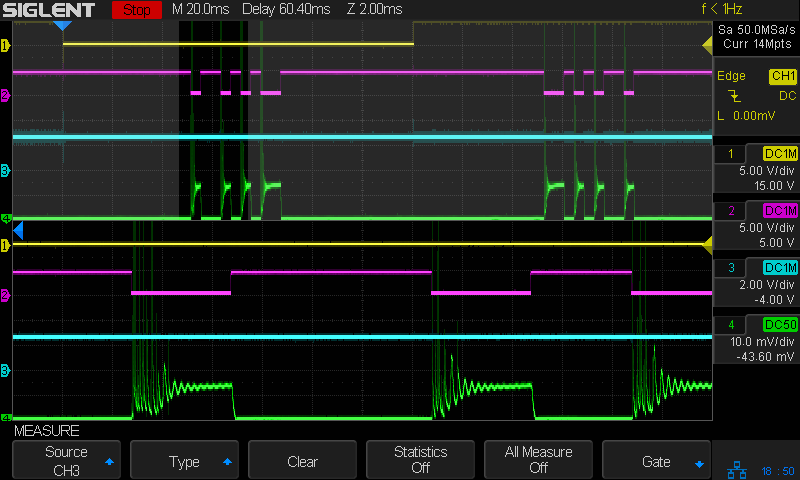
The traces:
1 X axis DIR, low = left-to-right (yellow)
2 L-ON laser enable, low active (magenta)
3 PWM digital signal (cyan)
4 tube current – 10 mA/div (green)
The PWM signal runs at 20 kHz and presents itself as a rather blurred trace, but you can see both the general tendency and the discrete steps between the vertical gray bars. As far as I can tell, the signal never reaches 0% or 100%, most likely to prevent the PWM filters from saturating in either condition.
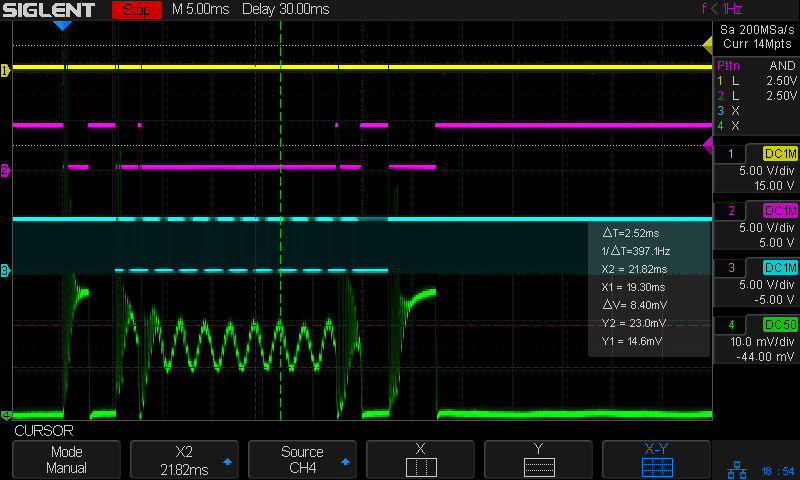
The tube current drops from 23.8 mA to 13.8 mA, just over the half-power level of 12 mA, at 200 Hz:
Tube Current – PWM bandwidth – 10 sine – 200mm-s – 10ma-div – 254dpi
So the PWM bandwidth is a little over 200 Hz, slightly higher than the analog bandwidth of a little under 200 Hz.
All of the measurements as a slide show:
Tube Current – PWM bandwidth – 10 sine – 25mm-s – 10ma-div – 254dpi
Tube Current – PWM bandwidth – 10 sine – 50mm-s – 10ma-div – 254dpi
Tube Current – PWM bandwidth – 10 sine – 100mm-s – 10ma-div – 254dpi
Tube Current – PWM bandwidth – 10 sine – 200mm-s – 10ma-div – 254dpi
Tube Current – PWM bandwidth – 10 sine – 300mm-s – 10ma-div – 254dpi
Tube Current – PWM bandwidth – 10 sine – 400mm-s – 10ma-div – 254dpi
Tube Current – PWM bandwidth – 10 sine – 500mm-s – 10ma-div – 254dpi
Now, with all the measurements in hand, maybe I can reach some sort of conclusion.
As before, with the Ruida KT332N controller’s L-AN analog output connected to the HV power supply IN terminal:
Ruida KT332 – analog laser control wiring
This time the scope traces include both the controller’s output voltage and the laser tube current:
The traces:
1 X axis DIR, low = left-to-right (yellow)
2 L-ON laser enable, low active (magenta)
3 L-AN analog voltage (cyan)
4 tube current – 10 mA/div (green)
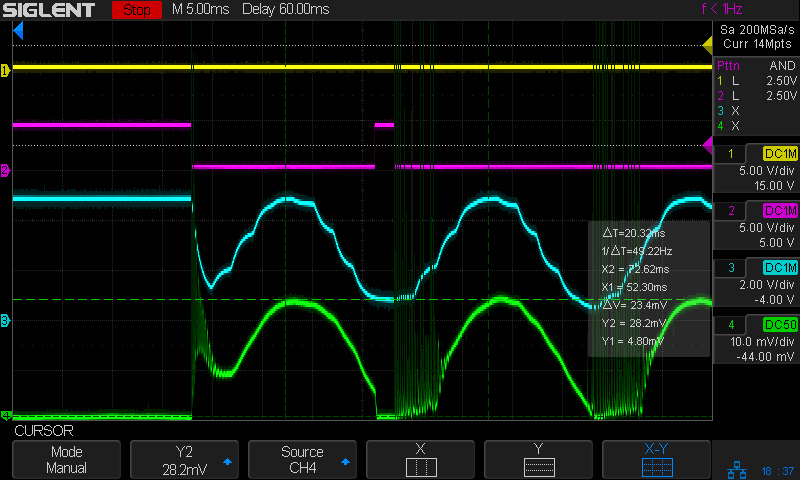
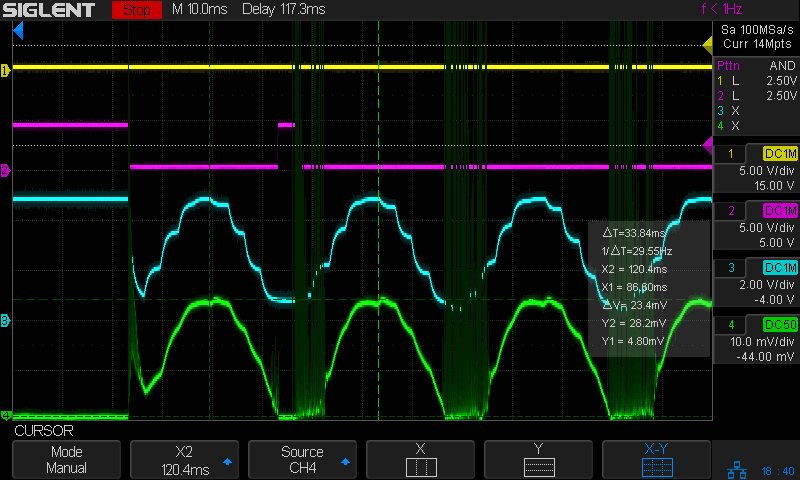
At 50 mm/s = 50 Hz both the L-AN analog voltage and the laser current hit full scale:
Tube Current – analog bandwidth – 10 sine – 50mm-s – 10mA-div – 254dpi
The laser current resembles a damped RLC oscillation when started at nearly full scale and is entirely chaotic when started from zero, but behaves reasonably well for the rest of the cycle.
The power supply’s current bandwidth is definitely smaller than the controller’s voltage bandwidth, as shown by all those sampling steps simply vanishing.
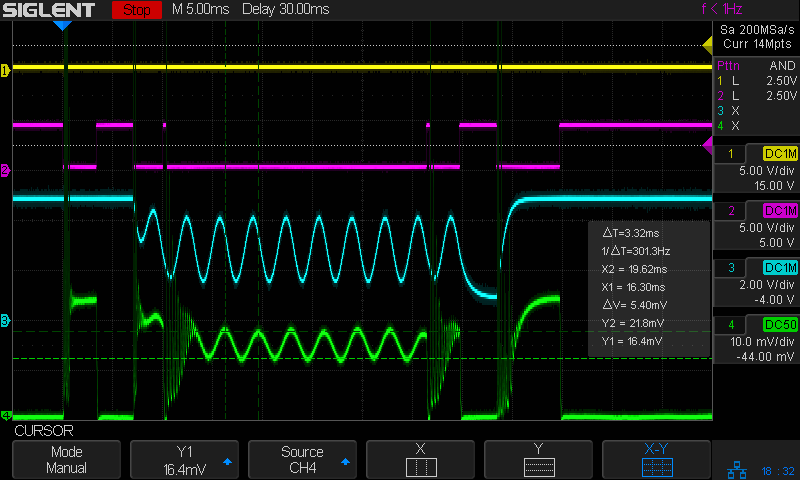
As expected, at 200 mm/s = 200 Hz the L-AN analog voltage is down 3 dB:
Tube Current – analog bandwidth – 10 sine – 200mm-s – 10mA-div – 254dpi
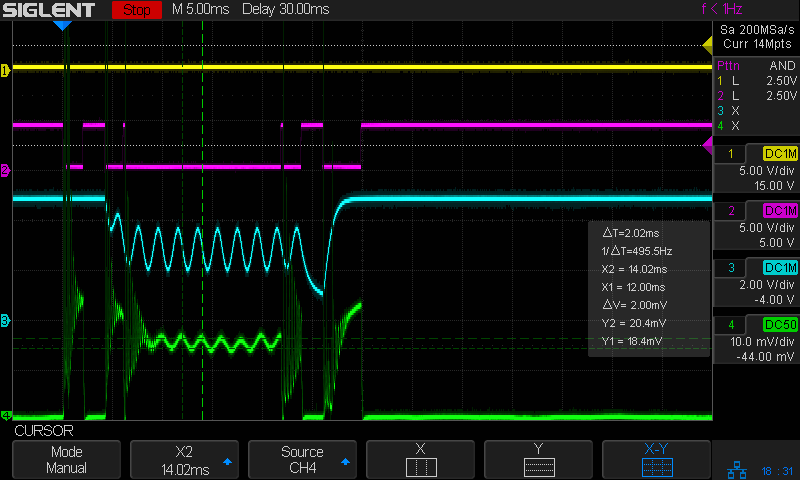
At that frequency the tube current is down 8 dB, from 23.4 mApp to 9.4 mApp, showing how much the power supply’s PWM filter contributes to the rolloff. Since we’re interested in the overall bandwidth, the tube current is down 2.4 dB to 17.8 mA at 100 Hz, suggesting the -3 dB (16.6 mA) frequency is just slightly higher:
Tube Current – analog bandwidth – 10 sine – 100mm-s – 10mA-div – 254dpi
However, I think that’s the wrong way to calculate the -3 dB point of the laser power, because the tube operates at essentially constant voltage, which means both the analog voltage and the tube current are linearly related to the laser tube power, rather than being proportional to its square root.
If that’s the case, then the analog output voltage is down by ½ at 300 Hz and the tube’s half-power point occurs at 23.4 mA/2 = 11+ mA, closer to 200 Hz than 100 Hz. Given the resolution of the measurements, this doesn’t make much difference, but it’s worth keeping in mind.
Applying a 100 Hz PWM pulse (thus, a sharp step) to the power supply shows the laser tube current has a risetime (and falltime) around 2 ms, about what you’d expect from a single 200 Hz lowpass filter inside the power supply:
As far as I can tell, the controller’s “analog” output is just its digital PWM output passed through a 200 Hz low-pass filter. It would be useful as an analog input to a power supply without an additional PWM filter, but combining those two filters definitely cuts the overall bandwidth down.
All of the measurements as a slide show:
Tube Current – analog bandwidth – 10 sine – 25mm-s – 10mA-div – 254dpi
Tube Current – analog bandwidth – 10 sine – 50mm-s – 10mA-div – 254dpi
Tube Current – analog bandwidth – 10 sine – 100mm-s – 10mA-div – 254dpi
Tube Current – analog bandwidth – 10 sine – 200mm-s – 10mA-div – 254dpi
Tube Current – analog bandwidth – 10 sine – 300mm-s – 10mA-div – 254dpi
Tube Current – analog bandwidth – 10 sine – 400mm-s – 10mA-div – 254dpi
Tube Current – analog bandwidth – 10 sine – 500mm-s – 10mA-div – 254dpi
To round this out, I must measure the laser tube current bandwidth using the controller’s PWM signal. Because PWM passes through only the power supply’s lowpass filter, the bandwidth should be slightly higher.
Overall, though, the bandwidth seems surprisingly low.
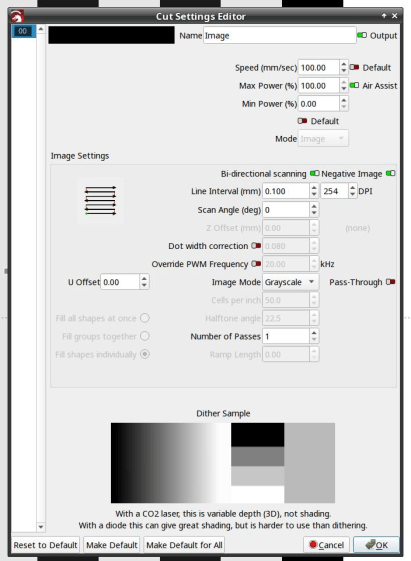
Engrave it in grayscale mode as a negative image with 0.1 mm line spacing:
LightBurn – bandwidth test pattern setup
Monitor the Ruida KT332N controller’s analog laser power control output:
Tube Current – analog bandwidth – 10 sine – 25mm-s – beam off – 254dpi
The traces:
1 X axis DIR, low = left-to-right (yellow)
2 L-ON laser enable, low active (magenta)
3 L-AN analog voltage (cyan)
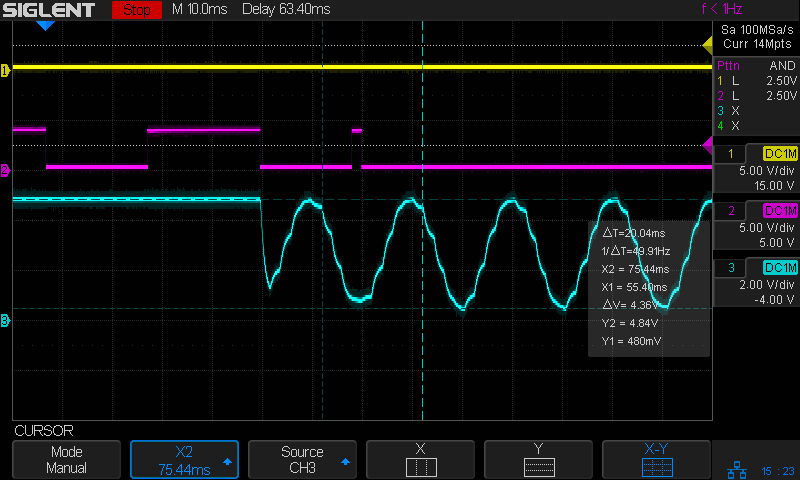
The scope triggers when the top two traces go low during a left-to-right scan with the laser beam active. The trigger point lies far off-screen to the left, with the delay set to pull the interesting part of the scan into view.
Although both the controller’s L-AN output and the laser’s IN input specify a signal range of 0 V to 5 V, the analog output voltage never goes below 0.4 V, but (as will seen later) that produces 0 mA from the laser power supply.
Set the X cursors to the top and bottom of the sine wave and read off the 4.36 V peak-to-peak value.
Set the Y cursors to matching points on successive cycles and read off ΔT=33.44 ms. Because each cycle is 1 mm wide, the scan speed is set to 25 mm/s and traveling 1 mm should require 40 ms, puzzle over that number and the related fact that 1/ΔT=29.91 Hz. This seems to happen only for speeds under 50-ish mm/s, for which I have no explanation.
Repeat the exercise at various speeds up through 500 mm/s:
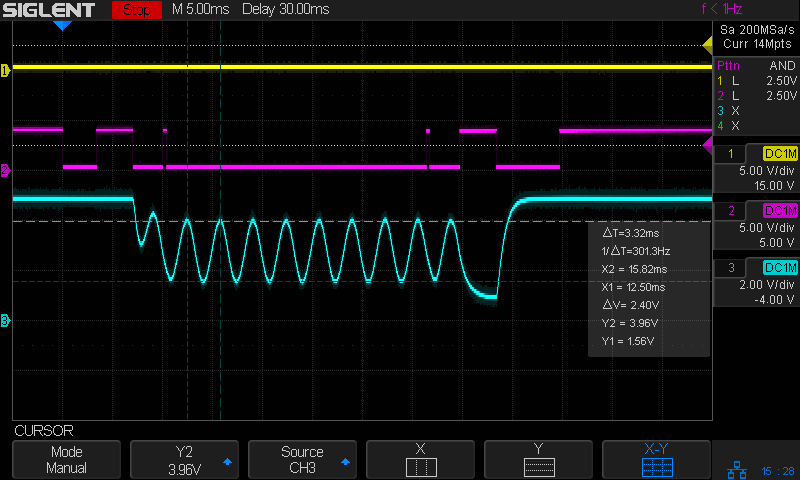
Tube Current – analog bandwidth – 10 sine – 500mm-s – beam off – 254dpi
The analog output voltage has dropped to 1.56 Vpp.
The average voltage increases from 2.66 V at 25 (or is it 33?) Hz to 2.78 at 500 Hz, which is reasonably close to the same value.
The signal’s -3dB point would be at √½ × 4.36 Vpp = 3.1 Vpp, which happens at 200 mm/s = 200 Hz:
Tube Current – analog bandwidth – 10 sine – 200mm-s – beam off – 254dpi
Then if you tell LightBurn to engrave the pattern with a line-to-line (vertical) spacing of 127 dpi = 5 pixel/mm, it will sample every other pixel in each row, producing a rather peculiar sine-ish wave:
Tube Current – analog bandwidth – 10 sine – 25mm-s – beam off – 127dpi
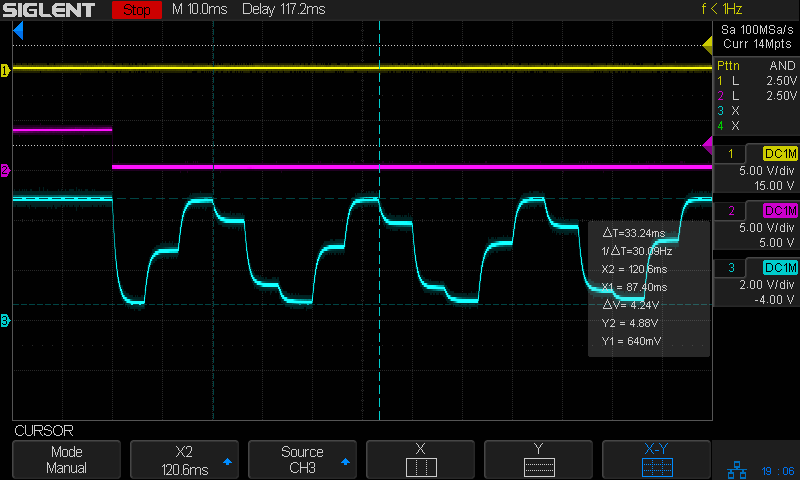
You must engrave at 254 dpi = 10 pixel/mm in order to get all the pixels in the output stream:
Tube Current – analog bandwidth – 10 sine – 25mm-s – beam off – 254dpi
That still looks gnarly, but it’s more along the lines of what the coarse 10 samples / cycle pattern calls for.
The risetime for each of those steps is on the order of 2 ms, so the controller’s analog output bandwidth isn’t much better than 150-ish Hz.
Close examination of the bar pattern shows the end of the first cycle really does hit exactly 0% intensity where the controller raises L-ON (magenta trace) to force the output current to zero. The other minima remain a few percent above zero and cannot be squashed flat.
Today I Learned: LightBurn enforces square pixels at the line spacing distance for grayscale engraving.
I think this means you must resize / resample the grayscale image to match the engraving line spacing, because LightBurn could take the nearest adjacent pixel or average two adjacent pixels if its horizontal sampling doesn’t match the image resolution.
The pattern gets plunked into the same white/black frame as before, using GIMP because it’s easy.
Importing the resulting PNG image into LightBurn allows configuring the laser parameters. Each sine wave is 1 mm (ten whole pixels!) wide, so engraving at 250 mm/s covers one cycle every 4 ms for a 250 Hz signal:
Tube Current – analog – 10 sine – 250mm-s – 10 ma-div
Changing the engraving speed will change the test signal frequency, although the laser can’t get much beyond 500 mm/s.
The sine wave pattern goes from 0% to 100%, but at 250 Hz the controller output doesn’t reach those extremes, suggesting the output filter rolloff is lower than the 200 Hz inferred from the 1.5 ms risetime and falltime values.
Because the power supply output current isn’t matching the controller voltage excursion and its waveform is much rounder, its bandwidth is even lower.
For example, this would generate five square waves:
Gray bars 10-90
The bars are 10 pixels wide, so scaling the image at 254 dpi makes them 1 mm wide:
LightBurn – bandwidth test pattern setup
As before, the first and last bars are 100% (white), with 0% (black) bars just inboard. The other bars are 10% and 90% to stay a little bit away from the 0 V and 5 V limits. I set Lightburn to invert the colors so that 100% = full power and 0% = beam off.
Engraving the pattern at 100 mm/s makes each bar 10 ms wide and the risetimes and falltimes are easy to see:
Tube Current – analog – gray bars 10-90 – 100mm-s – 10 ma-div
[Edit: Clicked the wrong picture.]
Although it’s a bit handwavy, a 1.5-ish ms risetime suggests a single pole (ordinary RC) time constant τ = 700 µs = 1.5 ms/2.2, so the controller’s output filter cutoff would be around 200 Hz = 1/(2π τ).
The laser tube current looks a little slower than that, so there’s a definite tradeoff among engraving speed, edge crispness, and power level.
The L-AN terminal produces an equivalent analog signal:
Ruida KT332 – analog laser control wiring
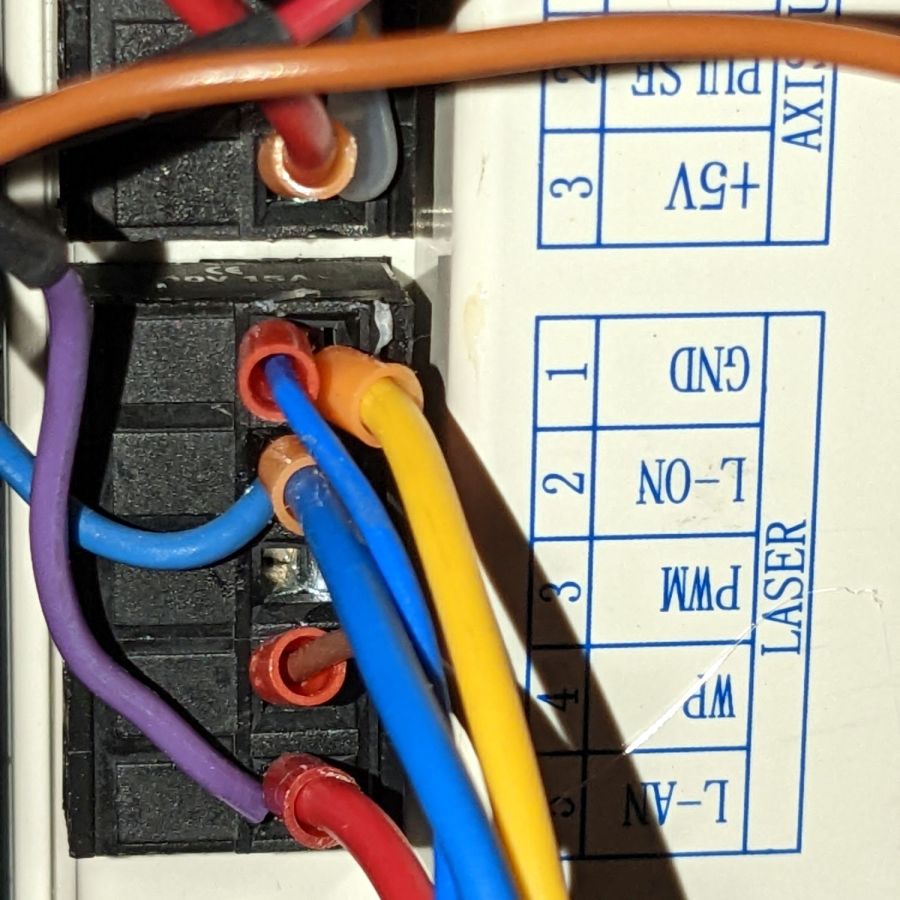
The power supply accepts both analog and PWM signals on its IN terminal, so no rewiring was needed on that end:
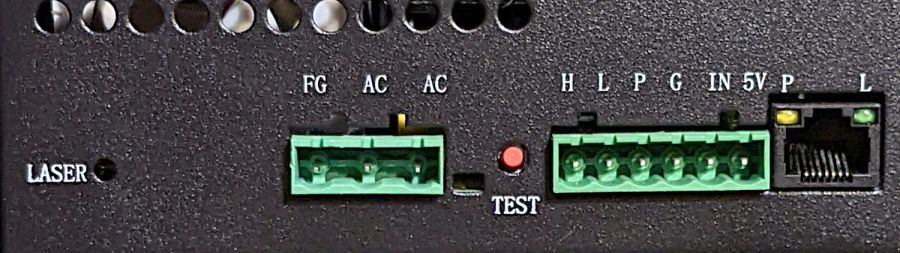
OMTech 60W HV power supply – terminals
This test pattern came in handy again:
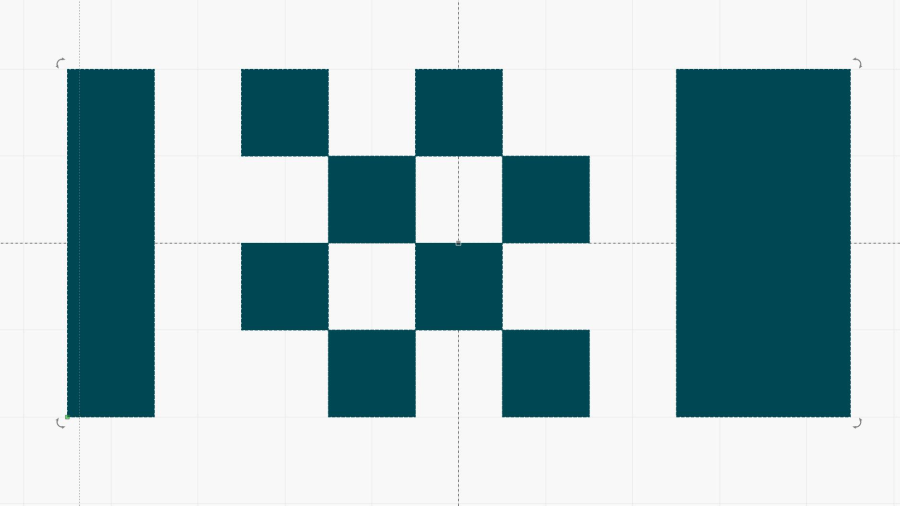
Gray bars
The pattern has white bars on the left and right edges as markers. I invert the pattern in LightBurn so that white produced 100% PWM and black produced 0% PWM.
The L-AN output produces 5 V for 100% power and 0 V for 0% power, with other power fractions spread out in between:
Tube Current – analog – gray bars – 10 ma-div
The traces:
1 X axis DIR, low = left-to-right (yellow)
2 L-ON laser enable, low active (magenta)
3 L-AN analog voltage (cyan)
4 tube current – 10 mA/div (green)
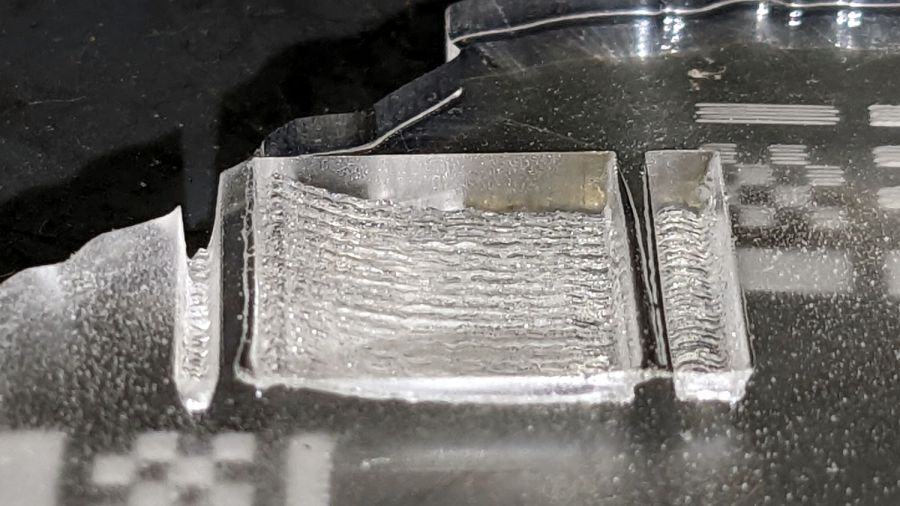
Engraving that pattern in scrap acrylic looks like you’d expect:
Analog mode acrylic engraving
There’s little trace of the discrete intensity levels in the acrylic trench and the scan interval is a rather coarse 0.2 mm.
The PWM signal does not appear in that scope shot, because it runs at 20 kHz and is a blur at 20 ms/div.
It’s worth noting that the tube current has large startup spikes at low power levels in both PWM and analog control, so the spikes are generated internal to the power supply and have nothing to do with the PWM input signal.
Another test pattern using constant power:
Pulse Timing Pattern – 1 mm blocks
At 10% power the analog output is about 0.5 V:
Tube Current – analog – 10pct 250mm-s – 10 ma-div
At 50% power the analog output is a constant 2.5 V and the tube current settles at a constant 12-ish mA, about half of the power supply’s maximum 25 mA:
Tube Current – analog – 50pct 250mm-s – 10 ma-div
Obviously, controlling the laser power to intermediate values using an analog signal does not involve switching the current between the supply’s minimum and maximum values: there are no PWM pulses involved to do the switching.
I suspect the analog output comes from the PWM signal run through an internal low-pass filter similar to the one in the power supply. Based on the PWM frequency measurements and squinting at the rise / fall times, the analog filter cutoff is probably around 1 kHz.
Other than bragging rights, I don’t see much advantage to using the analog signal in place of PWM.