Ed Nisley's Blog: Shop notes, electronics, firmware, machinery, 3D printing, laser cuttery, and curiosities. Contents: 100% human thinking, 0% AI slop.
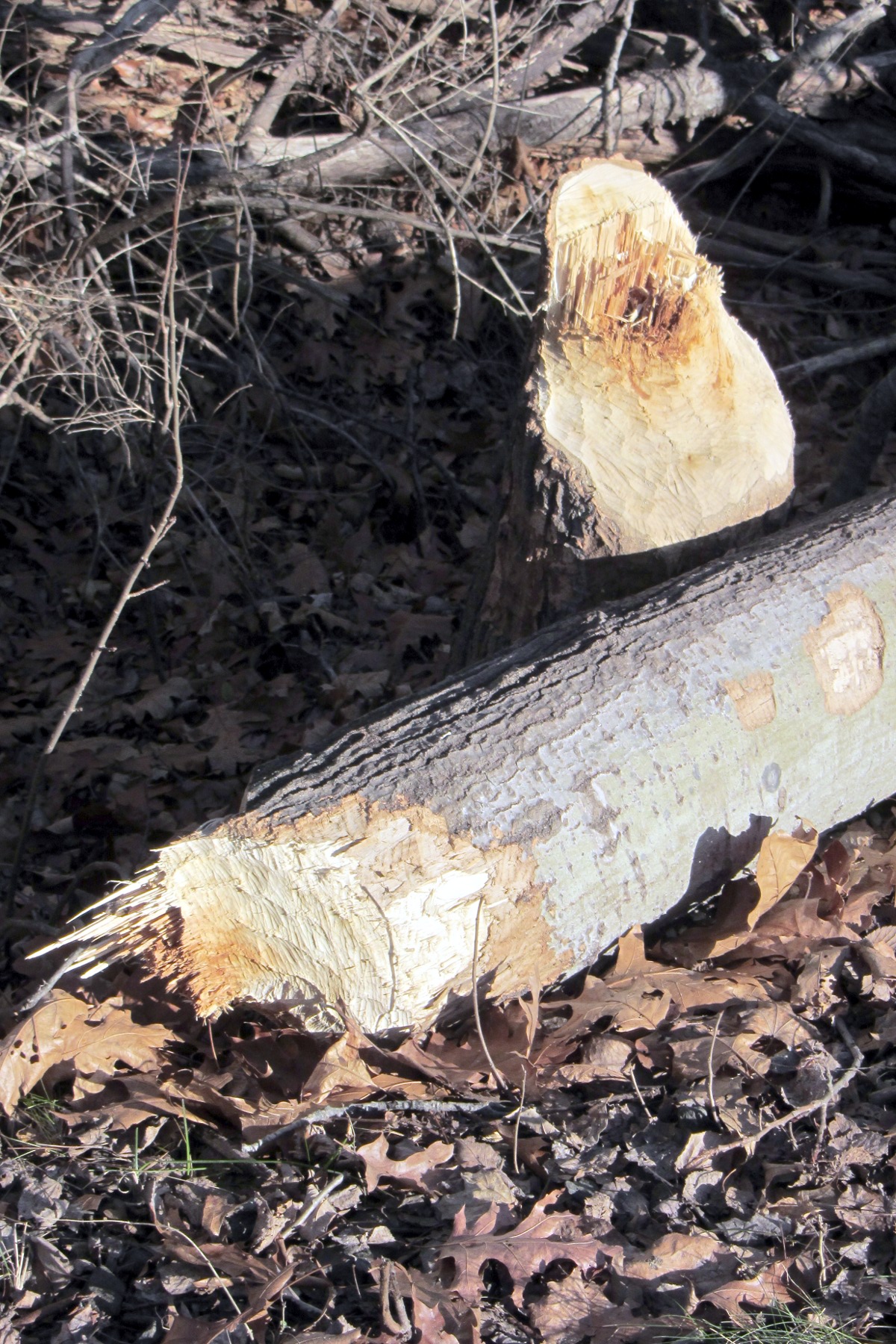
Evidently, the beaver stopped just before the tree toppled, because the last cut looks very much like a chainsaw.
I didn’t spot their lodge out in the lake; they may have tucked it under the bank below the railroad bed.
If they keep this up, they’re sure to get trapped and moved somewhere they can’t interfere with our enjoyment of the natural landscape along the rail trail. [wince]
Although the contacts passing power to the Wouxun HT worked well, they were obviously (in retrospect, as always) in the wrong place. Recently I rode the bike over a major bump and heard the radio reboot (it gives off two low-speed Morse “M” characters), which suggests at least one of the screw heads just barely touches the radio’s spring contacts.
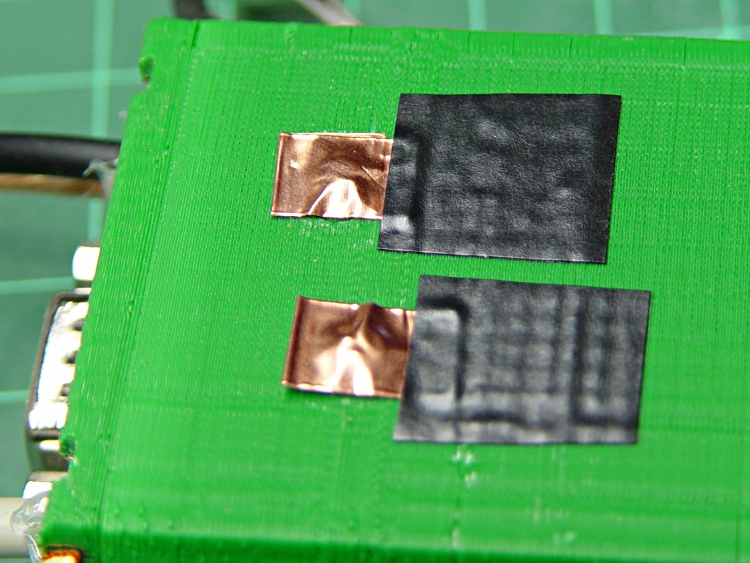
Two folded-under strips of copper tape may work around that problem until I build a whole ‘nother interface:
Copper foil on power contacts
The black tape adds emphasis to the lightly sticky end of the copper tape. The folded-under ends lie to the left in the picture, so there’s a continuous copper sheet connecting the radio battery contacts to the screw heads on the green case. It’s not a huge cross-sectional area, but … it’s better than no area at all.
The last time I tried this fix, I used woven copper mesh tape. This time, the solid copper tape was on top of the TLB (Tape Lookaside Buffer) holding the specialty tapes. Either should work fine.
During that ride for apples, we stopped for lunch in the middle of the Walkway where the scenery is a lot better and the traffic much more pleasant than elsewhere along our route:
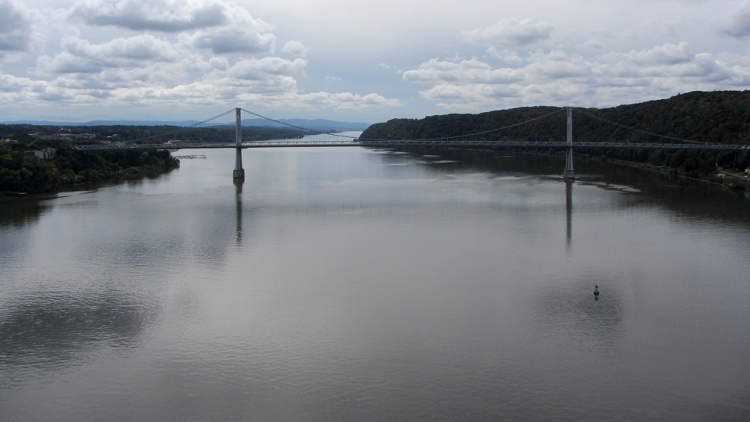
Poughkeepsie Bridge
For reasons that have nothing to do with engineering judgement, the west (right) end of the Mid-Hudson Bridge terminates at a cliff with the road in a monster cut turning abruptly to the right and ramping up to the toll plaza. It’s still a pretty span…
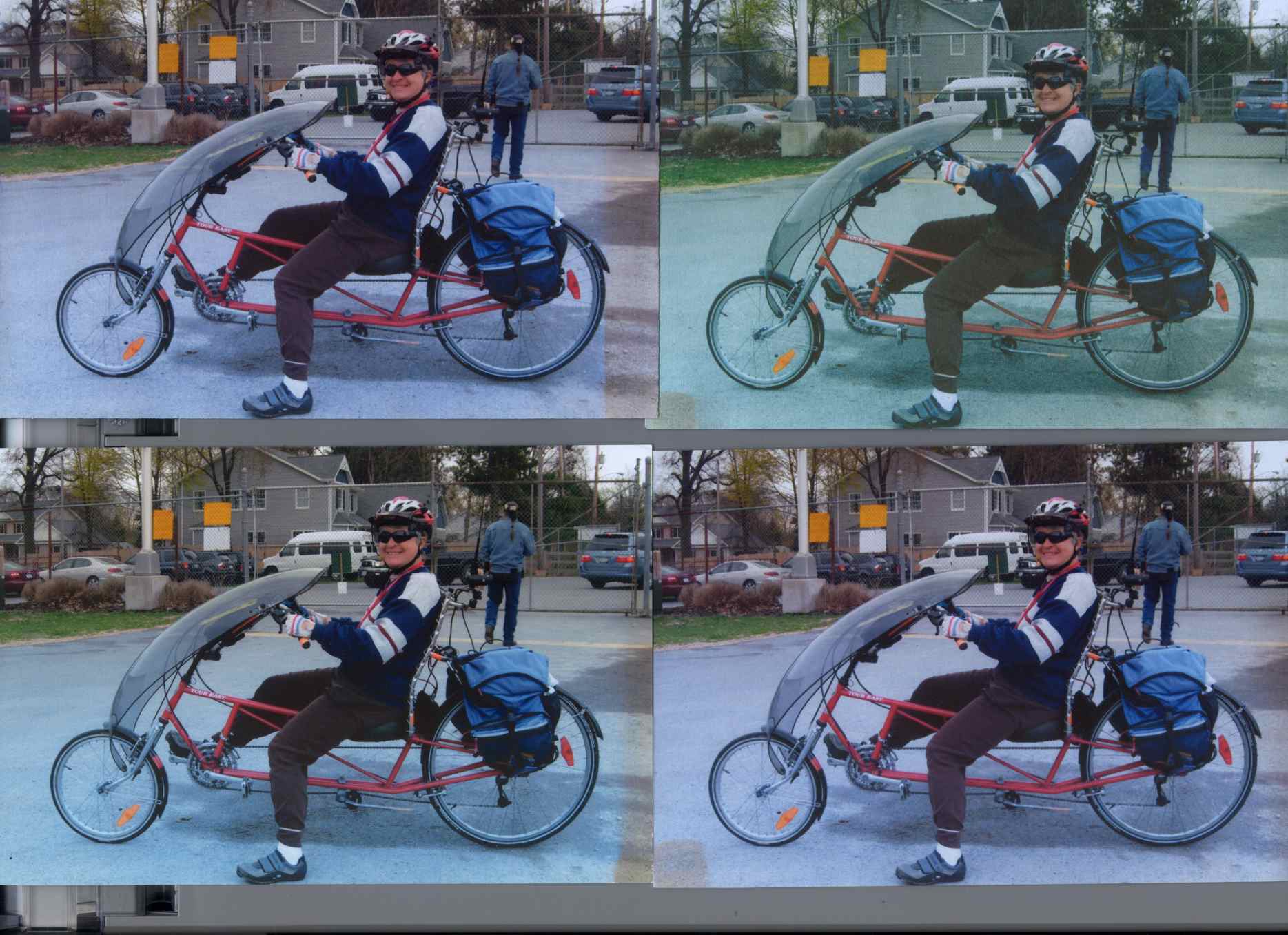
Back in December 2007 I printed four copies of a picture on various papers with the Canon S630 and hung them on a floor joist over my workbench, directly below a fluorescent shop light. Having just hung those screwdrivers where the pictures used to be, it’s time to see what’s happened.
The pictures, scanned on an HP C7670A (aka Scanjet 6300C) against the neutral gray of the ADF platen:
Inkjet Colors vs. Paper vs. Time
The papers, clockwise from lower left:
Glossy
Matte
Plain
Inkjet
While the scanner isn’t renown for its color fidelity, the overall results look about right; the platen really is that shade of gray and the upper-right picture has a sickly green hue.
The faded edges along the right side of the left-hand image show where the adjacent sheet overlapped: the colors didn’t fade nearly as much. The small rectangles on the lower left corners of the right-hand images show where I put clothes pins to keep the sheets from curling.
All of the images have a blue overtone; the magenta dye fades out with exposure to UV from the fluorescent fixture.
As you’d expect, the glossy paper looks best, with very crisp detail. The inkjet paper is next, followed by the matte, and the plain paper in the upper right obviously doesn’t support the ink well at all.
Of course, after five years I no longer have any of those papers and am using entirely different ink…
To show that the scanner really does matter, here’s the same set of images from a Canon LiDE 30:
Inkjet Colors – Canon LiDE30
In both cases. that’s without any color correction / gamma compensation / whatever. I should fish out my scanner calibration targets and go through the whole color calibration dance again; with any luck, the Linux color management infrastructure will be less inadequate by now.
The two packets at 15:50:20 represent two different paths from the WA2YSM-15 digipeater to the APRS database: one through WB2ZII-15 and the other through KC2DHU. The “Rate limited” message indicates that the database regarded the two as different packets, which they are: the position data differs by one character. The database discards identical packets without comment, because the network must handle all the packets generated by a single RF transmission from one GPS tracker to multiple receivers, but rejects what it sees as deliberate (or inadvertent) attempts to overwhelm it.
Decoding the packets provides a bit more information:
2012-10-21 15:49:53 EDT: KE4ZNU-9>T1TP5W,WA2YSM-15,WIDE1*,WIDE2,qAR,WB2ZII-15:`eS$l{1b/"4U}
   type: location
   format: mice
   srccallsign: KE4ZNU-9
   dstcallsign: T1TP5W
   latitude: 41.67616666666667 °
   longitude: -73.91800000000001 °
   course: 121 °
   speed: 16.668 km/h
   altitude: 62 m
   symboltable: /
   symbolcode: b
   mbits: 101
   posresolution: 18.52 m
   posambiguity: 0

2012-10-21 15:50:20 EDT: KE4ZNU-9>T1TP5V,WA2YSM-15,WIDE1,K2PUT-15*,WIDE2,qAR,WB2ZII-15:`eR lzlb/"4V}
   type: location
   format: mice
   srccallsign: KE4ZNU-9
   dstcallsign: T1TP5V
   latitude: 41.676 °
   longitude: -73.90066666666667 °
   course: 80 °
   speed: 16.668 km/h
   altitude: 63 m
   symboltable: /
   symbolcode: b
   mbits: 101
   posresolution: 18.52 m
   posambiguity: 0

2012-10-21 15:50:20 EDT: KE4ZNU-9>T1TP5V,WA2YSM-15,WIDE1,K2PUT-15*,WIDE2,qAR,KC2DHU:`eR<0x7f>lzlb/"4V} [Rate limited (< 5 sec)]
   type: location
   format: mice
   srccallsign: KE4ZNU-9
   dstcallsign: T1TP5V
   latitude: 41.676 °
   longitude: -73.9165 °
   course: 80 °
   speed: 16.668 km/h
   altitude: 63 m
   symboltable: /
   symbolcode: b
   mbits: 101
   posresolution: 18.52 m
   posambiguity: 0

2012-10-21 15:52:31 EDT: KE4ZNU-9>T1TP8T,W2LW-15,W2LV,WIDE2*,qAR,W2GSA:`eR|lz:b/<4T}
   type: location
   format: mice
   srccallsign: KE4ZNU-9
   dstcallsign: T1TP8T
   latitude: 41.68066666666667 °
   longitude: -73.916 °
   course: 30 °
   speed: 16.668 km/h
   altitude: 61 m
   symboltable: /
   symbolcode: b
   mbits: 101
   posresolution: 18.52 m
   posambiguity: 0
Feeding the coordinates into Google Maps shows that the first packet (to WB2ZII-15) at 15:50:20 carries the damaged data. The second (to KC2DHU) has the correct position, but was rejected because it arrived just after the first and wasn’t an exact duplicate.
AX.25 packets carry a checksum and it’s a convolutional code, not a simple XOR, so I think it’s safe to say the packets were received as transmitted; you’ll find an intro to that whole topic, with further references, in the N1VG OpenTracker project. The database doesn’t store complete AX.25 packets, so we can’t run their headers and data through the checksum algorithm to see if they both produce good results. Here’s the raw packet payload:
2012-10-21 15:50:20 EDT KE4ZNU-9: 75 bytes
0x00 K E 4 Z N U - 9 > T 1 T P 5 V , W A 2 Y S M - 1 5 , W I D E 1 ,
     4b45345a4e552d393e5431545035562c57413259534d2d31352c57494445312c
0x20 K 2 P U T - 1 5 * , W I D E 2 , q A R , W B 2 Z I I - 1 5 : ` e
     4b325055542d31352a2c57494445322c7141522c5742325a49492d31353a6065
0x40 R   l z l b / " 4 V }
     52206c7a6c622f2234567d

2012-10-21 15:50:20 EDT KE4ZNU-9: 72 bytes [Rate limited (< 5 sec)]
0x00 K E 4 Z N U - 9 > T 1 T P 5 V , W A 2 Y S M - 1 5 , W I D E 1 ,
     4b45345a4e552d393e5431545035562c57413259534d2d31352c57494445312c
0x20 K 2 P U T - 1 5 * , W I D E 2 , q A R , K C 2 D H U : ` e R 7fl
     4b325055542d31352a2c57494445322c7141522c4b43324448553a6065527f6c
0x40 z l b / " 4 V }
     7a6c622f2234567d
So it seems the TinyTrak3+ sent out a packet containing bad position data, wrapped with a correct checksum.
The NMEA-format 4800 baud 8N1 serial data from the GPS receiver puck to the TT3+ has no parity error detection, so I suspect a character or two got clobbered (by RFI?) and produced a bad position. NMEA messages have a simple XOR checksum that’s susceptible to that kind of error. Note that the Mic-E encoded message shown above is not passed from the GPS receiver to the TT3+; we never see the raw GPS data.
Our TinyTraks use SmartBeaconing to transmit only on significant course changes, so the sequence of events probably went like this:
The TT3+ decodes a damaged NMEA message from the GPS receiver
It notices an abrupt position change and sends that incorrect position
The next NMEA message arrives correctly
The TT3+ sees another abrupt jump and sends that position
The aprs.fi database rejects the message due to rate limiting
The TT3+ remains silent until the next turn
The map doesn’t show all the turns, because that’s a hilly area and not all RF packets make their way from my bike to an APRS receiver.
For what it’s worth, although we were riding at a fairly steady pace, I don’t believe the five-significant-figure accuracy of those speeds, either.
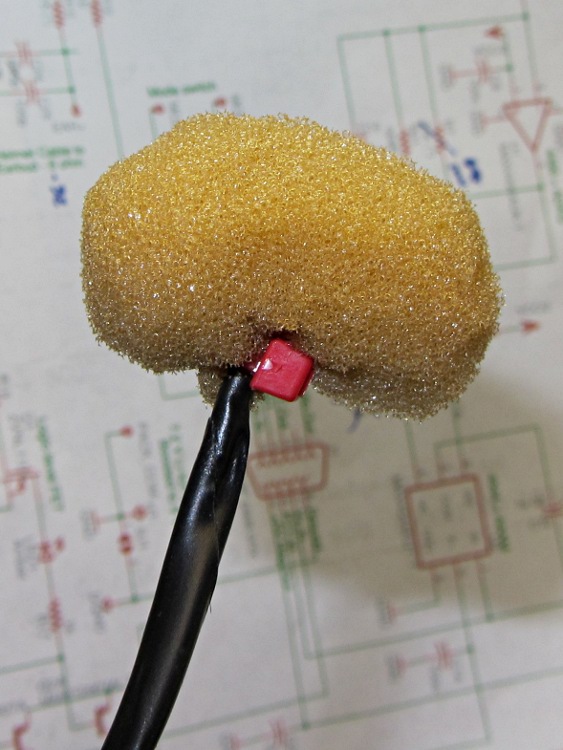
The bikes stand upright inside the van and the helmets ride on the floor with all their stalks sticking up. This usually works out well, but on our last trip my helmet rolled under my bike and rubbed the foam ball surrounding its mic against the chain, producing a result so awful that I had to install new foam.
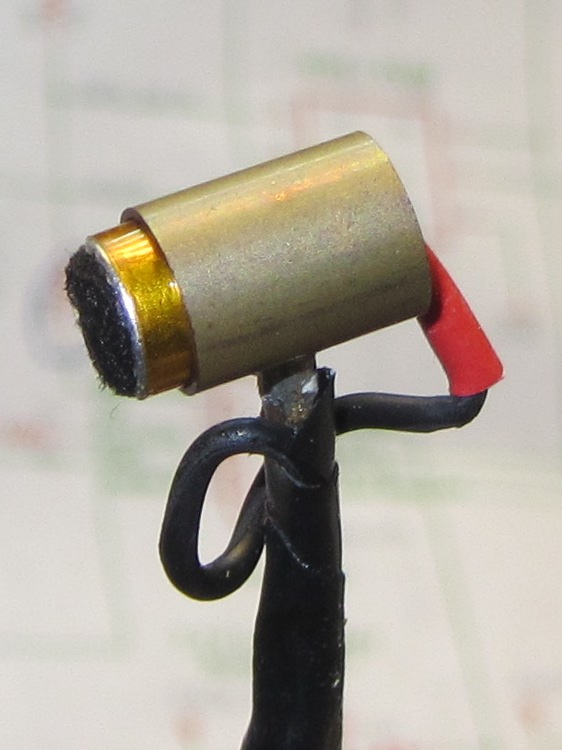
The foam comes from a sheet of Sonex acoustic foam baffle, snipped into a reasonable approximation of a ball, with a slit deep enough to surround the mic, and a cable tie holding it closed:
Foam mic ball on bike helmet boom
For what it’s worth, I’ve found that excessive wind noise correlates with too much mic gain. The mic rides about a finger’s width from the corner of my mouth, I talk at a normal volume, the amp supplies about 20 dB of gain, and we have no trouble with wind noise. The amp gain depends on the mic sensitivity, so your results will certainly differ; these mics came from the heap with no specs whatsoever.
I suppose wind noise also depends on the bike’s speed, but when I’m going that fast I don’t have enough brain or lungs left over to hold a conversation…