Ed Nisley's Blog: Shop notes, electronics, firmware, machinery, 3D printing, laser cuttery, and curiosities. Contents: 100% human thinking, 0% AI slop.
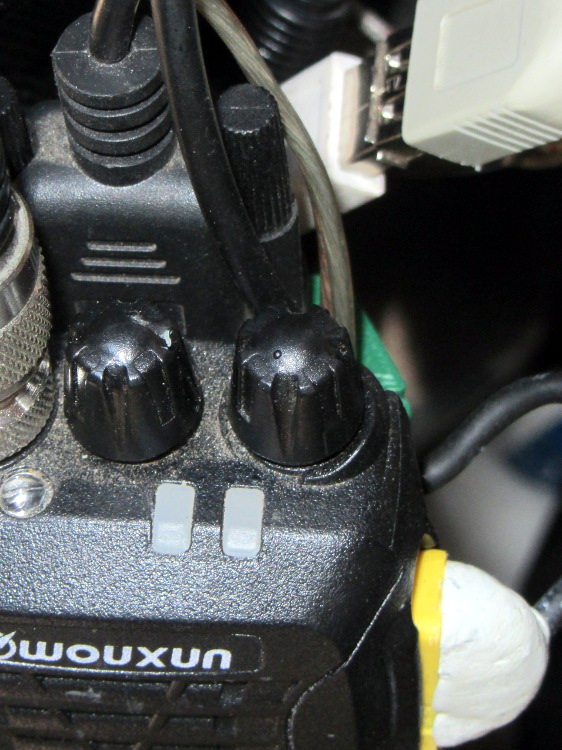
The volume / on-off control knob on our Wouxun KG-UV3D radios has the most minute raised dot you can imagine to mark its orientation. Yes, it’s another subtle black-on-black control! See if you can spot the dot:
Wouxun KG-UV3D – volume knob marking
The radio lives in a small pack attached to the back of the seat frame: we turn it with a fingertip and adjust the volume by touch; the dot is just barely perceptible to my finger. Nevertheless, WIBNI (Would It Be Nice If) you could look at the knob from a distance and determine whether the radio was turned on?
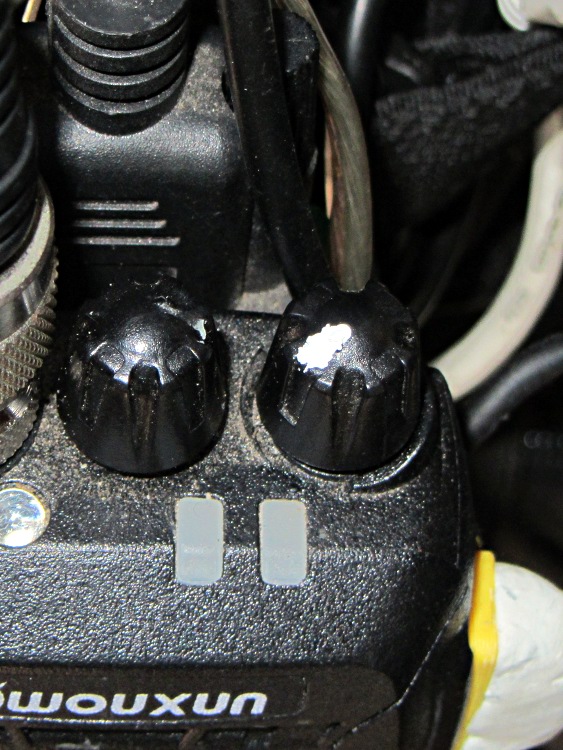
A dab of typewriter (remember typewriters?) correction fluid later:
Wouxun KG-UV3D – garish knob marking
Not elegant and sure to wear off after a while, but the smudge should remain visible forever.
The paving along Rt 376 just south of Raymond Avenue developed transverse ridges; evidently the old concrete roadway below the more recent asphalt cap is shifting. Bumps in the travel lane are not to be tolerated, so they milled off all the ridges. Problem solved!
Of course, the remaining asphalt isn’t thick enough to withstand any stress and promptly crumbles:
NYS DOT joint milling quality
Although the shoulder may appear to be wide enough for bicycle traffic, the debris strewn along it makes for a perilous journey: the larger chunks are bigger than my fist. Several of the milled joints along the unimproved section of Raymond and that stretch of 376 are disintegrating, so it’s not like they got just this one wrong.
Doesn’t bother the DOT one little bit, because their idea of a “shared use facility” is a sign with a picture of a bicycle, labeled Share The Road. As long as the travel lane seems mostly passable by automobiles, their job is done.
Our Larval Engineer acquired a free bicycle to get around at school: a Rollfast “girl’s bike” dating back to 1972 with 105 miles on the odometer. She completely dismantled it, cleaned everything, reassembled it in reverse order, and added a rear rack & panniers. Having touched every part of the bike, she’s now in a much better position to fix whatever may go wrong in the future.
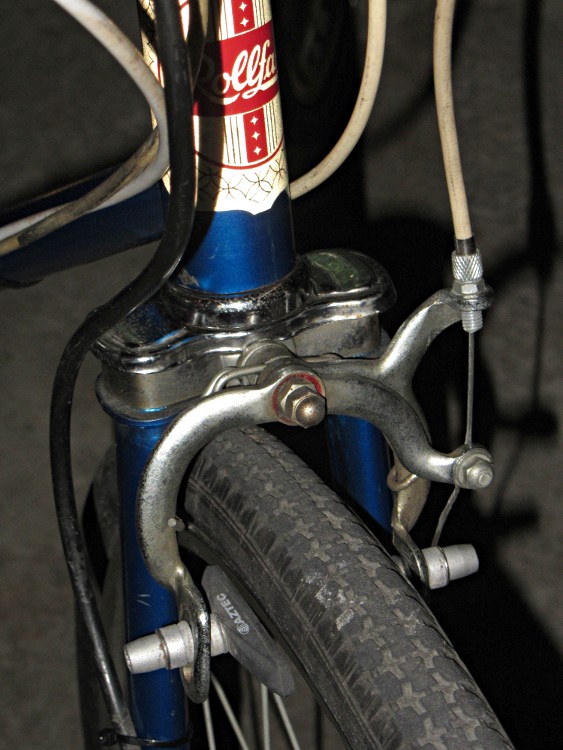
It was an inexpensive bike to start with and we left everything as-is, with the exception of the brake pads. You’re supposed to bend the brake arms to align the pads with the rims, a technique which I didn’t like even back in the day. So we swapped the OEM pads with worn-but-serviceable Aztek pads sporting spherical washers:
They’re way grippier than the old pads, even on those chromed-steel rims. I had a bike with steel rims and old pads; given the slightest hint of water, it didn’t stop for squat. With any luck, the Azteks will at least slow this one down.
Although she wanted to take the Tour Easy, the bike must live outside under the apartment stairs all year and, frankly, that’d kill the recumbent in short order. Forgive me for being a domineering parent; when she has a good place to store a spendy bike, it’s hers for the taking.
We haven’t figured out how to mount the GPS/APRS tracker + radio and antenna. The evidence suggests she prefers to travel incognito from now on…
I designed the GPS+Audio case around the TinyTrak3+ board in my radio, which has two square, blue-plastic trimpots. The case worked fine for that board. Then I printed the case for the next bike and that TT3+ didn’t slide neatly into place:
TinyTrak3+ trimpot overhang
Turns out that one of the three TT3+ boards uses plastic trimpots and the other two have metal trimpots bent to fit the existing holes (so they’re not a drop-in replacement), with a very slight overhang beyond the edge of the PCB.
So I attacked the case with some riffler files and carved a notch above the PCB slot. No pictures of that, lest you think I’m a butcher of lovely 3D printed objects. Next time: build the notch into the case’s solid model.
Most likely, this is the only instance of those pots causing anyone a problem…
The Wouxun KG-UV3D is advertised as a “dual band” radio, but it has only one hardware receiver: in TDR mode (there is no explanation of what TDR means, so there may not be an English equivalent; I suspect it’s not Time Domain Reflectometry) with two frequencies / channels displayed, the first to receive a transmission produces audio output until that signal stops, regardless of what happens on the other frequency / channel. In contrast, the ICOM Z1A and W32A radios we were using had two hardware receivers and the audio output was the sum of the two signals, with independent volume controls.
That wouldn’t matter, except that I monitor the E911 dispatch channel while riding, so that I know when an emergency vehicle will be coming along my route: distracted drivers are bad enough, but a distracted driver dodging an ambulance is really bad. The E911 transmitters have punchy audio compared to anything else, so it’d be nice to turn down the dispatcher’s level compared to the relatively quiet voice + APRS signals on the other channel.
No can do.
The KG-UV3D also requires much higher audio on the mic input than the Z1A for the equivalent output. Contrary to that schematic, I’m now running the op amp gain at about 4.5 (13 dB) instead of 1.6 (4 dB): it’s a 100 kΩ feedback resistor. That puts it on a par with the E911 audio, but it’s still somewhat quiet.
The TinyTrak3+ board produces audio tones through a 4-bit binary resistor network that feeds into a 220 kΩ resistor in series with the 10 kΩ trimpot that sets its output level. Cranking that pot all the way up produces roughly the same volume as the +13 dB helmet mic audio. If I increase the mic gain any further, however, I should also increase the TT3+ audio output, which means reducing the 220 kΩ resistor on the TT3+ board. The TT3+ doc advises:
Some mobile radios require more audio drive than TinyTrak3 puts out. If audio levels are too low, even with the R6 pot set to maximum, consider replacing the 220K R5 with a 100K resistor or shorting jumper. This should allow for about double the audio range.
Dunno if that means another 3 or 6 dB or what, but it might come in handy.
However, increasing the mic gain has the disadvantage of causing more wind noise: it’s always there and high mic gain makes it much worse. The foam balls over the mics work well, but the voice volume drops off dramatically as the mouth-to-mic distance increase; about half an inch is a good distance. So there’s an upper limit on mic gain.
I’ve also increased the earphone attenuation, with a 150 Ω resistor in series with the earbud, to give the receiver volume control more useful range.
It’s workable as it stands and the many APRS receivers have no trouble decoding the packets, so all this is in the nature of fine tuning. I do miss the dual audio outputs, though…
After a few sessions of soldering-and-checking, it looks good:
HT-GPS PCB – cabled in place
The yellow wires on the far right are temporary power connections; battery power enters through the contact studs in those large holes that press against the radio’s battery terminals. The cable in the lower right is the mis-color-coded USB cable that carries audio to & from the earbud & mic on the helmet. Not all the pads have components; I didn’t use all the parallel bypass cap locations because I wasn’t up for protracted self-resonance measurements.
The TinyTrak3+ cable solders into the empty DB9 footprint over on the left. I must cannibalize that from the ICOM IC-Z1A interface in Mary’s bike after the next Wouxun KG-UV3D arrives; with any luck, there’ll be a rainy day or two for that work.
The as-built schematic (clicky for more dots), which is pretty close to the original intent:
Schematic – Wouxun HT GPS+Voice Interface – August 2012
Based on those measurements that suggest spacing the plugs at 11.5 mm on center, I tweaked that parameter in the source code there and printed another one, just like the other one. Actually, I printed four of the fool things this time:
Wouxun plug plates – 11.5 mm fixture
With the plugs in the gluing fixture and the fixture in the vise, a ring of epoxy around the threaded sides holds them in place:
Wouxun plug plate – wired
A trial fit in the Wouxun KG-UV3D shows that the jacks prefer the 11.2 mm spacing I measured on the Wouxun headset, but they’ll accept plugs on 11.5 mm centers. I don’t know if that’s a real specification difference, a manufacturing tolerance, or what.
FWIW, I’ve been using snippets of that cable forever, because it’s perfect for this application: two unshielded conductors and three more inside a braid, supple as a snake. It’s surplus, of course, with a gorgeous push-lock plug (and the jack!) on one end that must have cost a fortune… and which I’ll never to use for anything. Got two of them, just in case.
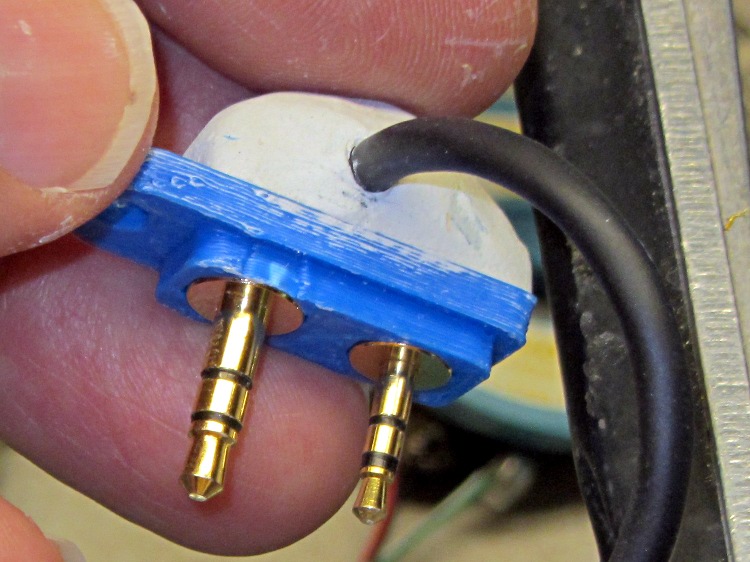
Mushing an epoxy putty turd on the top anchors everything in place and protects the wires:
Wouxun plug plate – epoxy cap
In point of fact, the cable insulation isn’t anchored inside the blob and a minor tug could pull it loose. There will be a bit of slack at the case to allow for unlatching it from the radio, but the lashup will spend its entire life inside a snug pouch, so it shouldn’t come to any harm. We shall see.




 The Smell of Molten Projects in the Morning