Ed Nisley's Blog: Shop notes, electronics, firmware, machinery, 3D printing, laser cuttery, and curiosities. Contents: 100% human thinking, 0% AI slop.
We didn’t get much more than damp and planned the ride with a bail-out route home, so it was all good.
The camera ran from STK Battery A, which had gone flat 37 minutes into a recent ride, so I popped it in the battery tester and drained the rest of its charge:
Sony NP-BX1 – STK A 27 min vs full – 2016-03-25
The dotted section says it had 0.85 W·h remaining after 27 minutes. Hand-positioning a copy of that curve against the full charge and discharge curve says the camera required 2.8 W·h. Eyeballometrically averaging the voltage over the leading part of the curve as 3.8 V says the battery delivered 0.74 A·h = 2.8 W·h / 3.8 V, then dividing that by 27/60 says the camera draws 1.6 A. That’s less than the 2 A guesstimate from previous data, but I don’t trust any of this for more than about one significant figure.
Running the camera for 27 minutes requires 2.8 W·h, meaning 37 minutes should require 3.8 W·h. The curve says that’s the capacity at the 2.8 V test cutoff, suggesting the camera also has a 2.8 V cutoff.
Looking at the discharge curves from yesterday’s post:
Sony NP-BX1 – STK ABCD – 2015-11-03 vs 2016-03-24
If all that hangs together, the C and D batteries should run the camera for just slightly longer than the A battery, but that doesn’t seem to be the actual result: they’re much better than that.
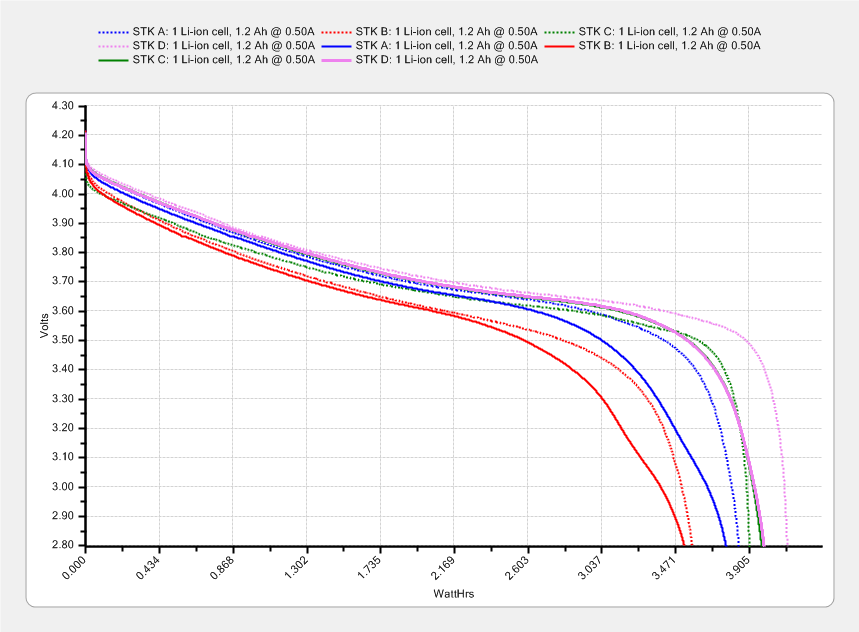
I’ve marched the four STK NP-BX1 lithium batteries through the Sony HDR-AS30V camera in constant rotation since last November. The A battery drained 35 minutes into an ordinary ride on a pleasant day, so charging and measuring the entire set seemed in order:
Sony NP-BX1 – STK ABCD – 2015-11-03 vs 2016-03-24
The dotted curves come from early November 2015, when the batteries were fresh & new, and the solid curves represent their current performance.
It’s been a mild winter, so we’ve done perhaps 75 rides during the last 150-ish days. That means each battery has experienced under 20 discharge cycles, which ought not make much difference.
The B battery started out weak and hasn’t gotten any better; I routinely change that one halfway into our longer rides.
The A battery started marginally weaker than C and D, but has definitely lost its edge: the voltage depression at the knee of the curve might account for the early shutdown.
Figuring that the camera dissipates 2.2 W, a battery that fails after 35 minutes has a capacity of 1.3 W·h. That suggests a cutoff voltage around 3.8 V, which makes absolutely no sense whatsoever, because the C and D batteries deliver at least 75 minutes = 2.8 W·h along similar voltage curves.
The B battery goes in the recycle heap and we’ll see how the A battery behaves on another ride…
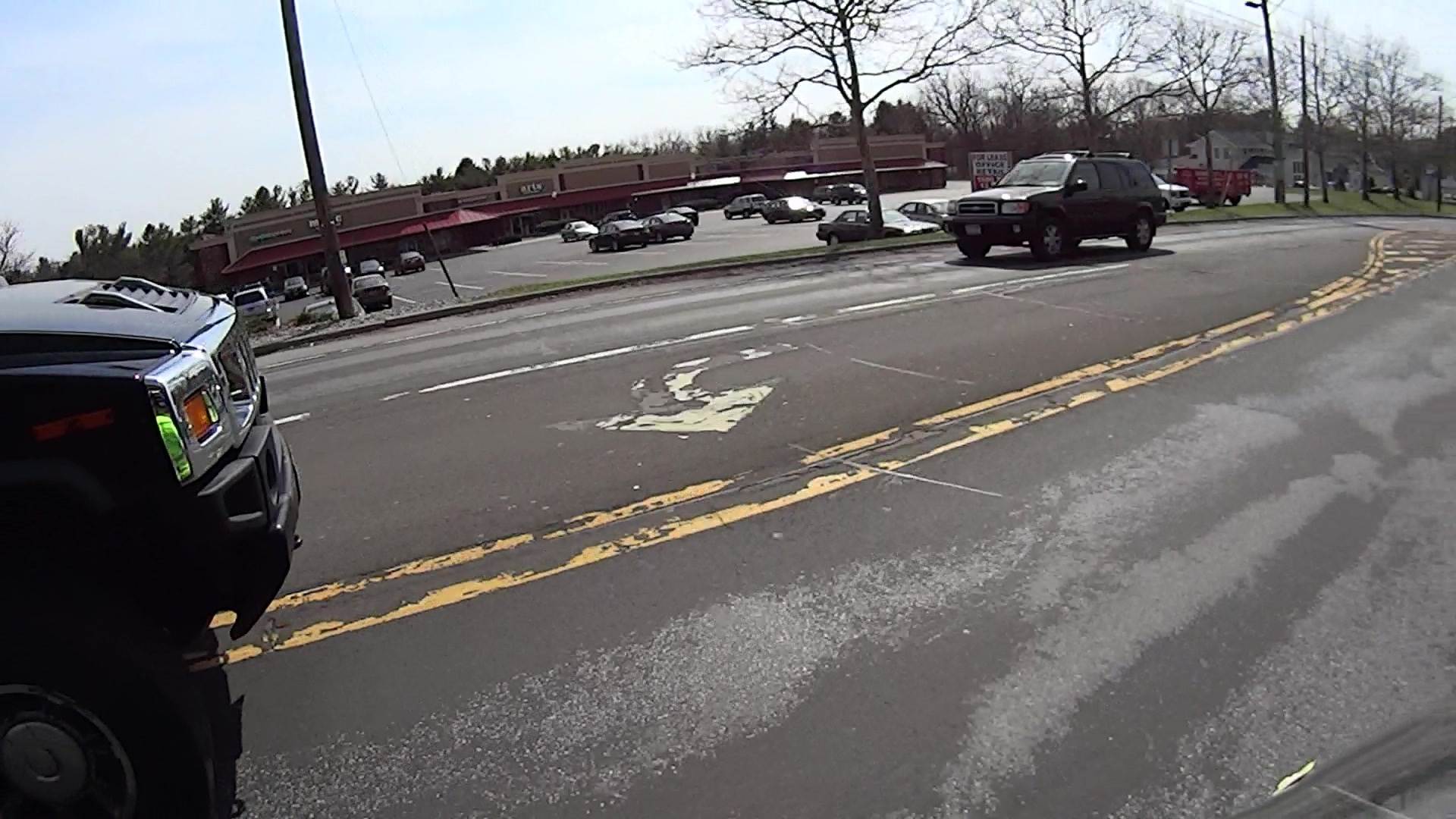
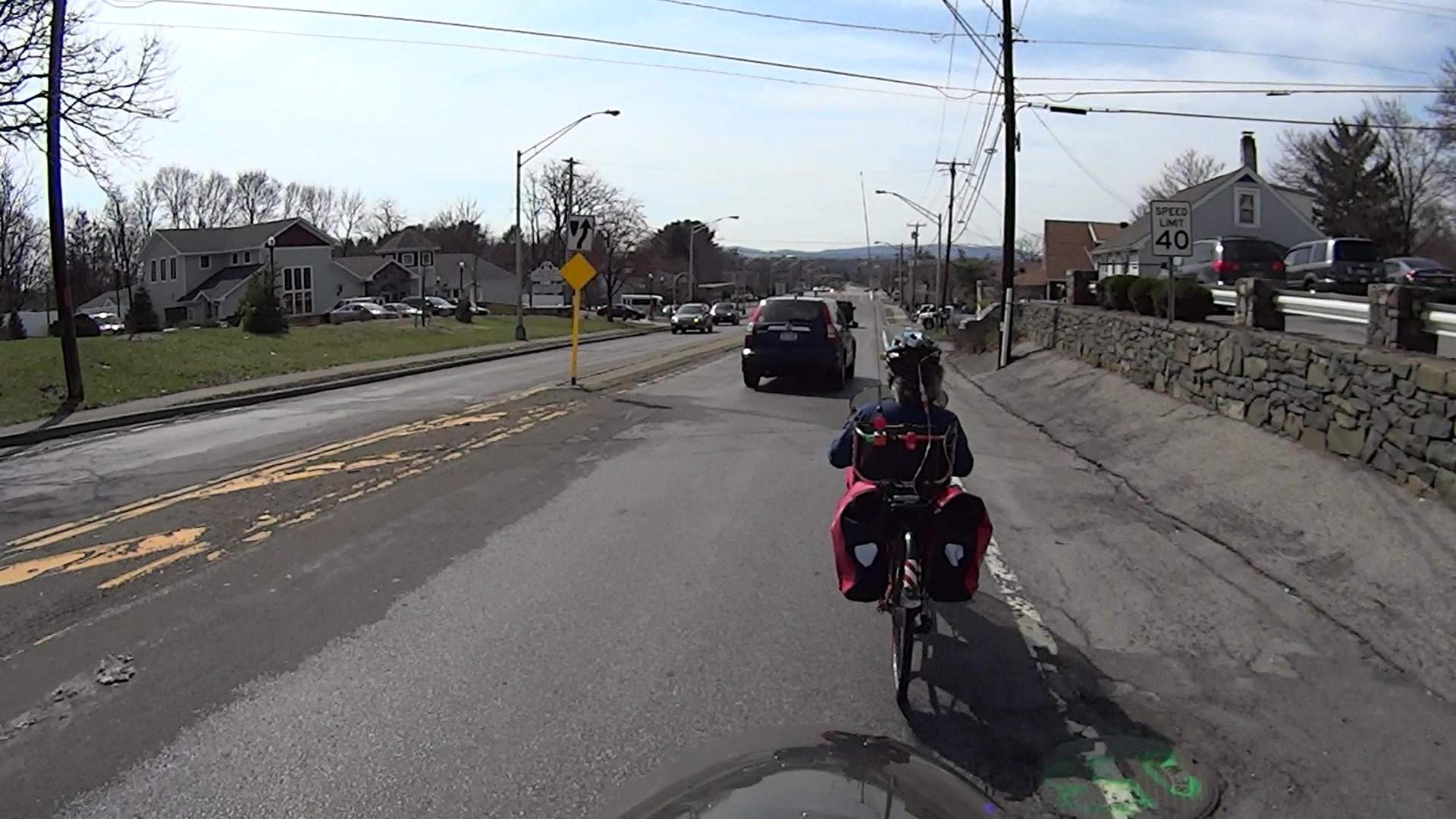
You can’t hear the horn that’s been honking for the last few seconds (sequence numbers = 1/60 s) as we approach 695 Dutchess Turnpike (a.k.a. Rt 44, a.k.a. NYS Bike Route 44):
Rt 44 at 695 – H2 Overtaking – front camera – 0113
You’ll note my fluorescent green shirt reflected in all that chrome. You can’t see the groceries tucked into the two under-seat bags; I’m not towing the trailer.
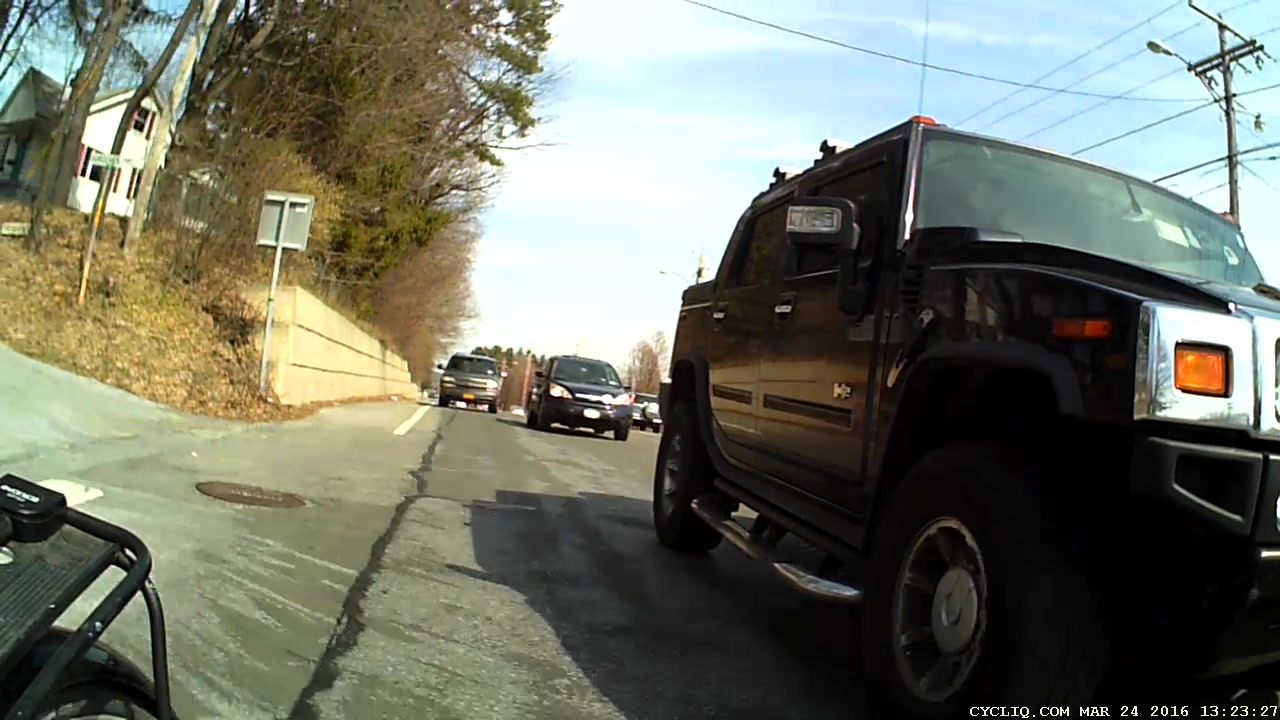
He gave us a surprising amount of clearance, given the aggressive honking:
Rt 44 at 695 – H2 Overtaking – front camera – 0186
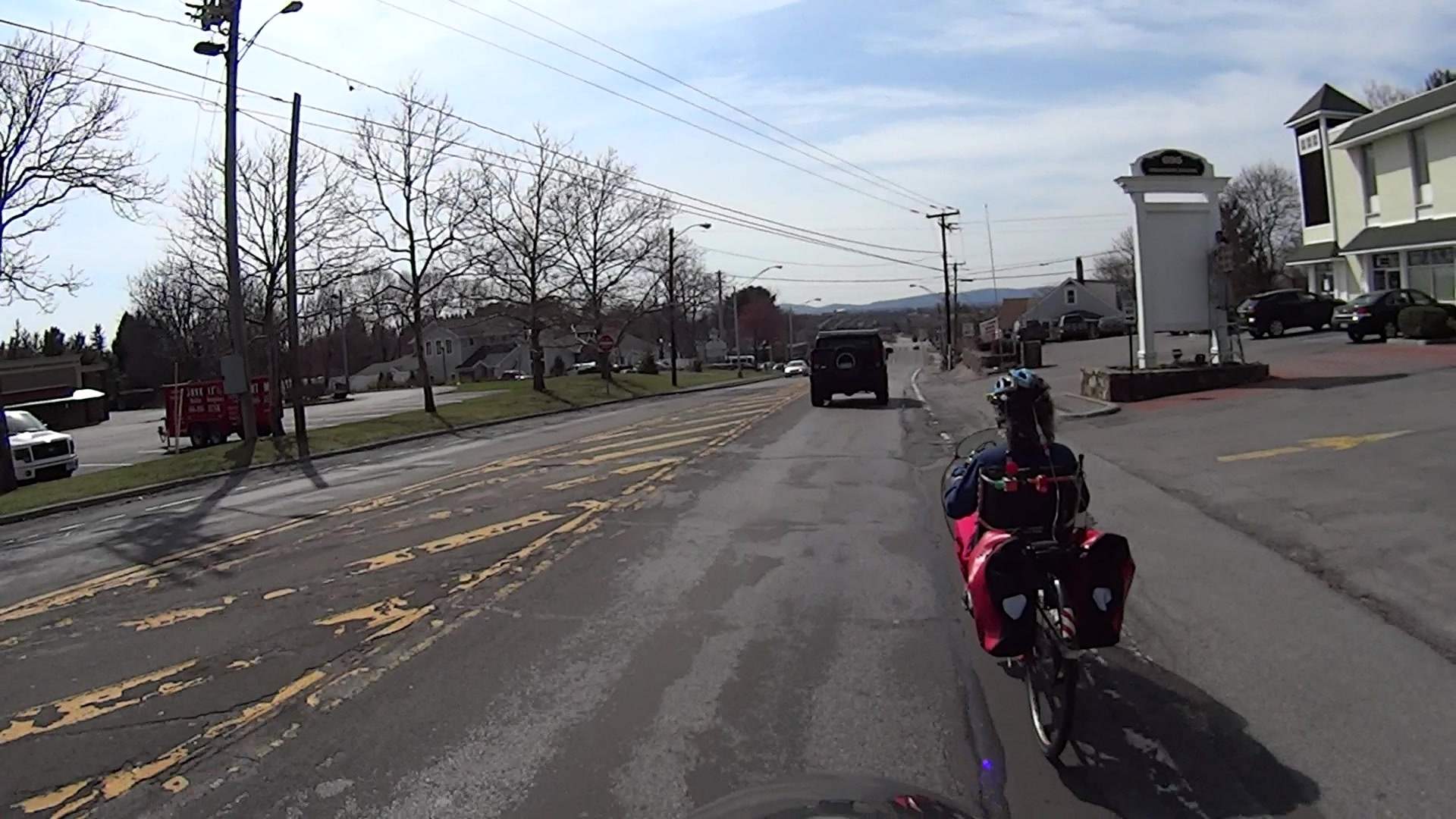
That’s one reason I ride a bit to the left of Mary’s track.
Now he can rev up and cross the double-yellow line:
Rt 44 at 695 – H2 Overtaking – rear camera – 0305
Total elapsed time from first honk to when I finished shouting out the license plate: 16 s.
At the next traffic signal and the better part of 70 s from the first honk, he turned left and we turned right, pretty much simultaneously:
Rt 44 at 695 – H2 Overtaking – rear camera – 2274
In lighter news, the green-painted manhole cover suggests some construction may be in-plan:
Rt 44 at 695 – H2 Overtaking – front camera – 0697
I’m not holding my breath for an improvement over the status quo, though.
Part of the problem may be that Hummers aren’t nearly the fashion statement they used to be; that failed Chinese deal didn’t help their image in the least.
FWIW and much to my surprise, H2s have chickenshit horns …
nnn = a unique, but not necessarily sequential, number
y = last digit of year
mm = month
dd = day
That produces these entries in my NAS hard drive full of bicycle action camera “footage”:
ll /mnt/video/Fly6/DCIM/
total 0
drwxr-xr-x 2 ed root 0 2015-12-10 14:18 10051210
drwxr-xr-x 2 ed root 0 2015-12-21 12:47 10051221
drwxr-xr-x 2 ed root 0 2015-12-24 20:26 10151224
drwxr-xr-x 2 ed root 0 2015-12-25 14:42 10251225
drwxr-xr-x 2 ed root 0 2015-12-26 15:26 10351226
drwxr-xr-x 2 ed root 0 2015-12-31 16:37 10451231
drwxr-xr-x 2 ed root 0 2016-01-16 16:56 10560115
drwxr-xr-x 2 ed root 0 2016-01-16 16:56 10660116
drwxr-xr-x 2 ed root 0 2016-01-31 13:28 10760131
drwxr-xr-x 2 ed root 0 2016-02-04 12:59 10860204
drwxr-xr-x 2 ed root 0 2016-02-07 17:05 10960207
drwxr-xr-x 2 ed root 0 2016-02-20 13:08 11060220
drwxr-xr-x 2 ed root 0 2016-02-21 12:03 11160221
drwxr-xr-x 2 ed root 0 2016-02-22 14:02 11260222
drwxr-xr-x 2 ed root 0 2016-03-06 18:16 11360306
drwxr-xr-x 2 ed root 0 2016-03-07 14:33 11460307
drwxr-xr-x 2 ed root 0 2016-03-08 14:57 11560308
drwxr-xr-x 2 ed root 0 2016-03-09 13:48 11660309
drwxr-xr-x 2 ed root 0 2016-03-10 11:24 11760310
drwxr-xr-x 2 ed root 0 2016-03-11 13:51 11860311
drwxr-xr-x 2 ed root 0 2016-03-12 16:04 11960312
drwxr-xr-x 2 ed root 0 2015-11-22 17:02 12051122
drwxr-xr-x 2 ed root 0 2015-11-25 19:14 12151125
drwxr-xr-x 2 ed root 0 2015-11-29 17:42 12251129
drwxr-xr-x 2 ed root 0 2015-11-30 16:53 12351130
drwxr-xr-x 2 ed root 0 2015-12-05 16:35 12451205
drwxr-xr-x 2 ed root 0 2015-12-07 16:53 12551207
drwxr-xr-x 2 ed root 0 2015-12-08 14:05 12690102
Annoyingly, the first three digits are not in ascending order of date, perhaps because the firmware recycles numbers previously used for now-deleted directories.
The year digit 9 in the last directory (12690102) came from the camera’s default 2009 startup date. You set the camera’s clock by editing its configuration file and rebooting that sucker, which I hadn’t done when I got a new Fly6 as a warranty replacement for the old one; apparently the battery shook itself loose after half a year of riding.
Deleting the directories created last November and December goes a little something like this:
rm -rf /mnt/video/Fly6/DCIM/???51[12]*
You probably want to dry-run that with a directory listing command (perhaps ls -al) just to be sure it will wipe out what you want and nothing else.
Within each directory, the file names follow a more rigid hhmmnnnn format:
hh = hour
mm = minute
nnnn = ascending sequence number
Which produces a set of files like this:
ll /mnt/video/Fly6/DCIM/11960312/
total 6.6G
-rwxr-xr-x 1 ed root 607M 2057-09-06 19:40 13120005.AVI
-rwxr-xr-x 1 ed root 810M 2057-09-06 19:40 13190006.AVI
-rwxr-xr-x 1 ed root 962M 2057-09-06 19:40 13290007.AVI
-rwxr-xr-x 1 ed root 573M 2057-09-06 19:40 13390008.AVI
-rwxr-xr-x 1 ed root 523M 2057-09-06 19:40 13470009.AVI
-rwxr-xr-x 1 ed root 596M 2057-09-06 19:40 13570010.AVI
-rwxr-xr-x 1 ed root 672M 2057-09-06 19:40 14070011.AVI
-rwxr-xr-x 1 ed root 716M 2057-09-06 19:40 14150012.AVI
-rwxr-xr-x 1 ed root 505M 2057-09-06 19:40 14250013.AVI
-rwxr-xr-x 1 ed root 497M 2057-09-06 19:40 14350014.AVI
-rwxr-xr-x 1 ed root 221M 2057-09-06 19:40 14450015.AVI
The NAS drive does not, for reasons I cannot explain, record the actual file creation timestamp; touch-ing the file afterward does update the timestamp correctly. So it goes.
The camera attempts to write the files in 10:00 minute chunks, but, because it deletes files (or, perhaps, entire directories) one-by-one in FIFO style, the actual file duration / size seems limited by the space made available by the deletions. The default 8 GB MicroSD card has something like 6.6 GB available and holds a bit under two hours of video; I should bump that to a 16 GB card to get a complete record of longer rides.
A few months back, the 13-tooth sprocket on my Tour Easy started skipping, which reminded me that I planned to replace all the drivetrain components. Time passed, the winter remained unseasonably warm and sunny, we kept riding, the skipping got much worse, and I just shifted across that sprocket.
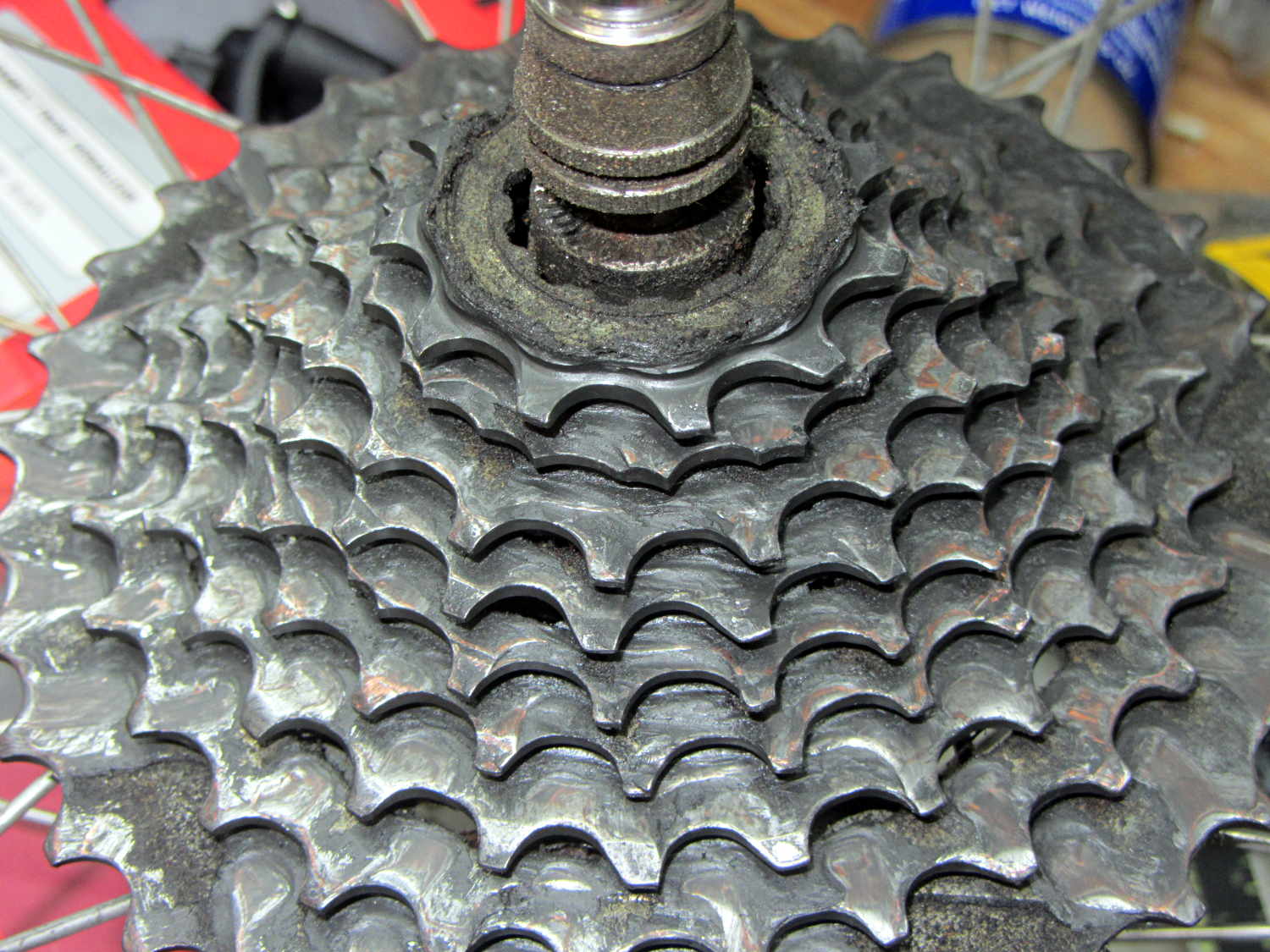
Finally, the rains returned, I heaved the bike up on the workstand, and started replacing things. Judging from the accumulated crud and severe wear, it’s been on there for quite a while:
Sprocket with broken teeth – as found
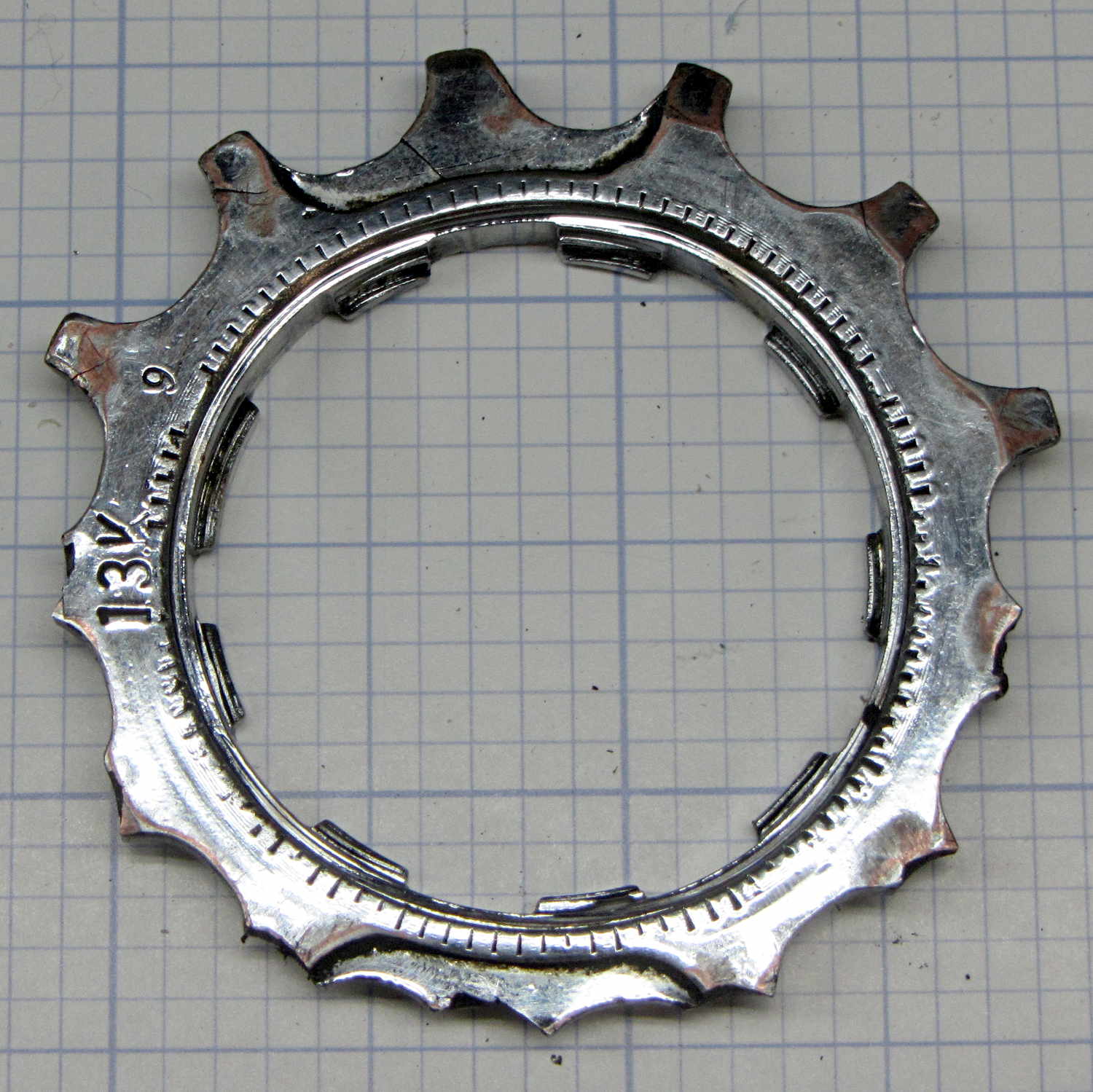
Here’s the offending 13-tooth sprocket, all shined up;
Sprocket with broken teeth – detail
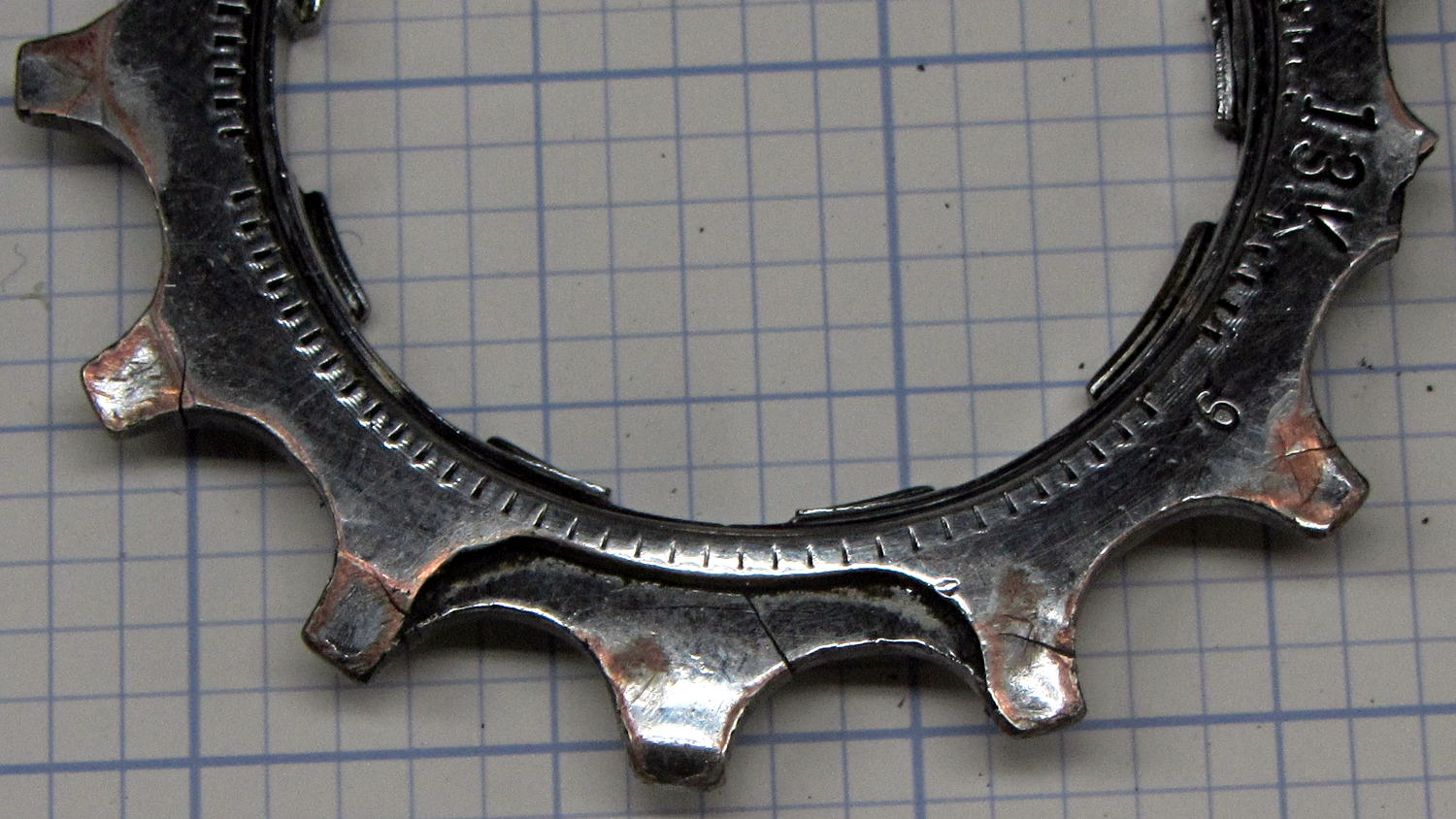
I don’t recall a catastrophic failure that stripped all those teeth off in one shot. A closer look showed cracks in the few remaining teeth:
Sprocket with broken teeth – cracked teeth
Which explains why the skipping gradually got worse: the poor sprocket shed teeth as I rode blithely along.
Huh.
That’s what happens with a severely worn sprocket: the chain applies tension to just the topmost tooth, rather than distributing it on the teeth around a third (or more) of the sprocket, and, one by one, that force breaks the teeth. The top picture shows at least one other sprocket with a missing tooth; all display the shark-fin profile of heavy wear.
As you can tell from the other bike pix & repairs around here, I’d rather ride than mess around with cleaning and suchlike. We’re on our second set of drivetrain components in 15 years, so I’d say treating all that stuff as consumable seems a fair tradeoff…
On 12 July 2015, I sent a report to NYSDOT about how the traffic signals at Burnett Blvd / Rt 55 greenlighted opposing traffic when our bicycles were still in the intersection:
Can you increase the minimum green and yellow times on the signals from Burnett Blvd to Rt 55?
The current settings are too short for bicycle traffic making a left turn across six traffic lanes.
The pictures show key points from our ride on 2015-07-10, returning from the Balloon Festival in Poughkeepsie. We took the DCRT around Poughkeepsie, went through Arlington to Rt 376 at Collegeview, then took Rt 376 Red Oaks Mill.
The image sequence numbers identify frames extracted from video files. The Front camera runs at 60 fps and the Rear camera at 30 fps.
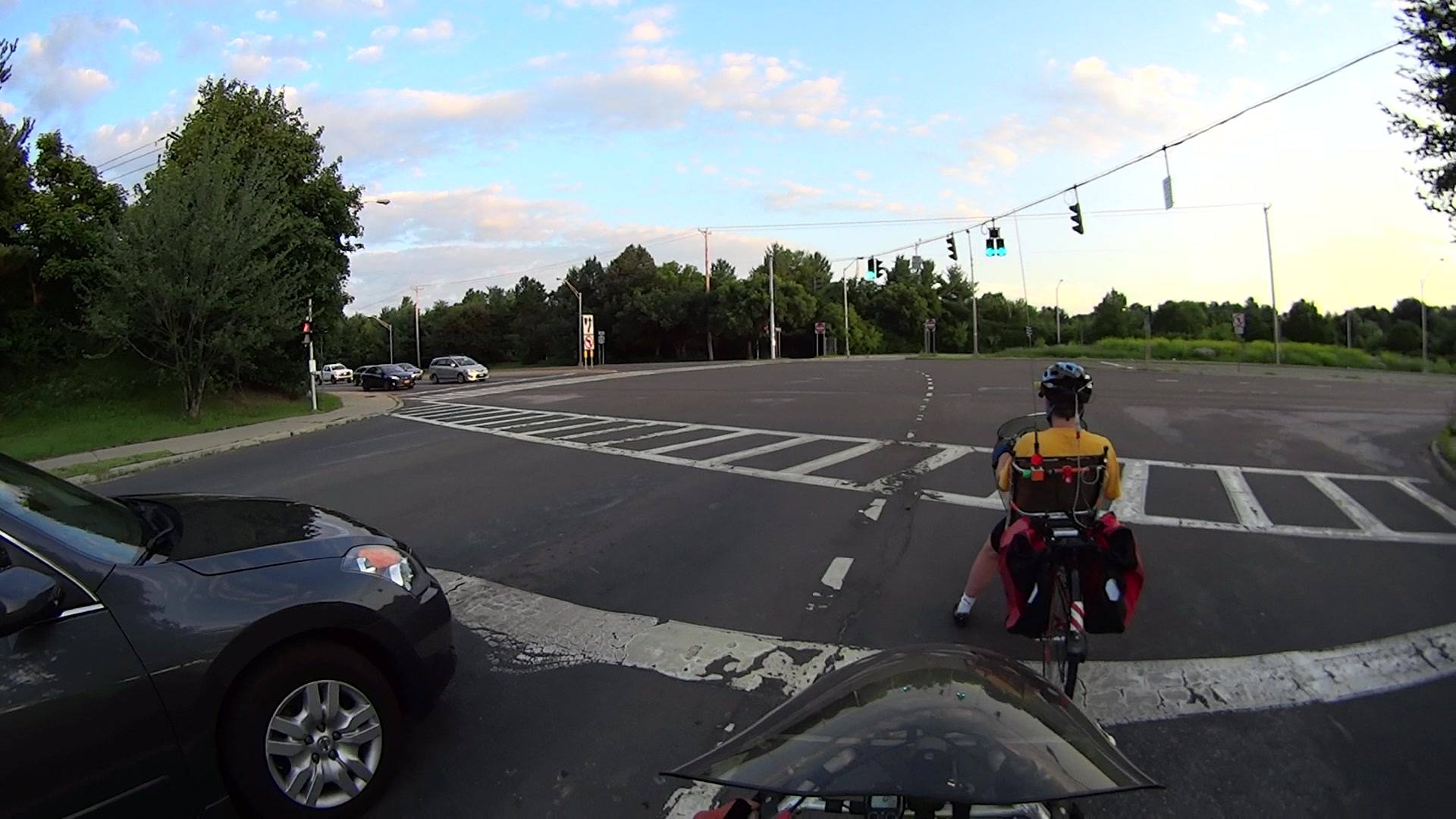
The red signals are in the process of turning off in Front 0196.
Burnett at Rt 55 Signal – Front 0196
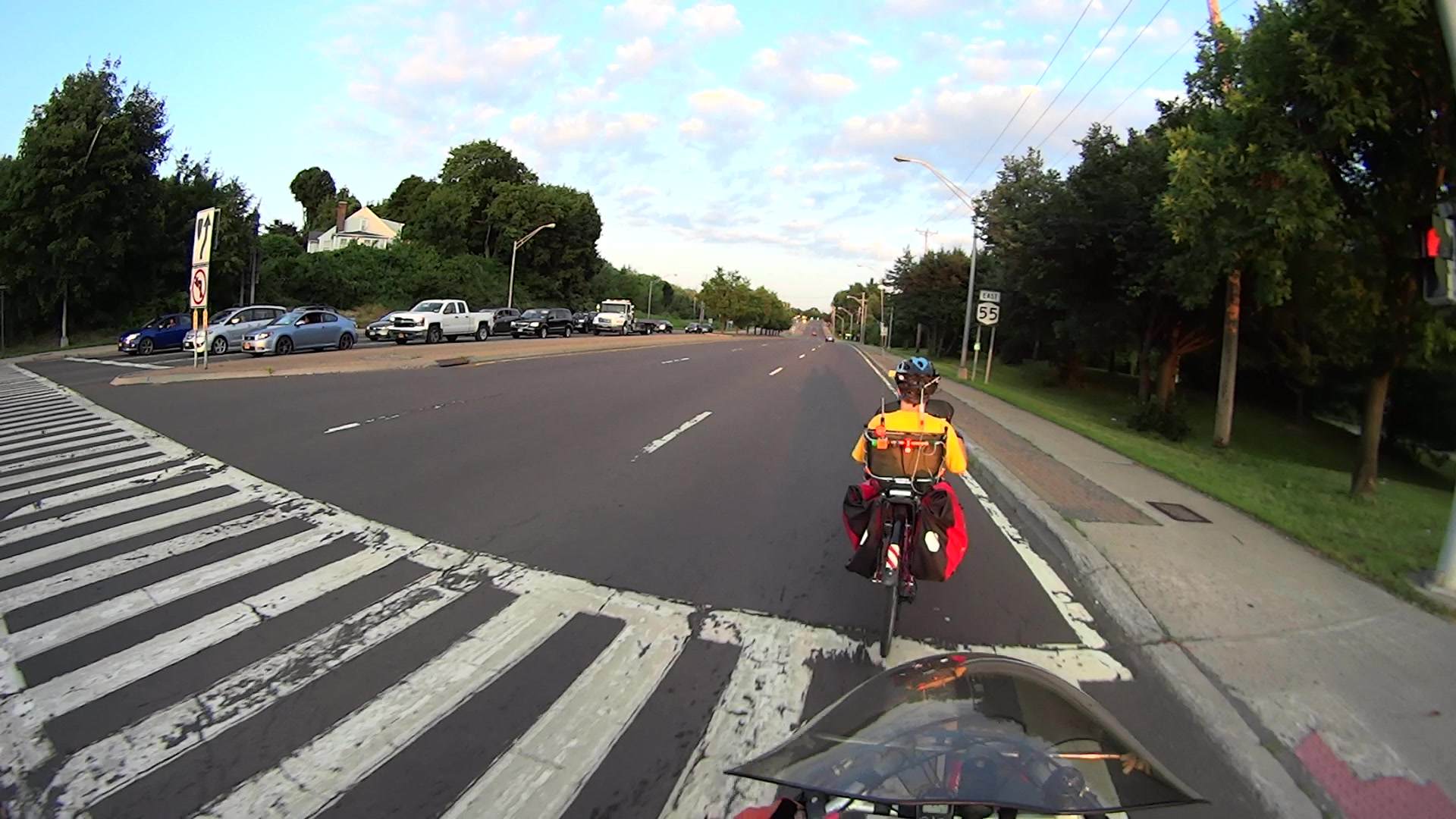
One second later in Front 0260, the car and our bikes are starting to roll. Given the number of drivers blowing through red signals at full speed, devoting one second to watching for oncoming traffic seems prudent.
Burnett at Rt 55 Signal – Front 0260
The yellow signals are turning on in Front 0633, seven seconds after the green. The car has reached the pedestrian ladder across Rt 55, but we’re still crossing the westbound lanes of traffic. We may not be the fastest riders on the road, but we’re not the slowest, either.
Burnett at Rt 55 Signal – Front 0633
We’ve reached the far side of the intersection in Front 1142, just under 16 seconds from the green.
Burnett at Rt 55 Signal – Front 1142
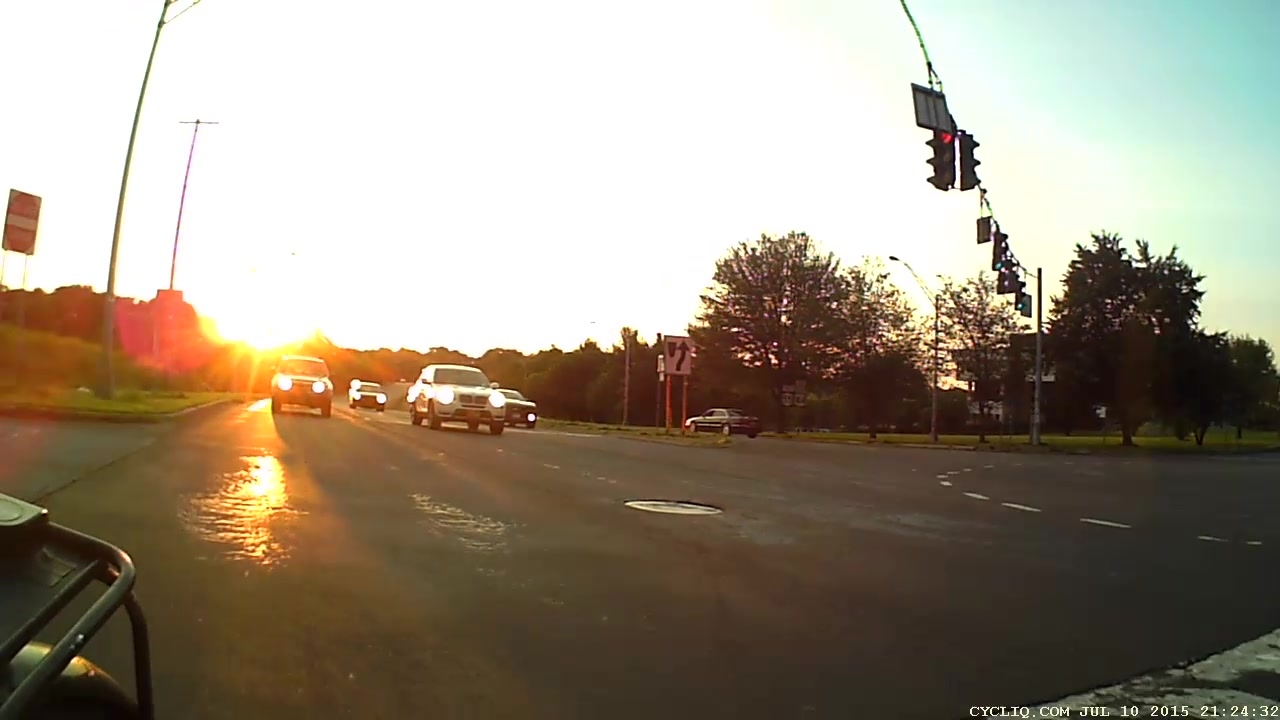
However, Rear 0408 shows that the opposing signals turned green while we’re still crossing the eastbound lanes of Rt 55. That’s about 15 seconds after the Burnett Blvd signals went green.
Burnett at Rt 55 Signal – Rear 0408
About 2.7 seconds later, Rear 0490 shows cars accelerating across the intersection toward us as we cross the pedestrian ladder. They started rolling immediately after their signal went green; waiting a second isn’t a universal practice.
Burnett at Rt 55 Signal – Rear 0490
Setting the minimum Burnett green to 12 seconds, the minimum yellow to 10 seconds, and the minimum delay from Burnett green to Rt 55 green to 30 seconds would help cyclists (just barely) reach the far side of the intersection before opposing traffic starts rolling.
Also: can you adjust the sensor amplifiers on Burnett to respond to bicycles and mark the coil locations on the pavement in both lanes? That would help us through the intersection during low-traffic-volume times, as our bikes seem unable to trip the signals.
Thanks…
This reply from the NYSDOT autoresponder was all I ever got from them:
Thank you for your inquiry. We will respond to your email message as soon as possible.
On 2 August 2015, I sent a report to NYSDOT about how the traffic signals at Old Post Rd – Spring Rd at Rt 9 greenlighted opposing traffic when our bicycles were still in the intersection:
The minimum green-to-opposing-green signal timing from Old Post Road across Rt 9 to Spring road is about 18 seconds: not long enough for bicycles to safely cross an intersection with eight traffic lanes.
The “Green” picture shows our starting position as the signal turned green: behind the first car in line. There’s another car behind us, which ensures the loop sensor will trip; it does not detect bicycles.
Spring Rd – Rt 9 – 2015-08-01 – Green
The “Yellow” picture shows the signal changing after 12 seconds, with the car from behind us now in the middle of the northbound lanes. We’re still in the middle of the southbound lanes.
Spring Rd – Rt 9 – 2015-08-01 – Yellow
The “Opposing Left Green” from the rear camera, 18 seconds from the first picture, shows green left-turn arrows for Spring Road. The opposing cars began rolling with Mary lined up with the northbound right-turn lane and me lined up with the right travel lane.
Spring Rd – Rt 9 – 2015-08-01 – Opposing Left Green
The car behind blew through the red signal on Old Post Rd; I think that’s why the opposing left-turning cars didn’t start sooner.
In the other direction, I often use the left turn from Spring Rd to southbound Rt 9 to reach the South Road Square strip mall. Similarly short yellow and overall cycle times apply in that direction.
Can you add (at least!) five seconds to the yellow and perhaps ten seconds to the minimum cycle time for both directions? That would help us clear the intersection before opposing traffic starts moving again.
Can you also mark the sensor loop locations in all those lanes so cyclists can find them and adjust the amplifier sensitivity / dwell to respond to bicycles? We’ve lined up atop the quadrupole loop pavement cuts on Old Post Road to no avail, but there’s not even a hint of the loop positions under the new Spring Rd paving.
Thanks…
This reply from the NYSDOT autoresponder was all I ever got from them:
Thank you for your inquiry. We will respond to your email message as soon as possible.
On 6 January 2016, this email message arrived from the same email address that never responded to my reports (emphasis added):
Dear Mr. Nisley:
This is in response to your correspondence regarding your experiences as a bicyclist at the intersections of Route 55 at Burnett Boulevard and Route 9 at Spring Road in the Town of Poughkeepsie, Dutchess County.
The New York State Department of Transportation (NYSDOT) is in the process of investigating alternate detection types and inductance loop patterns that would detect a wider range of vehicles. As alternate detection types are tested and approved, they will be integrated into the next traffic signal upgrade at both intersections. The distance varies based on geometry. The loops are centered in each lane and the front loop is a quadrapole, so there are wires down the middle of the loops.
A new timing program was implemented at Route 9 at Spring Road in August, and the yellow and red clearance times meet the current standards. The timing at Route 55 at Burnett Boulevard is in the process of being updated, and the clearance times will be updated as necessary to meet the current standards. Clearance times are determined based on speed, intersection dimensions, grade, and reaction time and cannot be adjusted. The sensitivity on all loops will also be adjusted, so they are as sensitive as possible without causing cross talk between the loops.
We appreciate and share your interest in making our highway systems safe and functional for all users.
If you have any questions or need additional information, please feel free to contact our Regional Traffic Safety & Mobility Group at (845) 437-3396.
NYSDOT Hudson Valley Region
I don’t regard that date a coincidence; NYSDOT was not responding to my reports. I sent a further note to clarify a few points:
On 01/05/2016 02:18 PM, dot.sm.r08.nysdot wrote: Clearance times are determined based on speed,intersection dimensions, grade, and reaction time and cannot be adjusted.
That seems to mean the times can be adjusted, but you won’t adjust them to allow cyclists enough time to clear the intersection.
We appreciate and share your interest in making our highway systems safe and functional for all users.
So, giving opposing traffic a green light while we’re still in the intersection NYSDOT’s way of “making our highway systems safe and functional for all users”.
Do I understand your statements correctly?
No reply, as I’ve come to expect by now.
I think the emphasis on “meet(ing) the current standards” is how NYSDOT will attempt to defend against claims that road conditions caused or contributed to a car-on-bike collision. I find it surprising that contemporary “standards” would allow greenlighting opposing traffic against bicycles, but perhaps they simply choose a standard that excludes bicycles.