Ed Nisley's Blog: Shop notes, electronics, firmware, machinery, 3D printing, laser cuttery, and curiosities. Contents: 100% human thinking, 0% AI slop.
Wow, that tasted good and definitely added a bit more pep to my morning bike rides!
The receipe produces a rather wet lump of dough in the mixing bowl:
No-knead bread – mixed
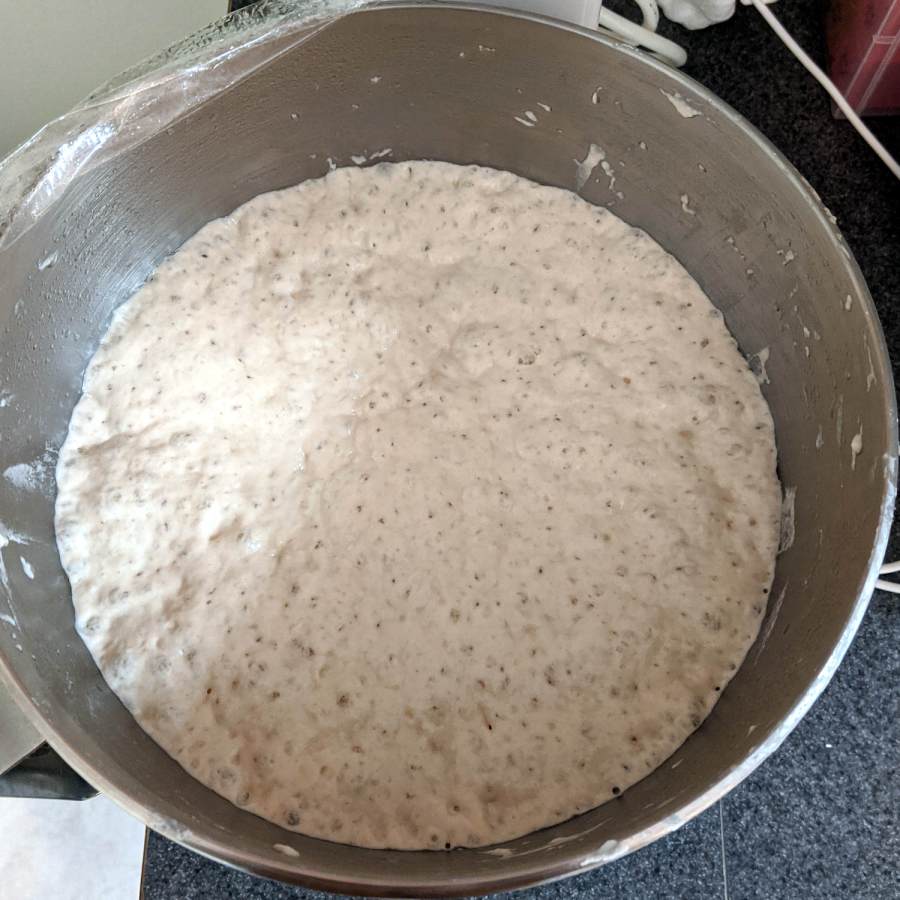
It looks much more promising after rising for 18 hours:
No-knead bread – 18 hour rise
The recipe calls for a large heavy pot, which produced a long-disused nickel-plated cast iron Wagner Ware No. 8 Drip-Drop Roaster from the attic:
No-knead bread – Wagner No 8 Roaster
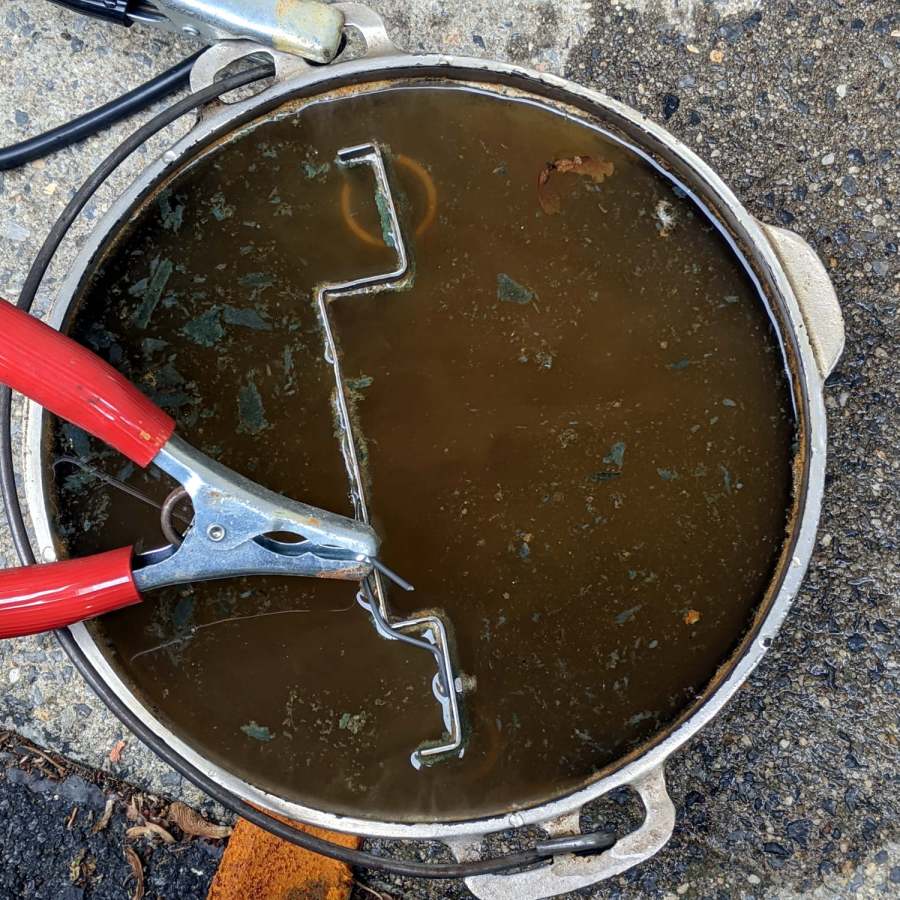
I scrubbed out the interior and used it as-found to good effect. After the cookin’ was done, a few hours of electrolytic stripping seemed in order:
No-knead bread – electrolytic pot strip
The lovely nickel plating on the outside of the pot didn’t need stripping, but the interior is once again a nice flat black surface and the next loaf should drop right out …
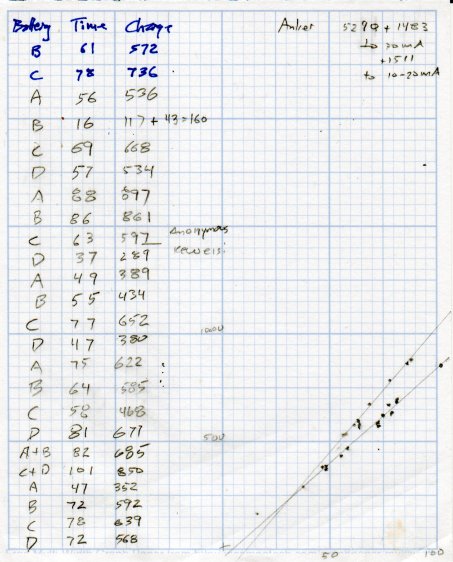
The vertical axis is the total charge in mA·h, the horizontal axis is the discharge time = recorded video duration. Because 1 A = 1 coulomb/s, 1 mA·h = 3.6 C.
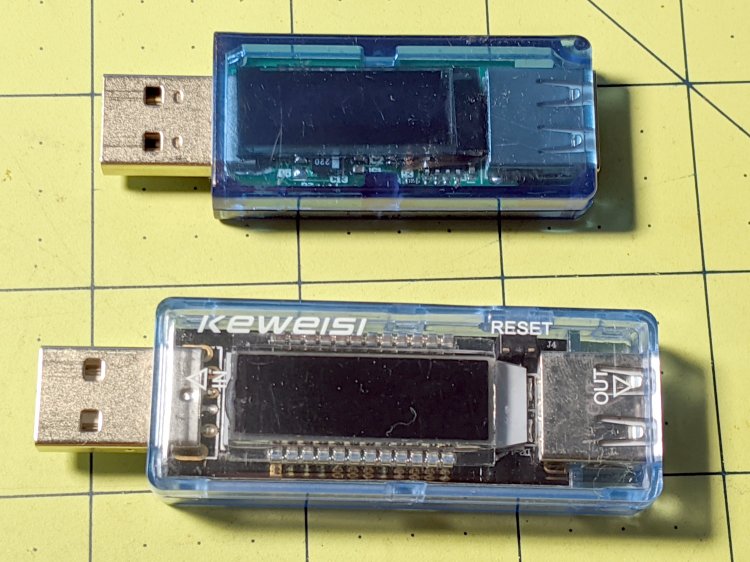
When you have one tester, you know the USB current. When you have two testers, you’re … uncertain.
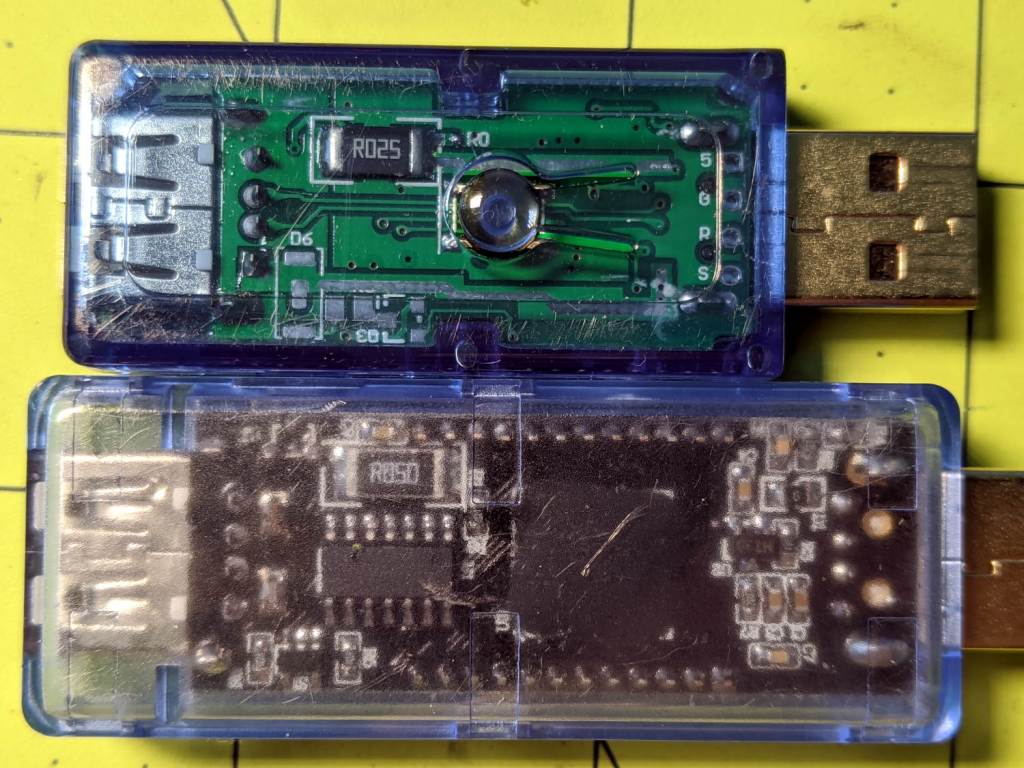
The upper tester is completely anonymous, helpfully displaying USB Tester while starting up. The lower one is labeled “Keweisi” to distinguish it from the myriad others on eBay with identical hardware; its display doesn’t provide any identifying information.
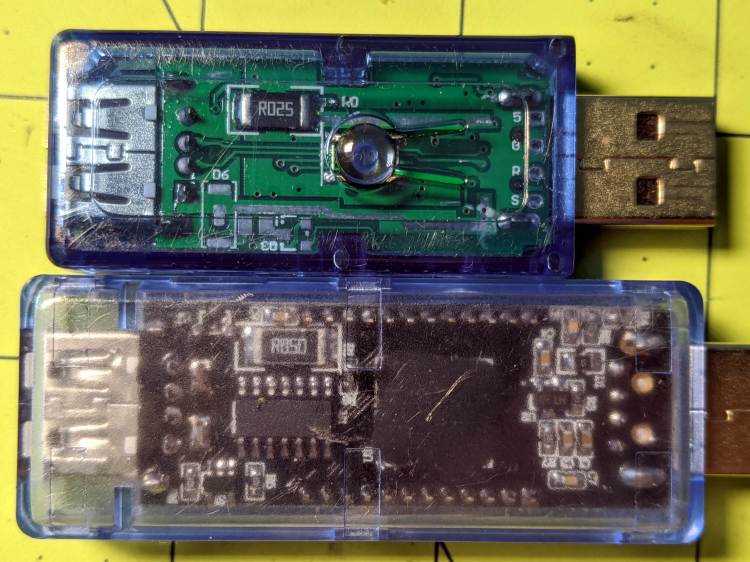
The back sides reveal the current sense resistors:
USB Testers – sense resistors
Even the 25 mΩ resistor drops enough voltage that the charger’s blue LED dims appreciably during each current pulse. The 50 mΩ resistor seems somewhat worse in that regard, but eyeballs are notoriously uncalibrated optical sensors.
The upper line (from the anonymous tester) has a slope of 11.8 mA·h/minute of discharge time, the lower (from the Keweisi tester) works out to 8.5 mA·h/minute. There’s no way to reconcile the difference, so at some point I should measure the actual current and compare it with their displays.
Earlier testing suggested the camera uses 2.2 W = 600 mA at 3.7 V. Each minute of runtime consumes 10 mA·h of charge:
10 mA·h = 600 mA × 60 s / (3600 s/hour)
Which is in pretty good agreement with neither of the testers, but at least it’s in the right ballpark. If you boldly average the two slopes, it’s dead on at 10.1 mA·h/min; numerology can produce any answer you need if you try hard enough.
Actually, I’d believe the anonymous meter’s results are closer to the truth, because recharging a lithium battery requires 10% to 20% more energy than the battery delivered to the device, so 11.8 mA·h/min sounds about right.
You’d (well, I’d) like to know the population infection rate, but we don’t have enough random testing to justify a number. Current testing remains biased toward those most likely to be infected, so the 15% cumulative rate (total positive / total tested) is certainly a gross overestimate and the 4% daily rate (new positive today / tested today) is still biased upward..
We figure the real population rate is well under 4%, which means we don’t encounter many infected folks out there.
But even 4% means staying isolated is the only way to prevent another wave of infection and another 23,000 deaths (in NY). The Mid-Hudson region has yet to meet all the state criteria for “restarting”, although Dutchess County has recently become ready, so we’ll be continuing all our usual at-home activities.
A number of state are now “opening up” without worrying about the details. Because exponential growth starts very slowly and the dying begins three weeks after the infections, the CNN charts (near the bottom of the page) will be revealing; we’ll witness several large-scale epidemiology experiments in real time over the next few months.
I think if any single action other than a virus killed 100,000 US citizens in three months, there wouldn’t be nearly as much discussion about the correct response. On the other paw, COVID-19 still runs a little under the rate for heart disease, so it seems we can get used to dying, even in bulk, when we do it long enough.
The debris field from a recent high-energy collision with a utility pole just north of Red Oaks Mill included another attractive hunk of jewelry:
Nissan Fog Lamp – as found
I asked the guy who runs the towing service across the intersection if this was a “high-performance car / low-performance driver” situation. He said “Nah, the car was a piece of crap.” It apparently collided with the pole after pulling out of the adjacent gas station with entirely too much foot on the throttle; the young driver was last seen having considerable difficulty with a field sobriety test.
Anyhow, the labeling suggests it’s the right-side fog light from a Nissan car.
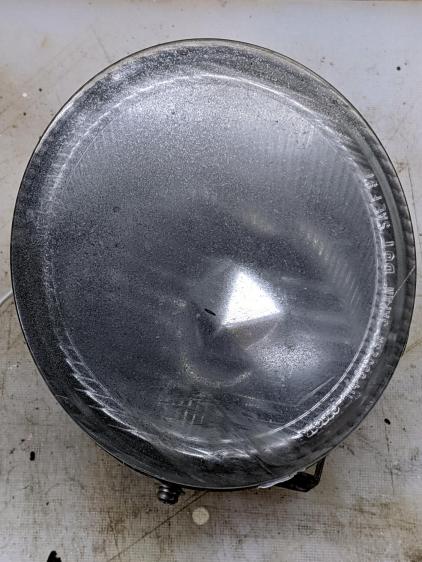
After removing various shattered plastic mounts and scrubbing off the obvious dirt, the lens didn’t look much better:
Nissan Fog Lamp – as-found lens
The bright triangle is one facet of the hood over the 55 W halogen bulb. The lens seems to be covered with a scattershot coat of gray spray paint or primer, rather than ordinary road grime, applied with surprising uniformity over the entire surface.
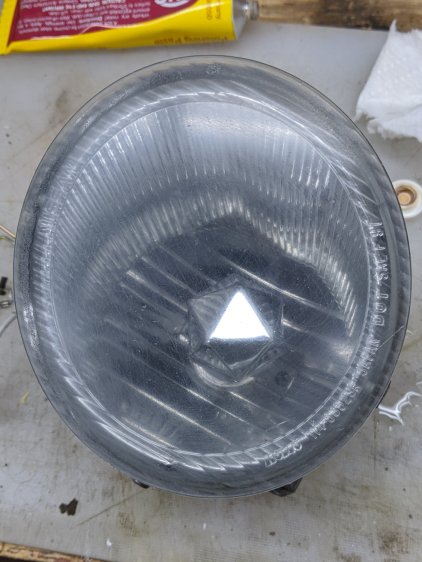
A quick wet-sand operation with 400 through 3000 grit paper, then some Simichrome, cleaned it up pretty well:
It’s definitely got a used-car finish: nice polish over deep gouges.
Look closely to see 400 grit diagonal scratches headed upward to the right; I must use 600 or 800 grit paper between the 400 and 1000. I don’t care about optical clarity, just knocking back the worst of the damage will suffice.
Methinks it would look pretty with internal RGB LED lighting, although the optics are obviously set up for a halogen filament just under the edge of the internal hood. If I get it just right, the thing could project a beam across the room …















 The Smell of Molten Projects in the Morning