Ed Nisley's Blog: Shop notes, electronics, firmware, machinery, 3D printing, laser cuttery, and curiosities. Contents: 100% human thinking, 0% AI slop.
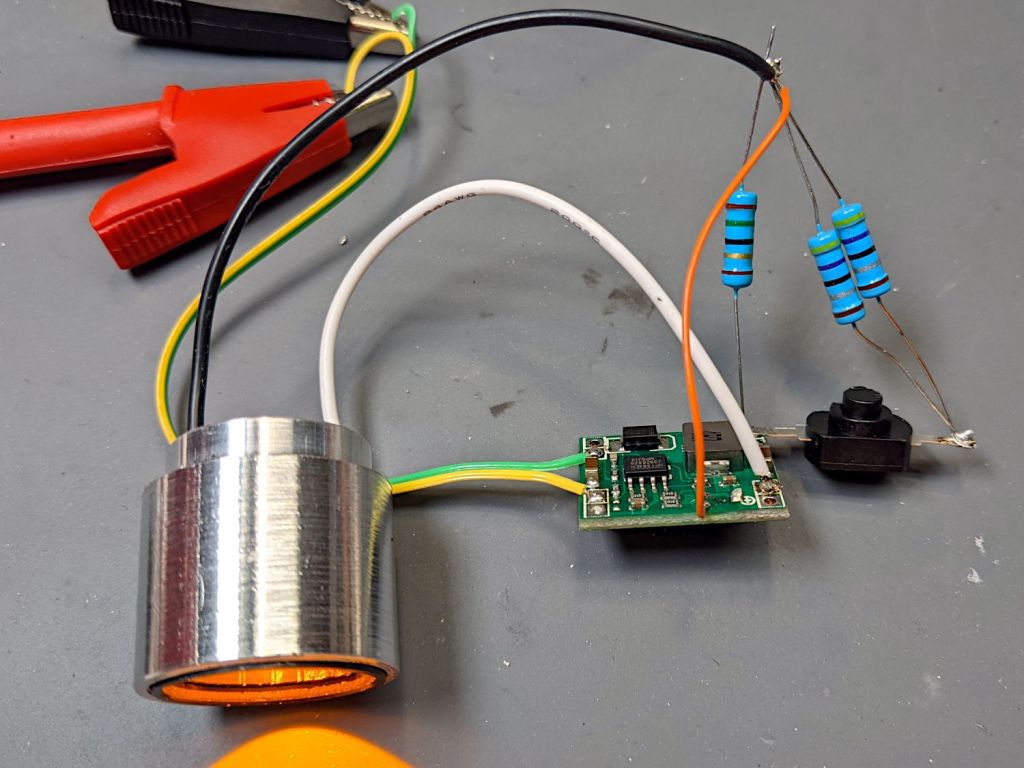
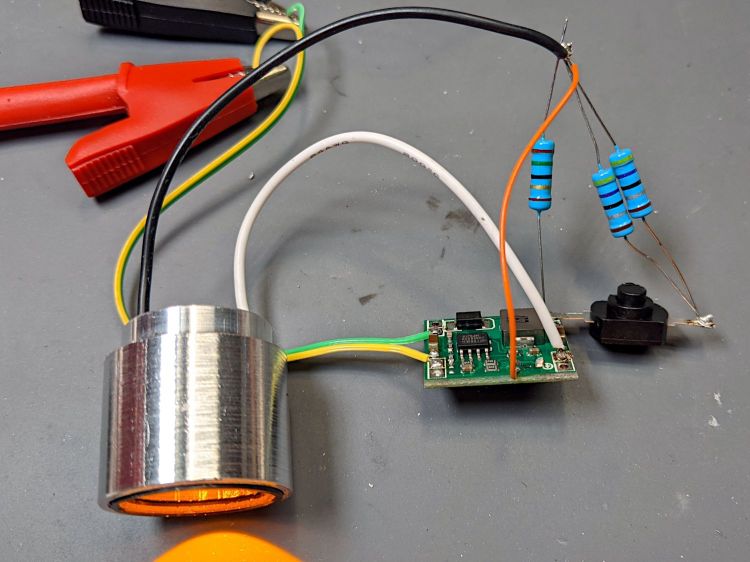
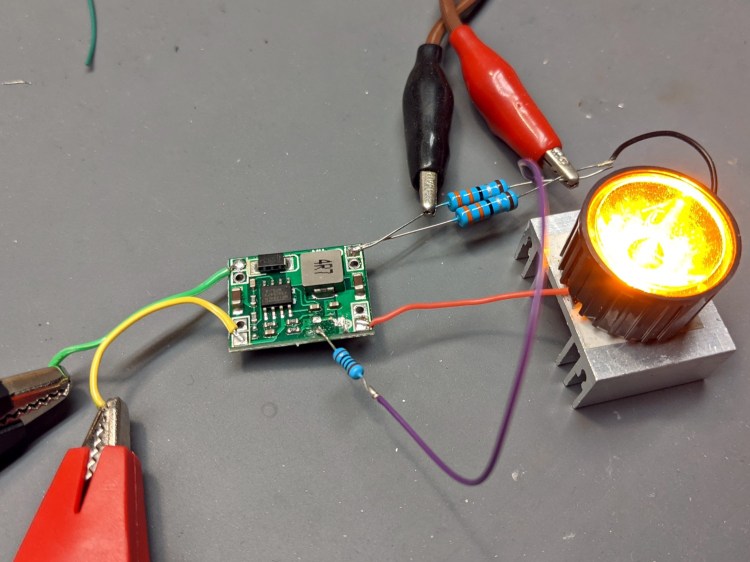
The 15 Ω unswitched resistor sets the LED current at 53 mA = 0.8 V / 15 Ω, with the LED dissipating about 100 mW. The resistor dissipates 43 mW.
Closing the switch puts the two parallel 4.7 Ω resistors in parallel with the 15 Ω resistor to produce 2.0 Ω, which sets the LED current to 390 mA and runs it at 950 mW. Each of the 4.7 Ω resistors dissipates 140 mW.
That much power raises the aluminum body to 50 °C = 120 °F: definitely uncomfortable but probably survivable for the LED inside.
Eyeballometrically, a decimal order of magnitude difference in the LED current produces an obvious brightness difference. My first try ran the LED at 500 mW (a binary order of magnitude less than 1 W) and wasn’t visually different. Given that the LED will run from the Bafang’s headlight output, saving power isn’t all that important.
If this is the first time you’ve encountered parallel resistors, this is why your calculator has a reciprocal button: the total resistance is the reciprocal of the sum of the reciprocals of all the resistances:
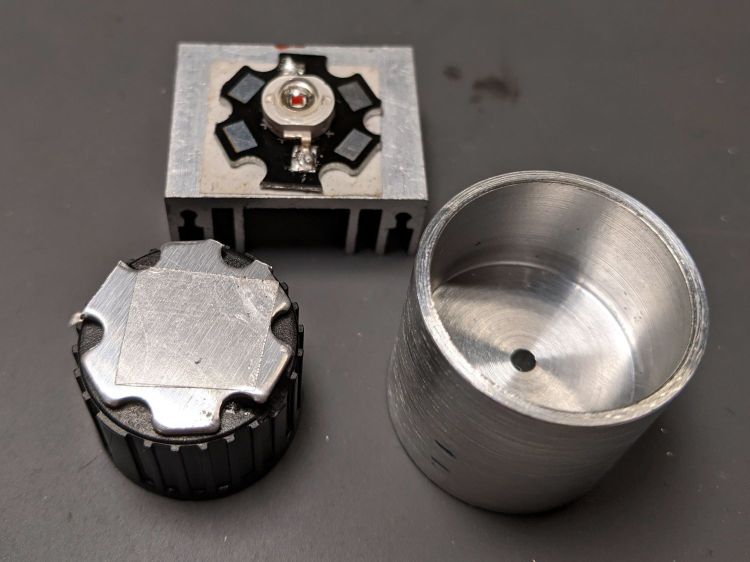
A pleasant evening at a virtual Squidwrench meeting produced the raw shape of the front end from a 1 inch aluminum rod:
1 W LED Running Light – heatsink raw
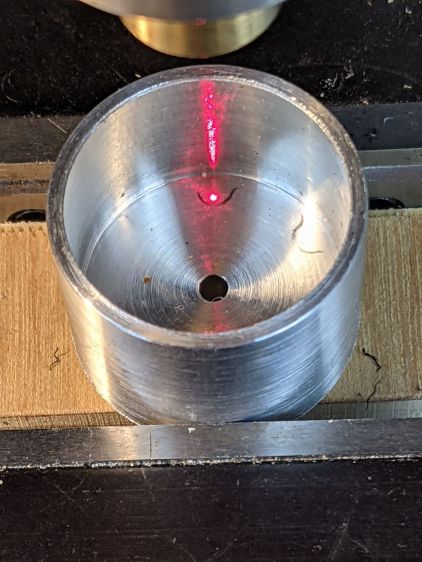
Trace the outline of the LED’s PCB inside the cylinder just for comfort, align to the center, and drill two holes with a little bit of clearance:
1 W LED Running Light – heatsink drilling
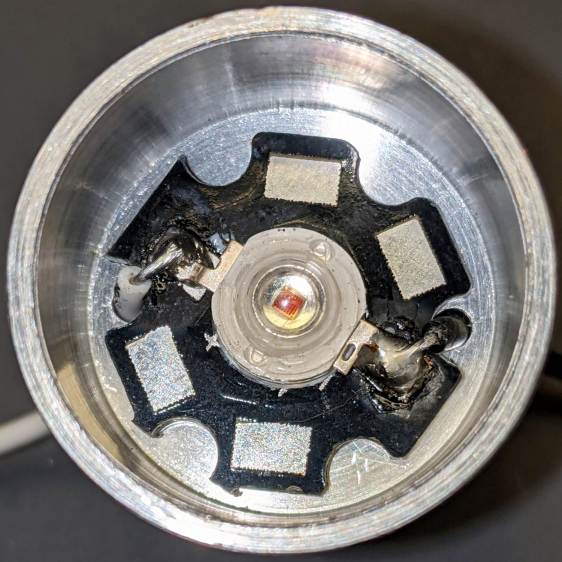
For the 24 AWG silicone wire I used, a pair of 2 mm holes 8.75 mm out from the center suffice:
1 W LED Running Light – heatsink fit
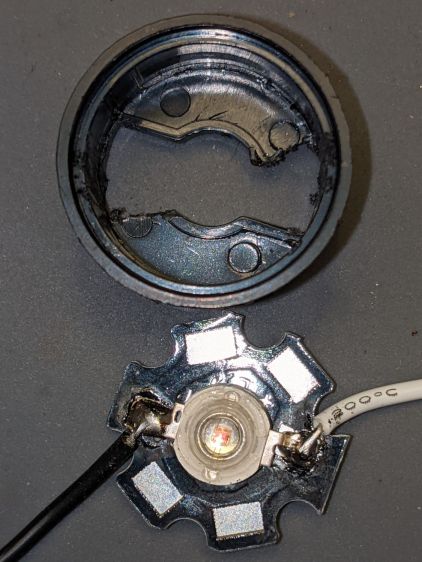
Gnaw some wire clearance in the lens holder:
1 W LED Running Light – wiring
Tap the central hole for an M3×0.5 screw, which may come in handy to pull the entire affair together.
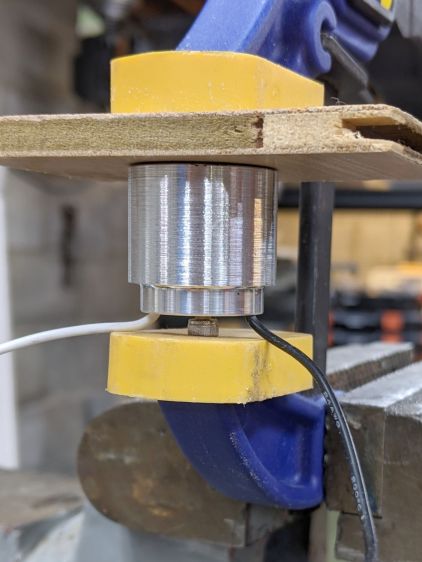
Epoxy the PCB onto the heatsink with the lens holder keeping it aligned in the middle:
1 W LED Running Light – heatsink clamp
Then see how hot it gets dissipating 900 mW with 360 mA of current from a 2.2 Ω resistor:
1 W LED Running Light – heatsink test
As you might expect, it gets uncomfortably warm sitting on the bench, so it lacks surface area. The first pass will use a PVC cylinder for easy machining, but a full aluminum shell would eventually be a nice touch.
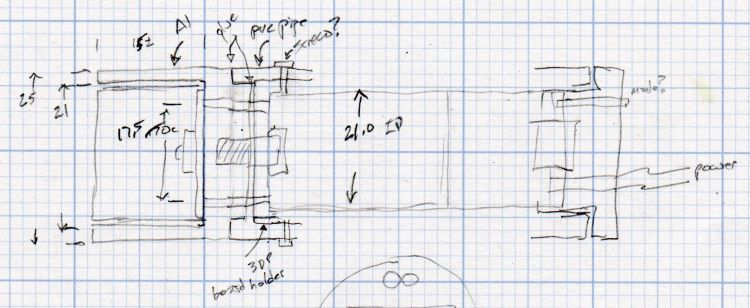
A doodle with some dimensions and aspirational features:
Running Light – 1 W LED case doodle
Even without a lens and blinkiness, it’s attention-getting!
Mostly because I wanted to verify that it really worked:
MP1584 current – red LED – Arduino blinkiness
The Arduino Nano runs the default Blink program that all the knockoff manufacturers use as their final QC test.
The MP1584 specs say the Enable input can accept a logic signal up to 6 V, the Nano runs at 5 V regulated down from the 6.3 V from the bench supply, and the 1 W red LED now flashes 1 s ON / 1 s OFF.
The current feedback works as it did before, too, which is comforting.
The Nano adds 20 mA to the bench supply, so the whole affair runs at 220 mA = 1.4 W. Of course, it’s now at a 50% duty cycle, so that helps.
MP1584 buck regulator – current feedback – red LED
I started with the same 1.65 Ω sense resistor and got the same 484 mA current, with the LED forward drop at a surprisingly high 3.3 V = 1.6 W. Ouch.
Adding a 1 Ω series resistor to get 2.65 Ω lowered the current to 300 mA with a forward drop of 2.45 V = 740 mW.
Running the numbers suggested a 2.3 Ω sense resistor made from a pair of parallel 4.7 Ω resistors, which produced 346 mA and an LED drop of 2.66 V = 920 mW. The resistor dissipates 280 mW.
The bench supply provides 6.3 V @ 200 mA = 1.26 W, so the overall efficiency is 94% and the LED burns 73% of the input.
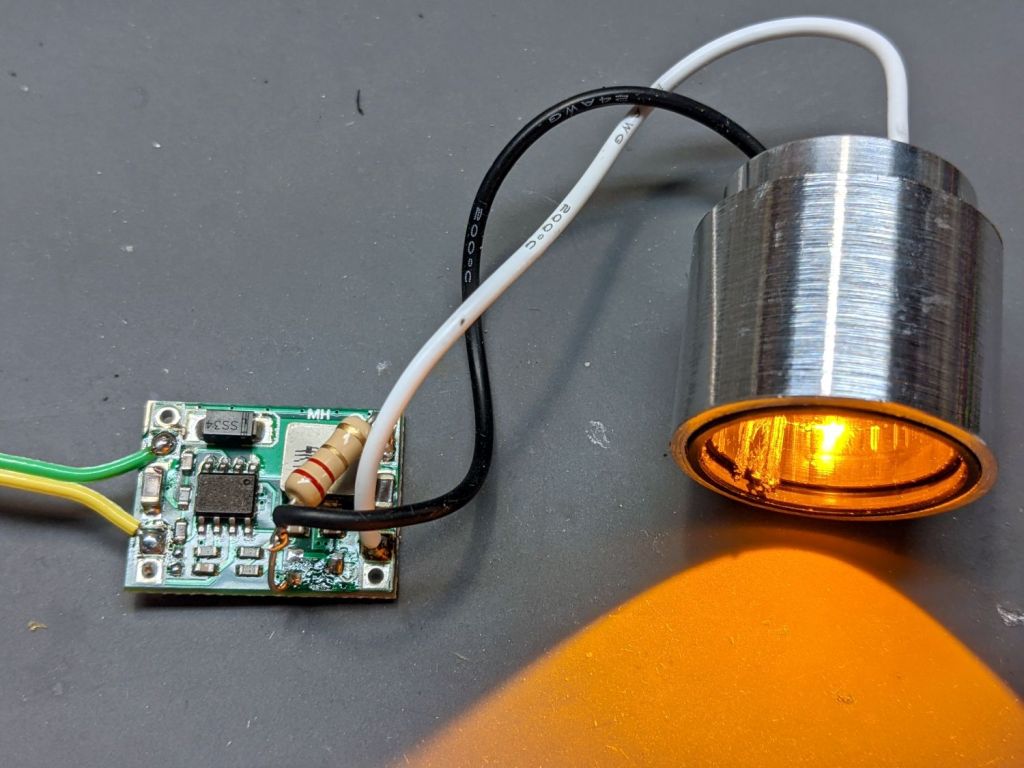
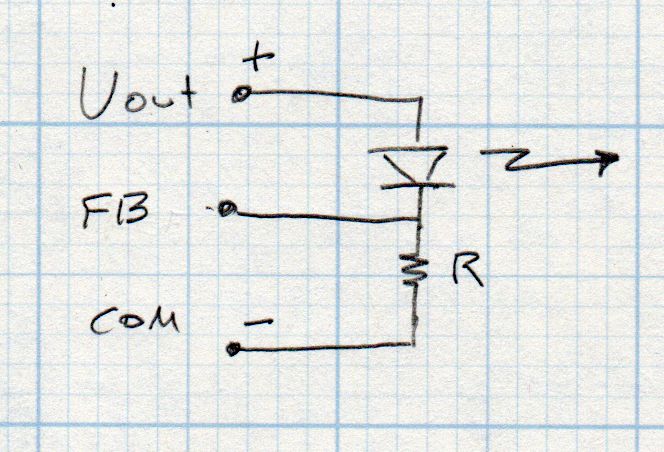
The PCB is the generic MP1584 buck regulator, as seen before in its normal voltage feedback mode, rewired to get feedback based on the LED current, so that it adjusts the output voltage to maintain a constant LED current, regardless of LED forward drop variations.
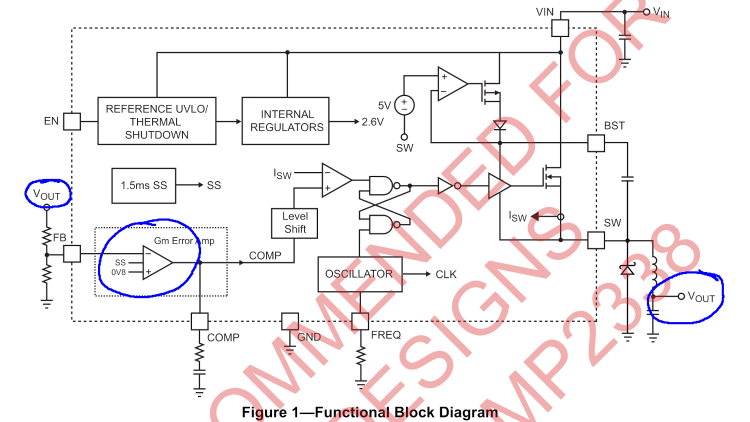
Pin 4 normally sees the output voltage divided down to the 0.8 V error comparator reference voltage:
MP1584 – buck regulator – voltage feedback
Yes, the MP1584 is “not recommended for new designs”, which surely accounts for the myriad cheap regulators built around it. Somebody picked up a great deal on a vast pile of obsolete ICs and is passing the savings along to us; there are exactly zero hits for MP2338 buck regulators.
Putting the ballast resistor on the low side of the LED turns it into a current sensor:
MP1584 – buck regulator – LED current feedback
Pick R to drop 0.8 V at the desired LED current and It Just Works™.
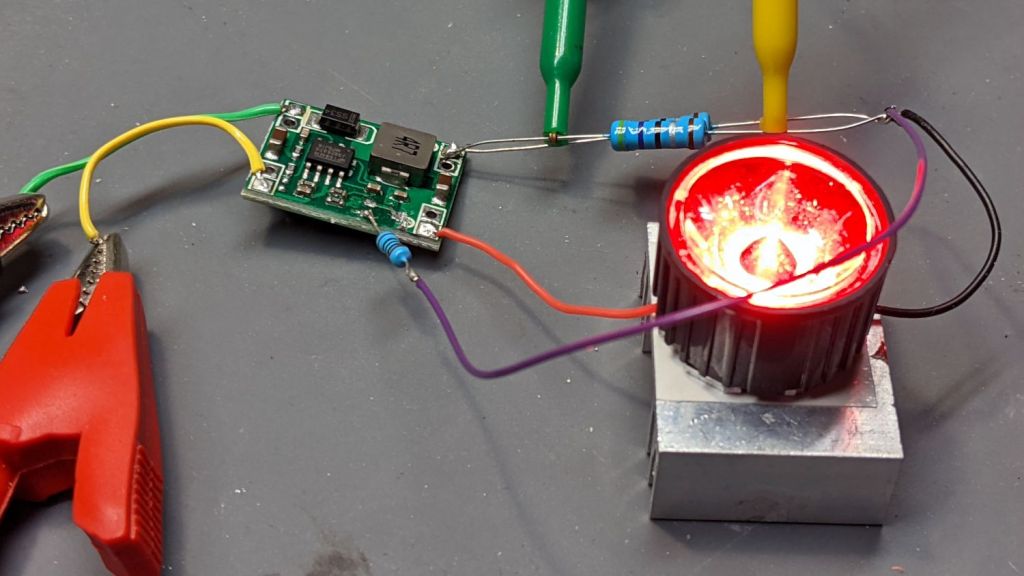
The two 3.3 Ω resistors in the top photo produce a 1.65 Ω sense resistor to set the LED current at:
485 mA = 800 mV / 1.65 Ω
It actually works out to a bit higher than that, because I stuck a 100 Ω resistor in series with the feedback input. The PCB still has the 8.2 kΩ resistor from the original voltage divider, so the error amp sees only 99% of the sense voltage, but it’s close enough.
With 6.3 V and 0.28 A = 1.76 W from the bench supply over on the left, the regulator puts 490 mA through the LED. The LED drops 2.54 V = 1.24 W and the resistor drops 0.809 V (that 1% thing) = 0.4 W for a total of 3.35 V and 1.64 W. The regulator is 93% efficient, although the resistor burns a quarter of the energy.
One could use a Hall effect current sensor and an op amp circuit to deliver the proper feedback voltage without resistive loss, but I think burning half a watt is Good Enough for the purpose.
One could add parallel resistors with MOSFET switches to set the LED current. An unswitched resistor would set the lowest current, with switched parallel resistors lowering the resistance, raising the current, and brightening the LED.
The PCB leaves the Enable input floating with an internal pullup. Grounding the pin shuts off the LED as you’d expect, so I can blink the LED without any further hassle.
One could imagine simultaneously blinking and brightening the LED as needed.
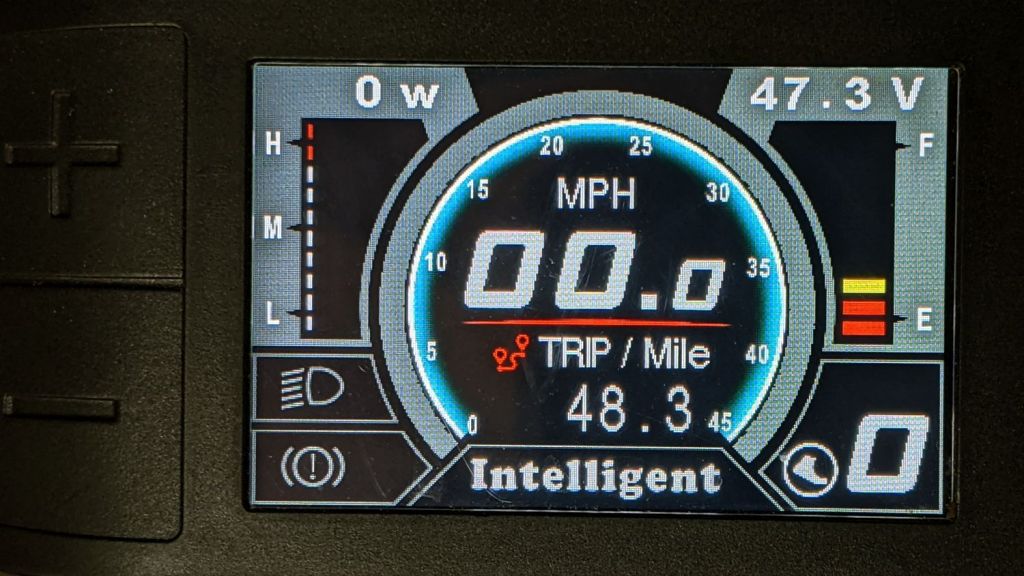
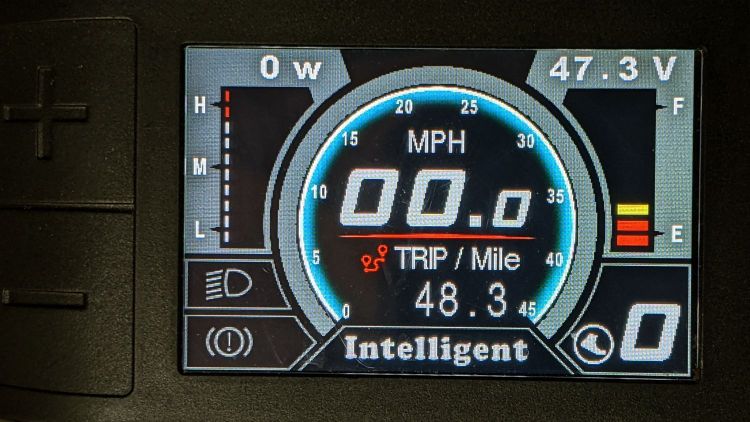
After a few days of riding, the Bafang 500C display on Mary’s bike gives the battery status:
Bafang 500C display – 48 mi 30 pct
The thermometer scale on the right shows 30% remaining battery capacity after 48.3 miles of riding, with the 11.6 A·h battery at 47.3 V.
For our type of riding, each 10% increment of battery charge delivers about 7 miles of range. Although we could probably get 70 miles between charges, recharging the battery at 20 to 30% makes more sense; the bike is in the garage, so why not?
Our typical 10 to 15 mile rides now average 12+ mph, with some level sections ticking along at 18 mph (giving me some serious exercise), which isn’t much by pro rider standards.
Computing the lithium battery charge state by measuring its voltage isn’t particularly accurate, but it’s about as good as you’re going to get.